Modi is running for his third consecutive term of office, but many believe he plans to remain in power indefinitely.

By Dr. Vikram Visana
Lecturer in Political Theory
University of Leicester
Introduction
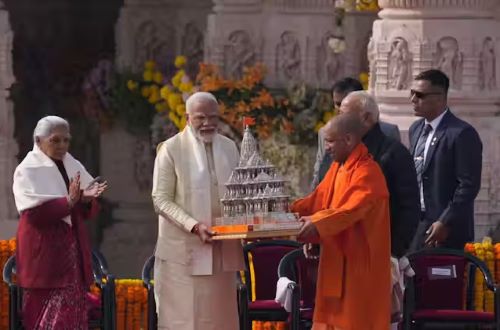
Pronouncing the fulfilment of “the dream that many have cherished for years”, Indian prime minister Narendra Modi has inaugurated a new Hindu temple at Ayodhya in Uttar Pradesh in the north of the country. It is built on the site of a mosque that was destroyed by Hindu nationalists more than 30 years ago.
When the Hindu nationalists demolished the 16th-century Babri Masjid mosque, they did so in the belief that it had been built by the Muslim Mughal emperor Babur on the site of an ancient Hindu temple that marked the birthplace of the god Ram. But the historical and archaeological evidence for the existence of this is hotly debated by experts.
Modi has turned the consecration of the Ayodhya temple into a massive national event, inviting 8,000 VIPs including Bollywood stars, Hindu religious leaders, politicians and diplomats. Hundreds of thousands of pilgrims also made their way to the town, which has received a US$3 billion (£2.35 billion) government-funded makeover.
Critics have condemned what they describe as a politicisation of a religious event, pointing to elections in April or May this year at which Modi will bid for a third term. Over his decade as prime minister, Modi has deliberately harnessed and encouraged Hindu nationalist aspirations for his own ends.
This event is undoubtedly aimed at energising Modi’s political base among Hindu nationalists. But there is more to this story than cynical electioneering.
The Hindu nationalist Bharatiya Janata Party (BJP), of which Modi is now the leader, has been advocating for decades for the construction of a Hindu temple on the site at Ayodhya.
In 1992, the party was a relatively minor player in a country dominated by the secular Indian National Congress. But in 2019, with Modi as prime minister, the Indian Supreme Court ruled that the temple could be built on the site. Plans for a new mosque were relocated nearby to a symbolically smaller patch of land.
History of Hatred
Immediately after the mosque’s destruction in 1992, riots between Hindus and Muslims erupted across India. One Hindu nationalist vigilante later defended his violence in curious political terms: “Muslims … had no compunction about killing people, while a Hindu would pause before killing and ask himself why he was doing it.”
The moral relativism of this remarkable statement reflects an attitude that has been at the heart of Hindu nationalist politics from its inception. It is centred on the twin paranoias of Hindu disunity because of the ancient caste system and the illusion of Islamic unity (Indian Muslims are actually doctrinally and politically divided.
In 1923, these paranoias were systematically laid out by Hindu political philosopher Vinayak Damodar Savarkar in his Essentials of Hindutva. This book is widely seen as a foundational text of Hindu nationalism. Imprisoned from 1911 to 1937 for sedition by the British, Savarkar rapidly shifted his revolutionary zeal from opposing the European colonisers to repudiating India’s Muslims.
At odds with his attempts to make Muslims out to be a polluting foreign influence is the fact that the majority were not external invaders but Hindu converts attempting to escape the caste system. The caste system perpetuated ideas of purity and pollution within the hierarchy. High castes enforced a range of occupational, hygiene, religious, and dietary practices on the lower castes through shame, sanctions and violence.
Accordingly, Savarkar believed that Muslim unity came from an immunity to shame. Observing Muslim inmates in his jail, he glibly attributed the violence of Muslim prison gangs to an impulse inherent in Islam.
With the same breath, he implored his Hindu inmates to jettison shame, mimic these traits and contemplate a violent politics of “cruelty” towards Muslims. In doing so, they would distract from caste divisions.
Savarkar exhorted Hindu society to discard Gandhi’s philosophy of passive resistance. Instead they should pursue a violent and “shameless” quest for Hindu fraternity in which caste distinctions would disappear. Meanwhile, the once united Muslims would live as a humiliated and cowed community that no longer had the self-belief to challenge Hindu political power.
The destruction of mosques and construction of temples became key strategies for uniting Hindus by banishing caste differences in Savarkar’s ideology. Some of the planned mega-temples would accommodate 5,000 worshippers from every caste. At the same time, tearing down Muslim heritage across India aimed to politically humiliate the seemingly unified Muslims and return political Hinduism “to its original glory”.
Cynical Politics
Modi’s government and its Hindu nationalist surrogate organisations have put this ideology into practice. The inauguration of the Ayodhya temple has little to do with Hindu religious doctrine. Indeed, the government was criticised for trying to arrange the event before the temple’s “sanctum sanctorum” (holy of holies) was completed.
The BJP also failed to invite several key Hindu monastic organisations. Indeed, being overshadowed by high-caste Brahmin priests would distract from Modi’s populist brand built around him as a humble middle-caste tea salesman.
Allied to this project are other strategies for forging Hindu unity while publicly humiliating Muslims. For instance, the arbitrary demolition of Muslim homes and businesses by mobs aided and abetted by local police.
These attacks occur when Muslims are deemed to have shown insufficient deference to Hindu sentiments – for example by eating beef or participating in anti-government protests. The bulldozer has since become a Hindu nationalist symbol and even internationalised by BJP troll-farms supporting Israeli actions in Gaza.
At first glance, the Ayodhya inauguration innocuously celebrates a new self-confident “Vatican for Hindus”. But we cannot forget its political motivations. If the violent destruction of a minority’s place of worship is given legal and political legitimacy in the name of Hindu nationalism, then democracy has given way to mob rule.
Originally published by The Conversation, 01.22.2024, under the terms of a Creative Commons Attribution/No derivatives license.
About the Author