Is it supply or demand?

By Dr. Tin Cheuk (Tommy) Leung
Associate Professor of Economics
Wake Forest University
Introduction
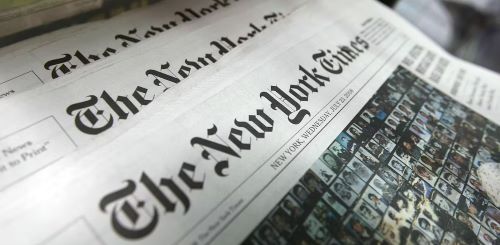
Late in December 2023, the former top editor of The New York Times’ editorial page, James Bennet, dropped a bombshell in an article for The Economist. “The leadership of the New York Times is losing control of its principles,” he wrote, saying slanted coverage at the institution is “pervasive.”
In the article, Bennet talked about the pressures driving what he called “liberal bias” at one of the world’s most influential newspapers. While recounting his final days at The New York Times – he resigned amid controversy in 2020 over an op-ed by Republican Senator Tom Cotton – he also discussed what economists call demand- and supply-side factors behind the rise of media bias.
Demand-driven bias happens when newspapers offer slanted news to appeal to readers. Supply-driven bias stems from the ideological leanings of owners or employees. Bennet indicated that both had influenced decision-making at The New York Times.
To be fair, not everyone agreed with Bennet’s diagnosis – not least the current leadership at The New York Times. But people across the political spectrum tend to agree that media bias is a problem, and not just at the Times.
I wanted to understand which cause of bias mattered more: supply or demand. So I did an experiment.
Why I ‘Read’ 100,000 Articles
As an economist who specializes in the economics of digitization, I’ve long been captivated by how new technology empowers editors with unprecedented control.
For example, in the old days, it was nearly impossible for newspapers to update their “front pages” after they had been laid out; if you wanted to make a change, you needed to literally stop the presses. But the rise of digital platforms lets editors make updates on a minute-by-minute basis. That helps certain stories remain in the spotlight, subtly guiding public discourse.
So, together with my colleague Koleman Strumpf at Wake Forest University, I looked at how this plays out in two of America’s leading newspapers: The New York Times, which people commonly believe leans left, and The Wall Street Journal, which is often viewed as leaning right. We analyzed more than 100,000 articles from both newspapers, as well as 22 million tweets linking to them, to tease out the factors that influence how long articles remain on digital homepages.
By controlling for demand-side preferences – as measured by the number of times each story was shared on Twitter, which we used as a proxy for reader interest – we found that supply-side biases were a big factor behind articles being kept on a homepage. In other words, newspapers kept stories prominently placed based on their own political preferences rather than because people were reading it.
Two Examples from ‘The New York Times’
Using a machine learning approach, we assigned political scores to each article, with the most Republican-leaning articles scored as “zero” and the most Democratic leaning as “one.” We found that both tweet counts and a publication’s ideological leanings affect how long a given article is kept on the homepage.
To illustrate, consider two stories from The New York Times. The first, “For Many Who Marched, Jan. 6 Was Only the Beginning,” published on Jan. 23, 2022, had a clear liberal-leaning tone, describing the event as the “worst attack on American democracy,” garnering it a “pro-Democrat” score of 0.93. The article was published at 3 a.m., featured on the homepage by 6 a.m., garnered around 200 tweet shares by noon, and stayed on the homepage for more than two days.
Contrast this with the second article, “At Least 46 Migrants Found Dead in Tractor-Trailer in San Antonio,” published on June 27, 2022. This piece had a more conservative-leaning tone, highlighting Texas Governor Greg Abbott’s criticisms of President Joe Biden. The story, which got a “pro-Democrat” score of just 0.22, was published at 9 p.m., immediately featured on the homepage, and received more than 600 tweet shares within two hours. However, despite its strong engagement, it was removed from the homepage within the next hour.
Media Bias as a Larger Phenomenon

Of course, unrelated issues like competition from breaking news could have affected how those two articles were placed. But they weren’t isolated cases.
We found that on the whole, articles aligning with the political leanings of their respective newspapers – liberal for The New York Times and conservative for The Wall Street Journal – tend to remain on the homepage longer, even after accounting for their popularity.
This is clear evidence of supply-driven media bias. Editorial choices aren’t just a response to reader demand; they reflect a publication’s ideological leanings. This influences which stories get highlighted, and which narratives dominate public discourse. (The New York Times and The Wall Street Journal did not respond to requests for comment as of publication time.)
Determining whether media bias is caused by supply or demand issues isn’t just an academic game. It has profound real-world implications.
Most important, it can help the public understand how competition in the media industry affects bias. If bias is mostly about publications responding to demand, more competition could actually make the problem worse, as outlets vie to cater to the specific preferences of their audiences.
On the other hand, if bias is largely supply-driven, competition could be a corrective. That’s because in a competitive market, media outlets have incentives to appeal to the broadest possible audience, which means bias is bad for business.
The recent waves of consolidation in the media industry, coupled with the noticeable rise in perceptions of media bias over the past decade, seems to support the supply-side argument. As fewer companies control more of the media landscape, outlets have less of an incentive to maintain a broad, unbiased approach.
Originally published by The Conversation, 12.17.2024, under the terms of a Creative Commons Attribution/No derivatives license.
About the Author