
By Casey Cep
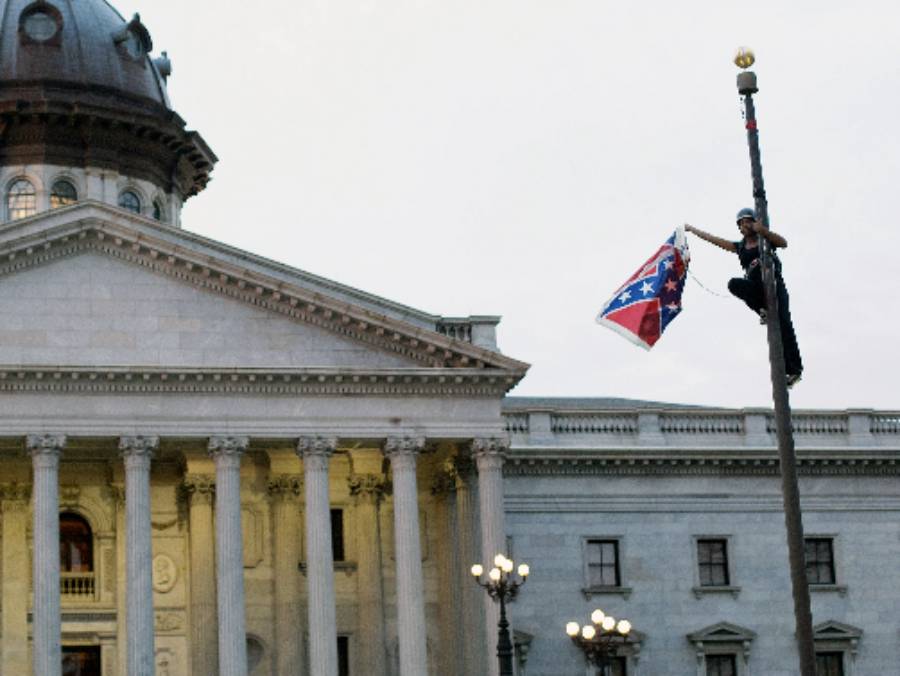
In the name of Jesus, this flag has to come down.” So begins one of the most consequential sermons of the twenty-first century. Bree Newsome, a thirty-year-old artist from North Carolina, was a few dozen feet above the ground, scaling a flagpole in front of the South Carolina State House. Police officers were hollering up at her, demanding that she come down, but she kept climbing, and kept preaching: “You come against me with hatred and oppression and violence. I come against you in the name of God. This flag comes down today.”
Newsome had been thinking about that Confederate flag for some time. Her ancestors had been enslaved in South Carolina, and she had heard stories from her grandmother about the violence perpetrated by the Ku Klux Klan in Greenville. Then, on June 17, 2015, a white supremacist murdered nine black parishioners during a Bible study at a church in Charleston, and Newsome decided it was time for the flag to come down. Ten days later, after meeting with other activists—including one who had scaled trees for Greenpeace—and practicing on a few lampposts, she climbed the thirty-foot pole outside the State House, reciting the Lord’s Prayer and the Twenty-seventh Psalm as she rose higher and higher, removed the flag, and returned it to the ground, where a crowd applauded and the police arrested her. Newsome spent about seven hours in jail; the Confederate flag was restored before she had even been released. But, by the second week of July, after millions of Americans had seen photographs or footage of her climb, the state legislature voted to permanently remove the flag from the capitol, and, in the years that followed, many other Confederate memorials and statues have come down around the country.
The daughter of a Baptist preacher who was once the dean of the Howard University School of Divinity, Newsome came by her faith and her preaching honestly, yet almost all of the publicity that followed her act of civil disobedience stripped her protest of its theological tenor. Such is the fate of much of the activism of the so-called religious left: if it is successful, it is subsumed by broader causes and coalitions; if it fails, it is forgotten. For all the opprobrium directed at the religious right, the activism of religious leftists suffers a different fate, alternately ignored and fetishized, trotted out every election cycle with a tone befitting the Second Coming: always just about to happen. This year’s Presidential race is the most obvious occasion for the new book “American Prophets: The Religious Roots of Progressive Politics and the Ongoing Fight for the Soul of the Country,” by the reporter Jack Jenkins.
“American Prophets” begins where Jenkins himself began as a religion reporter: in the fall of 2011, at the Occupy Wall Street protest in Boston’s Dewey Square, an offshoot of the gathering in New York City’s Zuccotti Park. Jenkins was freelancing for Religion News Service, a kind of faith-oriented Associated Press, and his first assignment was to cover the spiritual aspects of O.W.S. When Jenkins arrived at Dewey Square, he heard protesters singing hymns, and followed their voices to the sacred-space tent. That space was representative of the role he argues religion played in the movement: from the beginning, there were interfaith prayer services, protest chaplains, and supplies donated by local religious groups.
Over the next few years, Jenkins chased stories like that one for R.N.S., as well as for the Center for American Progress’s now defunct ThinkProgress. His book is a collection of that reporting, not really the history or systematics promised by his title but a series of portraits of people he argues are part of the “religious left,” a term Jenkins acknowledges that even some of his own profile subjects would reject, despite his almost definition-less definition: “an amorphous, ever-changing group of progressive, faith-based advocates, strategists, and political operatives.” As a result, “American Prophets” is actually a kind of contemporary “Lives of the Saints”—a series of profiles of admirable leftist activists whose politics are motivated by their faith. Whether those portraits constitute a collective is not only a problem for Jenkins, as a writer, but for the rest of us, as citizens.