Keyword research is about understanding your audience’s language and problems to create a content strategy that meets their needs. This moves you from guesswork to being the solution, gaining visibility for your work.
Understanding Your Audience & Defining Goals
Before opening any software or spreadsheets, you need to understand the humans behind the search queries. Keywords are simply the output of user intent.
Ask yourself: Who is my ideal reader or customer? What problems are they trying to solve? Are they looking for quick information, in-depth tutorials, or a product to buy immediately?
If you run a fitness blog, your audience might range from absolute beginners wanting to “lose weight fast” to seasoned athletes looking for “marathon training schedules.” These two groups use entirely different language. Defining your goals—whether it’s brand awareness, lead generation, or direct sales—will help you filter which keywords are worth targeting. You aren’t just looking for any traffic; you are looking for the right traffic.
Brainstorming Initial Keywords
Start with a brain dump. You know your industry better than anyone, so use that knowledge to create a seed list.
Think about the main topics (buckets) of your business. If you sell coffee beans, your buckets might be “coffee brewing,” “coffee beans,” and “coffee equipment.” From there, list specific terms that fall into these buckets.
- Coffee brewing: French press, pour over, cold brew guide.
- Coffee beans: Arabica vs Robusta, dark roast, fair trade coffee.
- Coffee equipment: Best coffee grinder, espresso machine reviews.
Don’t worry about search volume or competition yet. Just get the ideas down. Talk to your customer service team or sales reps—they are goldmines for knowing exactly what customers ask about.
Using Keyword Research Tools
Once you have your seed list, it is time to validate those ideas with data. Tools help you expand your list and see which terms actually get traffic.
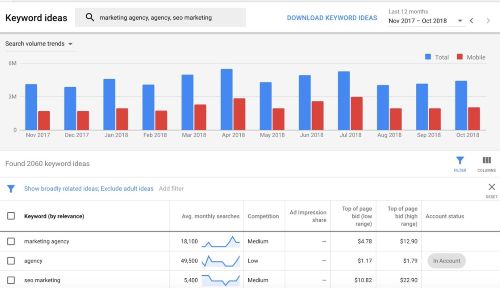
Google Keyword Planner is a great starting point because it comes directly from the source. It’s free (if you have a Google Ads account) and provides suggested bid estimates, which can indicate commercial intent.
SEMrush and Ahrefs are powerful paid options that offer deeper insights. They can show you related keywords you might have missed, phrase matches, and questions related to your seed keywords. These tools take the guesswork out of the process, moving you from “I think people search for this” to “I know 2,000 people search for this every month.”
Analyzing Keyword Metrics
Not all keywords are created equal. You need to analyze specific metrics to decide which ones to target.
Search Volume
This is the number of times a keyword is searched for in a given month. While high volume sounds great, it isn’t always the best target. A keyword with 100,000 searches is likely dominated by massive brands.
Keyword Difficulty (Competition)
This metric tells you how hard it will be to rank for a term. If you are a new website, targeting high-difficulty keywords is often a waste of resources.
Search Intent
This is crucial. If someone searches “buy running shoes,” they are ready to purchase (transactional intent). If they search “best running shoes for flat feet,” they are researching (informational intent). Match your content to the intent.
The Power of Long-Tail Keywords
If you are struggling to rank for broad terms like “marketing,” it’s time to pivot to long-tail keywords. These are longer, more specific phrases (usually 3+ words).
Examples:
- Head term: “Shoes”
- Middle tail: “Running shoes”
- Long-tail: “Women’s trail running shoes for wide feet”
Long-tail keywords generally have lower search volume, but they have much higher conversion rates. The person searching for the long-tail example above knows exactly what they want. By targeting these specific phrases, you face less competition and attract users who are further down the sales funnel.
Competitor Keyword Analysis
Why reinvent the wheel when you can see what’s already rolling? Competitor analysis involves looking at the keywords your rivals are ranking for.
Tools like SEMrush or SpyFu allow you to enter a competitor’s domain and see their top-ranking pages. Look for gaps in their strategy. Are there keywords they are ranking for that have thin or outdated content? That is your opportunity to write something better.
Also, look for keywords they aren’t targeting. Perhaps they have missed a specific niche or a new trend. If you offer specialized services, like local seo in Utah, check if your national competitors are neglecting that specific geographic market. Finding these gaps allows you to corner a segment of the market before they do.
Integrating Keywords into Content
Once you have your target keywords, you need to put them to work. However, the days of “keyword stuffing”—jamming a keyword into a sentence every three seconds—are long gone. Google is smart enough to read natural language.
Place your primary keyword in these strategic locations:
- The URL: Keep it clean and short.
- The Title Tag (H1): This tells search engines what the page is about.
- ** The First 100 Words:** Let the reader and the bot know immediately that they are in the right place.
- Subheadings (H2s and H3s): This helps structure the content.
For secondary and long-tail keywords, sprinkle them naturally throughout the body text. The goal is readability first, SEO second. If it sounds awkward to read out loud, rewrite it.
Tracking and Measuring Performance
Keyword research doesn’t end when you hit “publish.” You must track how your targeted keywords are performing.
Use Google Search Console to see which queries are driving traffic to your site. You might find you are ranking for keywords you didn’t even intentionally target.
Monitor your rankings over time. Are you moving up or down? If a page is stuck on page two of Google, it might need a content refresh or more backlinks. SEO is an iterative process; the data you gather today informs the strategy you build tomorrow.
Conclusion
Visibility isn’t a one-time achievement; it’s a constant pursuit. Search trends change, algorithms update, and new competitors enter the market. The keyword strategy that worked last year might be obsolete today.
About the Author