By Bill Moyers
ANNOUNCER: Welcome to a conversation between Bill Moyers and psychiatrist and author Robert Jay Lifton. The distinguished scholar is now 93. His memoir Witness to an Extreme Century reflects on seminal work exploring the experience of Hiroshima survivors, Hitler’s Nazi doctors, the trauma of Vietnam veterans and the violent Japanese religious cult that pumped Sarin gas into Tokyo’s subways.
After helping to establish a new field in medicine, he has spent his adult life helping us understand the effect on human behavior of people who arbitrarily create truth and then resist fiercely any who question that truth. His new book is Losing Reality, published by New Press. Here’s Bill Moyers…
BILL MOYERS: This being the Trump era, we find ourselves once again engulfed in two realities. There’s the reality of a spiraling global challenge from coronavirus, and there’s the ALTERNATE reality created by the president and his political and propaganda empire. They are spreading a virus of their own, lulling true believers into complacent ignorance with lies and misinformation.
Even as the Centers for Disease Control urged us to prepare for “significant disruption”, President Trump told us not to worry — the disease, nudged along by a miracle, will disappear. It’s all a hoax anyway, he said of the outbreak – perpetrated by Democrats and media. His White House chief of staff agreed, telling the public that the relentless news coverage is aimed at bringing the president down. A junior Trump even speculated that his father’s enemies hope the virus does come to this country and“ kills millions of Americans” thus ending his father’s winning streak. But leave it to Rush Limbaugh to come up with the most malevolent and suicidal lie of all – that the coronavirus is just “the common cold” – really nothing more than a Democratic talking point.
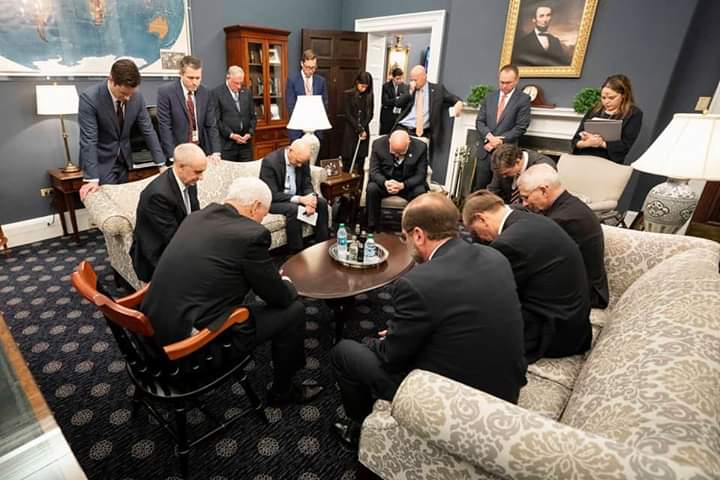
Over at Rupert Murdoch’s Fox News, the usual chorus of well-trained sycophants chimed in with the party line orchestrated by the president’s alter ego, Sean Hannity. Trump’s opponents, said Hannity, “are rooting for corona to wreak havoc in the United States.” Meanwhile, the President assigned the Vice President to be the commissar of censorship over government scientists and public health officials to make sure they hew to the official line, that is the White House view of reality. The Vice President promptly called them to a prayer meeting.
Dual realities. One exists in fact, in the world as it is. The other created by the President himself, to distract us from the truth. To make sense of this, I read Robert Jay Lifton’s new book Losing Reality and went by to talk to the distinguished scholar and psychiatrist at his apartment in New York City.
Bill Moyers: Losing Reality, when I first saw that title, I scratched my head. How do you lose reality?
Robert Jay Lifton: You lose it by creating falsehood and structuring that falsehood into a claim of reality. In terms of what we’re faced with, it’s Trump, but not only Trump, it’s people around him and associated with him. There is a kind of created reality. It’s what I call solipsistic reality, which simply means what is in your mind, what your sense of self needs and seeks, rather than what is based on the reasonable criteria for evidence. So that kind of solipsistic reality replaces what we would traditionally look at as reality. And that’s a dangerous moment.
Bill Moyers: What’s changed when reality is lost? What’s different?
Robert Jay Lifton: When reality is lost, it’s really impossible for democratic institutions to function. In fact, reality is never entirely lost. And the existence of institutions that depend upon a relation to reality is still hopeful. They’re being battered. But they’ve not been destroyed or eliminated.
Bill Moyers: Give me an example.
Robert Jay Lifton: Well, right now there’s a world epidemic, or even pandemic, that’s threatening us. A big issue has to do with health care, which has been ignored or nearly destroyed by right-wing Trumpists to the best that they could do that.
This is a truth of danger that we face which we must express. And the kinds of health care that we require are hard truths that can’t be falsified. And that’s why, despite all the lies, one must constantly counter them with truth and not wait for the lies to put forward truths.
And sometimes it gets weary to constantly expose lies and constantly reiterate truth. But one has to do that because that’s what a lawful society and a democracy require.
Right now, for instance, we’re in the middle of an attack — on the entire nature of the Justice Department, a major institution, for a law-bound society. There’s dreadful violation of their ordinary standards. And yet, there are struggles within the organization, from outside the organization, from people still working there, from people who have worked there in the past. The struggle is over resorting to law as opposed to personal authoritarianism. But it’s also a struggle over what is real, over what is true, over what we can depend upon. And that struggle is endless. And it’s become at the same time acute during the Trump era.
Bill Moyers: Just the other day, the president issued a slew of pardons for criminals who had committed serious financial and political crimes. And they were all mostly, men, white and privileged. What does that say to you about reality in America?
Robert Jay Lifton: They were not only mostly male, white and privileged. They were corrupt. That was a common feature. It parallels the corruption around Trump and in Trump. And his pardoning them is a negation of standards of corruption in favor of and acceptance and welcoming of them. And that too is playing with reality. When you pardon those among the most corrupt, you’re denying their corruption or accepting the corruption as part of the norm, what I call malignant normality. The two are almost the same. And preparing for further actions, further pardonings of corrupt people surrounding the administration.
Bill Moyers: Have we ever encountered a public figure who so consistently reversed truth and falsehood on such a vast scale?
Robert Jay Lifton: No. I think Trump is very unusual. The way he functions and evaluates reality only from the standpoint of the self and its needs. That’s the way that psychotic patients usually behave. We say they have a break with reality.
I don’t think Trump is psychotic. He’s, in fact, very talented at media manipulation and has some shrewd political sense that he employs. But the extremity of the solipsism and his paranoia and of his claim to being a messiah is so extreme in a person who is not psychotic, is what makes him so extraordinary and dangerous.
Bill Moyers: Over many years, you have studied people who claim ownership of the minds of others. You call them mental predators. Who are we talking about?
Robert Jay Lifton: Usually when we talk about those who seek ownership of reality and ownership of others’ minds, we’re talking about extremists, people who engage in what I call ideological totalism. That’s all or none belief systems, which claim absolute truth and absolute virtue.
And they’re often very complicated ideologies.
Trump would, at first glance, seem to be almost the opposite of them. He doesn’t have a systemic ideology. He has no ideology, really. It’s very changeable, the ideas he puts forward. But what he has in common with them is the claim to ownership of reality.
Bill Moyers: How do you own reality?
Robert Jay Lifton: You can’t. It’s a kind of fantasy and goal. One can never own reality. But the mental predators seek to own it. And they create all kinds of difficulty and pain and even violence in connection with that claim.
It isn’t new with Trump. People have sought to own reality from religious sources or political extremism. But with Trump, it’s a kind of simple or simplistic solipsistic endeavor. It’s ongoing. He has no other way of function. And in that sense, under him, our country is running on falsehood and unreality.
Bill Moyers: So what happens to the truth when an individual or a group claim to own reality?
Robert Jay Lifton: The truth doesn’t quite go away. It just becomes harder to connect with, or a little more unclear. And when we look at what’s been going on recently, first, the impeachment hearings and the impeachment itself. And then the trial, or so-called trial in the Senate. These were, of course, about Trump’s transgressions, his high crimes and misdemeanors for which impeachment became appropriate.
But they were also about reality, holding to reality, confronting falsehood and lies. And that struggle with reality is very much ongoing. And very much with us. And I tend to suspect that it may be Trump’s most lasting legacy in the difficulty we have coping with it and transcending it.
Bill Moyers: So reality in this case is what Donald Trump did, actually did, and what he says he did or didn’t do. And that’s the counter reality that he has created with the help of the Republican party, right?
Robert Jay Lifton: Yes. Well, people always ask me do I think that Trump believes in his falsehoods. And I say that the question assumes something about belief that may not be entirely true, that it’s definite and fixed. Belief is a form of behavior and it can change. It’s a form of adaptability.
So when you take some of Trump’s falsehoods, for instance, the primal falsehood of Barack Obama not being born in this country. He didn’t make that up. He got it from somewhere else. But he embraced it more than anybody else. Used it as a political lever for national presidential election.
And in that sense, we can say he was using it as a means of manipulation, consciously manipulating in relation to it. And that’s just plain old lying. But over time, one can suspect that he came in one side of his mind to partially believe it.
You know, you can’t really be effective as a conman unless you come to believe in your falsehoods. And that happens. And we see that in Trump.
Bill Moyers: Doesn’t that explain a lot about American history? We’ve been hospitable for conmen from the very beginning. And that becomes woven into the web of Americanism, what’s great about America, including our ability to fool each other.
Robert Jay Lifton: Yes, that’s all too true. And there are powerful strains in American society that feed the process we’re discussing. Yes, the conman. Many great American novelists have written about the conman at the heart of their novel. Beyond the conman, there are the nativists and Know-Nothing groups. And also the paranoid tendency — all these have affected the people around Trump.
And, of course, they long predated Trump. That’s why people can be confused about who’s responsible for all this. Some say it’s only Trump and it’s his psyche. Well, that’s not true because we have these trends in American society.
Others say Trump is of no account. It’s all American society. That’s not true either. There’s something sui generis about Trump. He contributes a lot of this with his solipsism. And also with his grandiose paranoia and angry and vitriolic impulses toward revenge toward anyone who doesn’t follow his falsehoods. So one has to see this kind of balance or imbalance or equilibrium involving Trump and these large and pervasive tendencies in American society that predated him and feed him.
Bill Moyers: You say he has Trumpistas, I would call them — one of the most powerful being Fox News and talk radio.
When a politically powerful individual is invested by the owner of a
particular reality, say, Rupert Murdoch and his family, with a mandate
to spread an alternative reality, he has a head start, doesn’t he?
Robert Jay Lifton: Yes. And that’s a terrible factor in all this.
I’ve also watched Fox News and now there are other places — Trumpist captivity of of more local outlets, recreated newspapers and radio stations. And these places live on falsehood. When just the latest conspiracy idea: The coronavirus was created intentionally by the Chinese communists to spread around the world in order to destroy their enemies.
Bill Moyers: Yeah, this is the rumor.
Robert Jay Lifton: This is the—
Bill Moyers: conspiracy theory.
Robert Jay Lifton: The latest conspiracy theory.
I listened to Fox News a little bit and, sure enough, their host was saying, “Well, how do you know they didn’t? Oh, you’re sticking up for China if you don’t believe it.” So what begins as wild conspiracism becomes repeated and reinforced by a very powerful medium and people who give it what seems like legitimation. That’s dreadful. And it very much contributes to what we’re calling losing reality.
Bill Moyers: What do they gain from it? What does Fox, including the owners of it, what do they gain from promoting such a widespread delusion?
Robert Jay Lifton: They don’t see it as a widespread delusion — the proponents any more than Trump does — because there’s been a process of delegitimation of the opposition. That’s really important. And—
Bill Moyers: What do you mean by that?
Robert Jay Lifton: Well, political theorists have begun to talk about it, in which they mean there no longer is a loyal opposition. There no longer are shared commitments to the national or international wellbeing.
You must defeat Democrats as the enemy. Not the loyal opposition, but the tarnished, evil enemy. And that takes precedence over anything else. Those who sponsor Fox News would have that kind of rationale. The delegitimation of the opposition, at least it’s more recent expression, is maybe several decades old.
And it’s devastating.
Bill Moyers: Yes, I’ve been around long enough to remember that Richard Nixon turned Democrats not into an adversary to be defeated at the polls, but an enemy to be destroyed in political warfare. And Newt Gingrich, who is probably the single most responsible individual for what is happening today, for changing the ground rules of politics to make it total war.
Robert Jay Lifton: Yes, from Gingrich rendering politics total warfare and when you make it absolute, win-lose and delegitimate the opposition, you’re moving toward some kind of authoritarian state. And there was that tendency in right-wing Republicanism before Trump which could join forces with Trump in this dangerous way. And could animate, could inspire those who back up or support Fox News and other outlets that profess only an absolute win-lose position.
Bill Moyers: And one of their achievements was to change the meaning of words and they simply twisted the meaning of language.
Robert Jay Lifton: Yes, what I called loading the language. Loading the language really means speaking in God words or devil words. And reducing large issues to what I call the thought terminating clichés. And that’s very much a characteristic of delegitimation. The language becomes so loaded that there’s no other way of thinking than those who are assuming authoritarian control and delegitimating the opponents.
Bill Moyers: So, are you saying that what’s happening to us now somehow fits the pattern of the totalistic ideologies that have consumed your life?
Robert Jay Lifton: I’m not saying that we are headed inevitably for an authoritarian society or Nazi-like society. What I am saying is that there are parallels. And they’re dangerous. You know, the Nazis didn’t do away with the major institutions of Germany.
They Nazified them. They had a term called gleichschaltung which simply meant reconstructing, reordering, re-gearing. They got rid of those who were unreliable, not reliable Nazis, [and] replaced them with reliable Nazis. And the institutions became sources of Nazi concepts and Nazi behavior.
Trump and his people are trying to do similar things with our institutions. Not do away with them, but Trumpize them. By removing, if possible, those with independent thought — and those who adhere to traditional realities — on the one hand, and replacing them with those who are willing to support his solipsistic reality on the other.
It doesn’t fully work. But it’s enormously confusing and harmful. It doesn’t fully work partly because, unlike Germany, we have had more substantive institutions of a Democratic kind. It doesn’t always feel that way. But they’ve been around for some time. And they’ve been law centered.
The Germany of Weimar, preceding Hitler, lacked such institutions of that kind. And in that sense, was more vulnerable to that kind of gleichschaltung or shift of gears in institutions. Trump is nonetheless, and his followers, attacking our institutions, weakening them.
There are times like now where our own institutions seem weakened and seem as if they’ll collapse under Trump and his followers’ attacks. But they don’t collapse that easily. We’ve seen that now in the struggle around the Justice Department. We’ve seen it in the Congress with the House of Representatives, which has been an enormous force in combating Trump.
And we’ve seen it among the common people in the various polls that
show American people still believe in the rule of law and in the
institutions that uphold that rule. Now, that doesn’t automatically
guarantee that we’ll be successful.
Bill Moyers:
You remind me of how much I felt the atmosphere had changed after I
watched those patriotic public servants — the diplomats — who testified
to what had happened in Ukraine, Yovanovitch and the others…
TESTIMONY FROM CONGRESS AUDIO
compared to how we all felt when we watched Cohen and Manafort and the others who paraded up there to tell their seamy stories. Do you believe that can happen, that people can be recharged by truth?
Robert Jay Lifton: When we watched these courageous civil servants testify at some personal risk and listened to them, we not only felt that justice was being served, we felt reality was being served. Here were people who had experiences of being attacked by Trump or his minions, and had witnessed harmful behavior that really betrayed our country. And they told about it in simple, honest words. We felt during those experiences of testimony a return to reality. That was the individual feeling that accompanied the larger sense of witnessing justice, rather than phony and false versions of what went on.
And it’s a struggle now through the whole society. The falsifications and conspiracism that we now live by in our society are not embraced by the majority of people as far as we far as can tell, but are embraced by enough people to worry us profoundly. And there’s every expectation that the majority here will hold. Meaning will cling to elements of truth, of reality and of institutional autonomy, which are crucial for a democracy to function. But nothing is guaranteed.
Bill Moyers: What do you think the Trumpsters are after?
Robert Jay Lifton: With Trump, there is no systemic or consistent ideology. But there is a narrative. And the narrative is that America was once great, it got into the hands of the wrong people, weak people. It then declined because it was taken advantage of. And now, “I will make America great again because I AM strong. I am chosen. And I can save America.”
So it’s a kind of purification. It’s a claim on the part of one man that has the — I don’t know if one would use the word “pure” — but he has the capacity because of his, yes, pure genius and pure capacity for being a savior, to rescue this country, make it great again. It’s a kind of purity of a single authoritarian person who claims to have nobility and claims that he alone and no one else can save the country. And by implication, the world. It’s pure megalomania.
Bill Moyers: I remember somewhere you told a story about meeting Adolf Hitler’s brilliant architect, Albert Speer, who built the Germany — physically, materially, aesthetically — that Hitler wanted.
Robert Jay Lifton: Yes. I interviewed Albert Speer, Hitler’s architect, four times. Each time for a couple of hours, and I learned a lot about the Nazi movement from him. What he told me was that he was a graduate student in architecture in the ’30s when everybody was hopeless. There was no future. The economy had gone bad.
Nobody could imagine anything good happening to them in the future. And Hitler came. Hitler had two speeches. He had his vulgar, street speech. And then he has his relatively intellectual speech which he gave at universities. And in that latter speech he said, “I now can unify Germany. We will then all be strong again and have a positive future.”
And when he said, “Germany can be strong again,” that meant not only militarily, which, of course, was very important because they had to renounce the Versailles Treaty and other things, but also people could feel themselves psychically strong.
Speer said he was mesmerized by this speech. It was what William James described as an experience of religious conversion in the purest form. And he (Speer) eventually became disillusioned.
Bill Moyers: But he joined the Nazi party first, didn’t he?
Robert Jay Lifton: Oh, he joined the Nazi party. And he served Hitler. And he was very close to Hitler and hee made a point of getting to see Hitler in his bunker, making a very dangerous trip at the end of the war in order to say goodbye to him. He hadn’t divested himself of this love for the Fuhrer, of the man who became a cult-like master or guru to him.
Bill Moyers: And by listening to that one speech he was himself lifted out of his despair and sense of hopelessness about the future and marched triumphantly into that future, only to see his country destroyed.
Robert Jay Lifton: Hitler was saying Hitler could make Germany great again. And Hitler could make individual Germans feel strong and great again. That’s— and we hear echoes in Trump – and we hear this in any intense political movement and a version of it in religious movements too.
And one is impressed by the parallel with Trump. Doesn’t mean that Trump is a Nazi.
Bill Moyers: No.
Robert Jay Lifton: He’s not. He doesn’t have enough ideology to be a Nazi, or the people around him. I’m not saying that any of them are Nazis. I’m saying that they embrace an authoritarian vision of rendering their country strong again and claim that only they can fulfill this vision.
He becomes for many people, a combination mafia don and cult guru as well as political leader. So I say he’s cult-like. I don’t claim that the whole thing is just a cult and that’s all. Rather, there are strongly cult-like patterns. You can see it and hear it in the chanting back and forth, which is almost religious-like.
There’s a holding out of the phrase and then a response from the religious community so to speak. And also in more recent terminology of Trump as the chosen one. He’s used that term himself.
And some of the more evangelical people around him have used it with full biblical sourcing. He’s the chosen one. You know, I remember one Nazi doctor I interviewed who came from a middle class family, academic people. And at first, they were disdainful of Hitler because he seemed so crude.
He said, “And then, we talked it over and we thought, well, maybe
he’s the right man because he is so crude.” There was a sense maybe he
was chosen. Maybe history has chosen him, just as people around Trump
and Trump himself say, “Maybe God has chosen Trump.” All the more so
because he’s so crude and different from other leaders. And that’s
really another parallel.
Bill Moyers: One of
President Trump’s cabinet members, Rick Perry, claimed that Trump was
chosen by God to lead America. And there’s a common belief among the
many of the conservative fundamentalists Christians you were just
referring to – Billy Graham’s son Franklin said, “I think God was behind
the last election.”
Robert Jay Lifton: Yes, that’s right. And the president has referred to himself as the chosen one. And, this is saviour talk. This is the kind of messianism that has a religious root. And I think you’ll agree that intense and sometimes fanatical evangelical thought has a lot to do with right-wing thinking in the United States.
And this would be parallel with that. This would be consistent with that. So that some of the people in Trump’s cabinet, including Pompeo, are intense evangelicals, and see Trump as carrying out the greater good. And with that perspective, the Democrats — who are seen as more secular — are the ultimate evil who must be destroyed, defeated.
And in this way, Trump, despite being probably the last man on earth to claim genuine religious involvement, nonetheless can be seen as chosen in a kind of indirect or hidden way. Chosen by God to carry out theology purposes.
Bill Moyers: I want to play for you, Robert, a recording of the televangelist Paula White, who is Trump’s spiritual advisor. And also heads his evangelical council of advisors.
The first recording you will hear, she’s speaking in tongues, which means a language she can’t herself understand. Here she is.
Bill Moyers: President Trump’s spiritual advisor, Paula White, who prayed at his inauguration. Here she is using her alleged spiritual authority to defend the president against what she calls demonic opponents.
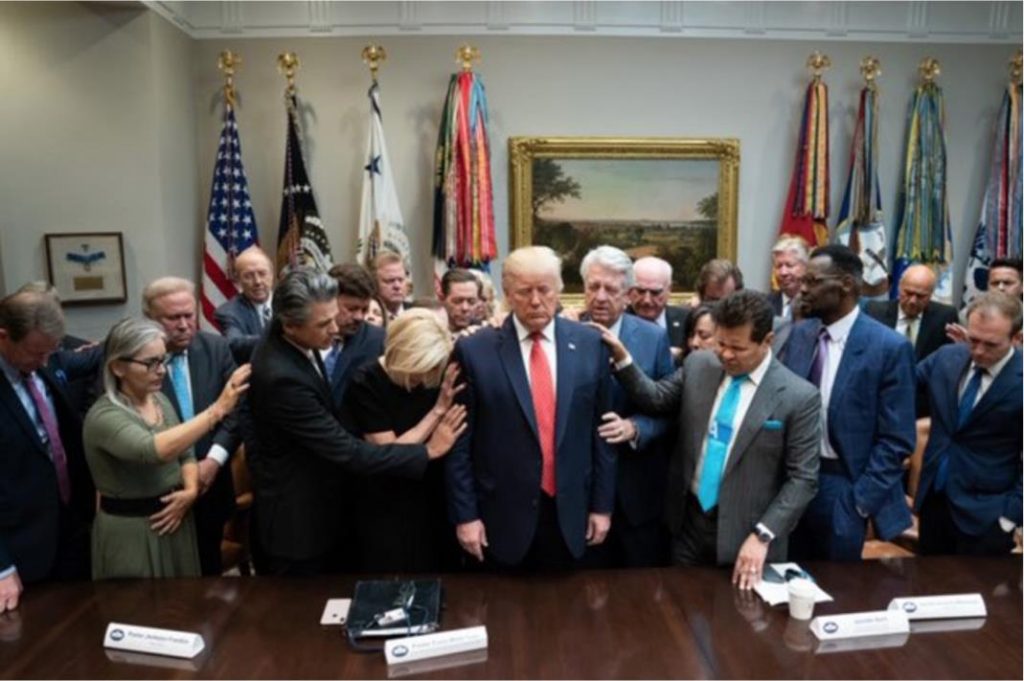
Paula White: We declare every demonic network to be scattered right now. We declare right now that there is a hedge of protection over our president. We deal with every demonic attack against him, against his mantle, against his purpose, against his position as he stands in position as president.
Bill Moyers: So she is saying that they’re throwing up a wall of protection to protect the president from demonic opposition. In other words, she and Christian right wingers like her are aiding and abetting the delegitimation of all opposition, right?
Robert Jay Lifton: Yes. That’s right. They’re giving religious authority, that is God-given authority. They’re claiming God-given authority to protect the president and attack his opponents. That’s totalistic or what I call cultist.
And that’s again evidence that Trump didn’t create all of this. He stepped into it and intensified and recast it. But the roots are deep in American society. And particularly, we shouldn’t make the mistake of just saying, “Oh, we have the two sides and each can be intense and over-intense or fanatical.” This problem comes from the right wing — it isn’t that the left-wing people have never been guilty of taking advantage of dubious approaches to reality.
But this wave of losing reality is specifically right wing. This wave of delegitimation of opposition. This authoritarian wave of claiming absolute truth and absolute virtue is particularly right wing and we should recognize that.
Bill Moyers: So what is Trump doing when he hands the Presidential Medal of Freedom to one of the biggest liars ever to thrive on duplicity and venality? And, of course, I’m talking about Rush Limbaugh.
Robert Jay Lifton: Trump is being consistent. He’s following his consistency to the end, so to speak. I mean, Rush Limbaugh being given the Medal of Freedom is, I don’t know what to call it. It’s more than egregious. It borders on the comic. But it is consistent with Trump’s claim to values. Why does Rush Limbaugh get the Medal of Freedom? He gets the Medal because he’s been loyal to Trump. He’s mouthed Trump’s falsehoods.
He’s furthered them with his own originality. He’s been completely corrupt and among the leadership in thought of those who follow the Trumpist/cultist line. So it makes full sense for Trump, within Trump’s malignant normality, to give the Medal of Freedom to Rush Limbaugh.
Bill Moyers: So what’s the ultimate danger, what you call extreme assaults on reality, by a man who holds the most powerful office in the world and is surrounded by sycophants in government, culture, the media, who echo and imitate his mendacity?
Robert Jay Lifton: Well, when the president of such a country lives on and attempts to coerce the rest of us to live on falsehood and lies, it’s dangerous to us and dangerous to the world. My argument is we’re not wired to go down with Trump. There’s nothing in our neurophysiology or brain structure that says we must destroy ourselves as a species.
And there’s nothing either that says we will certainly adapt and live together in harmony. We’re capable of either, according to our wiring. It’s up to us.
When I did my study of Nazi doctors and completed it — and it was a very difficult study — my friends would say something like this, “It’s okay. Now you’ve been exposed to the Nazi doctors. So what do you think of human beings now?”
And they expected me to say, “Not very much.” But instead, I said what I just said now. “We’re capable of going either way.” That’s what I believe. And that’s why I think that the efforts we make individually, and especially collectively, are crucial to the outcome.
Bill Moyers: But don’t you sense some reality fatigue in the country?
Robert Jay Lifton: I sense lots of reality fatigue and I feel it like everybody else at times. What reality fatigue is a kind of tiredness, a sense of being overwhelmed by the stream of lies and falsehoods. And having doubts that one can reverse that stream or stand up to them.
So yes, how can we not feel reality fatigue? But how can we not also feel it’s a luxury? We don’t allow ourselves reality fatigue, because reality fatigue is inseparable from democracy fatigue.
And that’s one thing we can’t allow ourselves.
My sense is that Trump’s increasingly more egregious and wild and solipsistic and paranoid behavior, which people describe as feeling free to do whatever he wants, and he’s got some of that. But is also an expression of increasing anxiety and could well be part of his end game. His end game possibly in losing the next election or in some other way.
That doesn’t mean it’s guaranteed. And it doesn’t mean that, if it is his end game, it won’t be painful and dangerous. But there is reason to feel that the society is struggling to mobilize its forces, and is not totally beholden to Fox News or those right-wing intellectuals or followers and their embrace of Trump and Trump’s destructiveness.
Bill Moyers: You think we can get the truth back?
Robert Jay Lifton: It’s hard. I think one of our great problems is that we don’t make enough use of the freedom to protest that we still possess and can maintain.
There is still in the society a recognition of great importance, of truth, and of the malignant nature of the normality that we’re being subjected to. And we have to take advantage of, embrace, that continuing recognition without any prior assumption that it’s easy or that we can win without difficulty.
Bill Moyers: When a few weeks ago I first heard you talk about your book, you sent me home to reread the speeches of Vaclav Havel, who enunciated, you said that night, the great principle of those revolutions that overthrew communist suppression – the Velvet Revolution back in, what was it? 1989?
Robert Jay Lifton: That’s right.
Bill Moyers: He called it “living in truth.” Living in truth. What do you take that to mean?
Robert Jay Lifton: It was a powerful message. Living in truth meant for Havel, and for some other Eastern European protest leaders, it meant countering the falsehoods which the oppressors depend upon by living in truth. Telling the truth. Living your own lives with each other in truth.
When I visited Prague not too long after the Velvet Revolution, I met with people who had totally changed in relation to that successful overthrow of the oppressors.
And I met one part-time ne’er do well musician not responsible to anything, when suddenly he found himself in charge of a protest newsletter, which he had to keep secret and distribute to people. And he did so with complete dedication and responsibility, showing tendencies he never knew he possessed.
I found others like that as well. So, we do possess these capacities as human beings, sometimes without our being aware of them. And what I’m describing, of course, is not just a matter of individual behavior it’s collective behavior, which it was all the way for Havel.
We need this. And we are capable of embracing it to a greater sense
than we’ve realized. So all this has no guarantee. But it does have
considerable possibility.
Bill Moyers: I think
you referred to it as the power of the powerless. “Living in truth,
takes place at the level of human consciousness and conscience, the
existential level.”
Robert Jay Lifton: Yeah. Yeah. That was Havel. In that sense, there’s a power to truth. There’s a power of life or death in truth. And he was right.
Bill Moyers: And I remember what I think is also one of your favorite quotes from Henry David Thoreau. “Rather than love, money and fame, give me truth.”
Robert Jay Lifton: Absolutely.
Bill Moyers: Thank you Robert.
Robert Jay Lifton: Thank you, Bill.
ANNOUNCER: Thank you for listening to Moyers on Democracy
That was Bill Moyers and Robert Jay Lifton
Until next time….read an excerpt of Lifton’s new book Losing Reality at Billmoyers.com. Check it out.
Postscript from Robert Jay Lifton
The coronavirus creates a new level of pressure on Trump in his reality struggles. The spread of this pandemic arouses primal anxieties in all of us that have to do with the vulnerability of our bodies and the threat of mortality. Even under ordinary conditions these are powerful concerns, as reflected in the importance of healthcare as a political issue.
The widespread death anxiety created by the present pandemic cannot be appeased by grandiose claims of perfect control over a minimized outbreak. When experiencing anxiety about medical mortality, we turn mainly to physicians, and they are frequently at odds with Trump’s version of denial and control. Trump has made uneasy compromises with medical views, but his erratic handling of the pandemic and his empty assurances about the economy do not inspire trust.
We then get a vicious circle of rejection of Trump’s false claims, leading to his increased anxiety and grandiosity, resulting in further mistrust of the population, etc. We can expect additional fantasy and ever more bitter attacks of those who question it.
Published by Common Dreams, 03.09.2020, under the terms of a Creative Commons Attribution-Share Alike 3.0 license.
About the Author