Mexico claims that US firearm manufacturers are fueling illegal cross-border gun trafficking and violent crime abroad.

By Timothy D. Lytton, J.D.
Regents’ Professor & Professor of Law
Georgia State University
Introduction
The government of Mexico is suing U.S. gun-makers for their role in facilitating cross-border gun trafficking that has supercharged violent crime in Mexico.
The lawsuit seeks US$10 billion in damages and a court order to force the companies named in the lawsuit – including Smith & Wesson, Colt, Glock, Beretta and Ruger – to change the way they do business. In January, a federal appeals court in Boston decided that the industry’s immunity shield, which so far has protected gun-makers from civil liability, does not apply to Mexico’s lawsuit.
As a legal scholar who has analyzed lawsuits against the gun industry for more than 25 years, I believe this decision to allow Mexico’s lawsuit to proceed could be a game changer. To understand why, let’s begin with some background about the federal law that protects the gun industry from civil lawsuits.
Gun Industry Immunity
In 2005, Congress passed the Protection of Lawful Commerce in Arms Act, which prohibits lawsuits against firearm manufacturers and sellers for injuries arising from criminal misuse of a gun.
Importantly, there are limits to this immunity shield. For example, it doesn’t protect a manufacturer or seller who “knowingly violated a State or Federal statute applicable to the sale or marketing” of a firearm. Mexico’s lawsuit alleges that U.S. gun-makers aided and abetted illegal weapons sales to gun traffickers in violation of federal law.
Mexico’s Allegations
Mexico claims that U.S. gun-makers engaged in “deliberate efforts to create and maintain an illegal market for their weapons in Mexico.”
According to the lawsuit, the manufacturers intentionally design their weapons to be attractive to criminal organizations in Mexico by including features such as easy conversion to fully automatic fire, compatibility with high-capacity magazines and removable serial numbers.
Mexico also points to industry marketing that promises buyers a tactical military experience for civilians. And Mexico alleges that manufacturers distribute their products to dealers whom they know serve as transit points for illegal gunrunning through illegal straw sales, unlicensed sales at gun shows and online, and off-book sales disguised as inventory theft.
In short, Mexico claims that illegal gun trafficking isn’t just an unwanted byproduct of the industry’s design choices, marketing campaigns and distribution practices. Instead, according to the lawsuit, feeding demand for illegal weapons is central to the industry’s business model.
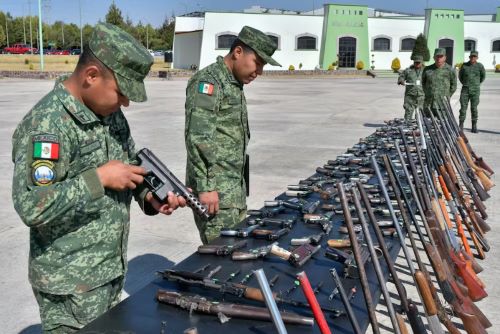
In response, the gun-makers insist that Mexico’s attempt to hold them legally responsible for the criminal activity of others is precisely the type of lawsuit that the federal immunity shield was designed to block. They argue that merely selling a product that someone later uses in a crime does not amount to a violation of federal law that would deprive a manufacturer of immunity. Additionally, the gun-makers assert that, even if Mexico’s lawsuit were not barred by the immunity law, they have no legal duty to prevent criminal violence that occurs outside the U.S.
The Next Legal Steps
In January 2024, a federal appeals court in Massachusetts decided that Mexico’s allegations, if true, would deprive the gun-makers of immunity, and it sent the case back to trial court. Mexico now needs to produce evidence to prove its allegations that the industry is not only aware of but actively facilitates illegal gun trafficking.
Additionally, to win, Mexico will need to convince a Boston jury that the manufacturers’ design choices, marketing campaigns and distribution practices are closely enough connected to street crime in Mexico to consider the companies responsible for the problem. This is known as “proximate cause” in the law.
For their part, the gun-makers have asked the trial judge to put the case on hold while they pursue an appeal to the U.S. Supreme Court. However, the Supreme Court has been reluctant to weigh in on gun industry cases until they have reached their conclusion in the lower courts, where most of them are dismissed and a few have settled.
High Stakes for the Industry
If Mexico does win at trial, its demand for $10 billion in damages could drive several of the nation’s largest firearm manufacturers into bankruptcy. Even if the case were to settle for much less, a victory by Mexico would provide a template for a wave of future lawsuits that could change the way the gun industry operates.
Similar theories about dangerous product designs, irresponsible marketing and reckless distribution practices in opioid litigation have transformed the pharmaceutical industry. Civil lawsuits have forced the drugmakers to take public responsibility for a nationwide health crisis, overhaul the way they do business and pay billions of dollars in judgments and settlements.
Mexico’s lawsuit holds out the prospect that the gun industry could be next.
Originally published by The Conversation, 02.16.2024, under the terms of a Creative Commons Attribution/No derivatives license.
About the Author