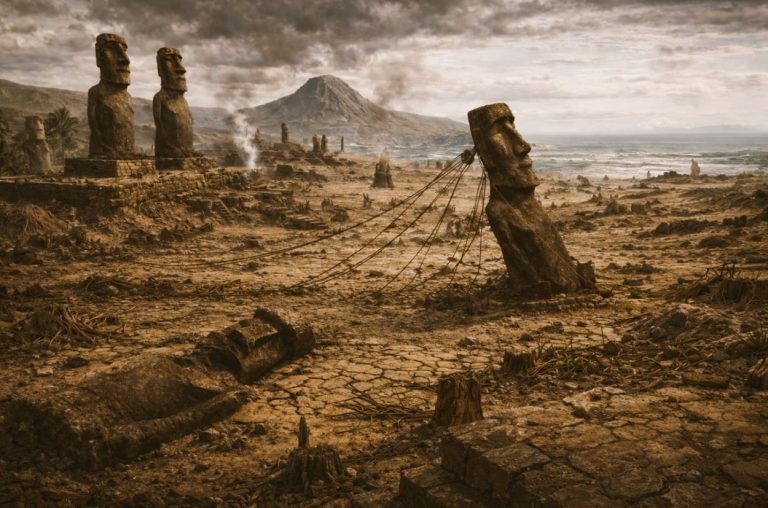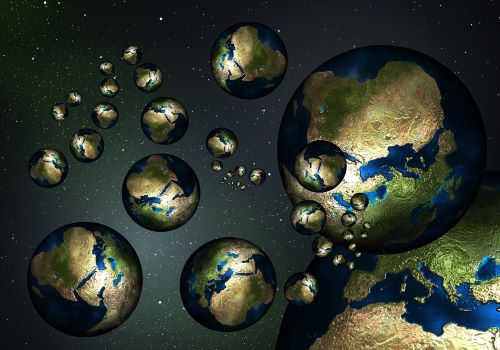
It has been hard to use knowledge to orchestrate and deliver systematic change to mitigate future climatic risks.

By Dr. Mike Hulme
Professor of Human Geography and Fellow and Geography Director of Studies
Pembroke College
Earth Day 19701
More than fifty years ago, twenty million Americans gathered in public streets, squares and parks across America to demonstrate their concern about the state of the planet. The first Earth Day rode the tide of late 1960s radicalism and protest in Western democracies and sought to “force the environmental issue into the political dialogue of the nation” (Lewis 1990: 10). Although it succeeded in doing so, and continues to do so more widely today in a very different world, it is questionable whether the larger ambitions of 1970 Earth Day to bring about a more sustainable civilisation have been met, not least with respect to a changing climate.
There is a paradox here. In the half century since 1970 it has been relatively easy for science to bring forward knowledge about the dynamics of the Earth system and identify the dangers of unmitigated climate change, knowledge that has now gained widespread public and political attention. And yet it has been manifestly harder to use such knowledge to orchestrate and deliver systematic change in the human sphere to mitigate future climatic risks.
In this essay I seek to analyse what is sometimes referred to as this ‘knowledge-action gap’ in three steps. First, I explain why facts alone can never be sufficient to drive policy and, second, I show that the facts of climate change can be consistent with different stories—sometimes radically different stories—that embody people’s beliefs about the past, present and future. Third, this then explains why what I call ‘climate solutionism’ is the wrong framework within which to operate. I conclude by suggesting a focus less on the destination—i.e., ‘stopping climate change’—and more on enhancing the political conditions of the journeying.
Why Facts Are Not Enough
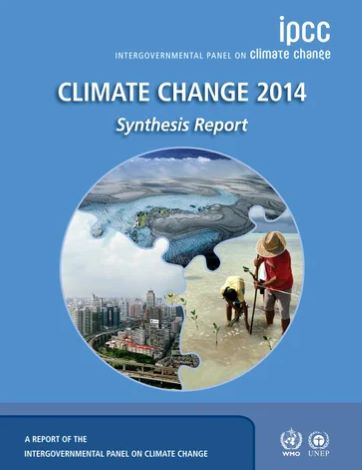
As recently argued or observed, ‘listening to the science’ would appear to be the sine qua non of the new wave of climate protest movements (Schinko 2020; Kenis 2021). Making sure that “objective facts” are laid “on the table” is believed to put pressure on “obstructionist states” to deliver political change (Schinko 2020: 22). Or as the late Rajendra Pachauri asserted back in November 2014 at the launch of the IPCC’s 5th Assessment Report, “all we need is the will to change, which we trust will be motivated by … an understanding of the science of climate change”. This ‘science first’ argument guides the consensus messaging campaign that seeks to emphasise above all else the “97% of scientists” who agree that human actions are changing the world’s climate. It also leads cognitive psychologists such as Stephan Lewandowsky to develop climate science communication strategies based on “inoculation theory” (Cook et al. 2017). This theory asserts that people can be made immune to falsehoods by being exposed, ahead of time, to those falsehoods they are most likely to encounter on social media and elsewhere.
But facts are never enough. With regard to climate change, seeking merely to ‘hit the numbers’—whichever one you choose: 2°C, 1.5°C, 350ppm, net zero—is not enough. It fuels what I have elsewhere called “climate reductionism” (Hulme 2011) and “climate deadline-ism” (Asayama et al. 2019) and encourages the type of “climate solutionism” of which I am critical (see below). ‘Closed’ timetables and emergency imperatives fail to respect the diverse moral horizons that characterise—and complicate—the difficult politics of climate change. Mere technique and technology crowds out wider explorations of human meaning and ethical purpose. Dan Sarewitz explains the flaw in this position:
[…] our expectations for Enlightenment ideals of applied rationality are themselves irrational. We are asking science to do the impossible: to arrive at scientifically coherent and politically unifying understandings of problems that are inherently open, indeterminate and contested (Sarewitz 2017: para. 25).
Which Story?
Establishing scientific facts about climate change (or offering scientific projections of future change) does not on its own drive political change. Consensus messaging, for example, fails to work because risk is socially constructed and value driven. So, if, as Sarewitz says, climate change is “inherently open, indeterminate and contested”, if in fact there is a surfeit of competing narratives each with different solutions to climate change, what should be our strategy? What are the wider resources beyond science—the motivational moral commitments that Jürgen Habermas refers to as “missing” in secularist societies (Habermas 2010)—that can enact and guide change? To illustrate what may be missing, I suggest below four different meta-narratives—guiding myths if you will, or ideologies—which are advocated by different voices to guide action in response to climate change. They differ from each other in various ways, sometimes profoundly. These future visions are rooted in different cultural values and often are antagonistic to each other. But they are similar in so far as they each require science and technology to be placed in a subservient role to their normative vision of how the world should be.
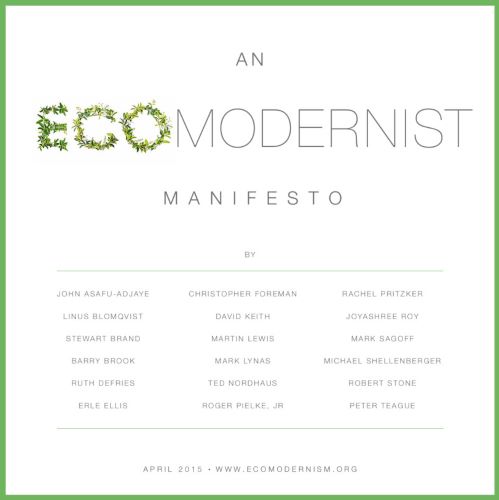
The first of these I group loosely under the label of ‘eco-modernism’. The argument here is that modernity can, so to speak, both have its cake and eat it. Yes, climate change is an outcome of rapid and penetrating technological expansion and economic and population growth. But it is through adjusting and redirecting these very great achievements of modernity towards more just and ecologically sensitive ends that climate change can be arrested. Thus, for example, the Ecomodernist Manifesto claims that humans need to use all their “growing social, economic, and technological powers to make life better for people, stabilise the climate, and protect the natural world” (Asafu-Adjaye 2015: 6).
A second ideology—or motivational discourse—is that of ‘ecological civilisation’. In essence, ecological civilisation is seen as the final goal of social, cultural and environmental reform within a given society. It argues that the changes to be wrought by climate change in the future can only be headed off through an entirely new form of civilisation, one based centrally on ecological principles. There are radically different techno and romantic versions of this envisioned future. The techno version of ecological civilisation has been embedded since 2012 in China’s Communist Party’s constitution. But it is very different from the romantic version espoused by deep ecologists and new cultural movements such as the Dark Mountain Project, which seek an unweaving of the core tenets of Western civilisation (Kingsnorth and Hine 2014).
A third narrative guiding political action in response to the challenges of climate change is the radical eco-socialist critique of capitalism. Following Naomi Klein’s 2015 book This Changes Everything: Climate vs Capitalism, this has been articulated even more decisively by the new social movement Extinction Rebellion (XR) and in some versions of the Green New Deal (Pettifor 2019). XR have a clear belief that the only adequate response to climate change is the overturning of the social order and the capitalist economic system. The real enemy of a stable and benign climate is ‘racialised capitalism’ and its fetishing of economic growth and the centralisation of wealth and power that capitalism fuels. XR is rooted in what for many are the political extremisms of anarchism, eco-socialism and radical anti-capitalist environmentalism. The ‘civil resistance model’ espoused by XR is intended to achieve mass protest accompanied by law-breaking, leading eventually to the disruption of “business-as-usual” through the movement’s calls to “tell the truth”, “act now” and “go beyond politics”.2
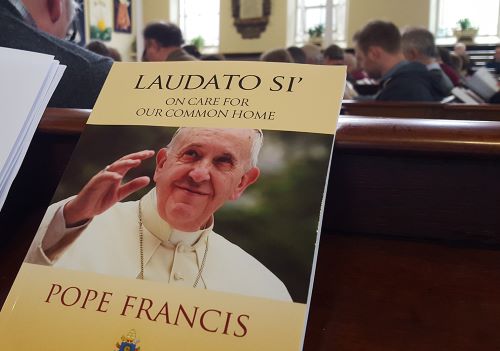
A fourth guiding myth was given new focus in 2015 through the publication of Pope Francis’ encyclical Laudato ‘Si: On Care for our Common Home (Pope Francis 2015). Here, the facts of climate change ‘reveal’ an emaciation of the human spirit which is having adverse repercussions for the material world. Pope Francis is concerned first and foremost to offer a vision of human dignity, responsibility and purpose. He draws upon the rich traditions of Catholic theology and ethics, notably the idea of virtue ethics which is valorised above utilitarian and deontological modes of ethical reasoning.3 On Care for our Common Home offers a powerful story, an inspirational account of divine goodness and healthy human living. It escapes the confines of a narrowly-drawn science and economics and shows the power, vitality and inspiration of a Christian worldview. Pope Francis draws attention to the centrality for the Christian faith of the idea of transformation, claiming “the ecological crisis is also a summons to profound interior conversion” (Pope Francis 2015: 158).
These ideologies offer different motivational commitments to tackling climate change and guide political action and public policy in different ways. For example, securing ‘green growth’ through a reformed capitalism is incommensurable with the eco-socialist ambition to dismantle the fetishism of growth upon which capitalism relies. Tackling climate change through inner spiritual transformation sits uneasily with the techno-modern vision of an ecological civilisation espoused by China’s Communist Party. The Dark Mountain Project wants ‘less’ modernity; eco-modernists want ‘more’. These meta-narratives illustrate why providing a coordinated global roadmap for climate action to deliver the 2°C target, in which all the pieces dovetail neatly into a single jigsaw, is not achievable.
Against Climate Solutionism

The belief that climate change can be solved can be traced back to its emergence in public life following the 1970 Earth Day as the latest in a series of environmental challenges facing the modern world. These challenges grew in scale from the merely local to the regional and then to the global. Climate change was in a line which can be traced back to Rachel Carson’s intervention in the early 1960s about DDT (Dichlorodiphenyltrichloroethane) and chemical pesticides, and which then progressed through concerns about river and ocean pollution, smog, acid rain, the ozone hole and, eventually, in the late 1980s to the fully-developed awareness of the challenge of global climate change. Although inheriting this problem/solution framing, what ‘solving’ climate change actually means has always been harder to establish. It is not as simple as eradicating DDT, installing sulphur scrubbers on power stations or eliminating CFCs (Chlorofluorocarbons).
Uniting behind science, putting ‘objective facts on the table’ and thinking that solutions will flow naturally from them—what I mean by ‘climate solutionism’—will not do. Science on its own offers no moral vision, no ethical stance, no political architecture for delivering the sort of world people desire. As Amanda Machin and Alexander Ruser have recently argued,
[…] emblematic numbers and the production of political thresholds, targets and truths will not smooth out or settle down the political disputes over climate change. The reliance upon emblematic numbers may ignite a sense of urgency, but it may also fuel the suspicion of politicians, scientists and climate change policy (Machin and Ruser 2019: 223).
My examples above of different meta-narratives which give meaning to climate change show that the solutions to climate change are under-determined by the facts. In other words, climate change is a wicked problem (Hulme 2009), a problem that has no definitive formulation and no imaginable solution. Wicked problems are insoluble in the sense that solutions to one aspect of the problem reveal or create other, even more complex, problems which in turn demand further solutions. Proposed solutions to climate change can only ever be partial; they set in train secondary and tertiary consequences which always exceed what can be anticipated. This is the condition pointed to by the nomenclature of the Anthropocene: namely, the modernist instinct for mastery, planning, optimisation and control is no longer an appropriate paradigm for living in the world of the twenty-first century.
Climate solutionism, driven by metrics, masks the contested politics and values diversity that lie behind different personal and collective choices—who wins, who loses, whose values count. It is a form of moral attenuation. Metrics are alluring because they simplify complex realities into ‘objective’ numbers and because they appear to short-circuit the need for difficult moral judgement. Metrification “may make a troubling situation more salient, without making it more soluble” (Muller 2018: 183). The circulation of ubiquitous carbon metrics operates as a facilitative and immanent mode of power. Morality by numbers also marginalises other modes of moral reasoning which cannot be reduced to calculation. These other modes offer richer narrative contexts that enable the wisdom of different choices to be deliberated, interpreted and judged. Wise governance of climate—as indeed in the application of wisdom in everyday life—emerges best when rooted in larger and thicker stories about human purpose, identity, duty and responsibility.
No Destination
We have reached beyond a stage (if there ever was one) when steering the planet towards some long-term commonly agreed normative goal or benign state was feasible. At best, consensus messaging and inoculation theory may yield a thin veneer of agreement about the reality of human-caused climate change. But there is no trick that will force a convergence of human values. The stories people tell about themselves, their past, their futures, their place on the planet will continue to divide. Mobilising some new “solution science” (Doubleday and Connell 2020) resting on a putative cultural authority of science will not eradicate political conflict. We live on one Earth, but we imagine many futures and hence are not susceptible to alignment of our actions toward securing a common single destination.
We rather have to abandon the dream that a sustainable ecological equilibrium that works for everyone can be designed, implemented and reached. Securing a predetermined agreed destination, such as the 2°C target, is an illusion; delivering “Earth system management” (as proposed by Schellnhuber and Tóth 1999) is a chimera. What should be aimed for are less ambitious, more incremental and multi-scalar projects, that emerge from a humbler disposition toward the future and anticipating perverse outcomes. These interventions should be driven from the bottom up rather than by a top-down narrative of securing a singular global target. For example, there are many different local, culturally-sensitive policies that can be designed to progress toward securing one or more of the 169 UN Sustainable Development Targets. These interventions do not rely upon globally coordinated action, nor a commitment to one shared ideology, nor do they measure success according to just one index.
The corollary of this disposition is that investing in new participatory and agonistic forms of democracy (Mouffe 2006), where value-conflicts and political disagreements are acknowledged, voiced and worked with, is as important—perhaps more important—than investing in new scientific or technical knowledge. There is a balance to be struck between the twin dangers of, on the one hand, the crisis politics of emergency and, on the other, perpetually ‘kicking the can down the road’. But good politics requires agonistic listening—the pursuit of what Nicholas Rescher (1993) calls ‘acquiescence’ in a decision—rather than consensual agreement. Have all interested parties been heard? Has their case been understood? Have their concerns been recognised? Over-emphasising the epistemic force of narrow science-based indicators—like global temperature or net zero emissions, or the emotional rhetoric of ‘only 10 more years’—are poor substitutes or short-cuts for political forms of closure.
Appendix
Endnotes
- This article was first published as Mike Hulme, ‘One Earth, Many Futures, No Destination’, One Earth, 2(4) (2020), 309–11, Copyright Elsevier. It has been lightly edited for this book volume.
- Editors’ note: see https://extinctionrebellion.uk/ and https://rebellion.global/.
- Editors’ note: virtue ethics focus on the morally virtuous dispositions of individuals that contribute to the flourishing of society more broadly, in contrast with a focus on actions designed for the purpose of generating broadly useful outcomes (utilitarian), or so as to be morally right in themselves, regardless of consequences (deontological).
Bibliography
- Asafu-Adjaye, John, et al., An Ecomodernist Manifesto (Ecomodernism.org, 2015).
- Asayama, Shin, Rob Bellamy, Oliver Geden, Warren Pearce, and Mike Hulme, ‘Why Setting a Climate Deadline is Dangerous’, Nature Climate Change, 9(8) (2019), 570–72, https://doi.org/10.1038/s41558-019-0543-4.
- Cook, Jon, Stefan Lewandowsky, and Ullrich Ecker, ‘Neutralizing Misinformation Through Inoculation: Exposing Misleading Argumentation Techniques Reduces Their Influence’,PLoS ONE, 12(5) (2017), e0175799, https://doi.org/10.1371/journal.pone.0175799.
- Doubleday, Zoë, and Sean Connell, ‘Shining a Bright Light on Solution Science in Ecology’, One Earth, 2 (2020), 16–19, https://doi.org/10.1016/j.oneear.2019.12.009.
- Habermas, Jürgen, An Awareness of What is Missing: Faith and Reason in a Post-Secular Age (Cambridge: Polity, 2010).
- Hulme, Mike, Why We Disagree About Climate Change: Understanding Controversy, Inaction and Opportunity (Cambridge: Cambridge University Press, 2009).
- Hulme, Mike, ‘Reducing the Future to Climate: A Story of Climate Determinism and Reductionism’, Osiris, 26(1) (2011), 245–66, https://doi.org/10.1086/661274.
- Kenis, Anneleen, ‘Clashing Tactics, Clashing Generations: The Politics of the School Strikes for Climate in Belgium’, Politics & Governance, 9(2) (2021), 135–45, https://doi.org/10.17645/pag.v9i2.3869.
- Kingsnorth, Paul, and Dougal Hine, ‘Uncivilisation: The Dark Mountain Manifesto’ (Dark-mountain.net, 2014), https://dark-mountain.net/product/uncivilisation-the-dark-mountain-manifesto/.
- Klein, Naomi, This Changes Everything: Capitalism vs. the Climate (London: Penguin, 2015).
- Lewis, Jack, ‘The Spirit of the First Earth Day’, EPA Journal, 16(1) (1990), 8–12.
- Machin, Amanda, and Alexander Ruser, ‘What Counts in the Politics of Climate Change? Science, Scepticism and Emblematic Numbers’, in Science, Numbers and Politics, ed. by Markus J Prutsch (London: Palgrave MacMillan, 2019), pp. 203–25.
- Mouffe, Chantel, On the Political (Abingdon: Routledge, 2006).
- Muller, Jerry, The Tyranny of Metrics (Princeton, NJ: Princeton University Press, 2018).
- Pettifor, Ann, The Green New Deal (London: Verso, 2019).
- Pope Francis, Laudato Si’ of the Holy Father Francis—On Care for our Common Future (Rome: Vatican Press, 2015).
- Rescher, Nicholas, Pluralism: Against the Demand for Consensus (Oxford: Oxford University Press, 1993).
- Sarewitz, Dan, ‘Stop Treating Science Denial Like a Disease’ (Theguardian.com, 2017), https://www.theguardian.com/science/political-science/2017/aug/21/stop-treating-science-denial-like-a-disease.
- Schellnhuber, John, and Ferenc Tóth, ‘Earth System Analysis and Management’, Environmental Modeling & Assessment, 4 (1999), 201–07, https://doi.org/10.1023/A:1019084805773.
- Schinko, Thomas, ‘Overcoming Political Climate-change Apathy in the Era of #FridaysForFuture’, One Earth, 2 (2020), 20–23, https://doi.org/10.1016/j.oneear.2019.12.012.
Chapter 1.1: Paradigms – One Earth, Many Futures, No Destination, from Negotiating Climate Change in Crisis, edited by Steffen Böhm and Sian Sullivan, published by Open Book Publishers (09.28.2021) under the terms of a Creative Commons Attribution 4.0 International license.
About the Author