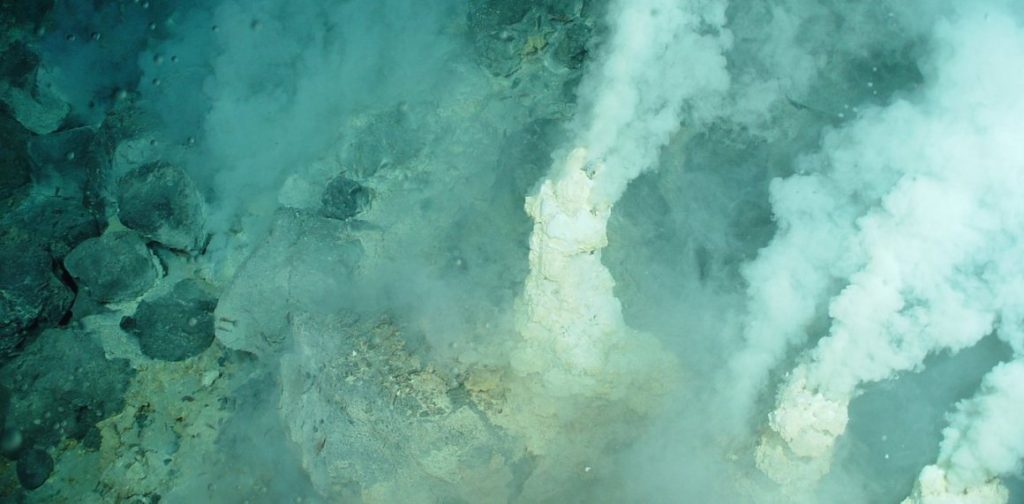
Study has led to a much deeper understanding of what we mean when we speak of “life”.
By Matt Brauer
In my one post I mentioned in passing the feature article appearing in November’s issue of PLoS biology.
In that paper, Richard Robinson describes some of the difficulties faced by researchers into the Origin of Life. The origin of replicating molecules is a question of intense interest to biologists because replication is the required (and perhaps sufficient) condition for subsequent evolution. (“Give biologists a cell and they’ll give you the world” is how Robinson puts it.)
The fundamental breakthrough in Origin of Life (OoL) research came, of course, from the famous Miller-Urey experiment, in which it was shown that energy applied to mixtures of inorganic compounds could lead to the formation of biologically significant molecules. Despite problems that later emerged in Miller and Urey’s model, the fundamental point always remained that some conditions exist that can result in the spontaneous origin of organic molecules.
But it’s a big long step from organic chemistry to biochemistry. The existence of biochemical precursors such as nucleotides and amino acids need not imply the development of replicating RNA and proteins. One of the biggest hurdles faced by OoL research is the fact that modern life at some point incorporated the dichotomy between replicating molecules and the effector molecules they code for. Life (the objection goes) would have had to develop two distinct but wholly dependent systems simultaneously. It is safe to say that this scenario is so unlikely that it is effectively impossible.
Life as we know it is not life as it has always been, however. Jack Szostak’s discovery that RNA needn’t be just a medium for the genetic code, but that it might also itself be an effector molecule, led to one solution to OoL’s chicken-and-egg problem. Szostak postulated that modern biology developed from an “RNA World”. In the precursors to modern cells, RNA was supposed to act both as replicator and as an enzyme, so that there was no need for a parallel and simultaneous origin of multiple complex systems. The Origin of Life via the RNA World is a “genes first” model, in which the replicator arose and gradually evolved by improving its autocatalytic replication activity.
The RNA World has problems of it own, of course, and various alternatives have been proposed to deal wih these. One model, based on “Peptide Nucleic Acids” (PNA), suffers from many of the same deficiencies that challenge the RNA World. But there is growing excitement about the idea that metabolic function might have preceded replicative function. These “metabolism first” models take recent discoveries about chemistry on surfaces and extrapolates to the conditions that might have characterized the early earth. The basic idea is that enzymes act simply by providing surfaces on which favored chemical reactions can occur. If the surface is what is important, why couldn’t an inorganic molecule provide this just as well. In fact, many modern metabolic enzymes require as cofactors so-called “Iron-Sulfur clusters”. In essence, the enzyme is simply a device for capturing a minute piece of the original crystalline surface, and making it available at the right place and time. (My favorite enzyme of the moment, Aconitase, is one of these Fe-S enzymes).
“Metabolism first” models imagine a porous crystalline structure through which reactants percolate, and within which polymerized products are captured. There’s a fair bit of handwaving involved in describing the next steps in the development of life, but the basic idea is nevertheless intriguing.
There are enormous gaps in all Origin of Life models. But these gaps ought to be expected: we’re talking about a singular event that happened 5-6 BYA, after all. Still, progress in the models continues. And, more importantly, Origin of Life research has resulted in profound insights into basic biochemistry that have generated phenomenally productive research programs.
In the end, even if all of our best current models are gross simplifications (as they most certainly are), their testing and refining have led to a much deeper understanding of what we mean when we speak of “life”.
Originally published by Panda’s Thumb under the terms of a Creative Commons Attribution-NonCommercial-NoDerivatives 4.0 International license.
About the Author