Thanks to a strong oral Urdu literary tradition in South Asia, poems from the past linger in the popular imagination.

By Dr. Krupa Shandilya
Associate Professor of Sexuality, Women’s and Gender Studies
Amherst College
Introduction
India’s government, led by Prime Minister Narendra Modi, implemented the controversial Citizenship Amendment Act, or CAA, in March 2024.
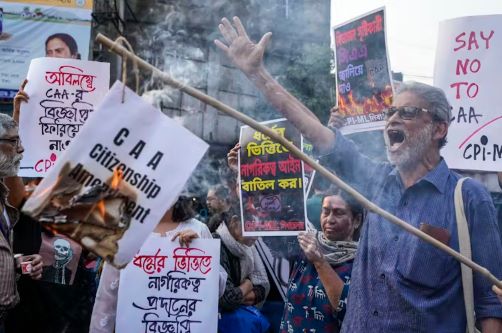
Opponents of the law – which fast-tracks citizenship for undocumented, non-Muslim migrants from Pakistan, Bangladesh and Afghanistan – decry the ways in which it discriminates against Muslims.
As they did when the law was passed in 2019, many Indians took to the streets.
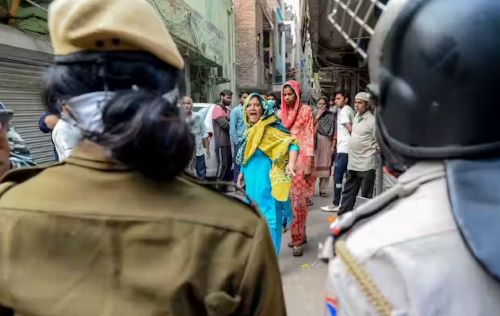
The demonstrations were more muted this time, though some protesters were detained by the police. The government, perhaps fearing a reprise, had increased police patrols and deployed paramilitary troops in places that had been hotbeds of protest.
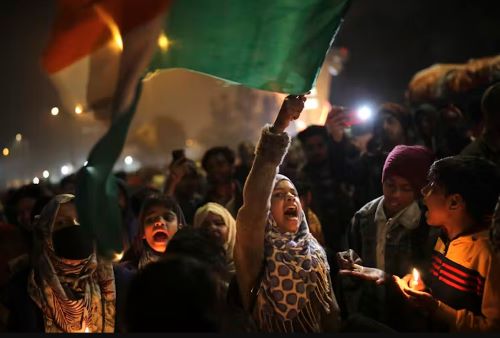
Four years ago, university campuses and Muslim neighborhoods such as Delhi’s Shaheen Bagh were packed with people who, day after day, chanted slogans, belted out songs and recited poetry.
Poetry seemed to unsettle the government the most. Dissenters reciting protest poems were accused of spreading hate against India, beaten and arrested by the police.
Poet Hussain Haidry rose to fame in the 2019-2020 protests. Haidry, who’s also a Bollywood lyricist and scriptwriter, penned anti-CAA poems that became a rallying cry against the government, particularly “Tum Dekhogey,” or “You will see” in English.
I first heard “Tum Dekhogey” in 2020 when Haidry recited it at a lecture at Columbia University on the anti-CAA protests.
As a scholar and translator of Urdu poetry, I was moved by the ways in which the poem described the state’s violence against peaceful protesters. I went on to translate the poem, and I’m currently writing about it for my forthcoming book, “Urdu Poetry and Politics in Contemporary India.”
For me, the poem crystallizes the disturbing turn of events in a country that once prized secularism, democracy and free expression. Because poems like Haidry’s directly challenge state power, the government and its supporters seek to portray them as seditious and anti-Indian.
A Secularist Ethos Squelched
The CAA was passed in 1955, a few years after India’s freedom from colonial rule in 1947.
It was intended to formalize citizenship for everyone living in India since 1949, as well as those born in India since or before that date.
But in 2019, the right-wing government changed this law to allow migrants of religious groups from neighboring Muslim majority countries to apply for citizenship.
There was one exception: Muslim migrants.
In one fell swoop, this new law erased India’s constitutional guarantee to grant citizenship to people of all religions. Most of India’s poor do not have formal citizenship papers, even if their families have lived in the country for generations. If they happen to be Muslim, they can no longer apply.
This law – in tandem with plans to create a National Register of Citizens, which would require all Indians to show proof of citizenship – would effectively render millions of India’s Muslims, lower castes and the poor ineligible for government benefits. They would be unable to vote and would face a constant threat of displacement from the country of their birth.
Delhi-based lawyer Gautam Bhatia has argued that dividing alleged migrants into Muslims and non-Muslims “explicitly and blatantly seeks to enshrine religious discrimination into law, contrary to our long-standing, secular constitutional ethos.”
In 2019, the passing of these laws by the Lok Sabha, the lower house of India’s Parliament, was met with nationwide protests. The most prominent was the Muslim women-led 101-day sit-in at Shaheen Bagh. Due to protests and widespread outcry, the implementation of the law was put on hold.
‘We Will Toss Your Crowns’
Perhaps the most recited poem at Shaheen Bagh and other sites during the 2019 protests was Faiz Ahmed Faiz’s Urdu poem “Hum Dekhenge” – or “We Will See.”
Faiz, who was born in pre-partitioned India in a region of the country that is now part of Pakistan, had written the poem in 1979 to protest the regime of Muhammad Zia ul Haq, Pakistan’s sixth president. Upon assuming power, Zia put the country under martial law and ruled as a military dictator while furthering the Islamization of Pakistan’s political and cultural life.
It might seem strange that a poem written to protest a Pakistani ruler several decades earlier was being used to protest Indian laws. But in South Asia, there’s a long tradition of reciting poetry as a form of protest, and poems from the past often evolve to become freshly relevant.
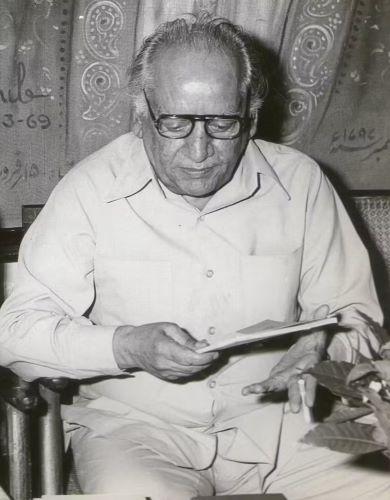
While many of these poems appear in print, the tradition is primarily an oral one – they are recited as poems and sung as songs at marches, protests and on university campuses. As a result, they can reside in the popular imagination decades after their publication.
In 2019, Faiz’s 1979 poem became a stirring riposte to the Modi government’s attempts to marginalize India’s Muslims.
Just as Pakistani protesters chanted the line “Sab taj uchale jayenge, sab takht giraye jayenge” – “We will toss your crowns, we will topple your thrones” – to decry Zia’s authoritarian regime, Indian protesters recited those same lines to denounce Modi’s rule.
‘I Was There and So Were You’
Haidry was at Shaheen Bagh during the 2019 protests. Inspired by the women’s activism, he wrote “Tum Dekhogey” as a riff on “Hum Dekhenge.”
While Faiz’s poem speaks of the power of the people to overthrow tyranny, Haidry’s poem is written from the perspective of the women of Shaheen Bagh. It lambastes the silent bystanders who do nothing as hardcore Hindu nationalists – who believe in Hindu supremacy – terrorize religious minorities.
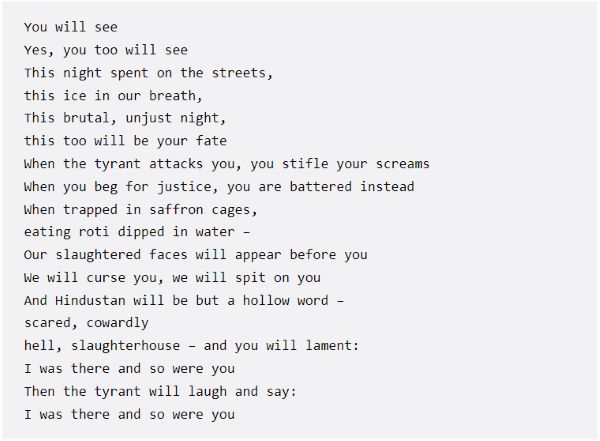
The poem begins by setting the stage.
“This night on the street, this ice in our breath” is a reference to the frigid winter nights that the women of Shaheen Bagh endured during their sit-in, when they had no access to heat or electricity. Those who watched and did nothing, Haidry warns, will one day meet the same fate as these women.
The next two lines speak to the various injustices endured by peaceful protesters – the “attacks” and “battering” at the hands of the state. Next the text suggests that Hindu nationalists trap regular citizens in “saffron cages.” Saffron is a reference to the color used by Modi’s Bharatiya Janata Party, or BJP. The cage can be thought of as a metaphorical one – of an India without fundamental rights. But it can also refer to the actual jail sentences being meted out to protesters.
The poem goes on to suggest that once the CAA becomes law, these silent bystanders will finally wake up and come to see that India has become a living “hell” and a “slaughterhouse.” When they lament their inaction, the tyrant will mock them – “laugh and say: / I was there and so were you.”
Haidry’s lyrical indictment of the government has enraged supporters of Modi and the BJP.
Because Haidry is also a Bollywood scriptwriter, there have been calls to boycott “Takht,” a film he worked on. And when singer and activist Kiran Ahluwalia, who lives in New York, posted a rendition of “Tum Dekhogey” on Instagram on March 18, 2024, she had the renewal of her Overseas Citizen of India card, a type of second passport, denied – a tactic often employed by the Modi government to punish dissenters.
Despite these attempts to suppress protest, the words of poets like Haidry continue to resonate.
Such is the beauty of poetry, which can slip through the bars of saffron cages with ease, speaking truth to power and oppression.
Originally published by The Conversation, 04.16.2024, under the terms of a Creative Commons Attribution/No derivatives license.
About the Author