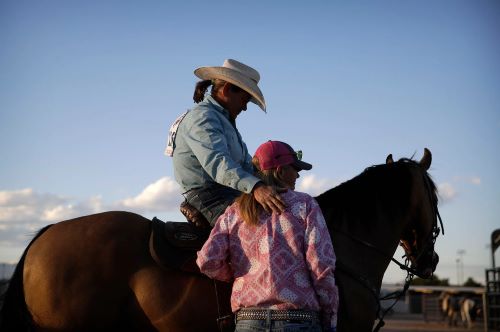
The sport has become a refuge for LGBTQ+ cowfolx who want a taste of the Wild West, and anyone who wants to join rodeo without judgment.

By Orion Rummler
LGBTQ+ Reporter
The 19th
“Everybody’s cheering for you in gay rodeo.”
That’s how Jackie Thompson, a gay rodeo champion in chute dogging and calf roping, remembers her time in the arena from 2002 to 2008. In her first competition, she wrestled a steer to the ground, with the goal of taking it down with her arms — and ended up on her back, holding the steer in a leglock around its neck.
“In that Atlanta rodeo, I didn’t know how to chute dog. Not at all,” she said. But she knew that she could learn to do it. As she kept competing, she practiced with training animals like steer. She was buoyed by the camaraderie that she felt inside the ring. Although she only met two other Black people while on the rodeo circuit, as a Black woman, Thompson felt comfortable being among fellow competitors who saw her as a peer first. Gay rodeo became a refuge where her identity didn’t seem to matter.
“When you’re in the chute, when you’re up next, everybody is rooting for you. It’s you against the animal,” she said. “There’s no competition except you and the time.”
Since the first gay rodeo was cobbled together in Reno in 1976, queer cowboys, cowgirls and cowfolx have been gathering to compete in a community that is more welcoming than traditional rodeo. Although the gay rodeo was designed to cater to men who wanted to combine an idealized country-western lifestyle with loud and out queerness, it has been open to women from the beginning — and as early as 2001, competitors could self-select their gender, enabling easier entry for transgender people.
Gay rodeo has become a refuge for all LGBTQ+ people who want a taste of the Wild West, and anyone who wants to join rodeo without judgment. Straight women frequently attend or participate in gay rodeos simply because men and women compete on the same terms. They’re judged separately, but take on the same challenges. There is also a lower barrier to entry than traditional rodeo, since competitors don’t need to own a horse or jump straight into danger. Goat dressing or steer decorating — putting underwear on a goat or tying a ribbon on a steer’s tail — is a common way to get started at the gay rodeo.
“It’s a place where people can do the sport they love, but it’s also a place to feel safe doing that sport,” said Rebecca Scofield, history department chair at the University of Idaho who has attended a number of gay rodeos herself. “These are not solitary events. People do not show up to ride, get their winnings and leave. It’s really about community.”
People seeking that community have gathered this year in Las Vegas, Phoenix, Little Rock and Kansas City — with more events planned from Denver and Salt Lake City to San Francisco and Grand Rapids, Michigan. The International Gay Rodeo Association (IGRA), founded in 1985, oversees the state and local associations that hold the country’s gay rodeos.
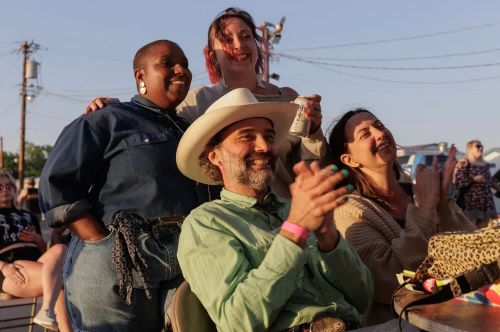
At that first rodeo in 1976, organizers were denied facilities to rent, said Brian Helander, the IGRA president. Because the rodeo was a gay event, organizers faced obstacle after obstacle — including having to beg and borrow stock animals. Nearly 50 years later, gay rodeo is a national phenomenon that raises money for charities across the country.
Helander was 40 when he went to his first gay rodeo in Phoenix. As he watched the cowboys and cowgirls ride their horses, he knew that he could do it too — and that he had found a safe place to give it a try. At straight rodeos, trying to gain acceptance was futile. There, the rodeo clowns made jokes to mock gay people, and the audiences lapped it up.
“I knew it wasn’t a place for me. It’s still that way today. It’s one of the last safe places to be homophobic in the country world,” he said. That othering within traditional rodeo is why gay rodeo exists today, Helander said. It provides a safe place for anyone who wants to be there.
“We have a lot of straight people that come, nonbinary people, gender-nonconforming individuals, anybody can come. If they want to be a cowboy or cowgirl, then that’s what we’ll help you be,” he said.
The idea of who can be a cowboy used to be much more rigid. As the concept of the cowboy was created in the American popular consciousness in the 20th century, through Wild West shows, films and novels, reality was whitewashed and filtered through rigid gender norms and heterosexuality. A significant number of cowboys were Black and Mexican Americans — including sheriffs and range-cattle workers. Independent, gun-toting women were prominent on the rugged frontier, as was cross-dressing and expansive gender expression. Some women lived as men, while some frontierswomen were found to be what modern society would describe as transgender.
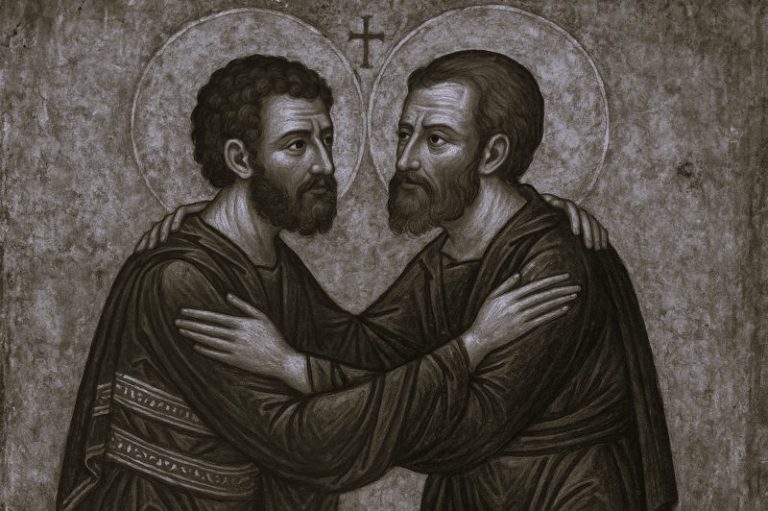
“It was just a much more diverse space than your average John Wayne film would lead you to believe,” Scofield said. That includes queerness in the Wild West, something largely underexplored in the public consciousness until “Brokeback Mountain” came out in 2005. In stag dances on the frontier, in eloquent letters expressing deep emotional commitment, and in close partnerships between working ranch hands, the intimate relationships between 19th century men in the American West are clear.
“To think that cowboys weren’t super gay is insane. These were men spending lots of time with each other,” she said.
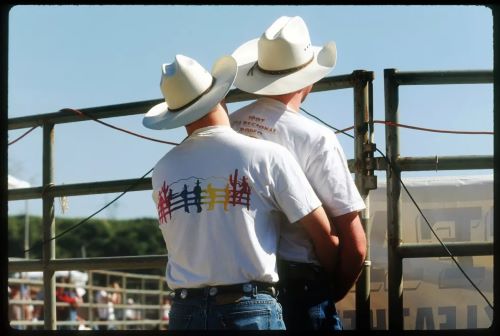
Scofield co-authored the book “Slapping Leather: Queer Cowfolx at the Gay Rodeo” with her colleague Elyssa Ford, and has interviewed dozens of gay cowboys, cowgirls and cowfolx across the country. Excerpts from those interviews are included in the book, which brings together over a decade of research from two prominent historians of gender and sexuality in the American West.
Their research finds that gay rodeo created a home for rural LGBTQ+ people, played a crucial role in the fight against HIV and AIDS by fundraising hundreds of thousands of dollars during the height of the epidemic, and pushed gayness further into mainstream American society while still embracing alternative sexualities and gender identities.
Gay rodeos rebuke old-fashioned ideas of what it means to be a rugged, hypermasculine cowboy — because at the gay rodeo, real cowboys dress in drag and chase down a goat with a pair of underwear. Their existence threatens a certain kind of American identity, Scofield and Ford write in their book; which means that homophobic contempt and threats of violence have never been far from the sanctuary of the arena.
Fans of the unique sanctuary found at the gay rodeo have also hailed from far outside the arenas dotted across the United States and Canada. Alejandra Gaeta, librarian and archivist at the Autry Museum of the American West, has sifted through many of the hundreds of letters stored in the IGRA’s collection. In letters from the mid-90s to the early 2000s — seen as the last heyday of gay rodeo — fans as far as France wrote to the IGRA to express their wish to go to the rodeo.
“There’s one letter I remember from a young teen, who’s saying ‘I just heard about this gay rodeo, I’d love more information. But can you send it with this envelope? I’ve pre-addressed it and put a stamp on it … because I live with my parents and I don’t want them to know,’” she said.
Gay rodeo, centered in the Western culture of the U.S., was able to reach a vast audience through its strong sense of community and identity, Gaeta said. Interviews in the Gay Rodeo Oral History Project, created by Scofield in 2016, explore how some competitors had no prior interest in rodeo until hearing about the gay rodeo.
“It became part of their lives simply because it was a place where they could go and be themselves,” Gaeta said. That included contestants who didn’t want to be photographed or use their real name at the gay rodeo, because it was a public event — and they weren’t out in certain parts of their lives.
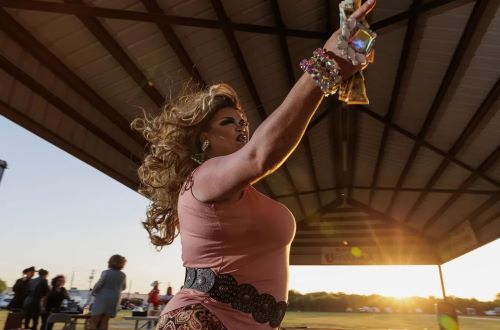
In the 1980s, as HIV and AIDS destroyed the lives of queer men across the country, gay rodeo became a source of hope. Gay rodeo was always used as a way to raise money for local causes, but now it had a unifying purpose: raising money for medical research and hospice care as the epidemic raged on and government officials dragged their feet.
Today, each rodeo selects what group or cause they want to give money to, including cancer research and prevention, animal rescues, and Boys and Girls Clubs. That core value stems from the true origin of gay rodeo: the competitive drag and ballroom circuit of the 1960s.
In the drag world of the 1960s, the imperial court system was born as a form of fundraising. Drag performers who are crowned emperor or empress of a city must raise money for civic organizations. Phil Ragsdale, a businessman in Reno, was crowned emperor in his city in 1975 — and he wanted to raise money for a local senior citizens group by holding a rodeo.
“That’s where it really all started,” Scofield said.
Despite its rich history, the future of the gay rodeo is uncertain.
Since 2009, there’s been a precipitous drop in the number of associations and gay rodeos, said Elyssa Ford, associate professor of history at Northwest Missouri State University, and co-author of “Slapping Leather.” Gay rodeo took a big hit during the COVID-19 pandemic, and prior to that, there had already been a decline in regional associations actually holding rodeos.
Ford is curious to see whether the recent resurgence of cowboy culture in popular music — from Lil Nas X and Orville Peck to Beyonce’s hit album ‘Cowboy Carter’ — will renew an interest in gay rodeos among urban queer communities. That’s where there needs to be a greater interest, she said, because most regional IGRA organizations are housed in urban areas.
The current increase in anti-LGBTQ+ legislation and rhetoric may also create the kind of hostile environment that drives an increased need for in-person queer community spaces, she said. That could bring more people back to the gay rodeo, too. Seeking that safety and support was part of the appeal of gay rodeo back in the 1980s, when the LGBTQ+ community was under attack during the HIV and AIDS epidemic.
“When there’s laws that are being passed that say, ‘Your history, and this history of the United States, cannot be taught in states,’” Ford said, queer people are confronted with the reality that “you have an identity that can be attacked and is being attacked, and therefore, the only way to counter that, in my view, is to come together.”
Thompson displays cases of her lassos, cowboy hats, shirts, winner’s ribbons and belt buckles from her time in the arena at the house she shares with her wife in Quebec. She left gay rodeo in 2008 to search for a new type of community that she could experience more than two or three times a year. She joined a diverse local chapter of the leather and kink community, which she found through rodeo.
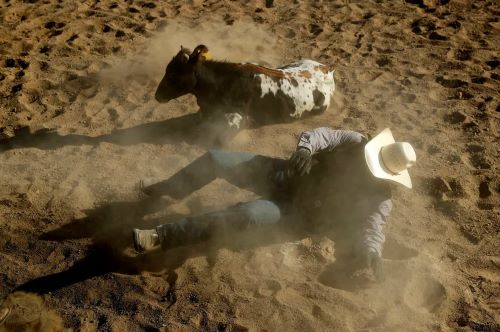
She hasn’t been back to a gay rodeo because as a spectator, it would be a completely different experience. She wouldn’t wake up early for calf roping and have someone make sure she’s had breakfast. She wouldn’t be struck by the feeling that everyone is there for each other.
“I would miss it too much. Miss being on the other side, miss the camaraderie,” she said. But she doesn’t rule out getting back in the arena, especially for a rodeo on the East Coast.
Originally published by The 19th, 07.08.2024, under the terms of a Creative Commons Attribution-NonCommercial-NoDerivs 4.0 International license.
About the Author