Partisans increasingly view each other as immoral. New research reveals the depth of that conviction.

By Phillip McGarry
Ph.D. Candidate in Experimental Psychology
University of Tennessee
Introduction
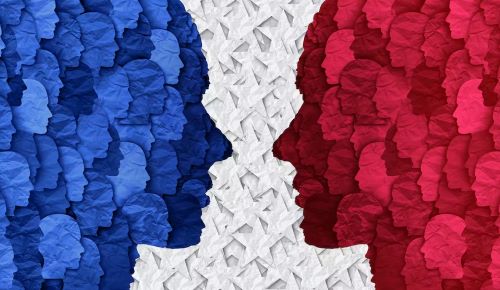
Both Republicans and Democrats regarded people with opposing political views as less moral than people in their own party, even when their political opposites acted fairly or kindly toward them, according to experiments my colleagues and I recently conducted. Even participants who self-identified as only moderately conservative or liberal made the same harsh moral judgments about those on the other side of the political divide.
Psychology researcher Eli Finkel and his colleagues have suggested that moral judgment plays a major role in political polarization in the United States. My research team wondered if acts demonstrating good moral character could counteract partisan animosity. In other words, would you think more highly of someone who treated you well – regardless of their political leanings?
We decided to conduct an experiment based on game theory and turned to the Ultimatum Game, which researchers developed to study the role of fairness in cooperation. Psychology researcher Hanah Chapman and her colleagues have demonstrated that unfairness in the Ultimatum Game elicits moral disgust, making it a good tool for us to use to study moral judgment in real time.
The Ultimatum Game allowed us to experimentally manipulate whether partisans were treated unfairly, fairly or even kindly by political opponents. Participants had no knowledge about the person they were playing with beyond party affiliation and how they played the game.
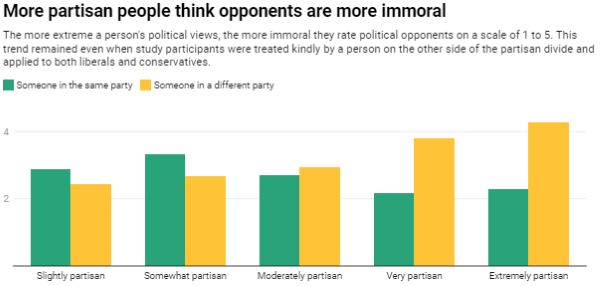
In our experiments, even after fair or kind treatment, participants still rated political opponents as less moral. Moreover, this was true even for participants who didn’t consider themselves to have strong political bias.
Other psychology studies suggest that conservatives are more politically extreme, being more likely to adopt right-wing authoritarianism and more sensitive to moral disgust. However, in our experiments, we found no differences in party animosity and moral judgment between liberals and conservatives, suggesting political polarization is a bipartisan phenomenon.
Why It Matters
Our experiments illustrate the magnitude of current political polarization in the United States, which has been increasing for at least the last four decades.
Americans with different political opinions could once cooperate and maintain friendships with one another. But as political attitudes begin to coincide with moral convictions, partisans increasingly view each other as immoral.
My colleagues and I are particularly interested in this topic, as we worry about the potential for political polarization based on moral convictions to descend into political violence.
What’s Next
My colleagues and I believe that a controlled scientific approach, rather than speculation, could help find ways to mitigate political polarization. Currently, we are running experiments to explore how online interaction – for example, through social media – can foster psychological distance between partisans. We’re also investigating how emotions such as disgust can contribute to the moral component of partisan animosity, and how the evolutionary origins of morality may play a psychological role in political polarization.
Originally published by The Conversation, 02.01.2024, under the terms of a Creative Commons Attribution/No derivatives license.
About the Author