By Katherine Stewart
Author and Journalist
Right around the time the House began its impeachment inquiry, the homepage of the U.S. Department of State featured a talk by Secretary of State Mike Pompeo titled “Being a Christian Leader.” Only a few weeks had passed since Attorney General William Barr told students at Notre Dame Law School that “secularists” are to blame for “moral chaos” and “immense suffering, wreckage, and misery,” and that “Judeo-Christian moral standards are the ultimate utilitarian rules for human conduct.” Then, at a January campaign rally at a Miami megachurch, President Donald Trump told the largely evangelical crowd that God is “on our side.”
Most of us have a sense that this kind of religious-nationalist rhetoric and behavior got its start with the revolution that Reagan brought to power. A decisive moment was in August 1980, at the Reunion Arena in Dallas, Texas, when Reagan addressed 15,000 thousand pastors and religious activists. “I know that you can’t endorse me,” but “I want you to know that I endorse you and what you are doing,” he said, to wild applause.
Reagan’s speech at the Reunion Arena marked a sea change in the role of conservative religion in American politics. But some of those who had helped organize the event were concerned that the one individual who deserved the most credit for the transformation of the interface of politics and religion was not on the podium. “We agreed that it was unfortunate that Rousas Rushdoony was not speaking,” radical theologian Gary North later observed, recalling an exchange with Robert Billings, a Reagan campaign staffer who had previously served as executive director of Jerry Falwell’s Moral Majority organization. Billings responded, “If it weren’t for his books none of us would be here.” “Nobody in the audience understands that,” North countered. “True, but we do,” Billings reportedly replied.
Howard Phillips, a former Nixon administration aide who was also present at the Reunion Arena, called Rushdoony the “most influential man of the 21st century.” As he confided to author and religious studies professor Julie Ingersoll in 2007, “The whole Christian conservative political movement had its genesis in Rush.”
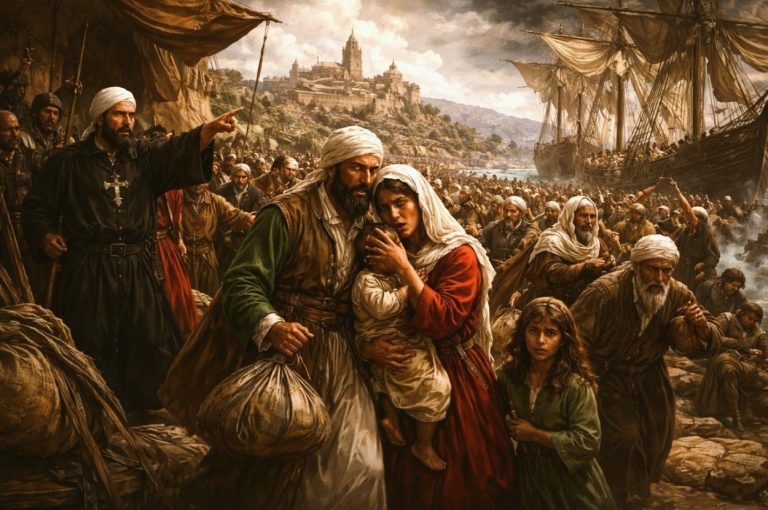
Rousas John Rushdoony was born in 1916 to Armenian immigrants who had narrowly escaped the genocide, in which as many as 1.5 million Armenians were murdered by Turks of the Ottoman Empire. Rushdoony’s father, who founded the Armenian Martyrs Presbyterian Church in Kingsburg, California, ministered to a community of fellow Armenian refugees, who agonized and grieved as letters from relatives back home came to a standstill. “In Armenia, there was no neutral ground between Islam and Christianity,” Rushdoony wrote in 1997. “And I came to realize there is no neutral ground anywhere.”
Rushdoony left his family home and made his way to college at the University of California, Berkeley. He did not fit in. Advised to read the classics, Rushdoony later called this “the ugliest experience of my life.” He pronounced the works of Shakespeare, Homer and the rest of the canon “classics of degenerate cultures. What they offer at their best is evil.”
Rushdoony emerged from Berkeley with all the distinctive features of his intellectual persona in place: a resolutely binary form of thought that classified all things into one of two absolutes; a craving for order; and a loathing of the secular world.
Rushdoony began to advocate for a return to “biblical law” in America. The Bible, Rushdoony said, commands Christians to exercise dominion over the earth and all its inhabitants. Women are destined by God to be subordinate to men; men are destined to be ruled by a spiritual aristocracy of right-thinking Christian leaders, and public education is a threat to civilization for it promotes a “secular world-view.” In over thirty books and publications, including The Messianic Character of American Education and The Institutes of Biblical Law – often hailed as his magnum opus and recommended as one of the Choice Evangelical Books of 1973 by evangelical flagship journal Christianity Today — Rushdoony laid it all out in a program he called Christian Reconstruction.
There is little mystery about the historical sources from which Rushdoony drew his own inspiration. He laid out all the details in his works. Setting aside the hardline Dutch Reformed theologians who supplied the backbone of his thought, Rushdoony drew on two traditions that would prove essential in understanding the genesis of today’s Christian nationalist movement. The first was the proslavery theology of America’s antebellum preachers. The second was the economic libertarianism that took root in reaction to the New Deal.
Among apologists for Christian nationalism today, the favored myth is that the movement represents an extension of the abolitionism of the nineteenth century and perhaps of the civil rights movement of the twentieth century, too. Many antiabortion activists self-consciously refer to themselves as the new abolitionists. Mainstream conservatives who lament that the evangelicals who form Trump’s most fervent supporters have “lost their way” suggest that they have betrayed their roots in the movements that fought for the abolition of slavery and the end of discrimination. But the truth is that today’s Christian nationalism did not emerge out of the movement that opposed such rigid hierarchies. It came from the one that endorsed them.
Rushdoony understood this well. Not long after escaping the horror of Berkeley, he took an interest in the work of Robert Lewis Dabney, a defender of slavery before the Civil War and who also supported patriarchy and the American form of apartheid after the war.
Rushdoony reprinted and disseminated some of Dabney’s works through his Vallecito, California-based Chalcedon Foundation, as well as through his publishing company, Ross House Books. He found himself agreeing with Dabney that the Union victory was a defeat for Christian orthodoxy. In Rushdoony’s mind, Dabney’s great adversaries, the abolitionists, were the archetypes of the anti-Christian rebels – liberals, communists, secularists, and advocates of women’s rights – who continued to wreak havoc on the modern world. As Rushdoony’s fellow Reconstructionist C. Gregg Singer put it, proslavery theologians including Dabney, Thornwell and their contemporaries “properly read abolitionism as a revolt against the biblical conception of society and a revolt against divine sovereignty in human affairs.” Rushdoony himself concluded, “Abolitionist leaders showed more hate than love on the whole.” The defeat of the orthodox side in the Civil War, Rushdoony asserted, paved the way for the rise of an unorthodox Social Gospel.
Rushdoony’s admiration for southern religious orthodoxy was such that he adopted a forgiving attitude toward certain forms of slavery. In books such as Politics of Guilt and Pity and The Institutes of Biblical Law, which is essentially an 890-page disquisition on “the heresy of democracy” and the first of a three-volume series under the same title, he makes the case that “the move from Africa to America was a vast increase of freedom for the Negro, materially and spiritually as well as personally.”
“Some people are by nature slaves and will always be so,” Rushdoony muses, and the law requires that a slave “recognize his position and accept it with grace.”
One of Dabney’s pet peeves was the provision of public education to Black children, whom he referred to as “the brats of black paupers,” which required unjust (in his view) taxation of “oppressed” “white bretheren.” Rushdoony sympathized with Dabney’s point of view on public education, and here began to fuse his views with a small-government ideology. “State supported and controlled education is theft,” he wrote, and called the claim of ownership to the lives of citizens by a “humanist state” slavery, too.
Rushdoony did not agitate for the literal enslavement of Black Americans in his time. But his fascination with proslavery theology was no passing fancy. The idea that the United States is a Redeemer Nation, chosen by God; that it is tasked with becoming an orthodox Christian republic in which women are subordinate to men, education is in the hands of conservative Christians, and no one pays taxes to support Black people; that at some point in the past the nation deviated horribly from its mission and fell under the control of atheist, communist, and/or liberal elites—the stuff of proslavery theology was the life of Rushdoony’s political thought.
Rushdoony soon found an even greater source of inspiration in the libertarian economic thinkers who emerged to beat back the New Deal. He was very much taken with figures like James W. Fifield as well as members of the Austrian school of economics, and began to churn out works arguing that the modern welfare state was “organized larceny” and “capitalism is supremely a product of Christianity.”
In this Christian-libertarian vision, Rushdoony saw the foundation for a thoroughly religious – or better, theocratic – understanding of the American republic. In Rushdoony’s telling, it was not the intention of America’s founders to establish a nonsectarian representative democracy. The First Amendment, he argues, aimed to establish freedom “not from religion but for religion.” “The Constitution was designed to perpetuate a Christian order,” he wrote.
The idea that the United States is a “Christian nation” – not just in the sense that its population was originally mostly Christian but that it was intended to serve as part of a Christian world order – was Rushdoony’s central contribution to the religious right.
Rushdoony had many prominent admirers, among them evangelical leader D. James Kennedy, whose ministry received millions of dollars in donations from the DeVos family. Kennedy popularized Rushdoony’s ideas through multiple sermons and publications, exhorting attendees at a 2005 conference organized by his ministry to “exercise godly dominion” over “every aspect and institution of human society.” The ultraconservative Catholic leader Richard John Neuhaus, who worked to broker a conservative evangelical and conservative Catholic alliance, pointed out that Rushdoony’s “theonomy,” or the idea of a social and political order rooted in “biblical law,” has “insinuated itself in circles where people would be not at all comfortable to think of themselves as theonomists.” He also attested, in 1990, to “increasing encounters with ideas clearly derived from Christian Reconstructionistm even among conservatives in the mainline/oldline churches.”
Today, the ideas of Rushdoony and his fellow Reconstructionists have penetrated into evangelical and conservative Catholic circles that are, quite often, unaware of their original sources. “Though we hide their books under the bed, we read them just the same,” as one observer put it to Michael J. McVicar, author of Christian Reconstruction: R.J. Rushdoony and the American Religious Conservatism.
To be clear, the Christian right is large and diverse in its specific
theologies. Many of its representatives know very little about R.J.
Rushdoony and others take pains to distance themselves from him. Some of
his extreme positions, such as the idea that homosexuals, blasphemers
and adulterers are all worthy of the death penalty, have been loudly
repudiated by conservative leaders. Yet it is difficult to understand
the ideological origins and structure of Christian nationalism in
America today without taking into account Rushdoony’s ideas.
Rushdoony’s work is touted today by some of the leading personalities and policy groups on the Christian right. Perhaps the most telling example comes from David Barton, whose efforts to reframe our constitutional republic as a Christian nationalist enterprise are at the center of so many of the movement’s cultural and legislative initiatives. Though perhaps not in a formal sense a Reconstructionist, Barton dances around many of Rushdoony’s defining ideas, even on the question of slavery.
In a paper titled “The Bible, Slavery, and America’s Founders,” posted on the WallBuilders website, Barton cites Rushdoony extensively, and argues that “in light of the Scriptures, we cannot say that slavery, in a broad and general sense, is sin. But this brief look at the Biblical slave laws does reveal how fallen man’s example of slavery has violated God’s laws.”
Where Barton strikes out on his own, it is to take a swipe at modern, liberal government as a form of slavery, a gesture that Rushdoony surely would have endorsed. “Since sinful man tends to live in bondage, different forms of slavery have replaced the more obvious system of past centuries,” Barton explains. “The state has assumed the role of master for many, providing aid and assistance, and with it more and more control, to those unable to protect themselves.” In a 2018 blog post, Watchmen on the Wall, the Family Research Council’s alliance of an estimated 25,000 pastors, praised Rushdoony as a “powerful advocate for the Christian and homeschool movements across America” who “challenged Christian leaders of his day to stand on biblical truth in the public square.” Rushdoony is a foundational thinker whose ideas continue to speak, long after he has been silenced.
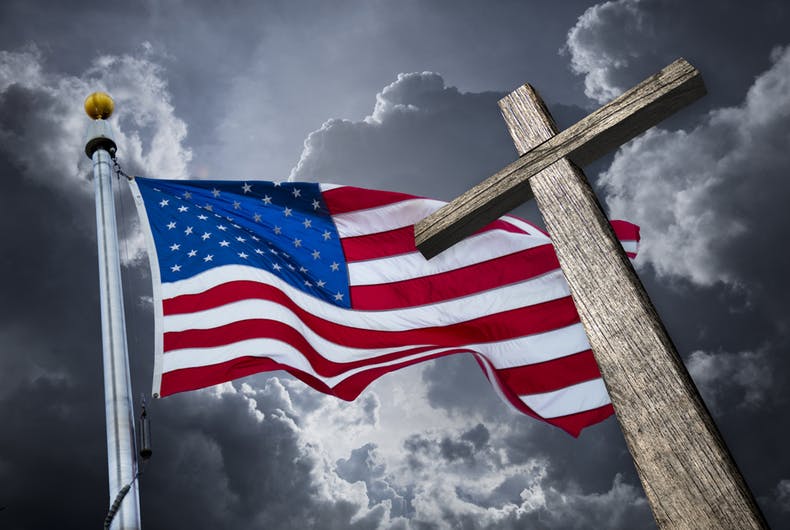
For a long time now, critics have viewed America’s religious right as a social or cultural movement. They assume that it represents a reaction to modern, secular culture, and that it speaks for a large mass of disaffected conservative evangelicals and others who are preoccupied with issues of concern to the family. But that simplistic interpretation is plausible only for those who do not actually listen to what its leaders have to say or trace its ideas to their primary sources. Christian nationalism today is a political movement, and its primary goal is power. Its ultimate aim is not just to win elections but to replace our modern constitutional Republic with a “biblical” order that derives its legitimacy not from the people but from God and the Bible – or, at least, the God and the Bible that men like Rushdoony claimed to know.
Originally published by History News Network, 03.08.2020, reprinted with permission for educational, non-commercial purposes.
About the Author