Trump considering deploying the Insurrection Act against peaceful civilian protests if elected again.

By Dr. Dayna L. Cunningham
Pierre and Pamela Omidyar Dean
Jonathan M. Tisch College of Civic Life
Tufts University

By Dr. Peter Levine
Lincoln Filene Professor
Associate Dean for Academic Affairs
Tisch College of Civic Life
Tufts University
Introduction
President Joe Biden argues that “democracy is on the ballot” in the 2024 election.
We believe there are potential threats to U.S. democracy posed by the choices voters make in this election. But the benefits of American democracy have for centuries been unequally available, and any discussion of the current threats needs to happen against that background.
One of us is a political scientist who focuses on civic engagement; the other is a former voting rights lawyer. At Tufts University’s Tisch College of Civic Life, we both lead nonpartisan efforts to educate college students and other people about their roles in democracy.
For us, Biden’s talk of democracy is a useful starting point for a broader conversation about U.S. democracy and the 2024 election.
The ‘Sacred Cause’
On Jan. 5, 2024, the president delivered a speech in Blue Bell, Pennsylvania, titled “Defending the Sacred Cause of American Democracy.”
As a candidate for reelection at the early stages of a political campaign, the president argued that he and his fellow Democratic candidates are in favor of democracy. Former President Donald Trump and his supporters in the U.S. Congress, said Biden, are against it.
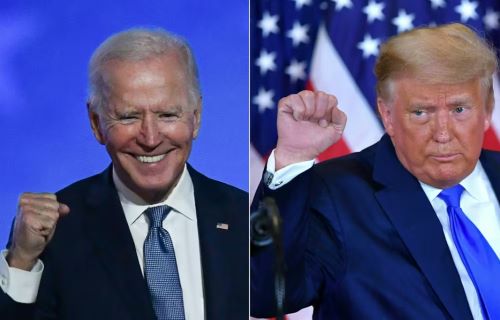
In this speech and other statements, Biden makes the following case: Trump supported or even incited the Jan. 6, 2021, insurrection, and he refuses to denounce political violence. Trump floats ideas for his second presidential term that include invoking the Insurrection Act, which authorizes the president to deploy the military inside the United States.
In contrast, Biden and Vice President Kamala Harris argue that they respect the Constitution, recognize their limited power and limited importance as leaders within a constitutional order and support freedom of speech. They maintain, in Biden’s words, that “political violence is never, ever acceptable in the United States.”
The basic facts in Biden’s speech appear accurate: Trump’s own statements support some of Biden’s claims.
If elected again, Trump is reportedly considering deploying the Insurrection Act against civilian protests. He has expressed open admiration for foreign authoritarian leaders, most recently Hungary’s Viktor Orban. He encouraged his supporters to “guard the vote” and to “watch those votes” in certain cities, which some interpret as threatening and potentially intimidating to election workers.
Trump has threatened to prosecute his political opponents, claiming in October 2023 that since he was being prosecuted during the Biden administration, that provided justification for him to do the same.
“This is third-world-country stuff, ‘arrest your opponent,’” Trump said during a New Hampshire campaign visit. “And that means I can do that, too.”
Democracy vs. Security
Biden’s own record, however, undermines some of his claims to be fully committed to democracy.
The Biden-Harris administration has been accused by human rights advocates and even Democratic senators of a double standard: championing democracy while maintaining close ties with authoritarian leaders, including the Saudis.
At the very least, Biden has continued a historic pattern of U.S. engagement across the globe that prioritizes security over human rights and liberal democracy. His administration is widely criticized for its support of Israeli Prime Minister Benjamin Netanyahu’s conduct of the war in Gaza and its disastrous humanitarian consequences.
At home, despite a major expansion of the government’s role in the economy, the Biden administration has not done anything significant to make federal policymaking more democratic or participatory.
Longer Trends
It’s helpful to step back from the daily campaign and its heightened rhetoric and consider how Biden’s assertion holds up in light of general research and evidence about democracy in the U.S. That analysis reveals a more complex picture of threats to democracy, some of which are specific to the upcoming election. Others have existed for some time.
In their 2020 book “Four Threats: The Recurring Crises of American Democracy ,” political scientists Suzanne Mettler and Robert C. Lieberman argue that democracies in general suffer when any of four trends occur: intense partisan polarization, efforts to exclude some people from the electorate, economic inequality and unilateral exercises of power by the executive branch.
Mettler and Lieberman show that each of these trends has been rising in the U.S. for several decades. Applying their framework, we’d note that both Biden and Trump used a comparable number of executive orders – 127 and 137, respectively – in their first three years to bypass a reluctant Congress and enact policies unilaterally. The Biden administration has been credibly accused of stretching executive power in areas such as student loan forgiveness.
These long-term trends mean that neither Trump nor Biden is mainly responsible for causing them. Biden criticized all four of these threats in his Jan. 5 speech, however, whereas Trump often endorses political polarization and limitless executive power and has challenged the validity of votes cast in urban and suburban areas with significant minority populations. This difference lends support to Biden’s argument.
Violence as a Threat to Democracy
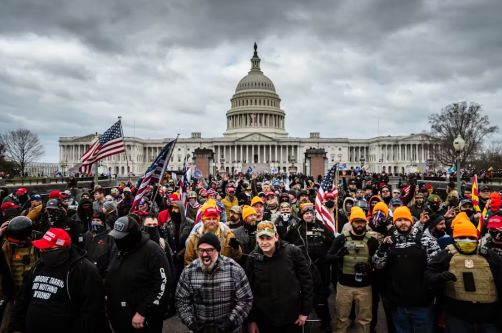
Notable in Biden’s campaign rhetoric about democracy is his alarm about political violence. In any democracy, violence is a threat because, among other things, it intimidates people and makes participation dangerous. In the U.S., political violence has always been associated with attempts to deny democratic rights. It is often racialized and targeted at the most vulnerable communities.
By its very nature, the system of slavery required extreme violence, political repression and the denial of democratic rights to enslaved black people. Though rarely recognized as such in history books, it could be characterized as a racially targeted police state coexisting within a liberal democracy for whites only.
Governance under slavery included organized vigilante violence, repression of dissent, violent clashes and rebellions, harsh suppression, broad prosecution of dissidents, and systematic passage of restrictive laws or renewed enforcement of existing measures when resistance emerged.
Desmond S. King and Rogers M. Smith in “Still a House Divided” catalog some of these patterns. Even after slavery and the post-Civil War period known as Reconstruction, political violence – frequently in response to Black political mobilization or the exercise of basic rights – helped maintain what was known as Jim Crow rule.
Two major instances among many stand out: the 1898 “Wilmington coup,” when white supremacists overthrew the democratically elected biracial city government, and the destruction of a city’s vibrant Black business district and community in the Tulsa Race Massacre of 1921.
Violence as a threat to democracy is by no means new, but the U.S. may be entering a new violent chapter.
While we do not have extensive historical data, the rate of political violence seems high now, and there are indications of dangerous trends. For example, in 2023, the U.S. Capitol Police investigated more than 8,000 threats against members of Congress, a substantial increase over 2022. The number of serious threats against federal judges has increased each year since 2019 and is 2.5 times higher now than five years ago.
Citing data collected by Nathan P. Kalmoe, Lilliana Mason and Bright Line Watch, democracy scholar Rachel Kleinfeld shows that the percentage of both Democrats and Republicans who believe that violence is sometimes justified to achieve their political goals has more than doubled since 2017, although this remains a minority view in both parties.
From 2020 to 2023, the Armed Conflict Location & Event Data Project cataloged 1,080 demonstrations in the United States that the organization labels violent – along with more than 50 times as many nonviolent demonstrations – plus 157 cases of excessive force against demonstrators and 22 armed clashes. This data establishes a baseline for tracking the phenomenon in the near future.
From our perspective, nonviolent protests are expressions of a vibrant democracy that deserve protection. There may be room to debate some of the protests labeled “violent.” However, the sheer number of demonstrations that the project labels violent – more than 1,000 in four years – is concerning to us.
The Jan. 6, 2021, attack on the Capitol may prove to be an example of a period of political unrest. Trump is deeply implicated in the violence. Biden is decrying it – but not necessarily proposing any response other than to vote against Trump.
Originally published by The Conversation, 03.19.2024, under the terms of a Creative Commons Attribution/No derivatives license.
About the Author