Ocean warming and thus thermal expansion played a major role in last year’s increase.

By Margherita Bassi
Daily Correspondent
Smithsonian Magazine
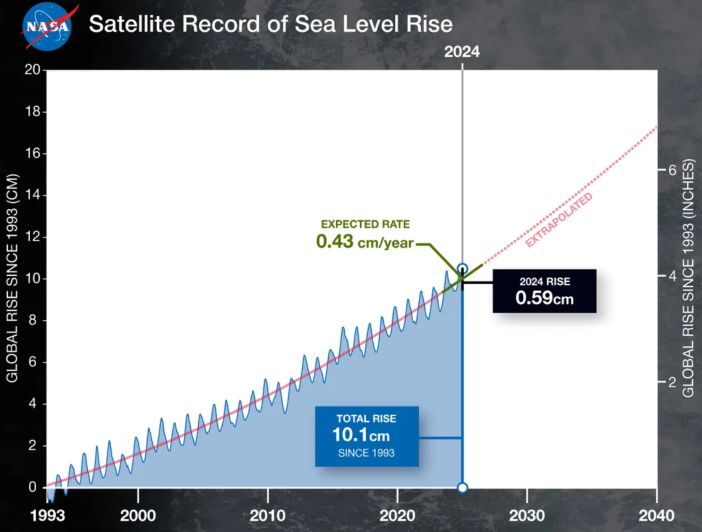
Last year was the hottest year on record, and now a recent NASA-led analysis shows that 2024 also marked an unexpected increase in sea level rise. While scientists had expected the rate of sea level rise for 2024 to be 0.17 inches per year, the true measure reached 0.23 inches per year.
“The rise we saw in 2024 was higher than we expected,” Josh Willis, an oceanographer at NASA’s Jet Propulsion Laboratory in Southern California, says in a statement. “Every year is a little bit different, but what’s clear is that the ocean continues to rise, and the rate of rise is getting faster and faster.”
Recently, the major driver of sea level rise has been the melting of ice sheets and glaciers, per the statement. In 2024, however, ocean warming and thus thermal expansion—when water volume increases because of heat—played a more significant role, accounting for two-thirds of sea level rise. Various factors can drive ocean warming and, in turn, thermal expansion, according to the statement. These include extreme winds, strong water currents and climate events such as El Niño—which cause heat to move vertically through the ocean’s stratified temperature layers.
Nevertheless, 2024’s marked jump is overall consistent with the increasing sea level rise rates scientists have been documenting for decades. According to a 2024 study also involving NASA scientists, the rate of sea level rise doubled between 1993 and 2023. Broadly, the rates of sea level rise are expected to continue accelerating, but Willis tells the Washington Post’s Kasha Patel that individual years will likely see some fluctuations because of natural phenomena.
In fact, Woods Hole Oceanographic Institution physical oceanographer Chris Piecuch didn’t find ocean warming’s contribution to the 2024 sea level rise “terribly surprising” since ocean warming frequently influences such yearly variations, according to the Washington Post. Overall, global sea levels have risen by four inches since 1993, according to the 2024 study.
“It’s true that four inches of sea level rise over the last few decades may not be concerning or noticeable to some people. And just four inches itself, occurring in a temporal vacuum, doesn’t spell a serious problem,” writes former National Park Service ranger and current Mashable science editor Mark Kaufman. “The problem, however, is it’s not stopping at four inches.” Specifically, sea level at U.S. coastlines is expected to rise on average between 10 to 12 inches in the next three decades.
“Low-lying coastal zones are home to around 900 million people. Rising seas mean a rising tide of misery,” United Nations Secretary-General António Guterres said at the 79th Session of the United Nations General Assembly in September, as reported by Le Monde and AFP. “Greenhouse gasses—overwhelmingly from burning fossil fuels—are heating our planet, expanding seawater and melting ice.”
Originally published by Smithsonian Magazine, 03.18.2025, reprinted with permission under a Creative Commons license for educational, non-commercial purposes.
About the Author