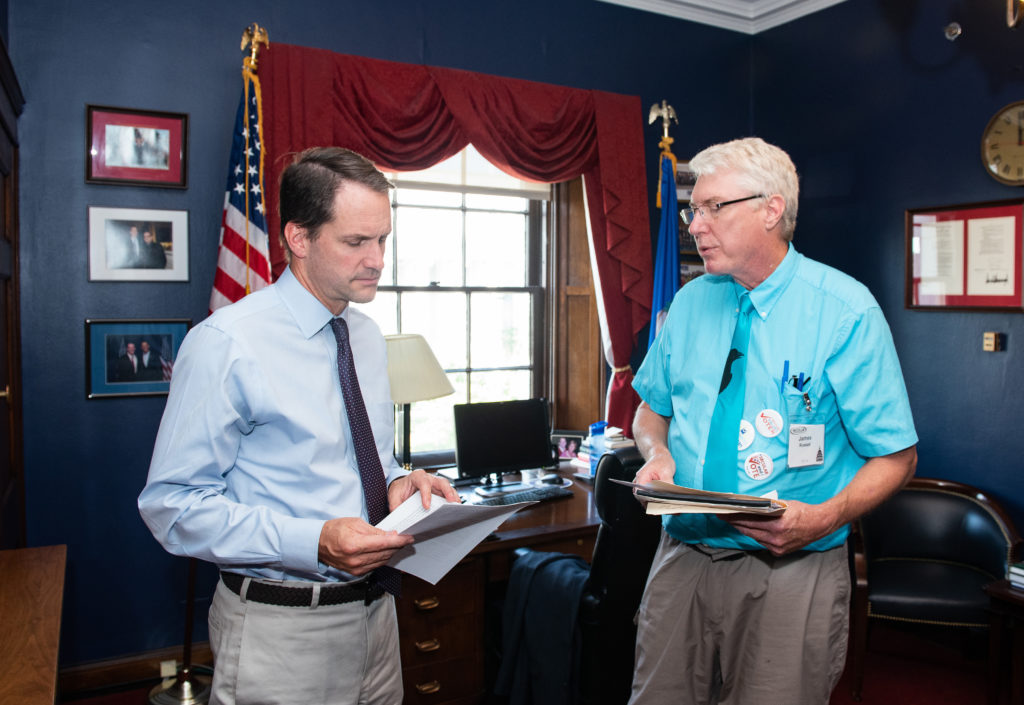
In partnership with addiction recovery experts, nonbelievers from across the country took to Capitol Hill last Friday to highlight the growing number of Americans who want, but don’t have access to, a faith-free addiction recovery program.
“Twelve-step and other faith-based recovery programs are widely accessible across the United States, but the truth is there is no one-size-fits-all route to addiction recovery,” said Sarah Levin, Director of Governmental Relations for the Secular Coalition for America. “There is growing demand for other options, and while SMART Recovery, LifeRing, Women for Sobriety, Secular Organizations for Sobriety, and other secular programs are recognized by health care providers, they lack adequate support by government agencies to reach the many Americans who want and need their help.”
Demand Growing for Secular Programs
The need for secular recovery programs has only increased in recent years. “Unaffiliated” is the nation’s fastest-growing religious demographic, recently reaching one quarter of the United States population. That nonreligious community, like all others in our nation, is part of the 19.3 million Americans over the age of 18 with a substance abuse disorder (SUD).
Our nation’s constitutionally secular government has also contributed to increasing demand, as multiple federal courts have ruled that nonreligious recovery programs must be an available option for anyone undergoing court-ordered addiction recovery, or that order is unconstitutional. (See Inouye v. Kemna, 9th Cir. 2007.) In the many American communities where secular programs aren’t available, that creates a challenge for parole officers and judges.
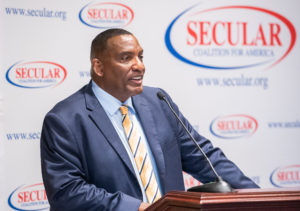
“I was told that 12 step-based programs was the way that I had to go, but it was based on something that I didn’t believe in,” said Barry Grant, a former addict now serving as Director of Outpatient Programs for the Hope House Treatment Center in Crownsville, MD, to the secular advocates gathered on Capitol Hill. “It is dangerous psychologically, emotionally, intellectually, and ultimately politically and socially to not fight for increased access to evidence-based programs. Having a program that fit my individual needs was a life-altering experience and this happens for countless others as well, each and every day.”
Peer support groups help many people to gain and maintain motivation to continue the difficult journey to recovery, but often the only peer support groups in a given area are based on the “twelve step” model, which works for some people but not for others. The emphasis on powerlessness in the face of addiction, the need to surrender to a higher power, the rejection of Medication-Assisted Treatment (MAT), and the overt religiosity of many twelve step groups are obstacles to recovery for some people.
According to Assistant Secretary for Mental Health and Substance Use Elinore McCance-Katz, MAT is the “gold standard” of addiction recovery treatment when used in conjunction with psychosocial treatment and community-based recovery support.
“Although secular, evidence-based addiction recovery programs hold thousands of meetings in the United States every week, many Americans lack access these critical options. At a time when so many people struggle with addiction, Congress must ensure that people of all faiths and none have somewhere to go for treatment,” continued Levin. “With support from government agencies, organizations that facilitate secular, evidence-based addiction recovery programs that support Medication-Assisted Treatment could more than double the number of meetings available.”
Secular Movement’s Political Influence Is Increasing
Organized by the Secular Coalition for America, the gathering on Capitol Hill has become an annual tradition that draws nonbelievers from across the nation to lobby on behalf of secular issues. This year’s event included representatives from organizations SMART Recovery and LifeRing, as well as some of the Coalition’s 19 member organizations including Black Nonbelievers, Inc., American Humanist Association, American Atheists, Center for Inquiry, Freedom From Religion Foundation, and the Society for Humanistic Judaism.
As they have grown, the nonreligious community has organized to take on a larger voice in policymaking—an effort that recently resulted in a Democratic National Committee vote to recognize that religiously unaffiliated Americans “should be represented, included, and heard by the Party.”
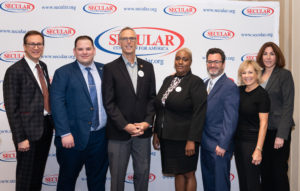
Along with speeches from Grant and child healthcare advocate Rita Swan, attendees heard from four members of the Congressional Freethought Caucus, including Founders and Co-Chairs Rep. Jamie Raskin (MD-8) and Rep. Jared Huffman (CA-2). Founded in 2018, the Caucus has quickly grown to 12 members and continues to raise its profile.
“In this Congress, I am the only one who is formally out as nonreligious,” said Representative Huffman. “I’m grateful to all of you for helping me get there publicly, because it just feels good to be who you are and not pretend that you’re anything you’re not. I’m also grateful because despite all of this conventional wisdom that there’d be backlash and a political price to pay, it has been quite the opposite. I’ve found a lot of new friends and new support—the political water is just fine.”
Ongoing Success with Lawmakers
With the support of the Freethought Caucus, the group of secular Americans met with nearly 100 House and Senate offices over the course of an afternoon, urging Congress to expand government support for secular, self-empowering, mutual support addiction recovery programs that support MAT in the next federal budget. And, as religious minorities and nonbelievers continue to be marginalized, or worse, around the world, the secular advocates also urged lawmakers to adopt H. Res. 512, which calls for the global repeal of blasphemy, heresy, and apostasy laws.
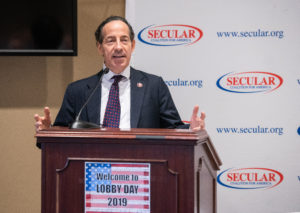
“You’ve got hundreds and hundreds of people all over the world who are rotting in prison because they’ve been convicted of not adhering to a religious orthodoxy or violating somebody else’s religious feelings or offending the sensibilities of the majority,” said Congressman Raskin. “Our own anti-blasphemy, anti-heresy principles in our Constitution have been hard-won…this is what America really has to offer the rest of the world. It is bipartisan and we should be able to get everybody to agree on this.”
As the House takes a recess, the Secular Coalition, their member organizations, and secular Americans from across the country are continuing their organized effort to lobby Congress in support of both issues.
Originally published by Secular Coalition for America, 09.27.2019, as an open press release.
About the Author