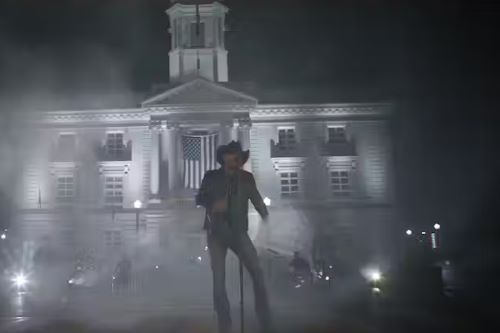
Country singer Jason Aldean’s hit song triggered renewed attention on vigilante justice, racism, and urban America.

By Dr. Joseph Patrick Kelly
Professor of Literature and Director of Irish and Irish American Studies
College of Charleston
Introduction
For better and worse, the Maury County Courthouse in Columbia, Tennessee, has come to represent the overlooked cultural divisions between urban and small-town America.
The courthouse was the site of the lynching of a Black teenager in 1927. It also served as a rallying spot for white vigilantes who assembled there during race riots in 1946.
It is now the focus of a modern-day controversy that emerged shortly after popular country singer Jason Aldean released his music video in July 2023 for his hit single “Try That in a Small Town.”
The courthouse was used as a backdrop with an American flag in that video. Though no mention of race occurs in the song, the racial overtones are there, as the lyrics boldly smack of modern-day, big-city crime against old-fashioned, small-city values:
Sucker punch somebody on a sidewalk/ Carjack an old lady at a red light/ Pull a gun on the owner of a liquor store/
Well, try that in a small town/ See how far ya make it down the road/ Around here, we take care of our own/ You cross that line, it won’t take long/ For you to find out.
Within days of its release, Country Music Television stopped airing the music video after critics argued that is was “pro-lynching” and could incite violence.
Aldean denied using coded racist language in his song or blowing any racial dog whistles – and Republican politicians were quick to defend him. For one, Arkansas Governor Sarah Huckabee Sanders accused Democrats of being “more concerned about @Jason_Aldean’s song calling out looters and criminals than they are about stopping looters and criminals.”
But in my view as a scholar who has studied the struggles to define American identity, the controversy over hidden agendas has diverted attention from Aldean’s overt message: that cities are turning the nation into a “shit show,” as Aldean sees it, and the remedy is a revival of small-town America.
But Aldean’s effort isn’t innocent nostalgia.
It echoes a similar period in American history during the 1920s and 1930s when the grievances of small-town America had dangerous consequences for democracy.
Master-Race Democracy
Before the Civil War, Southern states established what historians like George M. Fredrickson called a “herrenvolk,” or master race democracy that reserved citizenship and its benefits for one racial group at the expense of all others.
But after the war, passage of the 13th, 14th and 15th Amendments extended civil and political rights to newly freed African Americans. Known as the Reconstruction amendments, the new laws were a reversal of the Southern social order and enabled Black freedmen to hold public office, while banning white officers of the old Confederacy from federal office.
The new reality sparked a resurgence of white supremacy and racial violence against Black people by Southern whites, who feared being replaced by what they considered to be an inferior race.
One of the most influential expressions of this replacement anxiety was found in the 1916 book “The Passing of the Great Race,” a pseudo-scientific work by amateur anthropologist Madison Grant warning readers that a flood of inferior races – not only from Africa and Asia, but from eastern and southern Europe – was sweeping away the Anglo-Saxon civilization.
The remedy, Grant argued, was to get rid of democracy and disempower Black people and the teeming masses of urban immigrants as well.
By the 1920s, white Southern lawmakers had fashioned a new version of master race democracy and enacted Jim Crow laws that established racial segregation across the South and disenfranchised Black voters.
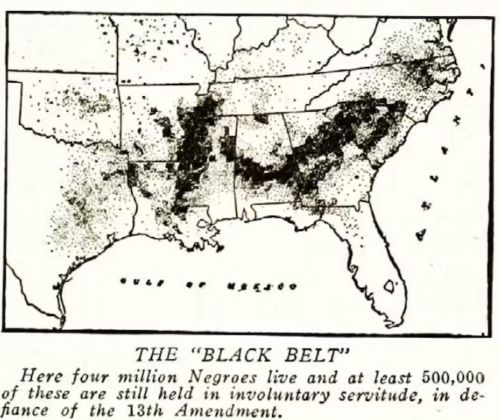
Vigilante violence, which surged in the 1920s, helped maintain this regime. In February 1927, Walter Lippmann, who some regard as the father of American journalism, called it “American village civilization.”
Later that year, on Nov. 13, Henry Choate, an 18-year-old Black man, was accused of assaulting Sarah Harlan, a white 16-year-old girl. Though she could not identify him, Choate was jailed, and a mob of hundreds of white people kidnapped him from his cell.
Choate was then tied to the back of a car and dragged across town, and eventually hanged in front of the Maury County Courthouse.
At least 20 other Black men were lynched in Maury County alone, and more than 230 Black people across Tennessee between 1877 and 1950, according to the Equal Justice Initiative, a nonprofit, social justice organization.
Armed Resistance and Racist Attacks
Along with lynchings, white supremacists had another way to suppress attempts by Black citizens to exercise their full rights: large-scale attacks by white law enforcement officials on Black neighborhoods.
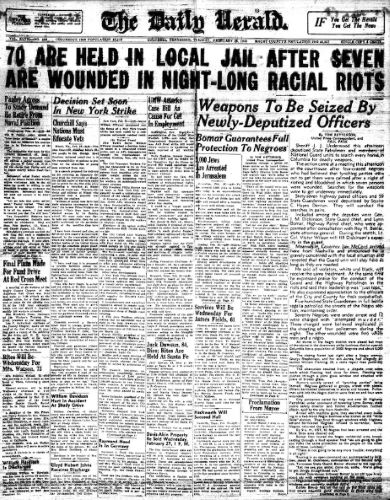
One such attack occurred on the night of Feb. 25, 1946, near the Maury County Courthouse.
A fight between a 19-year-old Black U.S. Navy veteran and a white radio repairman eventually led to an armed standoff between police and the 3,000 Black citizens who lived in a racially segregated section of the town known as the Mink Slide district.
When four local police tried to enter the neighborhood, Black men determined to prevent another lynching fired their weapons at the white officers, leaving all of them wounded.
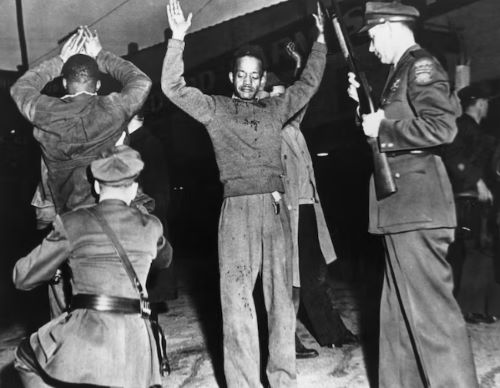
It didn’t take long before local police called in several dozen state police to help subdue the unrest. Armed with machine guns, white police officers shot out the windows of shops, arrested 62 Black people and charged 12 of them with the shootings of the local police officers.
“The Mink Slide area,” the local paper reported, “was cleared out.”
To add further humiliation to residents of the thriving Black community, the commander of the state police then rode through the neighborhood the next morning in an open car broadcasting through a loudspeaker, “Let me see you smile. Come on, smile.”
The next day, hundreds of deputized white men systematically searched Black homes and businesses, breaking things, looting and confiscating 300 weapons.
The most notorious of these large-scale attacks was the Elaine Massacre of 1919 in Arkansas. As the NAACP’s Walter White reported, hundreds of Black farmers, some of them military veterans, decided to form a labor union to escape Jim Crow’s peonage system of sharecropping.
Organizing workers might fly in the city, but not in rural Arkansas.
On Sept. 30, the farmers met in a church outside Elaine to discuss strategy and had armed guards stationed outside. A sheriff’s deputy and other white men confronted the Black men standing guard. The ensuing fight escalated until white vigilantes roamed the farmland, ransacking houses, confiscating arms and killing Black men, women and children on the slightest pretext.
Arkansas Gov. Charles H. Brough called the War Department for help. About 600 federal troops were sent to the area, and once there, they used machine guns to spray the the fields and woods. When the gun smoke cleared, at least 200 Black people were dead, and the only people held to account were a dozen Black men convicted of murder and sentenced to death.
Small-Town Nationalism
Aldean’s song paints a picture of a renewed culture war between urban and rural versions of America.
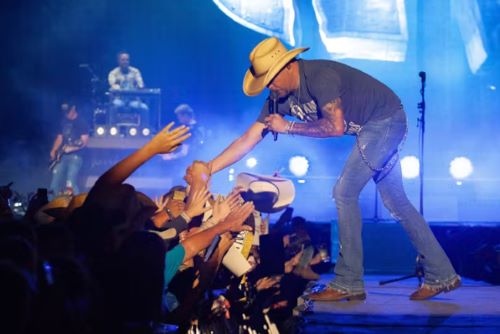
In my view, Aldean’s song expresses a deep sense of grievance among some white Americans and a suspicion that urban America is scornful and even hostile to the rural way of life.
In a recent concert, while addressing accusations of racism, Aldean said he only wants to “restore” the nation to “what it once was before all this bullshit started happening to us.”
But his lyrics remain unnerving:
Got a gun that my granddad gave me/ They say one day they’re gonna round up.
Originally published by The Conversation, 11.22.2023, under the terms of a Creative Commons Attribution/No derivatives license.
About the Author