State governments must step up.

By Reema Bzeih
Associate Director, State Climate Policy
The Center for American Progress

By Sam Ricketts
Senior Fellow
The Center for American Progress

By Shannon Baker-Branstetter, J.D.
Senior Director, Domestic Climate and Energy Policy
The Center for American Progress
Introduction and Summary
State climate action has never been more important. Donald Trump’s reelection to the White House, and his administration’s stated intention to stall and reverse federal climate and clean energy policies, means it is even more imperative that states lead the way on climate.1 A majority of the American people know that climate change is real and harms the nation, and they want the government to do something about it.2 And a majority support expanding access to clean energy, rather than more fossil fuels.3 However, starting in January, the Trump administration could work in the opposite direction.
For years, many state governments have demonstrated strong leadership on climate change. Indeed, the Center for American Progress and its partners have argued that states laid a policy road map for bold nationwide climate action, which informed the groundbreaking policies advanced in the Biden-Harris administration.4 However, as the impacts of climate change continue to accelerate—with deadly consequences for American communities and around the globe—and as federal lawmakers look to take U.S. climate policy backward, more state governments must go further in this leadership. State governments must enact new ambitious policies to foster even faster progress to reduce greenhouse gas emissions and energy costs, as well as to deliver good jobs, equitable economic development, and healthier communities. Those states that lead on climate will lower energy costs for their consumers and create more good jobs for their residents, as evidenced by the states that led on climate during the first Trump administration.5
Under the landmark Paris Agreement, the United States is committed to reducing greenhouse gas emissions by 50 percent to 52 percent by 2030. With the federal and state policies enacted as of June 2024, the United States is estimated to be on track to reduce this climate pollution by 32 percent to 43 percent below 2005 levels by 2030.6 Even without the incoming Trump administration’s problematic climate policies, this gap between the emissions reductions needed to stabilize the climate and the emissions cuts expected from current policy raised a call for more ambitious action at all levels of government. In December 2024, President Biden announced a new climate target for the United States: a 61 percent to 66 percent reduction in 2035 from 2005 levels in economywide net greenhouse gas emissions.7 Now, however, with the incoming Trump administration and other policymakers who are openly hostile to climate policy returning to the White House,8 and a federal judiciary that has already targeted environmental protections,9 it will once again fall upon state governments to carry the mantle of U.S. climate leadership. Local governments have a critically important role to play as well.
States are no strangers to making game-changing moves on climate. States created the nation’s first pollution control laws and clean energy standards and demonstrated continued climate leadership when former President Trump first tried to pull the United States out of the Paris Agreement. State leadership on climate change, justice, and jobs laid much of the groundwork for the progress made by the federal government during the Biden-Harris administration.10 And state leadership continues to this day: For example, in 2024, Vermont made history as the first state to require the fossil fuel industry to pay for the cost of recovering from and preparing for extreme weather events driven by climate change.11 Also, in 2024, Washington state voters overwhelmingly affirmed the state’s Climate Commitment Act, aimed at achieving a 95 percent reduction in greenhouse gas emissions by midcentury and investing billions in community solutions.12 And in 2023, Minnesota was one of the first states to require a comprehensive evaluation of the climate pollution associated with new transportation infrastructure projects.13
In many ways, state governments are much better positioned today to continue advancing climate action than when Trump first took office in 2017. The U.S. Climate Alliance—a coalition of governors committed to continued climate progress—now boasts 24 member governors.14 In addition, there are now twice as many pro-clean energy state legislatures.15 As 2025 begins, states must be called upon to go further and faster by taking action on climate strategies across every sector of their economies. States that have adopted a robust agenda for 100 percent clean electricity must now do the same for transportation and built infrastructure. States must lead the way in industrial decarbonization and pollution reduction by supporting clean and globally competitive U.S. manufacturing industries. And states must advance policies that deliver an equitable clean energy transition, and make polluters pay to clean up their mess.
This report identifies key policy advancements that are possible in a state-focused climate action race to the top, especially if states adopt the best-in-class climate policy ideas of other states in the power, transportation, buildings, and industrial sectors, as well as cross-cutting policies such as environmental justice and workforce development needed for a climate-ready workforce. In addition, this report also identifies best-in-class policies for states to hold polluters accountable and to finance an equitable clean energy transition. Key policies for specific sectors include the following:
- Power sector: delivering 100 percent clean electricity
- Adopt and accelerate clean electricity standards
- Hold utilities accountable via public utility commissions
- Set energy storage targets and promote grid-enhancing technologies
- Streamline clean energy and transmission siting, permitting, and interconnection
- Support community solar
- Transportation sector: accelerating the zero-emission vehicle market and build-out of zero-emission transportation infrastructure
- Adopt Advanced Clean Cars II and Advanced Clean Trucks standards
- Set and deliver on statewide vehicle miles traveled reduction targets
- Integrate climate assessment in the transportation planning processes
- Invest in transit infrastructure
- Establish electric vehicle-ready requirements for buildings
- Industry sector: supporting clean and competitive U.S. manufacturing industries
- Adopt green public procurement policies
- Incentivize industry to achieve emissions reductions
- Establish industrial emission standards
- Establish methane regulations for landfills
- Divert food waste from landfills
- Phase out products using hydrofluorocarbons
- Finance conservation and climate-smart practices in agriculture
- Buildings sector: reducing energy use and pollution from buildings
- Adopt building performance standards
- Adopt clean heat standards
- Adopt appliance efficiency and emission standards
- Enhance clean building codes
- Enact state housing and land-use reforms
- Decommission gas systems on a neighborhood scale
- Accountability for polluters: holding the fossil fuel industry accountable and using market-based mechanisms
- Price pollution and reinvest in communities
- Hold polluters legally accountable for cleaning up their mess
- Environmental and economic justice: prioritizing equity and justice in climate policy
- Target investments in disadvantaged communities
- Deploy inclusive green finance
- Require facilities to reduce local pollution in environmental justice communities
- Engage community members in policy processes
- Develop state-specific mapping tools
- Workforce development: supporting a clean energy economy
- Tie labor standards to clean economy investments
- Support registered apprenticeship and preapprenticeship programs
- Seek worker input for workforce development and transition
Past analysis has demonstrated that aggressive state action is a necessary complement to federal policies and can put the 2030 Paris climate target in reach, while even substantial progress on climate policy only at the federal level does not.16 The role of states is even more important in the absence of federal action.
State Policies to Deliver on Climate, Costs, Justice, and Jobs Goals
Power Sector: Delivering 100 Percent Clean Electricity
Overview
States can reduce their emissions and energy costs while also increasing job numbers and economic opportunity for disadvantaged communities by adopting the following high-impact policies.
The build-out of clean, carbon-free electricity is the linchpin to delivering a low-cost clean energy economy. Clean electricity is important in reducing emissions from not only power plants, but also other sectors such as transportation, buildings, and heavy industry, which are increasingly powered by electricity.17 States that have in recent years experienced the highest levels of new clean energy deployment have delivered the greatest benefits for their residents’ electric bills.18
States must lead the way in developing and implementing policies that will achieve 100 percent clean electricity as rapidly as possible, and with it, a more reliable, resilient, and lower-cost power sector. Already, 24 states, plus the District of Columbia and Puerto Rico, have embraced 100 percent clean electricity as a goal.19 And 13 states, plus the District of Columbia and Puerto Rico, have enacted policies requiring their electric utilities transition to 100 percent clean power.20 To realize this agenda, states should adopt policies such as clean electricity standards (CES), reforms to empower their public utility commissions (PUCs), energy storage targets, streamlined clean energy permitting, and support for community solar. The following policies support decarbonization of the electricity sector, including establishing interim targets and identifying opportunities to improve processes for generation, distribution, and accessibility to reliable power.
Adopt and Accelerate Clean Electricity Standards
States should adopt and accelerate timelines for performance standards requiring electric utilities to provide 100 percent carbon-free power to their customers. These standards, which first appeared in the early 1980s,21 require that a certain percentage of electricity that utilities produce comes from renewable or zero-carbon sources.22 These standards can take the form of renewable portfolio standards (RPS), which include renewable sources such as solar, wind, and hydropower, or CES policies, which include other low- or zero-emission sources such as nuclear energy and carbon capture and sequestration. Most states have also adopted an energy efficiency resource standard,23 which requires utilities to achieve greater energy efficiency. This policy goal could see renewed urgency given exploding utility load growth.24 Requiring utilities to use more clean electricity and achieve greater energy efficiency can also be accomplished through state PUC actions. These policies play an integral role in state efforts to diversify their energy mix, cut consumer costs, promote economic development, and reduce emissions.25
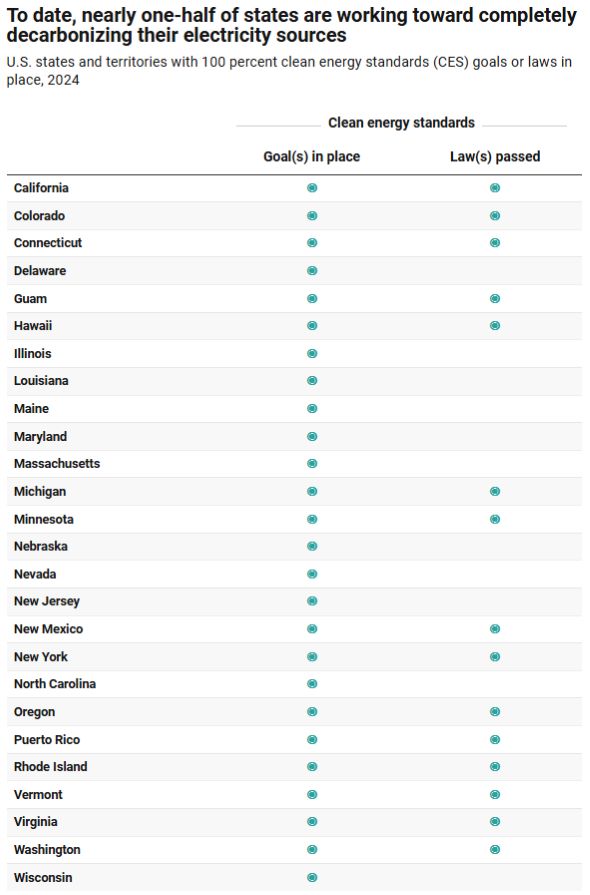
The following states have led the way in setting 100 percent clean electricity standards, and their leadership can continue to inspire other states to adopt similar measures:
- Hawaii in 2015 enacted the nation’s first law requiring its electric utilities to achieve 100 percent clean electricity, with an RPS law requiring 100 percent renewable energy by 2045.26
- Michigan’s clean energy future plan, signed by Gov. Gretchen Whitmer (D-MI) in 2023, includes an RPS requiring 60 percent renewable power by 2030, and a CES requiring 100 percent clean electricity by 2040. This legislative package also requires utilities to increase energy efficiency; streamlines the permitting of new wind, solar, and storage projects; sets a target for energy storage deployment; expands access to rooftop solar; and establishes a new office to support communities and workers in the energy transition.27
- Virginia’s Clean Economy Act, passed in 2020, made it the first Southern state to adopt a 100 percent CES.28 The state’s largest utilities must achieve 100 percent carbon-free energy generation by 2050.29
- Rhode Island has adopted the fastest 100 percent clean electricity requirement of any state, with an RPS requiring electric distribution companies and nonregulated power producers to supply 100 percent of their retail electric sales from renewable energy sources by 2033.30 This RPS has been updated twice since its first enactment in 2004.31
Hold Utilities Accountable via Public Utility Commissions
Most state PUCs were created in the early 1900s to regulate monopoly utilities spanning the electric, gas, water, telecommunications, rail, and other industries.32 Today, PUCs must embrace their role ensuring public utilities are acting in the public interest and addressing 21st-century grid challenges.33 In most states, PUCs hold strong regulatory authority that can be used to make progress for their states’ energy costs, climate goals, and grid reliability. At the same time, the statutory authority of many PUCs is outdated and may not fall short of ensuring PUCs can hold utilities accountable for incorporating decarbonization and environmental justice in their decision-making. PUC commissioners, and the governors, legislators, and voters who appoint them, should be held accountable for using these important bodies to modernize the power sector for a clean, reliable, and resilient energy future.34 In the least, PUCs should ensure their utilities account for the cost-saving effects of federal tax incentives in their planning.35 State PUCs must be proactive, aligned with the needs of a 21st-century grid, centering ratepayer cost concerns, and consistent with its state climate goals.
The following states have taken steps to require their utilities to support and align with state electrification and decarbonization goals:
- Colorado was one of the first states to require its major utilities to factor in the social cost of carbon into their integrated resource plans.36 Today, the state’s PUC also has the authority to embed equity into its decision-making.37
- Maine revised the statutory authority of its PUC to reduce greenhouse gas emissions in line with state targets and requires state agencies to address equity concerns in environmental justice, front-line, and other vulnerable communities.38
- New Mexico’s Public Regulation Commission in 2020 rejected a gas power plant proposed by a local utility on the grounds that the plant was not in the public interest, in that it did not comply with state laws and policies requiring a shift to a decarbonized grid.39
- Oregon directed its PUC to integrate the state’s climate pollution reduction goals and promote equity by prioritizing vulnerable populations and affected communities. It also required the PUC to consider climate change impacts and establish a public process to address differential energy burdens and inequities of affordability and environmental justice, including rate design and other programs to mitigate energy costs.40
Set Energy Storage Targets and Promote Grid-Enhancing Technologies
Clean energy storage systems for renewable energy include technologies integrated into the electric grid to capture energy from solar, wind, and hydroelectric power and to store it to be used later. These technologies help balance energy supply and demand and ensure the grid works efficiently, as energy is released only when needed rather than lost during times of lower energy demand.41 Grid-enhancing technologies help increase the capacity of existing transmission lines and electric distribution systems—helping to deliver more clean power from where it is generated to where it is consumed.42 States should set clean energy storage targets and policies enabling grid-enhancing technologies to promote deploying and utilizing these technologies that align with and empower state clean energy goals.
The following states have set ambitious energy storage targets to help stabilize their electric grids in an efficient and timely manner:
- California was the first state to adopt an energy storage procurement target. It initially required that the state’s investor-owned utilities procure 1.325 gigawatts (GW) of energy storage by 2020, before revising the goal to 1.825 GW by 2020. The California PUC approved a plan to set the state on a course of adding 86 GW of new resources to the grid by 2035.43
- Maryland is one of the most recent states to enact an energy storage target, with a goal to deploy 3 GW of storage capacity by 2033.44
- Montana’s House Bill 729, adopted in 2023, enables the state PUC to set cost-effectiveness criteria to allow utilities to deploy advanced transmission conductor technologies and recoup the cost via their ratepayers, similar to investments in new energy generation.45
- New York initially set a goal to procure 3 GW of energy storage by 2030 but most recently announced plans to double that goal to reach 6 GW by 2030.46
Streamline Clean Energy and Transmision Siting, Permitting, and Interconnection
The current time frames to permit and build renewable energy and interconnect systems are substantially longer than it takes to develop these projects.47 States must update their siting and permitting policies to allow the greater United States to connect GWs of new clean energy and transmission projects to the grid, reduce power costs, and improve grid reliability nationwide while also ensuring meaningful community engagement. States should also partner with their regional grid operators to advocate for and expedite interconnection processes and transmission planning for new clean energy projects.
The following states have taken steps to reform their siting and permitting standards to accelerate their deployment of clean energy technologies:
- Illinois set statewide renewable energy project siting standards that takes supremacy over unduly restrictive local decisions.48
- Michigan also accelerated procedures by giving the Michigan Public Service Commission authority over siting wind projects larger than 100 megawatts (MW) and solar and battery storage projects larger than 50 MW.49
- Minnesota consolidated certain permitting responsibilities into a single law and shortened the timeline for state regulators to review and permit clean energy projects.50
- Washington increased the efficiency of siting and permitting by directing agencies to conduct preproject evaluation and analysis, while also establishing and investing resources in a fully coordinated permit process administered by the state’s Department of Ecology.51
- Texas has demonstrated enormous success in rapidly deploying clean energy and transmission. Clean energy is deployed through a “connect and manage”-style interconnection system,52 while transmission is deployed through a competitive renewable energy zones program that connects renewable energy with transmission projects to serve customers.53
Support Community Solar
Shared renewables, or community renewables, are a successful energy model allowing multiple customers to buy, lease, or subscribe to a portion of a shared green power system that is usually located away from their home or business.54 Community solar consists of a large-scale solar array connected to the local electricity grid. Through this energy system, local residents, businesses, organizations, and municipalities serviced by the cooperating utility company can subscribe to the solar farm and receive credits on their electricity bills.55 This provides numerous benefits, including lowering electricity bills, creating local jobs, and enhancing resilience during blackouts or weather events.56 States should develop strong incentive programs to expand their markets for community solar.
The following states have successfully integrated community solar into their electricity grids, and these best-practice models can be scaled to other states:
- New York has the largest community solar market in the country. This is in part due to generous incentive programs and a large population of residents needing to depend on a community solar farm as a result of having unsuitable roofs or being among the 46 percent of New Yorkers who rent their home.57 Each project must have at least 10 subscribers, and each subscriber must be allocated at least 1,000 kilowatt-hours per year.58
- Minnesota’s utilities installed 20 times more capacity than initially planned due to local interest,59 and the state’s PUC has worked to create an accessible, well-incentivized community solar system for homeowners and renters across the state.60 A qualifying solar garden must have at least 25 subscribers per MW, and low- to moderate-income households must constitute 30 percent of subscribers of each garden’s generation capacity.61
- Massachusetts was one of the first states to offer community solar options, and the first and only state to offer solar renewable energy credits in community solar contracts. For all community solar projects, at least half of the project’s users must be low-income residential customers.62
Transportation Sector: Accelerating the Zero-Emission Vehicle Market and Build-Out of Zero-Emission Transportation Infrastructure
Overview
The transportation sector accounts for almost one-third of all U.S. greenhouse gas emissions.63 Investing in a modernized system with policies that yield better climate, health, and economic outcomes is essential to reducing economywide emissions in the United States.64 And while there are real models for progress in states throughout the country, too many states, as well as the federal government, do not comprehensively incorporate climate change in authorities that govern transportation planning and infrastructure.65
The following policies represent effective, high-impact action that increases access to and the affordability of zero-emission vehicles, reduces individual vehicle miles traveled (VMTs), institutionalizes emissions reduction strategies within state transportation departments, and supports electric vehicle (EV) charging infrastructure.
Adopt Advanced Clean Cars II and Advanced Clean Truck Standards
States can achieve significant decreases in emissions by ensuring a gradually increasing percentage of cars and trucks sold are zero-emission vehicles. The Advanced Clean Cars II (ACC II) standard requires an increasing percentage of new light-duty vehicles sold in a state to be zero emission, with the requirement of achieving 100 percent in 2035.66 The Advanced Clean Trucks (ACT) rule, meanwhile, requires an increasing percentage of new medium- and heavy-duty vehicles sold in a state to be zero emission, with the requirement of achieving 75 percent, 55 percent, and 40 percent for Class 4–8 rigid trucks, Class 2b–3 pickup trucks and vans, and Class 7–8 tractor trucks in 2035, respectively.67 California was the first state to enact both policies, with other states moving to join. To date, 12 additional states have adopted ACC II, and 10 others have adopted ACT. Importantly, both state policies are empowered by a waiver under the federal Clean Air Act that ensures California can set stricter emissions limits than the federal government.68 This authority, which has been in place for decades, could be challenged by the incoming Trump administration.69 States must work together to defend these authorities.
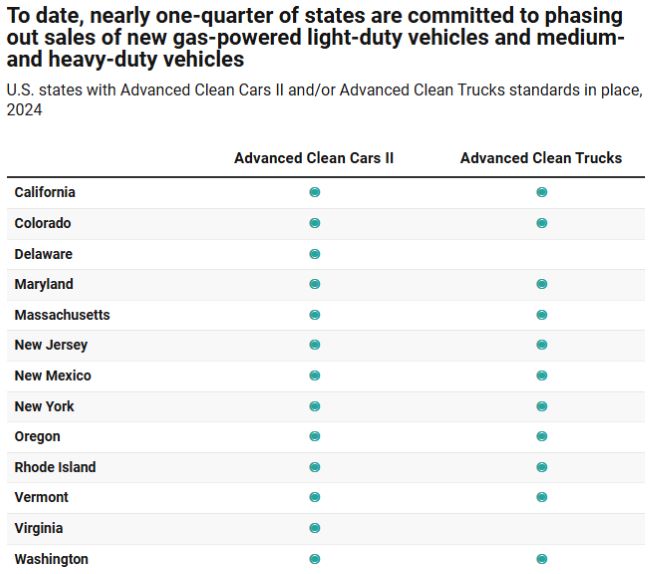
The following states have seen significant increases in their sales of zero-emissions vehicles and are on track to reduce their overall transportation emissions since adopting the ACC II and ACT regulations:
- California adopted the ACC II standard in 2022.70 The following year saw a 30 percent increase in zero-emission vehicles on the road, as these vehicles made up 25 percent of new vehicle sales in 2023.71
- Oregon also adopted ACC II in 2022 and reached a milestone in 2024 of registering more than 100,000 EVs statewide.72 Oregon is currently on track to reduce its transportation emissions 60 percent by 2050.73
- Maryland adopted ACC II in 2023 and reached the 100,000 EV registration milestone in 2024.74 This represents an increase of more than 59 percent compared with the number of EVs registered in 2022.75
- Colorado also adopted ACC II in 2023 and has seen an increase in EVs by 17.9 percent compared with 2022.76 EVs made up 14.5 percent of all new vehicle registrations in the state the following year.77
- New Jersey adopted ACT in 2021.78 The state has more than 510,000 medium- and heavy-duty vehicles registered, where Class 3 and larger trucks make up approximately 49 percent of the fleet and are responsible for approximately 70 percent of resulting greenhouse gas emissions.79 Under the ACT rule, by 2050, annual net societal benefits are estimated to be $1.1 billion, including $446 million in net fleet savings and $70 million in utility net revenue.80
- New York also adopted ACT in 2021, and the regulations are expected to take effect in 2025.81 The program is estimated to deliver more than 440,000 zero-emission trucks to the state, as well as $21.4 billion in public health, environmental, and economic benefits through 2050.82
- Vermont adopted ACT in 2022.83 Implementing the rule is estimated to result in more than $600 million of avoided costs for the state related to greenhouse gas emissions reductions and up to $24 million in health-related cost savings.84
- New Mexico adopted ACT in 2023.85 The regulations are estimated to deliver more than $3.3 billion in total benefits between 2020 and 2050, while annual greenhouse gas emissions from the state’s heavy-duty fleet will fall 39 percent by 2050.86
Set and Deliver on Statewide Vehicle Miles Traveled Reduction Target
Reducing both per capita and total VMT can drive down emissions from vehicles. Adopting a VMT reduction target helps inform long-term capital planning and align investments with climate and human needs. Meeting VMT targets requires implementing a host of policies to improve land-use decisions and invest in various mobility options. States should encourage more healthy and sustainable communities by changing the mix of their capital projects to prioritize investments, reform zoning, and adopt other policies that make it easier to take fewer and shorter trips by car and more by public transit, biking, walking, and other means.
The following states have taken steps to implement smart growth planning into their urban development strategies:
- California set a VMT reduction goal of 25 percent below 2019 levels by 2030 and 30 percent below 2019 levels by 2045.87 This has changed the way impacts of new development and transportation projects are measured in the state, as projects were originally evaluated on the potential increase in traffic they could create in the immediate area. This led to communities feeling compelled to expand their highways instead of investing in walkable communities with alternative transportation options.88
- Colorado’s Department of Transportation (DOT) set a VMT reduction target of 10 percent on or before 2030, relative to current levels.89 Along with updating the state’s goals and performance targets this year for advancing transportation safety and fixing state roads, the Colorado Transportation Commission also added a per capita VMT reduction target of 1 percent annually.90
- Maine set a 10 percent VMT reduction target for light-duty vehicles by 2025 and 20 percent in 2030, as well as a 4 percent reduction by 2030 for heavy-duty vehicles.91 Maine’s DOT has a number of projects underway aimed at increasing mobility options, including revitalizing downtowns, installing roadway features for pedestrian safety, incentivizing people to carpool or take “green” commutes, and providing grant opportunities for local and regional partnerships to pilot innovative ways to connect workers and employers through ride-sharing, vanpooling, and other subsidized transit options.92
- Washington set a VMT reduction goal in 2008 requiring an 18 percent reduction in VMT per capita by 2020, a 30 percent reduction by 2030, and a 50 percent reduction by 2050.93 In 2021, the state’s DOT was directed to develop a process for establishing local VMT reduction targets, recommend a suite of options for local jurisdictions to achieve the targets, recommend changes to laws and rules to support reduction in VMT, and identify funding requirements for state and local jurisdictions to establish local VMT reduction targets.94
Integrate Climate Assessment in Transporation Planning Processes
State DOTs and metropolitan planning organizations (MPOs) are essential in implementing policies, programs, and projects that can reduce greenhouse gas emissions. States should integrate the consideration of greenhouse gas emissions into transportation planning processes to help agencies develop adaptable strategies for existing structures, provide reliable information to be used in project planning, and ensure strategies to meet targets and make progress are aligned with state greenhouse gas reduction goals.
The following states have taken steps to require their DOTs to evaluate the amount of greenhouse gas emissions transportation projects may create:
- Colorado’s greenhouse gas Transportation Planning Standard requires the state’s five MPOs and its DOT to set emissions reduction targets for 2025 and each subsequent decade until 2050.95
- Minnesota is mandated to use an Infrastructure Carbon Estimator tool to evaluate greenhouse gas emissions from its state DOT’s construction projects and to utilize this information to monitor progress toward an agency goal for reducing construction greenhouse gas emissions.96
- New Jersey developed a Carbon Reduction Strategy that ranks and scores its state DOT’s projects and programs based on their greenhouse gas reduction benefits.97
Invest in Transit Infrastructure
State governments are crucial in supporting the planning, operations, and maintenance of public transportation service. States should prioritize their transportation dollars toward improving public transit services, fixing and properly maintaining transportation infrastructure, and improving public safety, rather than expanding highways. When transit agencies face heavy financial stress, state support can be an essential funding source allowing transit to continue delivering service.98 While the passage of the Infrastructure Investment and Jobs Act, also known as the bipartisan infrastructure law, increased federal transit spending for states, states could not use those funds on operations, expenses that cover bus drivers’ salaries, or bus maintenance. These operational costs account for two-thirds of transit agencies’ total expenses, and without federal support, the burden of this funding can only come from state funding, local funding, and fare box revenue, or capital generated from passengers paying to use public transit services.99 Where state and local decision-makers value transit, states use more highway dollars for public transportation.100
The following states have taken steps to establish programs that ensure transportation funds are invested into transit infrastructure and not just in highway expansion projects:
- New York’s Statewide Transportation Improvement Program (STIP) was developed by the state’s DOT in consultation with local officials in nonmetropolitan areas and in cooperation with MPOs in urbanized areas.101 STIP has programmed $44 billion for 2023 through 2026, where $28 billion is directed toward funding transit services.102 The remaining STIP funds will go toward improving roads, highways, and nonmotorized projects, as well as urban and rural projects.103 The state’s approval of a phased-in congestion pricing plan starting in January 2025 will also add significant revenue—estimated to generate $15 billion to be put toward capital projects aimed at improving transit.104 Congestion pricing is an effective tool that can lower transportation pollution and improve driving performance by reducing traffic congestion during peak hours, increasing the predictability of trip times, and potentially encouraging alternative transportation modes such as public transit. The program also promotes a progressive form of collecting revenue, as equity for nondrivers and lower-income groups is enhanced.
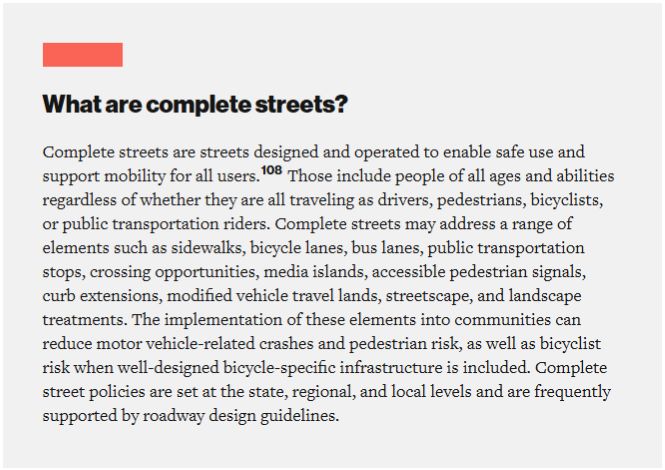
- California’s Senate Bill 1 is a legislative package that invests more than $54 billion over the next decade to fix roads, freeways, and bridges in communities across California and puts more dollars toward transit and safety.105 California’s state-maintained transportation network receives roughly half of the bill’s revenue, with the other half of funding going to local roads, transit agencies, and the expansion of the state’s growing network of pedestrian and cycle routes.106 In 2021, California’s DOT also issued an updated complete streets policy.107 (see text box below)
- New Jersey recently renewed the state’s Transportation Trust Fund (TTF) for five more years, which will invest billions of dollars to modernize and maintain New Jersey’s statewide transportation infrastructure.109 The TTF also provides additional capital funding for NJ TRANSIT, supports local and county projects to alleviate the burden on local taxpayers, and helps to create thousands of new jobs.110 New Jersey also transferred 15 percent of its federal highway dollars received to the Federal Transit Administration—more than any other state in the nation, primarily using the Congestion Mitigation and Air Quality program to pay for routine needs such as new buses and train cars.111
Establish Electric Vehicle-Ready Requirements for Buildings
Along with advancing legislation to accelerate EV deployment, states also must ensure proper charging infrastructure is in place, so EV drivers have consistent and reliable access to chargers at home and at their destinations. States should plan for integrating chargers along roads, but also within commercial and residential buildings.
The following states have taken steps to require that new residential and commercial constructions are able to accommodate charging infrastructure for EVs:
- Maryland requires new homes with a garage, carport, or driveway to have a Level 2 EV charger or electric prewiring for one.112
- Oregon requires 20 percent of parking spaces at all newly constructed commercial buildings, multifamily residences with five or more units, and mixed-use developments to have electrical capacity to support Level 2 EV chargers, while new residential construction must be able to support the installation of one Level 2 EV charger.113
- Washington requires new commercial and multifamily residential buildings to have a minimum of 10 percent of parking spaces equipped for EV charging, with an additional 20 percent of spaces ready to accommodate chargers.114
Industry Sector: Support Clean and Competitive U.S. Manufacturing Industries
Overview
The industrial sector is responsible for nearly one-third of global carbon emissions and 30 percent of U.S. emissions.115 Along with carbon dioxide, the industry sector is also a significant source of other potent greenhouse gases such as methane and hydrofluorocarbons (HFCs).116 Methane and HFCs have heat-trapping capabilities that can significantly exacerbate the effects of climate change.
Many policies that incentivize or assist industrial facilities to reduce their greenhouse gas emissions also deliver important cobenefits, such as reduced waste and energy costs, which reduce harmful pollution in local communities, and enhance a facility’s global economic competitiveness. The following policies set a baseline for strategies that decarbonize supply chains, incentivize investment in clean technologies, and support growth toward a strong and clean manufacturing economy, while reducing harmful local pollution.
Adopt Clean Public Procurement Policies
To reduce greenhouse gas emissions in the industrial sector, states should require materials used for state-funded projects to be the cleanest and most sustainable available. Many states have now implemented Buy Clean programs, a policy initiative that incorporates low-carbon requirements into government construction material purchasing by requiring environmental product declarations for reporting the impacts of building materials production.117 This ensures taxpayer dollars are spent responsibly on materials manufactured in a clean, efficient, and environmentally friendly manner—reducing pollution and adverse health impacts while supporting quality jobs and investment in American manufacturing.118 Some states, such as Washington, included high labor standards in their procurement program—called Buy Clean, Buy Fair” policies.
The following states have taken steps to adopt comprehensive green procurement policies:
- Colorado’s Buy Clean policy mandates the Colorado Office of the State Architect to establish a maximum global warming potential limit for asphalt and asphalt mixtures, cement and concrete mixtures, glass, posttension steel, reinforcing steel, structural steel, and wood structural elements. In 2024, the state established a maximum global warming potential, to be revised in 2026, for materials used in public projects that cost more than $500,000.119
- Minnesota’s Buy Clean, Buy Fair policy established a task force to report identified details to the commissioner of administration, who will establish global warming potential maximum standards by 2026. The standards apply to carbon steel rebar, structural steel, concrete, and asphalt paving mixture.120
- New Jersey’s Low Embodied Carbon Concrete Leadership Act builds on the Buy Clean model as the first regulation in the nation to incentivize businesses to use low-carbon concrete materials on state projects. Concrete mixes with global warming units below a threshold established by the New Jersey Department of Environmental Protection are eligible for tax credits amounting to 8 percent of the cost of the contract.121
- Washington’s Buy Clean, Buy Fair policy applies to construction projects larger than 50,000 square feet or building renovation projects where the cost is greater than 50 percent of the assessed value. Covered products include structural concrete, reinforcing steel, structural steel, and engineered wood products. Along with requirements for embodied carbon reporting, Washington’s policy also requires state contractors to collect and report data from suppliers on the working conditions at their production facilities and supply chain management. State contractors must disclose whether covered products have a health certification as well.122
Incentivize Industry to Achive Emissions Reductions
Transitioning to cleaner industrial processes can sometimes carry an up-front price premium because of retrofit or new technology costs. To offset this premium, states should provide different types of financial incentives to industrial facilities. Grant programs, tax incentives, and other financing tools can help alleviate costs associated with reducing climate and conventional pollution from industrial facilities and help scale the deployment of new technologies that could drive a wider impact across the industrial sector.
The following states have established incentive programs to encourage and support industry with adopting cleaner technologies in their facilities:
- California’s Industrial Decarbonization and Improvement of Grid Operations program provides $100 million in incentives for industrial facilities that reduce greenhouse gas emissions and support the electric grid.123 California also has a Food Production Investment Program that provides grants to help food producers reduce greenhouse gas emissions by adopting advanced energy technologies.124
- Colorado offers reimbursement-based grants for industrial and manufacturing facilities that voluntarily reduce their greenhouse gas emissions and air pollutants that can be applied to install renewable energy, electrify fossil fuel-powered equipment or processes, and fund projects that produce or utilize clean hydrogen or carbon capture in industrial facilities.125 Colorado also created tax credits for industrial facilities to implement greenhouse gas reduction improvements126 and exempts all sales, storage, and use of low-carbon construction materials from state sales and use tax.127
- New Jersey requires builders to offer a unit concrete product that utilizes carbon footprint-reducing technology that has half the embodied carbon of ordinary concrete.128 The law then provides tax credits to the customers using that concrete.129
- New York provides grants for industrial facilities and other large nonresidential energy consumers to reduce carbon emissions through electrification, energy efficiency, or manufacturing process emissions reduction.130 New York also has a stand-alone program that offers incentives for industrial facilities to install on-site renewable energy.131
- Pennsylvania was awarded a $396 million grant in 2024 from the U.S. Environmental Protection Agency’s (EPA) Climate Pollution Reduction Grants Program to create Reducing Industrial Sector Emissions in Pennsylvania (RISE PA)—a statewide industrial decarbonization grant program.132 RISE PA will offer incentives and grants ranging from $25,000 to $300 million for small-, medium-, and large-scale decarbonization projects.133
Establish Industrial Emission Standards
By 2035, industry production is projected to be the largest source of domestic greenhouse gas emissions.134 Iron and steel, chemicals, and cement-making account for roughly 55 percent of global industrial emissions, and just 10 industries make up about 90 percent of global industrial emissions.135 States should set binding statutory targets for industrial-sector greenhouse gas emissions and set ambitious interim targets that put them on track to meet state climate goals.
The following states have taken steps to reduce their industry emissions by setting greenhouse gas emissions reduction targets for industry producers:
- California requires the California Air Resources Board to develop a strategy for the state’s cement sector to achieve a greenhouse gas intensity 40 percent below baseline levels by 2035 and net-zero greenhouse gas emissions by 2045.136
- Colorado adopted regulations on emissions from industrial facilities that release at least 25,000 metric tons of greenhouse gas emissions annually.137 The rule required qualified facilities to prove through an audit process that they use the best practices and technologies to save energy and reduce greenhouse gas emissions.138 Facilities were then required to cut emissions to what the best controls would achieve plus an additional 5 percent intensity reduction per year starting in 2025.139 The state adopted a second phase of this regulation requiring facilities with manufacturing operations emitting at least 25,000 metric tons of greenhouse gases per year to collectively reduce greenhouse gas emissions by 20 percent relative to 2015 levels by 2030.140 These facilities also must submit plans to achieve the necessary reduction. Facilities that failed to comply must pay into a state-managed fund that will be used to finance state decarbonization projects.141
- Massachusetts set a target for industrial and nonenergy sectors to reduce emissions 76 percent below 1990 levels by 2050.142 Interim emissions limits, including sector-specific limits, are set for every five years.143
Estalish Methane Regulations for Landfills
Methane is a powerful greenhouse gas that has more than 80 times the warming power of carbon dioxide over the first 20 years after reaching the atmosphere.144 It also accounts for about 16 percent of global greenhouse gas emissions. Reducing methane emissions is one of the quickest and most efficient ways the United States can combat climate change.145 Landfills are the third-largest source of U.S. methane emissions. Globally, these emissions must be regulated to slow the rate of global warming and avert the most acute climate risks.146 Under the Clean Air Act, the EPA is tasked with devising regulations to lower methane emissions; however, experts say the agency’s landfill rules fall short of achieving necessary reductions.147 States should prioritize developing and enforcing stricter landfill regulations. States already doing so should expand upon existing policies.
The following states have taken steps to track and manage the amount of methane emissions released by their landfills:
- California was the first state to regulate landfill methane emissions.148 The state requires active landfills with less than 450,00 tons of waste to submit reporting annually. Landfills equal to or with more than 450,000 tons of waste must calculate their landfill gas heat input capacity and submit a detailed landfill gas heat capacity report.149 Municipal waste landfills that meet the applicability thresholds are required to install gas collection and control systems (GCCS), and all gas control devices must be subjected to annual source testing and monitored for leaks.150
- Maryland requires municipal solid waste landfills with a calculated methane generation rate greater than 8,548 tons per year to install a GCCS. The regulations also require the evaluation of methane emission rates through both instantaneous—500 parts per million by volume (ppmv) and integrated (25 ppmv) monitoring requirements and standards, as well as leak monitoring standards (500 ppmv) for GCCS components that contain landfill gas.151
- Oregon’s rules broaden the types of landfills that must follow methane protocols, including every type of landfill except hazardous waste.152 The state’s smallest landfills—those below 200,000 tons—are required to report tonnage of waste in place, while midsized landfills must calculate potential methane generation and either install a landfill GCCS or prove their methane emissions are lower, if their modeled emissions exceed 664 metric tons per year. Large landfills above 2.5 million tons need to file more detailed paperwork listing all emissions measurements and are subject to more stringent testing requirements in addition to quarterly monitoring procedures.153
- Washington in 2024 finalized its landfill methane rules and established a $15 million grant program to implement this work. These regulations apply to active and closed municipal solid waste landfills that have received waste since January 1, 1992. Landfill owners and operators are required to install gas collection and control equipment, energy recovery devices, and/or treatment and processing systems to reduce methane emissions. The regulations also include quarterly monitoring of landfill surfaces—drone-based monitoring is a permitted compliance option154—and a timeline to ensure any methane leaks are quickly fixed.155
Divert Food Waste from Landfills
Food waste is the single largest component taking up space inside U.S. landfills.156 An estimated 58 percent of the fugitive methane emissions from municipal solid waste landfills are specifically from landfilled food waste.157 In 2015, the EPA and the U.S. Department of Agriculture announced a national goal to cut food loss and waste in the United States by 50 percent by 2030, and a number of states have created food waste laws to contribute to the national goal.158 States should prioritize policies that keep food out of landfills to reduce their methane emissions; they should ensure food goes to better use via donations or recycling through composting to boost soil health and sequester carbon, or through anaerobic digestion that converts waste into biofuels capable of replacing fossil fuels for energy.
The following states have taken steps to divert food waste from their landfills and establish food recycling programs:
- California has a statewide target to reduce organic waste disposal 75 percent by 2025 and rescue at least 20 percent of food that is now being disposed and use it for consumption, also by 2025.159 To help meet this target, the state requires all residents to separate organic waste and all businesses to recycle their organic waste, depending on the amount of waste they generate per week, and donate edible food to food recovery organizations.160
- Massachusetts requires any business producing a half ton or more of food waste per week to either send food waste to compost facilities or anaerobic digesters, which turns waste into energy, or divert edible surplus food to charities or food recovery services.161 The Massachusetts Department of Environmental Protection administers a grant program to fund recycling and composting equipment, school recycling, and organics capacity development projects to support businesses and other entities with their recycling efforts.162
- Vermont passed in 2012 its Universal Recycling Law, which enforces a statewide ban on food waste from disposal in trash and landfills.163 It is the only state with an organic waste ban that applies down to the residential level.164 The law also mandates a food scrap collection service at waste facilities and requires food scrap haulers to offer their services to nonresidential customers and apartments of four units or more if no other haulers offer that service.165
Phase Out Products Using Hydrofluorocarbons
HFCs are chemicals used in refrigerators, air conditioning, insulating foams, and aerosols. These climate pollutants have hundreds to thousands of times the heat-trapping power of carbon dioxide. Still, unlike carbon, HFCs only remain in the atmosphere for about 15 years before decomposing completely.166 Studies have shown that reducing HFC use could avoid 0.5 degrees Celsius of warming by 2100.167 Replacing HFC-based appliances with more efficient models can also yield significant economic savings for industry, as up-front costs to install new technology are low and savings on fuel are high.168 The EPA recently announced its final rule to establish a new program to better manage, recycle, and reuse climate-damaging HFCs under the American Innovation and Manufacturing Act. This supports the Montreal Protocol commitment of achieving an 85 percent HFC phasedown by 2036.169 States should commit to accelerating their efforts to phase down HFCs by setting emissions reduction targets and continuing to work toward complete bans on products that use HFCs.
The following states have taken steps to restrict HFC use in new products and reduce HFC emissions from existing products:
- California is required to reduce HFC emissions 40 percent below 2013 levels by 2030.170 To help meet this reduction goal, the state prohibits the manufacturing and selling of aerosols, foams, retail food refrigeration, cold storage warehouses, residential refrigeration appliances, and chillers that yield specific HFCs.171
- Vermont’s HFC rules prohibit the sale, lease, rent, or installation of foam insulation products, commercial refrigeration, and residential refrigeration that consist of or use specific HFCs with high global warming potentials.172 Vermont must also reduce HFC emissions 40 percent below 2013 levels by 2030.173
- Washington’s HFC rules prohibit manufacturers from using certain HFCs in new air conditioners, including heat pumps, and commercial refrigeration equipment sold in the state. The rules also established a refrigerant management program with registration, leak inspection, leak repair, recordkeeping, and reporting requirements for owners or operators of large stationary refrigeration and air conditioning systems.174
Finance Conservation and Climate-Smart Practices in Agriculture
Climate-smart and conservation practices are the key to a productive, sustainable agricultural sector. Climate-smart agriculture increases and maintains productivity and yield, enhances resilience to environmental changes, and reduces greenhouse gas emissions.175 Climate-smart agriculture and forestry in the United States build on many practices that farmers already use, including cover cropping, conservation tillage, and nutrient management. States should increase adoption of best management practices such as these to allow for more specific, targeted approaches that promote agricultural climate resilience.176
The following states have taken steps to support their farmers with adopting climate-smart agricultural practices:
- California’s Healthy Soils Incentives Program and Healthy Soils Program Demonstration Grant initiative promote the development of healthy soils on the state’s ranches and farmlands by providing financial assistance for conservation management practices that improve soil health, sequester carbon, and reduce greenhouse gas emissions.177 Eligible practices include cover cropping, no-till farming, compost application, and conservation plantings.
- Georgia’s Conservation Tax Credit Program aims to protect the state’s natural resources and encourage the dedication of properties for conservation purposes, which include wildlife habitat protection; water quality protection for wetlands, rivers, and lakes; and outdoor recreation protection. The program provides tax credits to landowners who donate fee-title lands or permanent conservation easements to a state agency, government entity, or Land Trust Alliance-accredited land trust.178
- Iowa’s 2017 Cover Crop-Crop Insurance Demonstration Project provided farmers with a $5 per acre rebate on crop insurance if they implemented cover crops.179 Crop insurance is considered one of the most critical risk management tools in agriculture, while cover crops increase soil fertility, reduce runoff, prevent soil erosion, and increase soil moisture-holding capacity. The pilot program received applications for more than 170,000 additional cover crops in early 2019.180
- Michigan’s Agriculture Environmental Assurance Program helps farmers adopt practices that cost-effectively reduce erosion and runoff into state rivers, ponds, and streams. The program sources most of its funding by instituting registration and water quality protection fees on more than 15,000 pesticides sold in the state, and from a $1 fee per ton of fertilizer sold.181
Building Sector: Reducing Energy Use and Pollution from Buildings
Overview
Fossil fuel gas is the main energy source to heat and cool about 50 percent of all U.S. homes.182 Gas combustion releases a large amount of greenhouse gas emissions indoors, and this pollution can harm human health.183 Gas combustion in residential and commercial buildings is one of the most significant sources of pollution disparities overwhelmingly affecting communities of color.184 States need to lead the way in developing standards and strategies that accelerate building decarbonization, which will not only deliver health and climate benefits, but also save consumers money on their electric bills.185 To do so, states must take full advantage of the tax credits and electrification rebate programs for building retrofits and efficiency upgrades made available by the Inflation Reduction Act. The following policies will support efforts to eliminate emissions from new and existing residential and commercial buildings.
Adopt Building Performance Standards
From large-scale heating and cooling units powered by fossil fuels to elements as simple as poor insulation from a weak building envelope, a building’s space presents numerous opportunities to reduce greenhouse gas emissions. States should adopt building performance standards (BPS), which includes policies and laws that can reduce emissions by requiring existing buildings to meet energy or greenhouse gas emissions-based performance targets.186 In 2022, the federal government launched the National BPS Coalition, which comprises a nationwide group of state and local governments that have committed to inclusively designing and implementing building performance policies and programs in their jurisdictions.187
The following states have adopted BPS:
- Colorado requires buildings 50,000 square feet or larger to benchmark their whole-building energy use and set performance targets annually.188
- Maryland requires commercial and residential buildings 35,000 square feet and larger to reach net-zero emissions by 2040. Building owners must prepare to report energy data starting in 2025 and meet interim standards starting in 2030.189
- New York passed in 2023 the All-Electric Building Act, which bans new buildings under seven stories from including stoves, furnaces, or water heaters that burn gas and other fossil fuels, starting in 2026. Larger buildings are required to comply beginning in 2029.190
Adopt Clean Heat Standards
Energy used for space heating, water heating, industrial processes, and other end uses in the residential, commercial, and industrial sectors accounts for nearly one-third of all carbon dioxide emissions from energy use.191 States should adopt clean heat standards (CHS) to help drive emissions down at the pace and scale required to address climate policy goals. These performance standards set for fossil fuel providers encourage the progressive adoption of clean heat resources and require the provider to deliver a gradually increasing percentage of low-emission, clean heat resources to customers.192
The following states have adopted or are in process of adopting CHS:
- Colorado was the first state to enact a CHS, requiring gas distribution utilities to meet targets of a 4 percent emissions reduction below 2015 levels by 2025 and 22 percent by 2030.193
- Maryland released a draft framework that includes selecting gas utilities, heating oil, and propane importers as obligated parties; allowing for third parties to participate in the CHS by creating credits and then selling them to said obligated parties; providing opportunities for technologies such as networked geothermal systems; and potentially allowing for alternative fuels such as biomethane, biodiesel, woody biomass, hydrogen, and others for high-heat applications utilizing a life-cycle emissions analysis.194
- Massachusetts released a draft framework requiring heat providers to fully electrify a set number of residences, of which 25 percent must be met by projects that serve customers who are eligible for low-income discount electricity rates. The framework also requires annual emissions reductions from space heating demand in residential and commercial buildings.195
- Vermont’s enacted CHS requires fossil fuel wholesalers and dealers to help meet 26 percent emissions reduction below 2005 levels by 2025, 40 percent below 1990 levels by 2030, and 80 percent below by 2050.196 Vermont also retires clean heat credits, which can be created by facilitating customers to switch to a lower-emitting renewable energy source or installing equipment that avoids emissions.197
Adopt Appliance Efficiency and Emission Standards
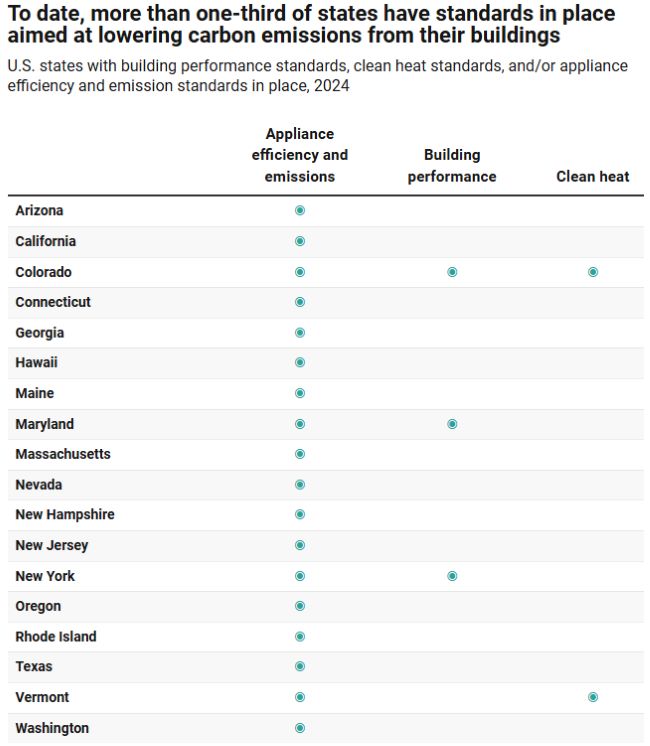
These standards set minimum energy efficiency and/or emissions levels for appliances and other energy-consuming products in homes, businesses, and industry.198 In the absence of specific federal standards, states should create standards and inspire other states to adopt similar measures. Appliance efficiency standards help lower greenhouse gas emissions, can reduce utility bill costs, and prevent wasteful products from entering the supply chain.199
The following states have led the way in establishing appliance efficiency standards, and their models can inspire other states to adopt similar measures:
- California was the first state in the nation to set efficiency standards for appliances and has been the originator of numerous standards covering 20 categories and more than 50 products that the federal government has adopted.200 The state recently proposed a rule that requires all new space and water heaters sold to be zero-emission by 2030.201
- Vermont was the first state to adopt standards for numerous commercial appliances, including ovens, dishwashers, steam cookers, and fryers.202
- Massachusetts was the first state to adopt standards for EV supply equipment.203
Enhance Clean Building Codes
States can significantly decrease building emissions through electrification and efficiency practices, and it is essential to prioritize these decarbonization efforts in both new construction strategies and evaluations of existing structures. Building energy codes set minimum efficiency requirements for new and renovated commercial and residential buildings, reducing energy use and emissions over the life of the building.204
Just one state has taken steps to enforce a building code that prioritizes energy and emission reduction:
- California is the first state to have a state-mandated green building code that encourages electric heat pump technology, replacing end-of-life rooftop heating, ventilation, and air conditioning (HVAC) units with high-efficiency systems, establishing electric-ready requirements for kitchens, updating solar and storage standards for assembly buildings, and strengthening ventilation standards to improve indoor air quality.205
Enhance State Housing and Land-Use Reforms
Efficient urban and suburban development produces significant benefits across climate, economy, and social well-being. Along with addressing the nation’s current cumulative shortage of 4 million homes, enacting state-level land-use reform to encourage compact development can also reduce annual U.S. pollution by 70 million tons of carbon dioxide equivalent in 2033.206 Promoting the development of high-density and compact housing can increase the amount of housing available in an area, leading to shorter travel distances and less car dependency for residents. Reducing urban sprawl also leads to less land consumption, preventing the loss of natural carbon sinks.207 Local governments derive the power to zone and regulate land use from the state, and as a result, local governments influence the types and amount of housing built in their communities.208 States should prioritize reducing regulatory barriers to housing production by preempting local land-use policies to require municipalities to adopt more construction-friendly land-use codes.
The following states have taken steps to increase housing opportunity in their communities by prioritizing development strategies that reduce urban sprawl:
- Oregon signed House Bill 2001 in 2019, making it the first state to pass legislation requiring updates of local rules that previously limited the types of housing residents could build.209 Oregon’s Department of Land Conservation and Development created a model code for local jurisdictions to reference and provided localities ongoing technical assistance for development.210 The code details that medium-sized cities in the state are required to allow residents to build duplexes in areas zones for single-family dwellings.211 Cities in the Portland metropolitan region and other cities with populations exceeding 25,000 must allow residents to build duplexes, triplexes, fourplexes, cottage clusters, and townhouses in residential areas.212
- Colorado passed of legislation in 2024 requiring cities and towns to reform their land-use regulations. The six bills signed include altering zoning laws to allow higher-density housing; broadly legalizing accessory dwelling units and creating grant and loan programs to help finance construction for low- to moderate-income homeowners; eliminating parking mandates for multifamily residential properties within a quarter mile of a transit stop with 30-minute frequency or better; giving local governments right of first refusal to buy apartment complexes built with public subsidy dollars when their affordability restrictions expire; banning local occupancy restrictions; and requiring local governments of communities with more than 1,000 people to submit an assessment of housing needs to the state.213
Decommission Gas Systems on a Neighborhood Scale
Building electrification could significantly challenge a local gas distribution system’s funding and cost recovery mechanisms in some utility service areas. States should implement strategies to reduce gas system spending and manage rates and transitions for gas customers who have not switched to electric building equipment. Gas system decommissioning is a strategy that refers to the process of permanently disconnecting a building from the natural gas supply network, usually by removing the gas meter and sealing the gas line.214 To avoid burdening remaining gas users with increased costs, decommissioning is best done in a targeted manner by focusing on areas with high potential for electrification and making a transition plan for the whole neighborhood.
The following states have taken steps to require their utilities to evaluate and support local neighborhoods served with decommissioning their gas systems:
- California requires its PUC to identify neighborhoods eligible for gas line replacement, which can then volunteer to become neighborhood decarbonization zones.215 These priority zones include environmental justice and low-income neighborhoods. If two-thirds of residents agree to the project, the entire community is eligible to receive free electric appliances to replace those formerly powered by gas.216
- Colorado requires any dual-fuel utility to work with an approved community to rank neighborhood-scale alternatives projects and, before June 1, 2026, to submit at least one neighborhood-scale alternatives project in each community to the commission for approval or an explanation of why no neighborhood-scale alternatives project will be pursued in a community.217 Every year after, the utility is required to submit a report to the commission on the implementation of any approved neighborhood-scale alternatives project.218
- Massachusetts’ Department of Public Utilities issued an order directing local distribution companies (LDCs) to study the feasibility of piloting a targeted electrification project in coordination with relevant electric distribution companies; the department is also required to conduct a comprehensive review of the forecast of the potential magnitude of stranded investments, including the impact of accelerated depreciation on cost recovery.219 For future cost recovery proposals for new distribution system investments, the LDCs are required to demonstrate that nongas pipeline alternatives, such as energy efficiency, demand response, targeted electrification and networked geothermal, were considered. Further, to dissuade gas customer expansion and align rate design with climate objectives, the department instructs LDCs to revise their per-customer revenue decoupling mechanism to a decoupling mechanism based on total revenues.
Recommendations for State Action
As states embark on this new chapter of climate leadership, they have tailwinds supporting their efforts in the form of the Inflation Reduction Act and the bipartisan infrastructure law—twin federal laws that provide hundreds of billions in tax incentives, financing, and grant programs to support the clean energy transition. The future of some of these federal investments is in doubt, as the Trump administration has promised to repeal clean energy incentives,220 despite the fact that these incentives have benefited various states.221 These laws have already created more than 300,000 new jobs222 and catalyzed more than $400 billion in new investments.223
The Center for American Progress and its partners have written in detail about how these new investments provide enormous opportunities for state governments and how states can maximize these investment opportunities as they look to cut climate pollution and energy costs and build a thriving clean energy economy for their residents.224 The recommendations that CAP has provided to states, which are perhaps now more important than ever, include:225
- Build state government climate staff capacity and interagency coordination
- Enact complementary state incentives and performance standards to ensure clean energy options for their residents
- Create and capitalize state green banks and other energy financing institutions to leverage public and private sector investment
- Raise consumer awareness of new incentives for clean technologies
- Prioritize equitable investments for disadvantaged communities
- Support well-paying union jobs and address workforce needs
- Confront barriers to rapidly siting and permitting new clean energy projects
As the Trump administration takes office, states should be prepared to assume the reins to drive climate and clean energy progress and to defend against attempts to delay the rollout of critical federal funding already awarded to state and local entities.
Accountability for Polluters: Holding the Fossil Fuel Industry Accountable and Using Market-Based Mechanisms
Overview
Another area in which states have led in climate and environmental policymaking, and where more states continue to innovate, is requiring industries to pay the costs of the climate pollution they cause. The most common way states have done this is by enacting a fee, or “carbon price,” upon large emissions sources in a single state or programs spanning across a region. These programs have the added benefit of providing revenues that states can reinvest in projects that further drive emissions reductions—especially in disadvantaged communities. In addition, several states have taken steps to require those industries that have contributed the most historical climate pollution to pay to clean up the costs associated with climate damage.
Price Pollution and Reinvest in Communities
Some states have adopted cap-and-invest-style programs that set a declining statutory cap on emissions from their largest sources and require polluting entities to pay to purchase a credit for each ton of emissions they are responsible for that year. The number of these allowances shrinks each year, as the program is designed to reduce overall emissions. In addition, revenues from the sale of emissions allowances can be reinvested in projects that further reduce emissions, build sustainable community solutions, and reduce customers’ energy costs.
The following states have taken steps to create initiatives that hold polluting entities accountable for the amount of greenhouse gas emissions they release:
- California in 2006 enacted Assembly Bill 32, which provided the California Air Resources Board with the authority to establish a cap-and-invest (or cap-and-trade) program—the first such statewide program in the nation.226 The law, which voters have reaffirmed, the state Legislature has reauthorized, and has advanced through agency implementation, aims to achieve an 85 percent reduction in climate pollution from 1990 levels by 2045.227 It has been the backbone of California’s nation-leading climate policies, and state lawmakers have moved to complement it with sectoral standards and strategies advancing 100 percent clean electricity, vehicles, and building appliances.
- The Regional Greenhouse Gas Initiative (RGGI) is a multistate initiative established by nine Northeastern states in 2005. Launched in 2009, the project limits climate pollution from these states’ electricity sectors through a cap-and-invest system.228 In its first five years, the RGGI saved consumers more than $1.2 billion on utility bills, drove $4 billion worth of economic activity, and provided $5.7 billion in health care benefits for the region.229 The program now includes 11 states, and others are considering joining.
- Washington Gov. Jay Inslee (D-WA) signed in 2021 the Climate Commitment Act (CCA), making it the second state in the nation with an economywide cap-and-invest program, which aims to reduce the state’s greenhouse gas emissions by 95 percent.230 The CCA mimics important provisions from California’s 2006 cap-and-invest law, such as requiring a certain percentage of program revenues to flow to disadvantaged communities. The CCA also reflects lessons learned in how it involves environmental justice communities in program implementation and sets more stringent limits on carbon market participants.231
Hold Polluters Legally Accountable for Cleaning Up Their Mess
Some states have also looked to climate policies that embrace the long-established “polluter pays” precept in environmental law, which holds that polluters should bear the financial burden for the environmental degradation they have caused, rather than those living with it. Several state attorney generals have brought legal action against fossil fuel companies for the climate damages caused by their pollution and for misleading the public about these harms for decades. More recently, some states have advanced new policies loosely modeled on the federal government’s Comprehensive Environmental Response, Compensation, and Liability Act, commonly called Superfund, which assess a fee on certain industries for their historical contribution to climate pollution.232
The following states have taken steps to pass policies that hold polluting entities financially accountable for their actions that have increased climate change risk for local residents:
- Rhode Island in 2018 brought a lawsuit against 21 fossil fuel companies alleging that these companies promoted fossil fuels while concealing their product’s known hazards for the global climate and the harms that climate change is having and will continue to have in the state.233 Those harms include sea-level rise, more frequent and severe flooding, extreme precipitation, and drought. New York, Massachusetts, the District of Columbia, and other states and cities have followed with similar action.
- Vermont enacted the Climate Superfund Act in 2024, which requires the largest fossil fuel companies to pay for a share of the climate change damages they have caused, in an amount proportional to their emissions from 1995–2024.234 Vermont’s Agency of Natural Resources is now charged with developing a Climate Superfund Cost Recovery Program Fund and collecting payments from responsible parties, which will then be reinvested in climate-resilient infrastructure and public health programs.235
- New York officially enacted a climate Superfund bill in December 2024, making it the second state to require fossil fuel companies to pay for their share of climate change damages.236 The legislation creates a Climate Superfund to support New York-based projects that bolster the state’s resilience to dangerous climate impacts such as flooding and extreme heat. By creating a Climate Change Adaptation Cost Recovery Program, the law also ensures fossil fuel companies contribute to the funding of critical infrastructure investments, such as coastal protection and flood mitigation systems, to enhance climate resilience of communities across the state.
Environmental and Economic Justice: Prioritizing Equity and Justice in Climate Policy
Overview
For too long, power plants, industrial facilities, and toxic waste sites have been disproportionately located in communities of color and low-income areas, forcing residents to live with unsafe air quality and drinking water and causing higher rates of cancer, asthma, and other life-threatening health problems.237 The environmental justice movement was born to protect the right of every person to breathe clean air, drink clean water, and live free from harmful pollution and chemical exposure.238
States’ climate policy design should include equity and environmental justice. Some states have taken steps to do so and have helped to inspire equity-focused climate policy at the federal level. For example, New York’s Climate Leadership and Community Protection Act (CLCPA), passed in 2019, requires that no less than 35 percent, with a goal of at least 40 percent, of climate action benefits go to New York’s disadvantaged communities.239 Inspired by this state law, as well as by calls from environmental justice advocates to center equity and justice in national climate policy,240 the Biden-Harris administration announced in 2021 its Justice40 Initiative pledging to direct at least 40 percent of federal climate, clean energy, and other infrastructure investment benefits to disadvantaged communities.241 Other states must take similar leadership in centering environmental justice in climate policy.
Target Investments in Disadvantaged Communities
Centering environmental justice and equity in state climate policy is essential to reducing harmful pollution and improving public health and economic opportunity in communities bearing the greatest pollution burdens. States can do this by targeting investments to benefit communities of color and low-income communities.
The following states have taken steps to direct investments toward reducing pollution burden inequalities in disadvantaged communities:
- New York requires 35 percent to 40 percent of overall benefits from clean energy and energy efficiency programs, projects, or investments in the areas of housing, workforce development, pollution reduction, low-income energy assistance, energy, transportation, and economic development to go to environmental justice communities, as identified by implementing criteria finalized by the state’s Climate Justice Working Group.242
- California requires at least 25 percent of funds from the state’s cap-and-trade program to be allocated toward disadvantaged communities. At least 5 percent of these allocations must go toward projects within low-income communities or benefiting low-income households, and another 5 percent must go to projects within and benefiting low-income communities, or low-income households that are outside of a defined community but within a half mile of a disadvantaged community.243 California has also pioneered best-in-class programs that invest in disadvantaged communities, such as the state’s Transformative Climate Communities program.244
- Washington requires at least 35 percent of proceeds from the state’s cap-and-invest program be invested in projects that benefit overburdened communities, and at least 10 percent of those proceeds go to Tribal-supported projects. The state’s Environmental Justice Council is tasked with making recommendations to the Legislature on how revenue should be used. It requires agencies using these funds to report their progress toward environmental justice goals to the council.245
Deploy Inclusive Green Finance
States should advance policies that deploy financing for climate and clean energy solutions and create economic opportunities, especially for projects, market segments, and communities historically underserved by financial institutions and overlooked by public and private investments. New clean energy economic opportunities may not reach these communities without institutions committed to equitable green finance. State and local governments have recognized this challenge and have created mission-driven green finance institutions to deploy investments in equitable climate solutions. The more than 40 state and local public and nonprofit green banks nationwide are poised to make clean energy more affordable and more accessible for more communities.246 State green banks and state energy financing institutions are also poised to play a key role in leveraging capital in the new $27 billion Greenhouse Gas Reduction Fund (GGRF) created in the Inflation Reduction Act and may be able help to leverage billions U.S. Department of Energy Loan Programs Office authorities that were expanded in the bipartisan infrastructure law.247 Several states have pioneered best practices, that others should follow.
The following states have successfully deployed green finance institutions, and these best-practice models can be utilized by other states to adopt similar programs:
- Connecticut’s Green Bank was one of the first mission-driven green banks established in the country, in 2011. The Connecticut Green Bank accelerates the deployment of clean energy projects using limited public sector funding that attracts and leverages significantly more private sector capital investment.248 These institutions stand to play a key role in leveraging capital in the new $27 billion GGRF created in the Inflation Reduction Act, and especially the GGRF’s National Clean Investment Fund and Clean Community Investment Accelerator programs.249
- Hawaii’s Green Energy Money $aver On-Bill Program was the first debt-free on-bill financing program in the country. This initiative, and other innovative on-bill financing programs like it, aim to help low- to moderate-income households, renters, and small businesses finance renewable energy and energy efficiency projects over time on their electric bill.250
- North Dakota’s Clean Sustainable Energy Authority Loan Fund (CSEA), administered by the Bank of North Dakota, provides grants and low-cost loans for a range of projects that promote sustainability.251 The CSEA supports a range of projects that reduce emissions, promote clean energy jobs, and maximize the market potential of sustainable energy. The program provides grants and loans up to $10 million that can cover up to 50 percent of the project cost.
- Nebraska’s Dollar and Energy Saving Loans Program is a state revolving loan fund first established in 1990 that provides low-cost financing for a variety of energy efficiency improvements and renewable energy projects to Nebraska residents and businesses.252 Today, the majority of states operate at least one energy revolving loan fund, with many using federal and state funds, greenhouse gas auction revenues, bond issuances, and private capital to establish and grow their programs.253 States can adopt and expand these funds and use these programs to take advantage of new federal financing programs, such as elective pay tax credits.254
- Washington’s Clean Energy Tax Assistance Program provides outreach and technical assistance to support communities in accessing new federal elective pay tax credits for qualifying projects, such as solar, energy storage, and EV charging infrastructure.255 Elective pay is a transformative tool for community investment.256 And states have an important role in empowering their communities to unlock elective pay tax credits, which can cover 30 percent to 70 percent of the cost of new cost-cutting clean energy infrastructure.257
Require Facilities to Reduce Local Pollution in Environmental Justice Communities
Power plants, industrial facilities, and toxic waste sites are disproportionately located in communities of color and low-income areas, leading to higher levels of pollution and greater health risks in these communities.258 Undoing decades of systemic racism and economic inequality requires leadership that is committed to achieving an equitable and just transition to a cleaner, greener, and healthier future. Mandatory emission reduction policies, an approach developed by environmental justice experts, are climate approaches intentionally designed to maximize the reductions of harmful greenhouse gas copollutants from sources located in, or that significantly affect, low-income communities and communities of color, also known as environmental justice communities.259 States have worked and should continue working with environmental justice leaders to lead the way in implementing climate policies explicitly designed to reduce greenhouse gas copollutants.
The following states have taken steps to require polluting facilities to evaluate any potential harm they might inflict on surrounding environmental justice communities:
- Illinois’ mandate to phase out fossil fuels from the state’s power sector by 2045 includes prioritizing the retirement of coal and gas plants based partly on their proximity to environmental justice communities and local pollution impacts.260
- New Jersey adopted the first-of-its-kind legislation explicitly requiring polluting facilities, such as gas-fired power plants, wastewater treatment plants, and landfills, to evaluate their environmental and public health impacts. In addition, the legislation denies permits for new facilities that will disproportionately negatively affect surrounding communities.261
- New York requires polluting facilities to prepare environmental impact statements to determine whether the facility’s siting will cause or increase a disproportionate pollution burden in disadvantaged communities.262
- Rhode Island prohibits the placement of new high-heat medical waste processing facilities in environmentally sensitive areas, including communities with a high percentage of low-income or Black, brown, Indigenous, or other residents of color.263
Engage Community Members in Policy Processes
Another way states have institutionalized equity in their strategies is by establishing environmental justice offices and other programs and processes with dedicated staff to support meaningful community engagement, enforcement, accountability, and communication of equity and environmental justice measures across state actions. State environmental justice governance is most effective when it can influence policy outcomes to reduce pollution, address cumulative impacts, and improve public health and quality of life in overburdened communities.
The following states have taken steps to ensure members of environmental justice communities have the opportunity to engage in state policy decision-making:
- Colorado established an Environmental Justice Advisory Board to decide grant funding awards, based on the amount of money the Legislature makes available; make policy recommendations to the governor’s office and Colorado Department of Public Health and Environment (CDPHE) about environmental justice issues; and convene experts and community members to provide insight.264 Colorado also created an environmental justice ombudsperson role that works with staff from across the CDPHE to respond to concerns flagged by community members so that over time, trends are identified and CDPHE leadership can make needed changes.265
- Michigan has a designated Office of the Environmental Justice Public Advocate, where multiple teams focus on environmental justice initiatives such as providing funding opportunities for state community projects; educating state government employees; and directing work groups engaging statewide on communications and outreach, planning and policy, research and data, and equity training.266
- New Jersey created an Environmental Justice Advisory Council that holds public forums to discuss integrating environmental justice into state programs, policies, and activities. The council provides guidance, builds the New Jersey Department of Environmental Protection’s capacity, and improves its support of the state’s environmental justice constituents and stakeholders. The council also oversees four working groups—environmental education and communications; air; land; and water—where each member of the council focuses directly and primarily on the issue(s) for which working groups were created.267
Develop State-Specific Mapping Tools
To identify where pollution burdens exist, states should develop mapping tools to visualize essential data such as demographics, environmental hazards, and socioeconomic disparities that identify local environmental injustice.268 These tools also track progress and hold governments accountable for advancing policy action that will alleviate the cumulative impacts of pollution and other stressors on overburdened communities.
Some states have taken the initiative to develop their own environmental justice mapping tools featuring additional map layers and information that might not be available at the national level.
- California: CalEnviroScreen269
- Colorado: Colorado EnviroScreen270
- Connecticut: Connecticut EJ Screening Tool271
- Maryland: MD EJScreen272
- Massachusetts: MA DPH EJ Tool273
- Michigan: MiEJScreen Mapping Tool274
- New Jersey: Environmental Justice Mapping, Assessment and Protection Tool275
- New Mexico: NM EJ Mapping Tool276
- New York: Maps and Geospatial Information System Tools for Environmental Justice277
- North Carolina: DEQ North Carolina Community Mapping System278
- Washington: Overburdened Communities of Washington State Map279
Workforce Development: Supporting a Clean Energy Economy
Overview
Transitioning to a clean energy future must include support for good jobs. The following policies will help create true pathways to good, union jobs by tying investments to labor standards, supporting registered apprenticeship programs, and investing in education and training for the existing workforce and the next generation of workers.
The Labor Standards to Clean Economy Investments
Workforce models in the climate space need to include labor standards that ensure every worker and community benefits from the clean energy economy. States should incorporate prevailing wages, community benefits agreements, labor peace, and project labor agreements to serve as a baseline for a successful model. These standards secure community resources for workers and empower workers to collectively bargain around wages and benefits.
The following states have taken steps to promote high-quality union jobs building the clean energy economy:
- Connecticut was the first state to require prevailing wages for operations and maintenance workers for all large-scale renewable energy projects280 and require developers to negotiate community benefits agreements.281
- Illinois has some of the most robust labor and equity standards in the nation, including required project labor agreements on all utility-scale wind and solar projects, prevailing wage on nearly all nonresidential wind and solar projects, and reporting on diversity and inclusion efforts for the renewable industry.282
- Michigan set minimum prevailing wage and benefits standards for workers who construct and maintain utility-scale clean energy facilities; requires clean energy developers to enter into project labor agreements for the construction of utility-scale projects and when public funds are being used; and establishes the formation of community benefits agreements on utility-scale public projects or when public funds are being used.283
- Washington became the first state to tie tax incentives for clean energy projects together with requirements that these projects meet certain labor standards.284 To receive a full incentive, a project developer must execute a project labor agreement or community benefits agreement. The project can also benefit from a partial incentive if it demonstrates that a certain percentage of project labor hours were performed by registered apprentices and residents, and if a certain percentage of project contract dollars were awarded to minority-owned, women-owned, and veteran-owned businesses.285
Support Registered Apprenticeship and Preapprenticeship Programs
As clean energy jobs expand with clean energy integration, states must support existing jobs, work with local labor unions, and establish new career pathways that properly train and support workers. Registered apprenticeship programs combine on-the-job training with classroom instruction on the skills necessary to work in a specific field and are typically paid, full-time jobs.286 Preapprenticeships prepare individuals to enter the workforce and succeed in a registered apprenticeship program and are typically formatted as educational courses that can be found in labor unions, high schools, universities, community colleges, or other institutions.287
The following states have taken steps to support workers’ skills and access to good job opportunities in the clean energy transition:
- California has a state apprenticeship program that has been used to train construction workers on clean energy projects. It has also established 12 preapprenticeship training partnerships.288
- Illinois established 13 workforce hubs that offer training, certification preparation, and skill development for entry-level jobs in clean energy-related industries, as well as three regional centers serving preapprenticeship programs to provide training for apprenticeship programs in construction and building trades.289
- New York has three apprenticeship programs, including for HVAC installment, offshore wind electricians, and offshore wind welders.290 The state also has preapprenticeship programs focused on training for building electrification and energy efficiency technologies, renewable energy generation, interconnection, transmission, distribution and storage, and EV charging station installation and repair. 291
Seek Worker Input for Workforce Development and Transition
Similar to how states have institutionalized equity into their governance structures, they should also ensure that workforce development benefits from worker input.
The following states have taken steps to require workers’ and communities’ input for decisions or plans related to workforce development:
- Colorado’s Office of Just Transition works with an advisory committee and is guided by an action plan to create transition programs for coal workers and communities.292
- Illinois’ Energy Transition Workforce Commission led the assembly and rollout of the “Energy Transition Workforce Report.”293
- Michigan’s Community and Worker Economic Transition Office houses resources, funding, and data useful to workers and communities affected by shifts to renewable energy in both the utility and automotive sectors.294
- New York’s Just Transition Working Group manages the state’s Clean Energy Fund, which targets funding toward a workforce development plan on talent pipelines, training, and education opportunities for incumbent and future workers.295
- Oregon’s Higher Education Coordinating Commission’s Office of Workforce Investments houses programs, a public workforce development system, and other key information to support those already working or those seeking work.296
The impacts of climate change on American communities are only accelerating. It will therefore be crucial for states to make key progress on all major climate strategies highlighted in this report, and moving forward, ambitious climate policies will play a significant role in delivering faster progress on reducing greenhouse gas emissions and local pollution.
Conclusion
States have always been leaders in climate and clean energy policy and took on the extra responsibility of combating climate change during the first Trump administration.297 Starting in 2025, with the incoming Trump administration and its expected retreat on climate change action, states will once again be called upon to keep up momentum for the clean energy transition. By identifying success stories and scaling out these best practices, states can save valuable time and accelerate action. Building a powerful clean energy economy will reduce the impacts of climate change, lower energy costs, support good jobs, and improve environmental justice for the American people.
State and local leadership must reach further on their climate action goals, move faster on implementing high-impact policies, and work together to ensure a healthier and more prosperous future.
Endnotes
- Coral Davenport and Lisa Friedman, “What Trump’s Victory Means for Climate Change,” The New York Times, November 6, 2024, available at https://www.nytimes.com/2024/11/06/climate/trump-climate-change.html.
- Jennifer De Pinto, Anthony Salvanto, and Fred Backus, “CBS News poll finds big majority of Americans support U.S. taking steps to reduce climate change,” CBS News, April 21, 2024, available at https://www.cbsnews.com/news/poll-reduce-climate-change-extreme-weather-04-21-2024/.
- Fox News, “2024 Fox News Voter Analysis,” available at https://www.foxnews.com/elections/2024/general-results/voter-analysis (last accessed November 2024).
- Sam Ricketts and others, “States Are Laying a Road Map for Climate Leadership” (Washington: Center for American Progress, 2020), available at https://www.americanprogress.org/article/states-laying-road-map-climate-leadership/.
- U.S. Climate Alliance, “Jobs in the Clean Economy 2020” (Washington: 2020), available at https://usclimatealliance.org/report/clean-energy-jobs-report-dec-2020/; Trevor Higgins, “Clean Energy Will Lower Household Energy Costs,” Center for American Progress, October 21, 2021, available at ; David J. Hayes, “For a Reliable, Affordable, and Clean Energy System, ‘It’s the Grid, Stupid!’,” Stanford Law School, October 15, 2024, available at https://law.stanford.edu/2024/10/15/for-a-reliable-affordable-and-clean-energy-system-its-the-grid-stupid/.
- Ben King and others, “Taking Stock 2024: US Energy and Emissions Outlook” (New York: Rhodium Group, 2024), available at https://rhg.com/wp-content/uploads/2024/07/Taking-Stock-2024_US-Energy-and-Emissions-Outlook.pdf.
- The White House, “Fact Sheet: President Biden Sets 2035 Climate Target Aimed at Creating Good-Paying Union Jobs, Reducing Costs for All Americans, and Securing U.S. Leadership in the Clean Energy Economy of the Future,” December 19, 2024, available at https://www.whitehouse.gov/briefing-room/statements-releases/2024/12/19/fact-sheet-president-biden-sets-2035-climate-target-aimed-at-creating-good-paying-union-jobs-reducing-costs-for-all-americans-and-securing-u-s-leadership-in-the-clean-energy-economy-of-the-future/ .
- Kat So, “Climate Deniers of the 118th Congress” (Washington: Center for American Progress, 2024), available at https://www.americanprogress.org/article/climate-deniers-of-the-118th-congress/ .
- Shaun Goho and others, “Advocating for climate and clean air rules after a Supreme Court power grab,” Clean Air Task Force, July 15, 2024, available at https://www.catf.us/2024/07/advocating-climate-clean-air-rules-after-supreme-court-power-grab/.
- Sam Ricketts, Christy Goldfuss, Aimee Barnes, “The Biden Administration Brings State Climate Leadership to the White House” (Washington: Center for American Progress, 2021), available at https://www.americanprogress.org/article/biden-administration-brings-state-climate-leadership-white-house/.
- Vermont General Assembly, “H.809,” available at https://legislature.vermont.gov/Documents/2024/Docs/BILLS/H-0809/H-0809%20As%20Introduced.pdf (last accessed November 2024).
- The Associated Press, “Washington voters uphold landmark climate law against challenge from conservatives,” November 6, 2024, available at https://apnews.com/article/washington-climate-law-repeal-initiative-vote-bbac4bb2601db447d783ba5c511c9cbd; State of Washington Department of Ecology, “Climate Commitment Act,” available at https://ecology.wa.gov/air-climate/climate-commitment-act (last accessed December 2024).
- Jared Brey, “How Minnesota’s Transportation Bill Addresses Climate Change,” Governing, June 2, 2023, available at https://www.governing.com/climate/how-minnesotas-transportation-bill-addresses-climate-change.
- U.S. Climate Alliance, “Home,” available at https://usclimatealliance.org/ (last accessed November 2024).
- National Conference of State Legislatures, “State Renewable Portfolio Standards and Goals,” available at https://www.ncsl.org/energy/state-renewable-portfolio-standards-and-goals#:~:text=Iowa%20was%20the%20first%20state,renewable%20or%20clean%20energy%20targets (last accessed December 2024).
- Ben King and others, “Taking Stock 2023: US Emissions Projections after the Inflation Reduction Act” (New York: Rhodium Group, 2023), available at https://rhg.com/research/taking-stock-2023/; Alicia Zhao and others, “All-In for 2035” (College Park, MD: University of Maryland School of Public Policy, 2024), available at https://cgs.umd.edu/research-impact/publications/all-2035.
- Leah C. Stokes, “Cleaning Up the Electricity System,” Democracy Journal 56 (2020), available at https://democracyjournal.org/magazine/56/cleaning-up-the-electricity-system/.
- Brendan Pierpont, “Clean Energy Isn’t Driving Power Spikes” (Washington: Energy Innovation Policy and Technology LLC, 2024), available at https://energyinnovation.org/wp-content/uploads/2024/07/Clean-Energy-Isnt-Driving-Power-Price-Spikes.pdf.
- Clean Energy States Alliance, “Table of 100% Clean Energy States,” available at https://www.cesa.org/projects/100-clean-energy-collaborative/guide/table-of-100-clean-energy-states/ (last accessed November 2024).
- Ibid.
- Database of State Incentives for Renewables and Efficiency, “Programs: Iowa renewable energy and energy efficiency,” available at https://programs.dsireusa.org/system/program/ia (last accessed November 2024).
- Ibid.; Galen L. Barbose, “U.S. State Renewables Portfolio and Clean Electricity Standards: 2023 Status Update” (Washington: U.S. Department of Energy and Lawrence Berkeley National Laboratory, 2023), available at https://eta-publications.lbl.gov/sites/default/files/lbnl_rps_ces_status_report_2023_edition.pdf.
- American Council for an Energy-Efficient Economy, “Energy Efficiency Resource Standards (EERS),” available at https://www.aceee.org/topic/eers (last accessed November 2024).
- Sara Baldwin, “It’s time to stop fretting about load growth and get serious about demand-side solutions,” Utility Dive, August 6, 2024, available at https://www.utilitydive.com/news/stop-fretting-about-load-growth-and-get-serious-about-demand/722701/.
- National Conference of State Legislatures, “State Renewable Portfolio Standards and Goals.”
- Davide Savenije, “Hawaii legislature sets 100% renewable portfolio standard by 2045,” Utility Dive, May 6, 2015, available at https://www.utilitydive.com/news/hawaii-legislature-sets-100-renewable-portfolio-standard-by-2045/394804/.
- Office of Gov. Gretchen Whitmer, “Governor Whitmer Signs Historic Clean Energy and Climate Action Package,” Press release, November 28, 2023, available at https://www.michigan.gov/whitmer/news/press-releases/2023/11/28/governor-whitmer-signs-historic-clean-energy-climate-action-package; Michigan Department of Environment, Great Lakes, and Energy, “Michigan becomes a national leader in climate action with new legislation, making progress on the goals of the MI Healthy Climate Plan,” Press release, November 28, 2023, available at https://www.michigan.gov/egle/newsroom/mi-environment/2023/11/28/michigan-becomes-a-national-leader-in-climate-action-with-new-legislation.
- Gregory S. Schneider, “Virginia becomes first Southern state with a goal of carbon-free energy,” The Washington Post, April 13, 2020, available at .
- Virginia Department of Environmental Quality, “Renewable Energy,” available at https://www.deq.virginia.gov/our-programs/renewable-energy (last accessed November 2024).
- State of Rhode Island Office of Energy Resources, “100 Percent Renewable Electricity by 2030” (Providence, RI: 2020), available at https://energy.ri.gov/renewable-energy/100-percent-renewable-electricity-2030.
- State of Rhode Island Office of Energy Resources, “Renewable Energy Standard (2004),” available at https://energy.ri.gov/heating-cooling/fossil-fuels/learn-about-natural-gas/renewable-energy-standard-2004#:~:text=In%202004%2C%20the%20Rhode%20Island,percent%20renewable%20energy%20by%202035 (last accessed November 2024).
- National Council of State Legislatures, “Engagement Between Public Utility Commissions and State Legislatures,” available at https://www.ncsl.org/energy/engagement-between-public-utility-commissions-and-state-legislatures#:~:text=State%20legislatures%20and%20public%20utility,ensure%20equitable%20and%20quality%20service (last accessed November 2024).
- Jessie Ciulla and others, “PUC Modernization Issue Briefs” (Washington: RMI, 2022), available at https://rmi.org/insight/puc-modernization-issue-briefs/.
- Jessie Ciulla and Cory Felder, “The Untapped Potential of Public Utility Commissions,” RMI, July 12, 2021, available at https://rmi.org/the-untapped-potential-of-public-utility-commissions/.
- Stephanie Bieler, Rachel Gold, and Gennelle Wilson, “How Regulators Can Direct Utilities to Leverage IRA Savings,” RMI, August 28, 2024, available at https://rmi.org/how-regulators-can-direct-utilities-to-leverage-ira-savings/.
- Peter Fairley, “States Are Using Social Cost of Carbon in Energy Decisions, Despite Trump’s Opposition,” Inside Climate News, August 14, 2017, available at https://insideclimatenews.org/news/14082017/states-climate-change-policy-calculate-social-cost-carbon/.
- Colorado General Assembly, “SB21-272: Measures to Modernize The Public Utilities Commission,” available at https://leg.colorado.gov/bills/sb21-272 (last accessed November 2024).
- Maine State Legislature, “An Act to Promote Clean Energy Jobs and To Establish the Maine Climate Council,” available at https://legislature.maine.gov/legis/bills/bills_129th/chapters/PUBLIC476.asp (last accessed November 2024).
- Jessie Ciulla and others, “Purpose: Aligning PUC Mandates with a Clean Energy Future” (Washington: RMI, 2021), available at https://rmi.org/wp-content/uploads/2021/07/PUC-Clean-Energy-Goals-Report.pdf.
- Oregon Office of the Governor, “Executive Order No. 20-04,” available at https://www.oregon.gov/gov/eo/eo_20-04.pdf (last accessed November 2024).
- Nationalgrid, “What is renewable energy storage (and why is it important for reaching net zero)?”, available at https://www.nationalgrid.com/stories/energy-explained/what-is-renewable-energy-storage (last accessed November 2024).
- U.S. Department of Energy Office of Electricity, “Grid-Enhancing Technologies: From R&D to Reality,” November 13, 2023, available at https://www.energy.gov/oe/articles/grid-enhancing-technologies-rd-reality-0#:~:text=Grid%2Denhancing%20technologies%20(GETs)%20maximize%20the%20electricity%20transmission,power%20flow%20control%20devices%2C%20and%20analytical%20tools.&text=They%20include%20dynamic%20line%20rating%2C%20power%2Dflow%20control,renewables%EF%B8%8F%20and%20maximize%20the%20grid%27s%20current%20capacity.
- California Public Utilities Commission, “CPUC Drives California Toward a Clean Energy Future,” Press release, February 15, 2024, available at https://www.cpuc.ca.gov/news-and-updates/all-news/cpuc-drives-california-toward-a-clean-energy-future-2024.
- Public Service Commission of Maryland, “Maryland Energy Storage Program (MESP) 2023 Status Report” (Baltimore, MD: 2023), available at https://www.psc.state.md.us/wp-content/uploads/Maryland-Energy-Storage-Program-MESP-MGA-Status-Report-2023.pdf.
- Ava Gallo, “Enhancing Existing Transmission Lines Issue Brief” (Washington: National Caucus of Environmental Legislatures, 2024), available at https://www.ncelenviro.org/resources/enhancing-existing-transmission-lines-issue-brief/.
- New York State Energy Research and Development Authority, “Energy Storage Program,” available at https://www.nyserda.ny.gov/All-Programs/Energy-Storage-Program (last accessed November 2024).
- Lori Bird and Katrina McLaughlin, “US Clean Energy Goals Hinge on Faster Permitting,” World Resources Institute, February 9, 2023, available at https://www.wri.org/insights/clean-energy-permitting-reform-us.
- Illinois General Assembly, “HB4412,” available at https://www.ilga.gov/legislation/fulltext.asp?SessionId=110&GA=102&DocTypeId=HB&DocNum=4412&GAID=16 (last accessed November 2024).
- Michigan Legislature, “Legislative Analysis House Bill 5120,” available at https://www.legislature.mi.gov/documents/2023-2024/billanalysis/House/pdf/2023-HLA-5120-9233CFC8.pdf (last accessed November 2024).
- Minnesota Legislature, “HF 4700,” available at https://www.revisor.mn.gov/bills/text.php?number=HF4700&session=ls93&version=list&session_number=0&session_year=2024 (last accessed November 2024).
- Ryen Godwin, Sara Sayles, and Dylan Sollfrank, “Senator Joe Nguyen’s List of 2024 Washington Clean Energy Legislation,” Schwabe, June 3, 2024, available at https://www.schwabe.com/publication/senator-joe-nguyens-list-of-2024-washington-clean-energy-legislation/#:~:text=H.B.%201216%20(2023)%20increases%20the,environmental%20review%20and%20permitting%20processes.
- Ethan Howland, “Can ERCOT show the way to faster and cheaper grid interconnection?”, Utility Dive, November 27, 2023, available at https://www.utilitydive.com/news/connect-and-manage-grid-interconnection-ferc-ercot-transmission-planning/698949/#:~:text=What%20is%20connect%20and%20manage,to%20data%20from%20S&P%20Global (last accessed November 2024).
- Americans for a Clean Energy Grid, “Texas as a National Model for Bringing Clean Energy to the Grid,” October 13, 2024, available at https://www.cleanenergygrid.org/texas-national-model-bringing-clean-energy-grid/.
- U.S. Environmental Protection Agency, “Shared Renewables,” available at https://www.epa.gov/green-power-markets/shared-renewables (last accessed November 2024).
- Casey McDevitt, “The top community solar states in 2023,” Energysage, December 6, 2023, available at https://www.energysage.com/community-solar/comparing-top-community-solar-states/.
- Ibid.; U.S. Department of Energy, “Community Solar Basics,” available at https://www.energy.gov/eere/solar/community-solar-basics (last accessed December 2024).
- New York State, “NY-Sun,” available at https://www.nyserda.ny.gov/All-Programs/NY-Sun (last accessed November 2024); New York State Research and Development Authority, “New York Leads U.S. on Community Solar,” available at https://www.nyserda.ny.gov/Featured-Stories/New-York-Leads-on-Community-Solar (last accessed December 2024).
- New York State, “Community Solar for Contractors,” available at https://www.nyserda.ny.gov/All-Programs/NY-Sun/Contractors/Resources-for-Contractors/Community-Solar#:~:text=Each%20community%20solar%20project%20must,her%20historic%20average%20annual%20consumption (last accessed November 2024).
- McDevitt, “The top community solar states in 2023.”
- Minnesota Commerce Department of Energy and Utilities, “Community Solar Gardens,” available at https://mn.gov/commerce/energy/consumer/energy-programs/community-solar-gardens.jsp (last accessed November 2024).
- Ibid.
- Mass.gov, “Solar Massachusetts Renewable Target (SMART) Program,” available at https://www.mass.gov/info-details/solar-massachusetts-renewable-target-smart-program (last accessed November 2024).
- U.S. Environmental Protection Agency, “Fast Facts on Transportation Greenhouse Gas Emissions,” available at https://www.epa.gov/greenvehicles/fast-facts-transportation-greenhouse-gas-emissions (last accessed November 2024).
- Holly Reuter, Jess Wymer, and Jonathan Lewis, “Decarbonizing U.S. transportation: Progress and Opportunities,” Clean Air Task Force, August 19, 2024, available at https://www.catf.us/2024/08/decarbonizing-us-transportation-progress-opportunities/.
- Zack Subin, Ben Holland, and Drew Veysey, “A Fork in the Road: States Will Determine the Future of US Transportation Pollution,” RMI, April 5, 2023, available at https://rmi.org/states-will-determine-the-future-of-us-transportation/.
- California Air Resources Board, “Advanced Clean Cars II,” available at https://ww2.arb.ca.gov/our-work/programs/advanced-clean-cars-program/advanced-clean-cars-ii (last accessed November 2024).
- California Air Resources Board, “Advanced Clean Trucks Compliance and Incentives Update,” available at https://ww2.arb.ca.gov/resources/documents/advanced-clean-trucks-compliance-and-incentives-update (last accessed November 2024); California Air Resources Board, “Advanced Clean Trucks Fact Sheet,” available at https://ww2.arb.ca.gov/resources/fact-sheets/advanced-clean-trucks-fact-sheet (last accessed December 2024).
- Moe Khatib, “12 States Have Formally Adopted Advanced Clean Cars II,” EV Hub, December 4, 2023, available at https://www.atlasevhub.com/weekly-digest/12-states-have-formally-adopted-advanced-clean-cars-ii/#:~:text=However%2C%20for%20states%20that%20adopt,process%20of%20adopting%20the%20regulationhttps://www.epa.gov/state-and-local-transportation/vehicle-emissions-california-waivers-and-authorizations; U.S. Environmental Protection Agency, “Vehicle Emissions California Waivers and Authorizations,” available at https://www.epa.gov/state-and-local-transportation/vehicle-emissions-california-waivers-and-authorizations (last accessed December 2024).
- Drew Hutchinson, “California Vehicle Waivers ‘Legally Solid’ as Trump Eyes Repeal,” Bloomberg Law, December 24, 2024, available at https://news.bloomberglaw.com/environment-and-energy/california-vehicle-waivers-legally-solid-as-trump-eyes-repeal.
- California Air Resources Board, “Advanced Clean Cars II.”
- California Air Resources Board, “Cars and Light-Trucks are Going Zero – Frequently Asked Questions,” available at https://ww2.arb.ca.gov/resources/documents/cars-and-light-trucks-are-going-zero-frequently-asked-questions#:~:text=Can%20California%20achieve%20this%20goal,for%20quarterly%20California%20sales%20updates (last accessed November 2024).
- Oregon.gov, “Advanced Clean Cars II,” available at https://www.oregon.gov/deq/rulemaking/pages/cleancarsii.aspx (last accessed November 2024); Michaela Bourgeois, “Oregon sees over 100,000 registered electric vehicles amid effort to slash emissions,” KOIN 6 News, November 19, 2024, available at https://www.koin.com/news/oregon/oregon-sees-over-100000-registered-electric-vehicles-amid-effort-to-slash-emissions-11192024/#:~:text=PORTLAND%2C%20Ore.,electric%20battery%20and%20hybrid%20vehicles.
- Oregon.gov, “Climate,” available at https://www.oregon.gov/odot/state-of-the-system/pages/climate.aspx#:~:text=Oregon%20is%20on%20track%20to%20reduce%20emissions,reduction%20in%20Oregon’s%20transportation%20emissions%20by%202050 (last accessed November 2024).
- Maryland.gov, “Electric Vehicle Registrations Pass Record-Breaking 100,000 Mark in Maryland,” Press release, May 6, 2024, available at https://mdot.maryland.gov/tso/pages/newsroomdetails.aspx?newsId=779&PageId=38.
- Ibid.
- Alliance for Automotive Innovation, “Alliance for Automotive Innovation Reports New U.S. Electric Vehicle Data,” Press release, January 9, 2024, available at https://www.autosinnovate.org/posts/press-release/2023-q3-get-connected-press-release#:~:text=More%20than%20378%2C000%20EVs%20sold,and%20Oregon%20(16.3%20percent); Environmental Defense Fund, “Colorado Becomes First State in Mountain West to Adopt Second-Generation Clean Car Standard,” October 20, 2023, available at https://www.edf.org/media/colorado-becomes-first-state-mountain-west-adopt-second-generation-clean-car-standard.
- EV CO, “The EV Shift: Colorado’s Progress and Prospects in 2023” (Denver, CO: 2023), available at https://evco.colorado.gov/whats-new/the-ev-shift.
- New Jersey Department of Environmental Protection, “DEP Commissioner Latourette Announces Adoption of Clean Truck Rules, Setting New Jersey on Path for Zero-Emissions Vehicle Future,” Press release, December 20, 2021, available at https://www.nj.gov/dep/newsrel/2021/21_0043.htm.
- Gilbert Botham and Claire Sugihara, “A Roadmap to Zero-Emission Medium and Heavy-Duty Vehicles in New Jersey” (Trenton, NJ: New Jersey Department of Environmental Protection, 2024), available at https://dep.nj.gov/wp-content/uploads/drivegreen/pdf/mhd-roadmap.pdf#:~:text=While%20ZEVs%20are%20beginning%20to%20see%20increased,in%20the%20State%20as%20of%20December%202023.
- Kathy Harris, “Clean Trucks Rules Are NJ’s First Step,” Natural Resources Defense Council, December 20, 2021, available at https://www.nrdc.org/bio/kathy-harris/clean-trucks-rules-are-njs-first-step#:~:text=The%20ACT%20rule%20helps%20New,state%20adopts%20the%20HDO%20rule.
- New York State, “Governor Hochul Announces Adoption of Regulation to Transition to Zero-Emission Trucks,” Press release, December 30, 2021, available at https://www.governor.ny.gov/news/governor-hochul-announces-adoption-regulation-transition-zero-emission-trucks.
- Kathy Harris, “Clean Trucks New York Program to Bring Significant Benefits,” Natural Resources Defense Council, September 14, 2021, available at https://www.nrdc.org/bio/shelby-parks/clean-trucks-new-york-program-bring-significant-benefits.
- Vermont Department of Environmental Conservation, “Recently Adopted and Proposed Regulations,” available at https://dec.vermont.gov/air-quality/laws/recently-adopted-and-proposed-regulations (last accessed November 2024).
- Vermont Department of Environmental Conservation, “Advanced Clean Trucks Fact Sheet,” available at https://dec.vermont.gov/sites/dec/files/aqc/mobile-sources/documents/Advanced%20Clean%20Trucks%20Fact%20Sheet%20-%20Vermont.pdf (last accessed November 2024).
- New Mexico Environmental Department, “New Motor Vehicle Emissions Standards (Advanced Clean Cars II / Advanced Clean Trucks),” available at https://www.env.nm.gov/transportation/ (last accessed November 2024).
- Alexis Mena, Kathy Harris, and Guillermo A. Ortiz, “New Mexico Adopts Crucial Package to Clean Up Cars and Trucks,” Natural Resources Defense Council, November 16, 2023, available at https://www.nrdc.org/bio/alexis-mena/new-mexico-adopts-crucial-package-clean-cars-and-trucks.
- California Air Resources Board, “2022 Scoping Plan for Achieving Carbon Neutrality” (Sacramento, CA: 2022), available at https://ww2.arb.ca.gov/sites/default/files/2023-04/2022-sp.pdf.
- Califoria Department of Transportation, “VMT Reduction Branch,” available at https://dot.ca.gov/programs/esta/sb-743/ (last accessed November 2024).
- Colorado Department of Transportation, “2045 Program Distribution” (Denver, CO: 2021), available at https://www.codot.gov/programs/planning/assets/financial/2045-program-distribution.
- Kari Birdseye and Matt Frommer, “Colorado Commission Adopts New Safety, Climate, and Multimodal Transportation Goals to Guide Its Upcoming 10-year Plan,” Natural Resources Defense Council, September 19, 2024, available at https://www.nrdc.org/press-releases/cdot-commission-adopts-new-safety-climate-and-multimodal-transportation-goals-guide.
- Maine Department of Transportation, “MaineDOT Carbon Reduction Strategy” (Augusta, ME: 2023), available at https://www.maine.gov/mdot/climate/docs/MaineDOT%20Carbon%20Reduction%20Strategy%20(FINAL%20Submitted_11.14.2023).pdf.
- Maine Department of Transportation, “Reducing emissions through lower vehicle miles traveled (VMT),” available at https://www.maine.gov/mdot/climate/vmt/ (last accessed November 2024).
- Washington Legislature, “RCW 47.01.440,” available at https://apps.leg.wa.gov/rcw/default.aspx?cite=47.01.440#:~:text=(b)%20By%20July%201%2C,vehicle%20miles%20traveled%20reduction%20efforts (last accessed November 2024).
- Roger Millar and Kerri Woehler, “Vehicle Miles of Travel (VMT) Targets — Technical Report” (Olympia, WA: Washington State Department of Transportation, 2021), available at https://wsdot.wa.gov/sites/default/files/2022-01/VMT-Targets-Technical-Report-December2021.pdf.
- James Brasuell, “Colorado’s ‘Greenhouse Gas Planning Standard’ Changes the Transportation Equation,” TransitCenter, February 3, 2023, available at https://transitcenter.org/colorados-greenhouse-gas-planning-standard-changes-the-transportation-equation/#:~:text=The%20GHG%20Transportation%20Planning%20Standard%20requires%20each%20of%20the%20state%27s,each%20subsequent%20decade%20until%202050.
- Minnesota Department of Transportation, “Greenhouse gas emissions analysis,” available at https://www.dot.state.mn.us/sustainability/ghg-analysis.html (last accessed December 2024).
- New Jersey Department of Transportation, “NJDOT Technology Transfer: What is Integrating GHG Assessment and Reduction Targets in Transportation Planning?”, available at https://www.njdottechtransfer.net/ghg/ (last accessed November 2024).
- Stephen Coleman Kenny, “Follow the money: where does your state stack up on supporting transit?”, Transportation for America, February 22, 2023, available at https://t4america.org/2023/02/22/transit-report-card-part-1/.
- Ibid.
- TransitCenter, “Want to Use Highway Dollars for Transit? These Places Already Do,” November 29, 2022, available at https://transitcenter.org/want-to-use-highway-dollars-for-transit-these-places-already-do/#:~:text=What%20makes%20a%20state%20decide,%25)%20will%20be%20flexed%20dollars.
- New York Department of Transportation, “New York State Department of Transportation Notice of Public Review,” available at https://www.dot.ny.gov/programs/stip (last accessed November 2024).
- Ibid.
- Regional Plan Association, “How New York State is Spending Transportation Dollars” (New York: 2024), available at https://rpa.org/work/reports/how-new-york-state-is-spending-transportation-dollars.
- Jon Campbell and Stephen Nessen, “NYC’s congestion pricing tolls to launch Jan. 5: What you need to know,” Gothamist, November 14, 2024, https://gothamist.com/news/nycs-congestion-pricing-tolls-to-launch-jan-5-what-you-need-to-know.
- California Department of Transportation, “Senate Bill 1 (SB1),” available at https://dot.ca.gov/programs/sb1 (last accessed November 2024).
- California State Transportation Agency, “Transportation Funding in California,” available at https://calsta.ca.gov/subject-areas/transportation-funding-in-california#:~:text=This%20legislative%20package%20invests%20%2454,between%20state%20and%20local%20investments (last accessed November 2024); Rebuilding CA, “SB 1: Landmark transportation investment,” available at https://rebuildingca.ca.gov/about-sb-1 (last accessed November 2024).
- Barbara McCann, Anthony Boutros, and Anna Biton, “Public Roads – Winter 2023: Complete Streets: Prioritizing Safety for All Road Users” (Washington: U.S Department of Transportation Federal Highway Administration, 2023), available at https://highways.dot.gov/public-roads/winter-2023/complete-streets-prioritizing-safety-all-road-users#:~:text=For%20example%2C%20California%20DOT%20(Caltrans)%20recently%20issued,Complete%20Streets%20policy%20issued%20in%20December%202021.&text=%E2%80%9CThe%20Complete%20Streets%20Action%20Plan%20identifies%20the,passenger%20rail%20in%20communities%20throughout%20the%20state.%E2%80%9D.
- U.S. Department of Transportation, “Complete Streets,” available at https://www.transportation.gov/mission/health/complete-streets (last accessed December 2024).
- Office of Gov. Phil Murphy, “Governor Murphy Signs Law Reauthorizing New Jersey’s Transportation Trust Fund for Five More Years,” March 26, 2024, available at https://www.nj.gov/governor/news/news/562024/20240326a.shtml#:~:text=TRENTON%20%E2%80%93%20Governor%20Phil%20Murphy%20today,NJ%20TRANSIT%2C%20supporting%20local%20and.
- Ibid.
- TransitCenter, “Want to Use Highway Dollars for Transit? These Places Already Do.”
- Maryland General Assembly, “HB0830,” available at https://mgaleg.maryland.gov/mgawebsite/Legislation/Details/hb0830?ys=2023RS (last accessed November 2024).
- Oregon Department of Consumer and Business Services, “Building Codes Division – Chapter 918,” available at https://secure.sos.state.or.us/oard/ruleSearchResults.action?ruleNumber=918-460-0200 (last accessed November 2024).
- Washington State Legislature, “WAC 51-50-0429,” available at https://apps.leg.wa.gov/wac/default.aspx?cite=51-50-0429 (last accessed November 2024).
- U.S. Department of Energy, “Industrial Decarbonization Roadmap” (Washington: 2022), available at https://www.energy.gov/sites/default/files/2022-09/Industrial%20Decarbonization%20Roadmap.pdf.
- U.S. Environmental Protection Agency, “Sources of Greenhouse Gas Emissions,” available at https://www.epa.gov/ghgemissions/sources-greenhouse-gas-emissions (last accessed November 2024); David Doniger, “Methane and HFCs: Milestones on the Pathway to Safer Climate,” Natural Resources Defense Council, September 27, 2017, available at https://www.nrdc.org/bio/david-doniger/methane-and-hfcs-milestones-pathway-safer-climate.
- Carbon Leadership Forum, “Buy Clean Policies: Overview and Implementation” (Seattle: 2024), available at https://carbonleadershipforum.org/buy-clean-policies-overview/.
- BlueGreen Alliance, “Buy Clean,” available at https://www.bluegreenalliance.org/site/buy-clean/ (last accessed November 2024).
- Colorado Division of State Property, “Buy Clean Colorado Act Policy,” available at https://osa.colorado.gov/sites/osa/files/documents/EE-5.0_0.pdf (last accessed November 2024); Jamie Friedman and others, “State Efforts To Decarbonize Key Industrial Sectors” (Washington: Center for American Progress, 2024), available at https://www.americanprogress.org/article/state-efforts-to-decarbonize-key-industrial-sectors/.
- Isak Kvam, “New jobs, cleaner building materials: Minnesota’s Buy Clean Buy Fair law,” Fresh Energy, August 16, 2023, available at https://fresh-energy.org/buy-clean-buy-fair-law; Richard Graves and others, “Embodied Carbon Policy Development in the Upper Midwest” (Washington: American Council for an Energy-Efficient Economy, 2024), available at https://www.aceee.org/sites/default/files/proceedings/ssb24/assets/attachments/20240722160831719_7f65b1ac-a5c1-41df-b86b-b0a5d40a2e87.pdf.
- New Jersey Legislature, “Bill S287 ScsSca (SCS/1R),” available at https://www.njleg.state.nj.us/bill-search/2022/S287 (last accessed November 2024); Sasha Stashwick, “New Jersey Adopts First-of-a-Kind Low Carbon Concrete Law,” Natural Resources Defense Council, January 31, 2023, available at https://www.nrdc.org/bio/sasha-stashwick/new-jersey-adopts-first-kind-low-carbon-concrete-law.
- BlueGreen Alliance, “The Buy Clean and Buy Fair Washington Act,” available at https://www.bluegreenalliance.org/wp-content/uploads/2022/01/Buy-Clean-Buy-Fair-WA-011822-vFINAL.pdf (last accessed November 2024).
- California Energy Commission, “Industrial Decarbonization and Improvement of Grid Operations – INDIGO,” available at https://www.energy.ca.gov/programs-and-topics/programs/industrial-decarbonization-and-improvement-grid-operations-indigo (last accessed November 2024); California Legislative Analyst’s Office, “The 2022-23 California Spending Plan” (Sacramento, CA: 2022), available at https://lao.ca.gov/Publications/Report/4633.
- California Energy Commission, “Food Production Investment Program,” available at https://www.energy.ca.gov/programs-and-topics/programs/food-production-program (last accessed November 2024).
- Colorado General Assembly, “SB22-193: Air Quality Improvement Investments,” available at https://leg.colorado.gov/bills/sb22-193 (last accessed November 2024).
- Colorado General Assembly, “HB23-1272: Tax Policy That Advanced Decarbonization,” available at https://leg.colorado.gov/bills/hb23-1272 (last accessed November 2024).
- Colorado General Assembly, “SB22-051: Policies To Reduce Emissions From Built Environment,” available at https://leg.colorado.gov/bills/sb22-051 (last accessed November 2024).
- New Jersey Legislature, “Bill S3091 ScaScaSa (3R),” available at https://www.njleg.state.nj.us/bill-search/2020/S3091 (last accessed November 2024).
- Ibid.
- New York State Energy Research Department Authority, “Commercial and Industrial (C&I) Carbon Challenge,” available at https://www.nyserda.ny.gov/All-Programs/CI-Carbon-Challenge (last accessed November 2024).
- New York State Energy Research Department Authority, “Renewable Technology Programs and Incentives,” available at https://www.nyserda.ny.gov/PutEnergyToWork/Energy-Program-and-Incentives/Renewable-Technology-Programs-and-Incentives (last accessed November 2024).
- Commonwealth of Pennsylvania, “Shapiro Administration Secures Nearly $400 Million in Federal Funding to Create Jobs and Cut Pollution,” available at https://www.pa.gov/en/governor/newsroom/2024-press-releases/shapiro-administration-secures-nearly–400-million-in-federal-fu.html (last accessed November 2024).
- U.S. Environmental Protection Agency, “Commonwealth of Pennsylvania,” available at https://www.epa.gov/inflation-reduction-act/commonwealth-pennsylvania (last accessed November 2024).
- King and others, “Taking Stock 2024.”
- Mike Williams and Auburn Bell, “The Pathway to Industrial Decarbonization” (Washington: Center for American Progress, 2022), available at https://www.americanprogress.org/article/the-pathway-to-industrial-decarbonization/.
- LegiScan, “California Senate Bill 596,” available at https://legiscan.com/CA/text/SB596/id/2434232 (last accessed November 2024).
- Nik Sawe, “Colorado’s Next Big Climate Solution Is Reducing Industry Emissions,” Forbes, August 13, 2023, available at https://www.forbes.com/sites/energyinnovation/2023/08/13/colorados-next-big-climate-solution-is-reducing-industry-emissions/.
- Ibid.
- Colorado Department of Public Health and Environment, “Greenhouse Gas Emissions and Energy Management for Manufacturing in Colorado (GEMM 1),” available at https://cdphe.colorado.gov/air-pollution/climate-change/greenhouse-gas-emissions-and-energy-management-for-manufacturing-in (last accessed November 2024).
- Davis Graham, “AQCC Regulation 27 Revisions – Greenhouse Gas Emissions and Energy Management for Manufacturing Phase 2 Rulemaking,” November 17, 2023, available at https://davisgraham.com/news-events/aqcc-regulation-27-revisions-greenhouse-gas-emissions-and-energy-management-for-manufacturing-phase-2-rulemaking/.
- Ibid.
- Massachusetts Executive Office of Energy and Environmental Affairs, “Clean Energy and Climate Plan for 2050” (Boston: 2022), available at https://www.mass.gov/doc/2050-clean-energy-and-climate-plan/download.
- Ibid.
- U.N. Environment Program, “Methane emissions are driving climate change. Here’s how to reduce them,” August 20, 2021, available at https://www.unep.org/news-and-stories/story/methane-emissions-are-driving-climate-change-heres-how-reduce-them.
- U.S. Environmental Protection Agency, “Importance of Methane,” available at https://www.epa.gov/gmi/importance-methane (last accessed November 2024).
- U.S. Environmental Protection Agency, “Basic Information about Landfill Gas,” available at https://www.epa.gov/lmop/basic-information-about-landfill-gas (last accessed November 2024).
- Keaton Peters, “Is the EPA about to get serious about methane pollution from landfills?”, Canary Media, July 10, 2024, available at .
- Ibid.
- California Environmental Protection Agency, “Implementation Guidance Document for the Regulation to Reduce Methane Emissions from Municipal Solid Waste Landfills” (Sacramento, CA: 2016), available at https://ww2.arb.ca.gov/sites/default/files/2020-07/LMR_ImplementationGuidance.pdf.
- Ibid.
- Maryland Department of the Environment, “Technical Support Document for COMAR 26.11.42 – Control of Methane Emissions from Municipal Solid Waste Landfills” (Baltimore, MD: 2022), available at https://mde.maryland.gov/programs/regulations/air/Documents/Technical%20Support%20Document%20-%20Control%20of%20Methane%20Emissions%20from%20MSW%20Landfills%20-%20Final%20w%20appendices.pdf.
- Peters, “Is the EPA about to get serious about methane pollution from landfills?”.
- State of Oregon Department of Environmental Quality, “Draft Rules: Division 239,” available at https://www.oregon.gov/deq/EQCdocs/100121_I_LandfillMethane.pdf#page=56 (last accessed November 2024).
- Commercial UAV News, “Washington State Authorizes Drone for Methane Emissions Monitoring in New Landfill Methane Emissions Rule,” May 21, 2024, available at https://www.commercialuavnews.com/washington-state-authorizes-drone-for-methane-emissions-monitoring-in-new-landfill-methane-emissions-rule.
- State of Washington Department of Ecology, “Washington adopts rule to decrease methane emissions from landfills,” May 13, 2024, available at https://ecology.wa.gov/about-us/who-we-are/news/2024-news-stories/new-rule-to-decrease-landfill-methane-emissions; State of Washington Department of Ecology, “New grants will help Washington landfills reduce methane emissions,” August 6, 2024, available at https://ecology.wa.gov/about-us/who-we-are/news/2024-news-stories/ecology-opens-landfill-methane-grants#:~:text=Using%20$15%20million%20in%20grants%20from%20Washington’s,methane%20escaping%20from%20municipal%20solid%20waste%20landfills.&text=%22This%20new%20grant%20program%20is%20a%20prime,local%20communities%20and%20provide%20cleaner%2C%20healthier%20air.%22.
- Skip Shapiro Enterprises, “Understanding Food Waste Laws in the U.S.,” December 8, 2023, available at https://shapiroe.com/blog/food-waste-laws-us/.
- U.S. Environmental Protection Agency, “Quantifying Methane Emissions from Landfilled Food Waste,” available at https://www.epa.gov/land-research/quantifying-methane-emissions-landfilled-food-waste (last accessed November 2024).
- U.S. Environmental Protection Agency, “United States Food Loss and Waste 2030 Champions,” available at https://www.epa.gov/sustainable-management-food/united-states-food-loss-and-waste-2030-champions#:~:text=To%20help%20galvanize%20national%20efforts,from%20the%20entire%20food%20system (last accessed November 2024).
- CalRecycle, “California’s Short-Lived Climate Pollutant Reduction Strategy,” available at https://calrecycle.ca.gov/organics/slcp/ (last accessed November 2024).
- CalRecycle, “Mandatory Commercial Organics Recycling,” available at https://calrecycle.ca.gov/recycle/commercial/organics/ (last accessed November 2024).
- Massachusetts Department of Environmental Protection, “Commercial Food Material Disposal Ban,” available at https://www.mass.gov/guides/commercial-food-material-disposal-ban (last accessed November 2024).
- Massachusetts Department of Environmental Protection, “MassDEP Waste and Recycling Grants and Assistance,” available at https://www.mass.gov/lists/massdep-waste-recycling-grants-assistance (last accessed November 2024).
- Vermont Department of Environmental Conservation, “Vermont’s Universal Recycling Law,” available at https://dec.vermont.gov/waste-management/solid/universal-recycling (last accessed November 2024).
- Emily M. Broad Leib and others, “Achieving Zero Food Waste: A State Policy Toolkit” (Zero Waste Coalition, 2023), available at https://cdn.sanity.io/files/34qvzoil/production/a517a31a81c38d76e897dd539bde3207affa164d.pdf.
- Ibid.
- Climate and Clean Air Coalition, “Hydrofluorocarbons (HFCS),” available at https://www.ccacoalition.org/short-lived-climate-pollutants/hydrofluorocarbons-hfcs (last accessed November 2024).
- Nathan Borgford-Parnell and others, “Phasing Down the Use of Hydrofluorocarbons (HFCs)” (Washington: The New Climate Economy, 2023), available at https://newclimateeconomy.net/sites/default/files/2023-08/Phasing-down-HFCs_final_web.pdf.
- Cory Rand, Joel Jaeger, and Ipek Gençsü, “Phasing Down HFCs: Good for the Climate and the Economy,” World Resources Institute, November 3, 2015, available at https://www.wri.org/insights/phasing-down-hfcs-good-climate-and-economy.
- U.S. Environmental Protection Agency, “EPA Finalizes Rules to Accelerate American Leadership in Cutting Climate-Damaging Hydrofluorocarbons Used in Refrigeration and Air Conditioning Equipment,” September 23, 2024, available at https://www.epa.gov/newsreleases/epa-finalizes-rule-accelerate-american-leadership-cutting-climate-damaging.
- California Legislative Information, “SB 1383: Short-lived climate pollutants: methane emissions: dairy and livestock: organic waste: landfills,” available at https://leginfo.legislature.ca.gov/faces/billTextClient.xhtml?bill_id=201520160SB1383 (last accessed November 2024).
- California Air Resources Board, “Hydrofluorocarbon (HFC) Prohibitions in California,” available at https://ww2.arb.ca.gov/resources/fact-sheets/hydrofluorocarbon-hfc-prohibitions-california (last accessed November 2024).
- Efficiency Vermont, “Update on the State of Vermont HFC rules,” available at https://www.efficiencyvermont.com/update-on-the-state-of-vermont-hfc-rules#:~:text=The%20State%20of%20Vermont%20recently,rent%2C%20or%20installation%20of%20products (last accessed November 2024).
- Vermont General Assembly, “No. 153: An act relating to addressing climate change,” available at https://outside.vermont.gov/agency/anr/climatecouncil/Shared%20Documents/ACT%20153%20As%20Enacted.pdf?_gl=1*1xczjjv*_ga*NDExMzk3Nzc4LjE3MzA0MDExNzY.*_ga_V9WQH77KLW*MTczMDc1NTU5MC4yLjAuMTczMDc1NTU5My4wLjAuMA (last accessed November 2024); Natural Resources Defense Council, “U.S. States Take the Lead in HFC Phasedown” (Washington: 2019), available at https://www.nrdc.org/sites/default/files/media-uploads/fact_sheet_on_state_hfc_action_0.pdf.
- State of Washington Department of Ecology, “Washington restricts refrigerants linked to global warming,” November 30, 2023, available at https://ecology.wa.gov/about-us/who-we-are/news/2023/nov-30-washington-restricts-refrigerants-linked-to-global-warming.
- U.S. Department of Agriculture, “Climate-Smart Agriculture and Forestry,” available at https://www.farmers.gov/conservation/climate-smart (last accessed November 2024).
- John Feldmann and others, “Innovative State-Led Efforts to Finance Agricultural Conservation” (New York: Environmental Defense Fund, 2019), available at https://www.edf.org/sites/default/files/documents/innovative-state-led-efforts-finance-agricultural-conservation.pdf.
- California Department of Food and Agriculture, “Healthy Soils Program,” available at https://www.cdfa.ca.gov/oefi/healthysoils/ (last accessed November 2024).
- Georgia Department of Natural Resources, “Georgia Conservation Tax Credit Program,” available at https://gadnr.org/GCTCP (last accessed November 2024).
- Feldmann and others, “Innovative State-Led Efforts to Finance Agricultural Conservation.”
- Ibid.
- Ibid.
- U.S. Energy Information Administration, “Use of energy explained,” available at https://www.eia.gov/energyexplained/use-of-energy/homes.php (last accessed November 2024).
- Elevate, “Building Decarbonization Is Essential: Here’s How It Works,” February 10, 2022, available at https://www.elevatenp.org/climate/building-decarbonization-is-essential-heres-how-it-works/.
- Christopher W. Tessum and others, “PM 2.5 polluters disproportionately and systematically affect people of color in the United States,” Science Advances 7 (18) (2021), available at https://www.science.org/doi/10.1126/sciadv.abf4491.
- Cara Buckley, “Here’s How Much Cleaner Energy Could Save America, in Lives and Money,” The New York Times, December 10, 2024, available at https://www.nytimes.com/2024/12/10/climate/heat-pumps-savings.html.
- U.S. Department of Energy Office of Energy Efficiency and Renewable Energy, “Building Energy Codes Program: Building Performance Standards,” available at https://www.energycodes.gov/BPS (last accessed November 2024).
- National BPS Coalition, “About the National BPS Coalition,” available at https://nationalbpscoalition.org/ (last accessed November 2024).
- Colorado Energy Office, “Colorado’s Building Performance Program,” available at https://energyoffice.colorado.gov/bpc (last accessed November 2024).
- Maryland Department of the Environment, “Building Energy Performance Standards,” available at https://mde.maryland.gov/programs/air/ClimateChange/Pages/BEPS.aspx (last accessed November 2024).
- Maria Gallucci, “New York passes first statewide ban on gas in new buildings,” Canary Media, May 3, 2023, available at https://www.canarymedia.com/articles/fossil-fuels/new-york-passes-first-statewide-ban-on-gas-in-new-buildings.
- Gabrielle Stebbins and Chris Neme, “A Comparison of Clean Heat Standards: Current Progress and Key Elements” (Hinesburg, VT: Energy Futures Group, 2024), available at https://www.edf.org/sites/default/files/2024-03/Clean%20Heat%20Standards%20Report_FINAL%2002-2024.pdf.
- Ibid.
- Colorado General Assembly, “SG21-264: Adopt Programs Reduce Greenhouse Gas Emissions Utilities,” available at https://leg.colorado.gov/bills/sb21-264 (last accessed November 2024).
- Maryland Department of the Environment, “Maryland’s Climate Pollution Reduction Plan” (Baltimore, MD: 2023), available at https://mde.maryland.gov/programs/air/ClimateChange/Maryland%20Climate%20Reduction%20Plan/Maryland%27s%20Climate%20Pollution%20Reduction%20Plan%20-%20Final%20-%20Dec%2028%202023.pdf.
- Massachusetts Department of Environmental Protection, “Massachusetts Clean Heat Standard,” available at https://www.mass.gov/massachusetts-clean-heat-standard (last accessed November 2024).
- Richard Cowart and Chris Nemes, “Clean Heat for a Cooler Planet: The Clean Heat Standard” (Hinesburg, VT: Regulatory Assistance Project and Energy Futures Group, 2021), available at https://www.raponline.org/wp-content/uploads/2023/09/rap-ean-clean-heat-standard-VT-2021-december.pdf.
- State of Vermont Department of Public Service, “Clean Heat Standard,” available at https://publicservice.vermont.gov/clean-heat-standard (last accessed November 2024).
- U.S. Department of Energy, “About the Appliance and Equipment Standards Program,” available at https://www.energy.gov/eere/buildings/about-appliance-and-equipment-standards-program (last accessed November 2024).
- New York State Research and Development Authority, “Appliance and Equipment Efficiency Standards,” available at https://www.nyserda.ny.gov/All-Programs/New-York-State-Appliance-and-Equipment-Efficiency-Standards (last accessed November 2024).
- California Energy Commission, “Appliance Efficiency Regulations – Title 20,” available at https://www.energy.ca.gov/rules-and-regulations/appliance-efficiency-regulations-title-20 (last accessed November 2024).
- California Air Resources Board, “Zero-emission Space and Water Heaters – Frequently Asked Questions,” available at https://ww2.arb.ca.gov/our-work/programs/building-decarbonization/zero-emission-space-and-water-heater-standards/faq#:~:text=The%20concept%20for%20the%20regulation,to%20purchase%20zero%2Demission%20unit (last accessed November 2024).
- State of Vermont Department of Public Service, “Vermont Appliance Efficiency and Water Conservation Standards,” available at https://publicservice.vermont.gov/efficiency/vermont-appliance-efficiency-and-water-conservation-standards (last accessed November 2024).
- Massachusetts Department of Environmental Protection, “Apply for MassEVIP Public Access Charging Incentives,” available at https://www.mass.gov/how-to/apply-for-massevip-public-access-charging-incentives#:~:text=Level%201%20and%20Level%202%20AC%20(not%20DC)%20electric%20vehicle,questions%20below%20to%20learn%20more.&text=Note:%20If%20your%20project%20is,which%20you%20might%20be%20eligible (last accessed November 2024).
- U.S. Department of Energy, “Building Energy Codes Program: Why Building Energy Codes?”, available at https://www.energycodes.gov/why-building-energy-codes (last accessed November 2024).
- California Energy Commission, “Energy Commission Adopts Updated Building Standards Expanding Requirements for Heat Pumps and Electric-Ready Buildings,” September 11, 2024, available at https://www.energy.ca.gov/news/2024-09/energy-commission-adopts-updated-building-standards-expanding-requirements-heat.
- Jacob Korn and others, “Why State Land Use Reform Should Be a Priority Climate Lever for America,” RMI, February 16, 2024, available at https://rmi.org/why-state-land-use-reform-should-be-a-priority-climate-lever-for-america/#:~:text=About%20one%2Dhalf%20of%20the,%2C%20less%20material%2Dintensive%20buildings.
- Ibid.
- Noah McDaniel and Jorge González-Hermoso, “Oregon Expanded Its Housing Options. How Can Other States Follow Suit?”, Urban Institute, available at https://www.urban.org/urban-wire/oregon-expanded-its-housing-options-how-can-other-states-follow-suit.
- Ibid.
- Ibid.
- Oregon.gov, “Medium Cities Middle Housing Model Code,” available at https://www.oregon.gov/lcd/Housing/Documents/OAR660046_EXHIBIT_A-Medium_Cities_Middle_Housing_Model_Code.pdf (last accessed November 2024).
- Oregon Legislative Assembly, “House Bill 2001,” available at https://olis.oregonlegislature.gov/liz/2023r1/Downloads/MeasureDocument/HB2001/Enrolled (last accessed November 2024).
- Daniel Herriges, “How Colorado Won Gold in Land-Use Policy Reform,” Strong Towns, May 15, 2024, available at https://www.strongtowns.org/journal/2024/5/15/how-colorado-won-gold-in-land-use-policy-reform.
- Gridworks, “CEC Gas Decommissioning Northern California Pilot,” available at https://gridworks.org/initiatives/gas-decommissioning/ (last accessed November 2024).
- California State Assembly, “Assembly Committee on Utilities and Energy,” available at https://autl.assembly.ca.gov/system/files/2024-06/sb-1221-min.pdf (last accessed November 2024).
- Ibid.
- Colorado General Assembly, “HB24-1379: Reduce Cost of Use of Natural Gas,” available at https://leg.colorado.gov/bills/hb24-1370 (last accessed November 2024).
- Ibid.
- Massachusetts Department of Public Utilities, “D.P.U 20-80-B,” available at https://fileservice.eea.comacloud.net/FileService.Api/file/FileRoom/18297602 (last accessed November 2024).
- Oliver Milman, “Trump promise to repeal Biden climate policies could cost US billions, report finds,” The Guardian, November 14, 2024, available at https://www.theguardian.com/environment/2024/nov/14/trump-clean-energy-climate-policies.
- Kristi E. Swartz, “It’s conservative states that benefit most from the IRA,” Latitude Media, August 15, 2024, available at https://www.latitudemedia.com/news/its-conservative-states-that-benefit-most-from-the-ira/.
- Climate Power, “Clean Energy Boom Report” (Washington: 2024), available at https://climatepower.us/research-polling/clean-energy-boom-report/.
- Lily Bermel and others, “Clean Investment Monitor: Tallying the Two-Year Impact of the Inflation Reduction Act” (New York: Rhodium Group, 2024), available at https://rhg.com/research/clean-investment-monitor-tallying-the-two-year-impact-of-the-inflation-reduction-act/.
- Sam Ricketts and others, “Implementing America’s Clean Energy Future” (Washington: Center for American Progress, 2023), available at https://www.americanprogress.org/article/implementing-americas-clean-energy-future/; Climate Power, “Implementing President Biden’s Clean Energy Plan in Your State or City” (Washington: 2024), available at https://climatepower.us/wp-content/uploads/2024/07/CP_Implementing-CEP-in-your-State.pdf.
- Center for American Progress, “Fact Sheet: Implementing America’s Clean Energy Future” (Washington: 2023), available at https://www.americanprogress.org/article/fact-sheet-implementing-americas-clean-energy-future/; Center for American Progress, “Resources From the State-Federal Climate Initiative: State Leadership and Opportunities on Climate, Justice, and Jobs,” Center for American Progress, available at https://www.americanprogress.org/article/resources-state-federal-climate-initiative/ (last accessed November 2024).
- Union of Concerned Scientists, “Ten Years After: Looking Back on California’s Global Warming Solutions Act (AB 32),” August 3, 2016, available at https://blog.ucsusa.org/adrienne-alvord/california-global-warming-solutions-act-ab-32-by-the-numbers/.
- California Air Resources Board, “AB 32 Climate Change Scoping Plan,” available at https://ww2.arb.ca.gov/our-work/programs/ab-32-climate-change-scoping-plan (last accessed November 2024).
- Center for Climate and Energy Solutions, “Regional Greenhouse Gas Initiative (RGGI),” available at https://www.c2es.org/content/regional-greenhouse-gas-initiative-rggi/ (last accessed November 2024).
- Bruce Ho, “The Regional Greenhouse Gas Initiative Is a Model for the Nation,” Natural Resources Defense Council, July 14, 2021, available at https://www.nrdc.org/resources/regional-greenhouse-gas-initiative-model-nation.
- State of Washington Department of Ecology, “Climate Commitment Act.”
- Mira Dhandra and Craig Rocha, “The Subtle Difference Between Washington and California’s Emission Trading Programs,” CCarbon, available at https://www.ccarbon.info/article/the-subtle-difference-between-washington-and-californias-emission-trading-programs/#:~:text=In%20Washington%2C%20a%20single%20compliance,the%20allowances%20at%20the%20auction (last accessed November 2024).
- U.S. Environmental Protection Agency, “Superfund: CERCLA Overview,” available at https://www.epa.gov/superfund/superfund-cercla-overview (last accessed November 2024).
- State Energy and Environmental Impact Center, “State Suits Against Oil Companies,” available at https://stateimpactcenter.org/issues/climate-action/suits-against-oil-companies (last accessed November 2024).
- Vermont Natural Resources Council, “Climate Superfund Law Enacted: Vermont Becomes First State to Hold Big Oil Financially Responsible for a Fair Share of Climate Damages,” May 31, 2024, available at https://vnrc.org/climate-superfund-law-enacted-vermont-becomes-first-state-to-hold-big-oil-financially-responsible-for-a-fair-share-of-climate-damages/.
- Climate Change in Vermont, “Climate Superfund Act,” available at https://climatechange.vermont.gov/climate-superfund (last accessed November 2024).
- Office of Gov. Kathy Hochul, “Governor Hochul Signs Landmark Legislation Creating New Climate Superfund,” December 26, 2024, available at https://www.governor.ny.gov/news/governor-hochul-signs-landmark-legislation-creating-new-climate-superfund.
- University of Michigan, “Targeting minority, low-income neighborhoods for hazardous waste sites,” January 19, 2016, available at https://news.umich.edu/targeting-minority-low-income-neighborhoods-for-hazardous-waste-sites/.
- Environmental Justice Health Alliance, “What Is Environmental Justice?”, available at https://ej4all.org/about/environmental-justice (last accessed November 2024).
- New York State, “Ensuring Equity and Inclusion,” available at https://climate.ny.gov/Our-Impact/Ensuring-Equity-Inclusion (last accessed November 2024).
- Equitable and Just National Climate Platform, “Home,” available at https://ajustclimate.org/ (last accessed November 2024).
- The White House, “Justice40,” available at https://www.whitehouse.gov/environmentaljustice/justice40/ (last accessed November 2024).
- New York State, “Disadvantaged Communities Investments and Benefits Reporting Guidance,” available at https://climate.ny.gov/Resources/Disadvantaged-Communities-Criteria/Investments-and-Benefits-Reporting-Guidance (last accessed November 2024).
- California Environmental Protection Agency, “California Climate Investments to Benefit Disadvantaged Communities,” available at https://calepa.ca.gov/envjustice/ghginvest/#:~:text=These%20investments%20are%20aimed%20at%20improving%20public,Act%20of%202006%20(Assembly%20Bill%2032%2C%20Nunez (last accessed November 2024).
- California Strategic Growth Council, “Transformative Climate Communities,” available at https://sgc.ca.gov/grant-programs/tcc/ (last accessed December 2024).
- Washington State Legislature, “SB 5126,” available at https://app.leg.wa.gov/billsummary?billnumber=5126&year=2021 (last accessed November 2024).
- U.S. Green Bank 50, “Home,” available at https://www.usgreenbanks.org/ (last accessed November 2024).
- U.S. Environmental Protection Agency, “Greenhouse Gas Reduction Fund,” available at https://www.epa.gov/greenhouse-gas-reduction-fund (last accessed November 2024).
- Connecticut Green Bank, “About Us: The Connecticut Green Bank is the nation’s first green bank,” available at https://www.ctgreenbank.com/about-us/ (last accessed December 2024).
- U.S. Environmental Protection Agency, “Greenhouse Gas Reduction Fund.”
- Environmental and Energy Study Institute, “Hawaii: Green Energy Money $aver (GEM$) On-Bill Program,” available at https://www.eesi.org/obf/case-study/hawaii (last accessed November 2024).
- Bank of North Dakota, “Clean Sustainable Energy Authority Loan Fund (CSEA),” available at https://bnd.nd.gov/loans/business/clean-sustainable-energy-authority-loan-fund-csea/ (last accessed November 2024).
- U.S. Environmental Protection Agency, “Nebraska Dollar and Energy Saving Loans (DESL) Program,” available at https://www.epa.gov/system/files/documents/2024-01/nebraska-energy-loan-program-profile_2024-01-26_508.pdf (last accessed November 2024).
- National Association of State Energy Officials, “State Revolving Loan Funds and Credit Enhancement Mechanisms,” available at https://www.naseo.org/issues/energy-financing/revolving-loan-funds (last accessed November 2024).
- Jeff Pitkin, Jeff Deason, and Greg Leventis, “Revolving Loan Fund Case Studies” (Washington: U.S. Department of Energy Statea and Community Energy Programs, 2024), available at https://www.energy.gov/scep/articles/revolving-loan-fund-case-studies-prepared-support-energy-efficiency-revolving-loan.
- Washington State Department of Commerce, “Federal Clean Energy Tax Assistance Program (CETCAP),” available at https://www.commerce.wa.gov/federal-energy-funding/cetcap/ (last accessed November 2024).
- Rachel Chang, “Understanding Direct Pay and Transferability for Tax Credits in the Inflation Reduction Act” (Washington: Center for American Progress, 2023), available at https://www.americanprogress.org/article/understanding-direct-pay-and-transferability-for-tax-credits-in-the-inflation-reduction-act/.
- Reema Bzeih and others, “The Key Role of States in Unlocking Direct Pay for Clean Energy” (Washington: Center for American Progress, 2024), available at https://www.americanprogress.org/article/the-key-role-of-states-in-unlocking-direct-pay-for-clean-energy/.
- University of Michigan, “Targeting minority, low-income neighborhoods for hazardous waste sites.”
- New Jersey Environmental Justice Alliance, “Mandatory Emissions Reduction (MER) for Climate Mitigation in the Power Sector,” November 2, 2023, available at https://njeja.org/mandatory-emissions-reductions-mer-for-climate-mitigation-in-the-power-sector/; Equitable and Just National Climate Platform’s Policy Development Workgroup, “Approaches to Defining Environmental Justice Community for Mandatory Emissions Reduction Policy” (2021), available at https://www.weact.org/wp-content/uploads/2023/05/Defining-EJ-Community-for-Mandatory-Emissions-Reduction-Policy.pdf.
- Illinois Department of Commerce and Economic Opportunity, “Climate and Equitable Jobs Act,” available at https://dceo.illinois.gov/ceja.html (last accessed November 2024).
- State of New Jersey Legislature, “Senate No. 232,” available at https://pub.njleg.gov/bills/2020/S0500/232_I1.HTM (last accessed November 2024).
- New York State Senate, “Senate Bill S8830,” available at https://www.nysenate.gov/legislation/bills/2021/S8830 (last accessed November 2024).
- Rhode Island General Assembly, “Bill restricting new high-heat medical waste facilities signed,” August 6, 2021, available at https://www.rilegislature.gov/pressrelease/_layouts/RIL.PressRelease.ListStructure/Forms/DisplayForm.aspx?List=c8baae31%2D3c10%2D431c%2D8dcd%2D9dbbe21ce3e9&ID=372001&Web=2bab1515%2D0dcc%2D4176%2Da2f8%2D8d4beebdf488.
- Colorado Department of Public Health and Environment, “Fact Sheet – Environmental Justice Advisory Board,” available at https://drive.google.com/file/d/1ek–WZS8fK8NWxLCVZlDFZIhJGx9ZkRw/view?pli=1 (last accessed December 2024).
- Colorado General Assembly, “HB21-1266: Environmental Justice Disproportionate Impacted Community,” available at https://leg.colorado.gov/bills/hb21-1266 (last accessed November 2024); Colorado Department of Public Health and Environment, “Environmental Justice Advisory Board,” available at https://cdphe.colorado.gov/ej/advisory-board (last accessed November 2024).
- Office of Gov. Gretchen Whitmer, “Executive Order 2019-06: Executive Reorganization,” available at https://www.michigan.gov/whitmer/news/state-orders-and-directives/2019/02/20/executive-order-2019-6 (last accessed November 2024); Department of Environment, Great Lakes, and Energy, “What is Environmental Justice?”, available at https://www.michigan.gov/egle/about/organization/environmental-justice (last accessed November 2024).
- NJ.gov, “Executive Order No. 23,” available at https://www.nj.gov/infobank/eo/056murphy/pdf/EO-23.pdf (last accessed November 2024); New Jersey Department of Environmental Protection, “Environmental Justice Advisory Council (EJAC),” available at https://dep.nj.gov/ej/ej-council/ (last accessed November 2024).
- Jonah Kurman Faber, “Report: An Assessment of Environmental Justice Policy in U.S. Climate Alliance States,” Climate XChange, September 3, 2021, available at https://climate-xchange.org/2021/09/report-an-assessment-of-environmental-justice-policy-in-u-s-climate-alliance-states/; Evergreen Collaborative, “Designing a New National Equity Mapping Program” (Washington: 2020), available at https://collaborative.evergreenaction.com/policy-hub/equity-mapping.
- California Office of Environmental Health Hazard Assessment, “CalEnviroScreen,” available at https://oehha.ca.gov/calenviroscreen (last accessed December 2024).
- Colorado Department of Public Health and Environment, “Colorado EnviroScreen 2.0,” available at https://cdphe.colorado.gov/enviroscreen (last accessed December 2024).
- Connecticut Institute for Resilience and Climate Adaptation, “Connecticut Environmental Justice Screening Tool,” available at https://connecticut-environmental-justice.circa.uconn.edu/ (last accessed December 2024).
- Maryland Department of the Environment, “MDE’s Environmental Justice Screening Tool,” available at https://mde.maryland.gov/Environmental_Justice/Pages/EJ-Screening-Tool.aspx (last accessed December 2024).
- Massachusetts Executive Office of Health and Human Services, “MA DPH EJ Tool,” available at https://matracking.ehs.state.ma.us/Environmental-Data/ej-vulnerable-health/environmental-justice.html (last accessed December 2024).
- Michigan Department of Environment, Great Lakes, and Energy, “MiEJScreen: Environmental Justice Screening Tool (Version 1.0),” available at https://www.michigan.gov/egle/maps-data/miejscreen (last accessed December 2024).
- New Jersey Department of Environmental Protection, “Environmental Justice in New Jersey,” available at https://experience.arcgis.com/experience/548632a2351b41b8a0443cfc3a9f4ef6 (last accessed December 2024).
- New Mexico Environment Department, “Tools and Maps,” available at https://www.env.nm.gov/more-menu-tools/ (last accessed December 2024).
- New York State Department of Environmental Conservation, “Maps and Geospatial Information System (GIS) Tools for Environmental Justice,” available at https://dec.ny.gov/get-involved/environmental-justice/gis-tools (last accessed December 2024).
- North Carolina Department of Environmental Quality, “DEQ North Carolina Community Mapping System,” available at https://www.deq.nc.gov/outreach-education/environmental-justice/deq-north-carolina-community-mapping-system (last accessed December 2024).
- Washington State Department of Ecology, “Overburdened Communities of Washington State,” available at https://gis.ecology.wa.gov/portal/home/item.html?id=454c5efc20334dc4909405310b2dbfcb (last accessed December 2024).
- CT Roundtable on Climate and Jobs, “CT Passes Senate Bill 999: The Climate and Community Investment Act!”, available at https://ctclimateandjobs.org/legislation/#:~:text=The%20legislation%20is%20the%20first,and%20create%20community%20benefits%20agreements (last accessed December 2024).
- Connecticut General Assembly, “Public Act No. 21-43,” available at https://www.cga.ct.gov/2021/act/Pa/pdf/2021PA-00043-R00SB-00999-PA.PDF (last accessed November 2024).
- Office of Gov. JB Pritzker, “Illinois takes bold climate action,” available at https://www2.illinois.gov/IISNews/23893-Climate_and_Equitable_Jobs_Act.pdf (last accessed November 2024).
- Michigan AFL-CIO, “Labor Standards in the Clean Energy and Jobs Act” (Lansing, MI: 2024), available at https://miaflcio.org/wp-content/uploads/2024/02/2024-Michigan-AFL-CIO-Clean-Energy-Report.pdf.
- Evergreen Action, “What Are Clean Energy Tax Credits And How Do They Work?”, May 17, 2023, available at https://www.evergreenaction.com/blog/what-are-clean-energy-tax-credits.
- Washington State Department of Labor and Industries, “Labor Standards Certification for Tax Incentives,” available at https://lni.wa.gov/licensing-permits/electrical/electrical-installation-information/clean-energy-projects (last accessed November 2024).
- U.S. Department of Labor Office of Disability Employment Policy, “Apprenticeship” available at https://www.dol.gov/agencies/odep/program-areas/apprenticeship (last accessed November 2024).
- U.S. Department of Labor, “Training and Employment Notice,” available at https://www.dol.gov/sites/dolgov/files/ETA/advisories/TEN/2023/TEN%2023-23/TEN%2023-23.pdf (last accessed November 2024).
- California Energy Commission, “California Clean Energy Jobs Act K-12 Program – Prop 39,” available at https://www.energy.ca.gov/programs-and-topics/programs/california-clean-energy-jobs-act-proposition-39-k-12-program (last accessed November 2024).
- Illinois Department of Commerce and Economic Opportunity, “CEJA Workforce Training Programs,” available at https://dceo.illinois.gov/ceja/workforce-training-programs.html#:~:text=The%20Climate%20Works%20Pre%2Dapprenticeship,pipeline%20of%20clean%20energy%20workers (last accessed November 2024).
- New York State Research and Development Authority, “Clean Energy Apprenticeships,” available at https://www.nyserda.ny.gov/All-Programs/Clean-Energy-Workforce-Development-and-Training/For-Job-Seekers-and-Students/Clean-Energy-Apprenticeships (last accessed November 2024).
- New York State Research and Development Authority, “Clean Energy Training for (Pre-) Apprenticeship and Journey Workers,” available at https://www.nyserda.ny.gov/All-Programs/Clean-Energy-Workforce-Development-and-Training/For-Training-Providers-Providers-and-Community-Partners/Clean-Energy-Training-for-Pre-Apprentices-and-Journey-Workers (last accessed November 2024).
- Colorado Department of Labor and Employment, “The Office of Just Transition,” available at https://cdle.colorado.gov/the-office-of-just-transition (last accessed November 2024); Colorado Department of Labor and Employment, “Colorado Just Transition Action Plan” (Denver, CO: 2020), available at https://cdle.colorado.gov/sites/cdle/files/documents/Colorado%20Just%20Transition%20Action%20Plan.pdf.
- Illinois Department of Commerce and Economic Opportunity, “Energy Transition Workforce Commission,” available at https://dceo.illinois.gov/events/energytransitionworkforcecommission.html (last accessed November 2024); Illinois Department of Labor, “Letter to General Assembly Members and Honorable Governor Pritzker,” March 21, 2024, available at https://dceo.illinois.gov/content/dam/soi/en/web/dceo/events/energy-transition-workforce-commission/energy-transition-workforce-commission-phase-ii-coverletter.report.3.2024.pdf.
- Michigan Department of Labor and Economic Opportunity, “Supporting Michiganders Navigating Transitions in the Auto and Energy Sectors,” available at https://www.michigan.gov/leo/bureaus-agencies/economic-transition (last accessed November 2024).
- Columbia Law School, “Establish a Just Transition Working Group,” available at https://climate.law.columbia.edu/content/establish-just-transition-working-group (last accessed November 2024); New York State Research and Development Authority, “Clean Energy Fund,” available at https://www.nyserda.ny.gov/About/Funding/Clean-Energy-Fund (last accessed November 2024).
- Higher Education Coordinating Commission, “Introducing the HECC Office of Workforce Investments,” available at https://www.oregon.gov/highered/about/workforce/Pages/intro-owi.aspx (last accessed November 2024).
- Michelle Melton, “A Post-Trump Accounting of State Climate Action” (Cambridge, MA: Harvard Law School, 2019), available at https://eelp.law.harvard.edu/a-post-trump-accounting-of-state-climate-action/.
Originally published by The Center for American Progress, 01.07.2025, republished with permission educational, for non-commercial purposes.
About the Author