In the face of a regressive Supreme Court and a slow-moving Congress, citizens must push states and cities to act.

By Rachael Lyle-Thompson, J.D.
Writer and Editor
On the morning of June 30, the last day of a U.S. Supreme Court term that oversaw disastrous decisions on guns and abortion, the Court issued its long-awaited opinion in West Virginia v. Environmental Protection Agency. To the chagrin of environmental and pro-regulation groups alike, the Court’s devastating and regressive ruling severely hampered the EPA’s authority to restrict greenhouse gas emissions from power plants, weakening the ability of the federal agency to take significant action on major issues such as climate change.
A few weeks after the Court’s ruling, the United Kingdom broke its highest-ever temperature record, and the normally temperate Pacific Northwest saw several heat-related deaths — all while heat waves, droughts, wildfires, and floods continue to batter the globe. It is abundantly clear that we are feeling the effects of climate change right now. And climate scientists have repeatedly warned us that things will only get worse if governments fail to act.
Fortunately, West Virginia v. EPA does not limit the authority of states, cities, and local municipalities to wean themselves off fossil fuels. Given the state of the Supreme Court and industry-backed efforts to delay action on federal climate legislation, states and local authorities must urgently move forward in tackling the crisis. It’s clear that the federal government has not been up to the task.
While the Inflation Reduction Act, which recently passed the Senate and includes significant funding for climate and energy programs, might provide some hope, we cannot rely solely on Congress. That’s been made evident over the last 18 months as West Virginia Sen. Joe Manchin (who had holdings last year valued at up to $5 million in the coal brokerage business that he founded) had continually delayed negotiations on a bipartisan infrastructure bill aimed at reducing fossil fuel emissions until, on the evening of July 27, he reversed course. The deal was struck after congressional staffers staged a sit-in outside of Sen. Chuck Schumer’s office demanding that he immediately restart negotiations on climate action.
Continued pressure, whether it be from congressional staffers or everyday citizens, will be vital in securing additional climate policies. We already have a blueprint for public action to protect public health and the environment: from collective action like that of the Standing Rock Sioux Tribe to the work of individuals like Rhiana Gunn-Wright, an architect of the proposed Green New Deal, and climate scientists themselves, we have seen how the public can transform climate policies.
In light of the recent setback of West Virginia v. EPA, it’s important to continue to push for those policies at every level of government. We can’t rely on the federal government alone. In fact, we are witnessing meaningful victories in the transition to a clean energy infrastructure at the state and local level. For one, the U.S. Climate Alliance, a group of pro-climate policy governors, has committed to achieving the Paris Agreement’s goal of keeping temperature increases below 1.5 degrees Celsius. Likewise, C40 Cities, a network of nearly 100 mayors from Miami to Seattle, has committed to putting inclusive climate action at the center of all urban decision-making. Cities and states can also look to California, in which certain cities have banned new gas stations and California itself is in the process of requiring all new cars sold in the state to be electric or zero-emission by 2035. With the Senate’s recent approval of the Inflation Reduction Act, we can build on these wins by demanding immediate climate action via the prioritization of clean energy jobs.
While the Act falls far short of a full-scale overhaul of our country’s fossil fuel-reliant infrastructure, it earmarks $369 billion in climate and clean energy investments, with $60 billion to advance environmental justice. It also includes incentives for domestic manufacturing (which is often cleaner than manufacturing conducted abroad), funds for consumers to undertake clean energy upgrades such as solar panels, a program to reduce methane emissions, tax credits of up to $7,500 for certain electric vehicles, a transition to more electric school and transit bus fleets, and funding for long overdue forest and coastal restoration measures.
As these funds are distributed, citizens should specifically demand that their lawmakers prioritize jobs in onshore and offshore wind and solar projects that are union-staffed and family-sustaining — especially in states like West Virginia where the environment and economy have been decimated by decades of exploitation by the coal industry. As states begin to create national markets for wind and solar, citizens should also ask legislators to require increased energy efficiency standards while offering subsidies to encourage the use of clean energy; that way, these new government requirements will not only advance climate action but will also help struggling businesses and families who want to ease their reliance on fossil fuels but may not have the funds to make the transition.
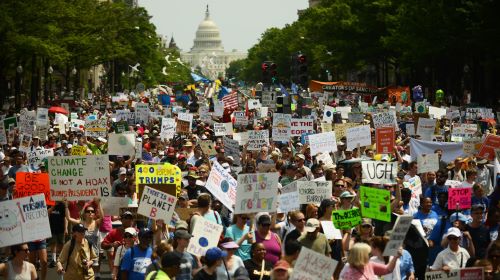
In addition to demanding that states implement climate portions of bills like the Green New Deal, we can exert financial pressure by refusing to do business with banks and insurance companies that finance and insure the construction and operation of oil pipelines, which continue to harm public health and drive climate change. We can show up in the streets and take direct action through organized protest and civil disobedience. And we can vote in the midterm elections come November. As both an environmental lawyer and a concerned citizen, I personally view my forthcoming vote as a direct rebuke of this activist, reactionary Supreme Court. Some of the progressive candidates running for office are climate activists in their own right, and some are simply running on climate-forward agendas: either way, research shows that these are winning platforms, particularly for candidates who prioritize high-paying, clean energy jobs.
A problem on the scale of climate change can never be solved without sustained public demand for forward-thinking policies — and that demand starts at the grassroots level. As many of us suffer through what is our hottest summer ever recorded, we must call and write our elected officials — from governors to representatives in Congress, to state and local lawmakers — and mandate that they listen to scientists and declare a climate emergency in exchange for our continued support. For the U.S. to be on a path to net zero emissions by 2050, lawmakers must put science and evidence first by transitioning to a clean energy infrastructure while considering the needs of workers and families alike.
The fact that the most ambitious climate action ever undertaken by the U.S. was ultimately supported by Manchin, political compromises aside, indicates to me that public demand for climate action is continuing to shift the political landscape in small but powerful ways. We must not lose momentum now. The community activist Saul Alinsky is often quoted as saying that power goes to two poles: those who’ve got the money and those who’ve got the people. We know who has the money in this ongoing negotiation. We can’t let them forget that we’ve got the people on our side.
Originally published by Undark Magazine, 08.11.2022, republished with permission for educational, non-commercial purposes.
About the Author