“Overall, Christianity loses far more people than it gains through religious switching.”

By Mikayla Roberts
Co-Executive Producer, WHOV TV & FM
Scripps Howard School of Journalism and Communication
Hampton University
Although Gen Zers generally identify as spiritual, Christianity doesn’t seem to resonate as much as it did with previous generations.
Only 45% of America’s Gen Z identify as Christian, according to Pew Research Center’s most recent Religious Landscape Study – a 10% decline from a previous 2014 survey. More than half of millennials and a little over 70% of Gen X respondents identified as Christian.
“A big part of what’s happened in recent decades is that as older cohorts of highly religious older people have passed away, they have been replaced by new cohorts of young adults who are less religious than their parents and grandparents before them,” the Senior Associate Director of Religion at Pew, Gregory Smith, said. Smith explained that each generation has become less religious as it has aged.
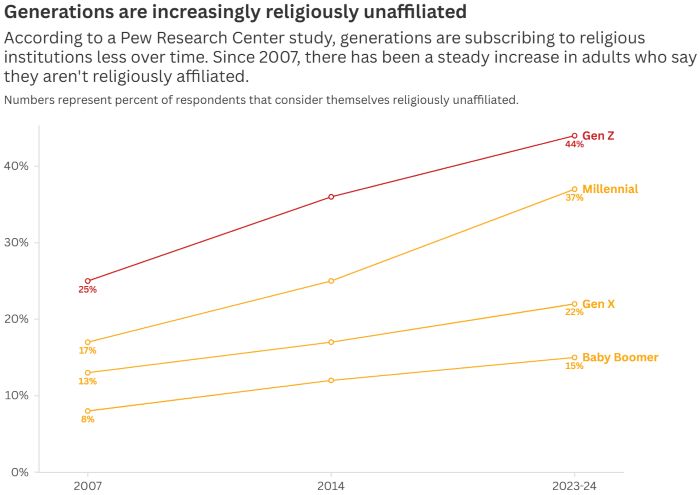
Only 63% of the U.S. population identify as Christian, a 15% decline since Pew’s 2007 study. Despite the decline, Pew researchers say the numbers are leveling out – at least temporarily.
“For lasting stability to take hold in U.S. religion, something would need to change,” Smith said. Gen Z would have to become more religious as they age or future generations would have to be more religious. But if the religiousness of future generations looks more like Gen Z than Gen X, then we can expect a long term decline in religion, according to Smith.
Almost half of Gen Z claimed religion isn’t important, a 15% increase from the 2014 survey. About a quarter of Gen Z respondents believe that religion does more harm than good.
University of Minnesota sociology professor Penny Edgell described the future of the religious landscape as lumpy. She believes there’s an important question emerging of how people who choose to remain involved in religion are different from those who choose not to, like their patterns of friendship and political involvement.
“More people know more people who are not themselves religiously involved. It’s not taken for granted. It’s understood as one option among maybe different kinds of options for how to live your life,” Edgell said.
The survey shows that about three-fourths of Gen Z come from homes in which religion was of some importance to their families – the same share of the total population that said the same. About 60% said that religion was of some personal importance to them growing up and a little over half say they’re not religious at all now.
Meanwhile, 65% of the generation identifies as spiritual. The growth in spirituality is not only reflected in Gen Z – over 70% of millennials and 80% of both Gen X and older generations claim spirituality.
“These rates of spirituality are high in a landscape where only 51% of Americans said they have even a positive view of religious institutions, let alone be involved in one. So what’s the story? ” Edgell said.
She believes that spirituality is becoming diffused out of religious institutions and into other institutions, like workplace wellness programs or community mindfulness seminars, previously thought of as secular.
The survey also shows that many switch religions between childhood and adulthood, Smith explained.
“Overall, Christianity loses far more people than it gains through religious switching… By contrast, the religiously unaffiliated gain more people through switching than they lose.” For every six people who say they were raised Christian but no longer identify as such, there is one convert to Christianity.
There’s also been a particular decline in Christianity across political lines. While there was only a 7% decrease from 2007 amongst conservatives, there was a 16% decline amongst moderates and 25% decline amongst liberals.
Smith clarified that this doesn’t necessarily mean that people’s political ideologies have led to changes in their religion. He said it’s possible that the opposite is true – religious people have changed their political outlook over time – or that some of both are happening.
“This political/religious sorting has a whole lot to do with whether people are happy about, invested in, and want to support traditional patriarchal gender and family arrangements or whether they want to challenge those,” Edgell expressed.
Edgell claims there’s a lot of evidence that the decline of religion has to do with people who are not affirming of mainstream family arrangements or whose sexuality is not heteronormative being distant from and critical of religious institutions.
For example, over three-quarters of Gen Z agreed that homosexuality should be accepted versus the just under 60% of baby boomers and older participants. Almost 80% of Gen Z favored same-sex marriage in comparison to 55% of baby boomers and older respondents.
Originally published by Capital News Service, University of Maryland Philip Merrill College of Journalism, 03.25.2025, republished under fair use for news reporting purposes.
About the Author