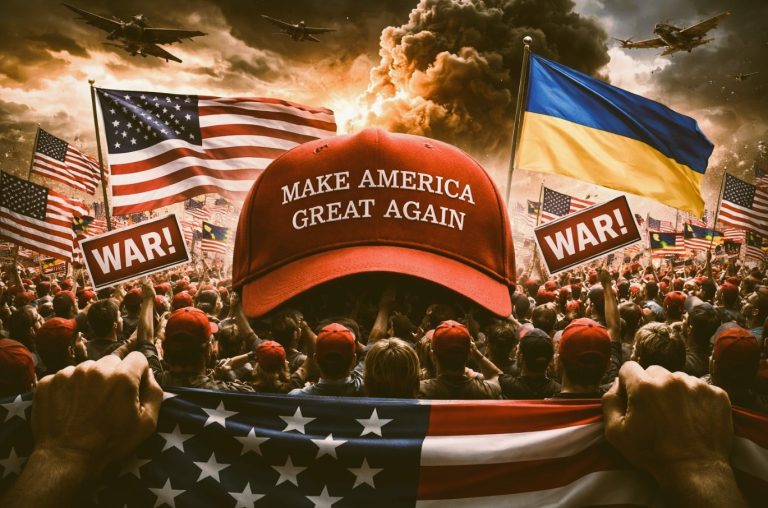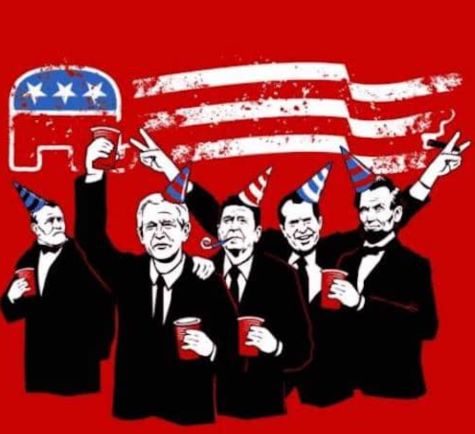
The Republican Party and its current leader shows many similarities to fascist policies.
By Wayne Price
Introduction
Donald Trump is the culmination of how the Republican Party has been developing for years. Together they threaten to establish an authoritarian state in the service of big capital. They endanger the lives, health, and living standards of the working class and the rest of the population. But supporting the Democratic Party is not the solution.
Noam Chomsky writes somewhere, “The Republican Party is the most dangerous organization in the world.” (I am quoting from memory.) Is this true? If it is, does it mean that the Democratic Party is the last, best, hope for the world? In my opinion, it is mostly true, but the Democrats are not the answer.
This view of the Republicans as an especial danger is developed by the liberal economist, Paul Krugman, in his latest book, Arguing with Zombies.
The modern Republican Party…is…just one part of a highly organized movement that includes the Murdoch media empire, a dizzying array of think tanks and advocacy groups that are mostly financed by the same group of billionaires, and more….[This is] ’movement conservatism’…Democrats had moved only slightly to the left—but Republicans moved very far to the right. There is polarization in our politics but…it’s ‘asymmetric’. (Krugman 2020; 297)
Writing of the Republican’s rejection of global warming: “We’re now ruled by people who’re willing to endanger civilization for the sake of political expediency, not to mention increased profits for their fossil-fuel friends.” (2020; 329) Further,
The history of Republican climate denial…looks a lot like Trumpism. Climate denial…was the crucible in which the essential elements of Trumpism were formed….Take Trump’s dismissal of all negative information about his actions and their consequences as either fake news…or the products of a sinister ‘deep state.’ That kind of conspiracy theorizing has long been standard practice among climate deniers…. (335-6)
This brings further danger: “Trump has brought a new level of menace to American politics, inciting his followers to violence against critics and trying to order the Justice Department to prosecute Hillary Clinton and James Comey. But climate scientists have faced harassment and threats, up to and including death threats, for years. And they have faced efforts by politicians to, in effect, criminalize their work.” (336) This was written before Trump’s Attorney General Bill Barr corrupted the Department of Justice in several high visibility cases (and many lesser noticed cases).
In summary,
Corruption, willful ignorance, conspiracy theorizing, and intimidation…[is] specifically a problem of the Republican Party…. Donald Trump isn’t an aberration, he’s the culmination of where his party has been going for years.(337; my emphasis)
Krugman does not see the Republican Party as currently managing an authoritarian, dictatorial, state. Instead, he claims that “the G.O.P. is an authoritarian regime in waiting, not yet one in practice.” (347) He notes that in Poland and Hungary, right-wing, nativist, nationalist, pseudo-populist, parties have been elected to power, only to establish effective,
one-party rule for the foreseeable future.” These parties “maintain the forms of popular elections, but have destroyed the independence of the judiciary, suppressed freedom of the press, institutionalized large-scale corruption, and effectively delegitimized dissent. (358)
Krugman fears,
It could all too easily happen here….The Republican Party is ready, even eager, to become an American version of Law and Justice or Fidesz, exploiting its current political power to lock in permanent rule….. (358) The Republican assault on health care is just the leading edge of an attack on multiple fronts, as the G.O.P. tries to overturn the will of the voters and undermine democracy in general. (367)
As evidence, he cites the Republican drive to limit and suppress voting, especially by People of Color and poorer working class people. This includes a years-long effort to gerrymander the states, to manipulate the voting process, to fight against all efforts to expand voting, and to close voting places. Currently the Republicans are bitterly opposed to voting by mail, even in a pandemic. This anti-voting effort has been carried out through Republican-led state legislatures, the Republican-controlled Senate, and the Republican-appointed Supreme Court majority (which gutted the Voting Rights Act). All levels of the Republican Party have given total support to Donald Trump, even in his most outrageous and despicable actions. They have defended Trump’s overriding of Congress, denying its subpoenas, rejecting its oversight, and violating its laws. Krugman also mentions various undemocratic actions at the state level, such as North Carolina, where a Democrat was elected governor but the Republican legislative majority voted to strip the office of much of its power. And so on.
To return to Noam Chomsky:
Both parties have moved to the right during the neoliberal period of the past generation….The Republicans have pretty much fallen off the spectrum, becoming what respected conservative political analyst[s]…call a ‘radical insurgency’ that has virtually abandoned normal parliamentary politics….The Republican Party’s dedication to wealth and privilege has become so extreme that its actual policies could not attract voters.” Therefore it has crafted an appeal to “evangelical Christians…, nativists,…unreconstructed racists, people with real grievances who gravely mistake their causes, and others like them who are easy prey to demagogues and can readily become a radical insurgency. (Chomsky 2017; 232)
David Frum, a former conservative, is quoted by Krugman, “If conservatives become convinced that they cannot win democratically, they will not abandon conservatism. They will reject democracy.” Krugman adds,
That’s happening as we speak. (369)
Is It Fascism Yet?
Not long after the 2016 election, John Bellamy Foster, editor of the Marxist Monthly Review journal, wrote: “Not only a new administration, but a new ideology has now taken up residence at the White House: neo-fascism.” (Foster 2017; 19) Is this a useful way to conceptual what is happening? (Krugman does not use the term “fascism.”)
What is fascism? It is one form of state which exists together with a capitalist economy. When World War II was over and the Nazi regime was gone, most of the same German big businesses which had existed before the war were found to still be in operation, ready to continue. Nazi rule had only strengthened German capitalism. But fascism is a different type of government from a bourgeois (“representative”) democracy. A bourgeois democracy has multiple parties, elections, free associations, freedom of speech, workers’ unions, or a free press (all within limits and exceptions—this is bourgeois democracy after all). The people can vote out the ruling party and replace it (although with a limited choice of alternate parties, such as Democrat or Republican).
Obviously, the U.S.A. is still a bourgeois democracy. Trump and the leading Republicans might wish for some sort of dictatorship (at times Trump has claimed that he has “total power”). But they do not have it. What Krugman and others are worried about is that the Republicans have taken significant steps in that direction, and that, under certain circumstances, they might go all the way, even while keeping the trappings of political democracy. Foster points out that both Mussolini and then Hitler came to power by appearing to rely on Italian and German constitutional procedures. (Mussolini was appointed by the Italian king; Hitler was appointed chancellor by the elected president.)
Fascism is different, not only from bourgeois demcracy, but even from more traditional authoritarianisms, such as monarchies or traditional military juntas. To completely crush their popular enemies, including the unions, fascists organize mass movements. Historically, these have been based in the lower middle classes. These contain the people who feel most threatened by economic and other crises, fearful of being driven down further into poverty, but still with anger against the “elites” above them.
The Republican Party has become a popular movement, a “radical insurgency.” This can be seen in their mass rallies for Trump and in their primaries where they punish any politician who is a little bit independent of the Trumpian agenda. “Trump’s electoral support came mainly from the intermediate strata of the population, that is, from the lower middle class and privileged sections of the working class….Nationally Trump won the white vote and the male vote by decisive margins….” (Foster 2017; 20-1) Despite their past (relative) privileges, these had often lost incomes or jobs in the last decades. They are overwhelmingly evangelical Christian. Some are rabid racists, while many are not but neither are they turned off by Trump’s racism. They are nativists, hating and fearing brown-skinned or non-Christian foreigners. Aside from a hard core of neo-Nazis, they do not think of themselves as “fascists.” Overall, they are about 40 percent of the population—a minority, but a big and motivated minority.
Central to the victories of the Italian Fascists and German Nazis were their extra-legal military forces: blackshirts and brownshirts, the stormtroopers and the fascisti. This does not exist for Trump or his party. There are no volunteer forces marching with colorful uniforms. But, as has already been mentioned, Trump has encouraged violence at his rallies and elsewhere. There has been an armed “militia” movement as well as people who are committed to carrying guns to demonstrations. Right-wingers have repeatedly threatened to use “second amendment remedies” if they are denied their way. There have been repeated confrontations between police and armed demonstrators, in which the police handle them with kid gloves. (Imagine how the police would treat armed African-American demonstrators!)
In short, the Republican Party and its current leader shows many similarities to fascist policies. But they also show certain key distinctions. There is a difference between cheating in elections, gerrymandering, and suppressing the vote—and cancelling elections, outlawing all but one party, and declaring Trump president-for-life. There is a difference between encouraging armed demonstrators to violate the laws—and organizing armed, uniformed, stormtroopers. These are steps toward fascism, which are bad enough, but they are not there yet. This might be called “neo-fascism” or “quasi-fascism” or “not-yet-fascism.”
Foster concludes,
If the White House is…neo-fascist in its leanings, this does not extend to the entire U.S. state….Still, there is no doubt that liberal or capitalist democracy in the United States is now endangered…We are, as political scientist Richard Falk has put it, in a ‘pre-fascist moment.’ At the same time, the base still exists within the state and civil society for organized, legal resistance. (23)
The Democratic Party?
Krugman plainly thinks that electing the Democrats is the solution. His book has a chapter on the greatness of Nancy Pelosi. He describes the Democrats as having “always been a loose coalition of interest groups….” (Krugman 2020; 297) While the Republicans have been moving sharply to the right, the Democrats have been trailing after, moving slowly to the right, under the leadership of Carter, Bill Clinton, and Obama. “Mainstream Democrats are now pretty much what used to be called ‘moderate Republicans.’” (Chomsky 2017; 232) They have generally moved away from their appeal to the unionized, mostly white, working class, and turned to middle class, more educated, white-collar workers and better-off suburbanites for votes.
But in society at large, younger adults and sections of the working class have become interested in “socialism.” For the first time in decades, there has been a revival of a “socialist” movement, as demonstrated by the growth of the Democratic Socialists of America and by Bernie Sanders’ campaign. So the Democrats have swung back a bit to their left, at least in rhetoric. “Democrats had moved only slightly to the left.” (Krugman 2020; 297) Contrasted to the Republicans’ ultra-right orientation, this can seem very progressive.
Krugman does not regard any of the Democrats, including Sanders, to really be “socialists”—which he defines as government ownership of the economy. (I am a libertarian, anti-state, socialist—which is to say, a revolutionary anarchist.) Instead he says the Democrats are “social democrats,” as in Europe: advocating taxes on the rich, regulation of business, and a welfare safety net for all. He does not note that the European social democratic parties have been pulling back from their reform programs, while the European right has been vigorously attacking the social democratic benefits of the people.
Four Crises
To develop a strategy for dealing with Republican attacks, we have to understand how this developed. Krugman writes, “‘Movement conservatism’ barely existed before the 1970s and it didn’t fully take over the G.O.P. until the 1990s….” (297) What happened in this period?
What paved the way for Trump’s neo-fascist strategy and gave it coherence was the deepening long-term crisis of U.S. political economy and empire, and of the entire world capitalist economy….The system [was] in a state of economic stagnation, with no visible way out. (Foster 2020; 45-6)
The 1970s was the end of the prosperity which followed World War II. The capitalist economy began to decline, to stagnate, and to lose profitability in the real economy while an inflated financialization bloomed. The U.S. economy and national state began to lose their international dominance to other countries. Beginning then, and expanding in the 90s, there was an attack on the working class, decreasing their benefits and weakening their organizations. The Republicans were the cutting edge of these attacks but the Democrats also participated. Unions shrunk to a fraction of their size in the work force. Inequality zoomed. “We live in an era of soaring inequality and growing concentration of wealth at the top….[in] our march toward oligarchy….” (Krugman 2020; 348-9)
Right now we are living through four interconnected crises. There is the covid-19 pandemic. How long it will last and how bad it will get cannot yet be foretold. It has triggered a second, international economic, crisis. Even “after” the plague has been reasonably controlled, the world may be in a major recession or depression. Meanwhile the climate cataclysm continues to advance. There are floods in the Midwest and gathering hurricanes off the Atlantic coast, while other environmental disasters hit the rest of the world. The eventual threat of human extinction still hovers if nothing is done. Finally, in a political crisis, all this is happening while the U.S. government is being managed by a completely incompetent, delusional, and narcissistic freak. Similarly, several of the state governments are led by incompetent, ignorant, and deluded governors—courtesy of the Republican Party.
It was not inevitable that these four crises would hit at the very same time. (It was not inevitable that a conservative president would be such a total jerk. Consider Germany’s Angela Merkel.) But they all are products of this extended period of capitalism, with its basic decline, at home and abroad.
Strategy Against Fascism
All of which indicates that fascism (or some sort of authoritarian government) cannot be prevented without fighting capitalism. The current Republican Party is a symptom of the chaos and decline of industrial capitalism. The Democratic Party cannot fight it effectively because it too is committed to the same rotting system. (I am not discussing here the need to combat openly Nazi and Klan groupings.)
For decades, the liberals, the unions, the leaders of the African-American community, and other progressive forces have thrown their human resources and money behind the Democrats. And repeatedly, reactionary Republicans (Nixon, Reagan, G.W. Bush) have been replaced by “moderate” or even “liberal” Democrats (Carter, Clinton, Obama). But this did not solve the problem. These “moderate”/“liberal” Democrats were invariably followed by other reactionary Republicans. Until now the Obama administration has been replaced by the most reactionary president yet! There is no reason not to assume that another Democratic president (the pro-business, militaristic, gaffe-prone, Biden) would not be followed again by a terrible Republican. No Democrat can solve the social problems which will once again drive many U.S. citizens to look towards the alternate party of our two-party system.
This is not a discussion of how (or whether) any particular individual should vote in 2020. But a strategy for preventing “neo-fascism” from taking over requires a different approach from electoralism or trust in the Democratic Party. There needs to be a mass movement of the working class and all oppressed people, of everyone who is outraged by the capitalist class’ mishandling of the covid plague, of the economic collapse, of the ecological cataclysm, and of all the other evils of this society. There needs to be a replacement of this ruling class and its state by a revolutionary libertarian, radically-democratic, cooperative, nonprofit, ecologically sustainable, society of free and equal humans.
Conclusion
The Republican Party is an extremely dangerous organization. Culminating (so far) in the Trump presidency, it wages war on the environment, threatening all human life. It threatens the public’s health and lives. It threatens the jobs and incomes of the working class and the rights of women and People of Color. It threatens political freedoms and democracy, however limited these are in a capitalist state. It has not yet established a fascist dictatorship but is “an authoritarian regime in waiting.”
The Republican Party cannot be defeated by building up the Democrats. This has never worked. Fascism can only be fought by fighting capitalism. In the long run, the greater evil cannot be defeated by the lesser evil. Things just get more evil. All parts of the system have to be opposed, on every issue.
References
- Chomsky, Noam (2017). Who Rules the World? NY: Picador/Henry Holt.
- Foster, John Bellamy (2017). Trump in the White House; Tragedy and Farce. NY: Monthly Review.
- Krugman, Paul (2020). Arguing with Zombies: Economics, Politics, and the Fight for a Better Future. NY: W.W. Norton.
Originally published by Monthly Review, 06.02.2020, under the terms of a Creative Commons Attribution-NonCommercial-NoDerivatives 4.0 International license.
About the Author