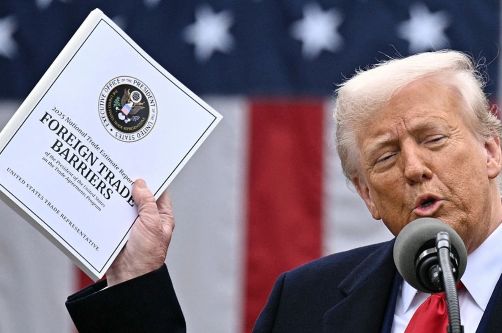
Trump is not very smart or well-informed.

By Thom Hartmann
Political Commentator
Feeling liberated yet?
People of a certain age will remember Yosemite Sam chasing Bugs Bunny around with a shotgun, blasting holes in walls, ceilings, and windows while completely missing his target. It’s the perfect metaphor for Trump’s tariff policy announced this week.
Trump is acting as if tariffs were a form of warfare, and he’s “fighting back” against the countries that have “taken advantage of us.” This is how he’s behaving like Yosemite Sam with his blunderbuss, shooting everywhere and just making a mess while missing the target altogether.
He’s not only throwing wild tariffs on every country that trades with America (except Russia), but he also put a flat 10% tariff on every product imported into the United States (except from Russia).
Additionally, this sort of rhetoric — and making tariffs country-specific instead of product-specific — is what drives trade wars that also run the risk of increasing the danger of actual wars.
“Shooting” at countries instead of at products is not only hostile; it’s also generally counterproductive except, literally, during time of war.
Further demonstrating Trump‘s ignorance about the difference between business-based tariffs on products and war-based tariffs on countries, his commerce secretary, billionaire Howard Lutnick, is warning countries not to engage in reciprocal tariffs or trade restrictions.
The second solid criticism of Trump’s tariff plan is that only Congress has the legal power to impose them, and that’s a good thing.
No manufacturer is going to invest billions of dollars and years of construction to build a factory here in response to a tariff thrown up on the whim of a mercurial president; they want to know that that tariff will be there for decades so they can earn back their investment.
Which is why, outside of wartime, tariffs should be specific to products, not countries.
Our Department of Commerce specifies over 17,000 separate categories of products that tariffs can be attached to, and they’re often startlingly specific. Steel, for example, has 740 sub-categories ranging from rolled steel to ingots to hundreds of items as specific as “Semi-finished iron/nonalloy steel, ≥ 0.25% carbon, rectangular/square cross-section, width ≥ 4x thickness.”
Products that we make in America, or want to make here again, should be the targets of tariffs, not the countries that make them. And while there are thousands of product categories that are amenable to tariffs, there are also things it would be stupid to put tariffs on because we don’t make them here — and don’t plan to.
For example, we don’t grow coffee in the US, but they do in Mexico; that’s why we imported 65.5 million kilograms of unroasted beans from that country in 2022. Slapping a tariff on all Mexican goods will sweep up coffee, which will only succeed in driving up inflation here, as the cost of the tariff is added to every cup in every kitchen and restaurant across America.
Bringing back manufacturing also a really good thing to do, because it’s historically been one of the most important ways that workers can find entrée into the middle class without a college education.
Sadly, though, Trump may be doing more damage than good to the cause of the middle class with his bizarre country-based tariff policy.
Trump is able to do his uninformed tariff song-and-dance because there’s a loophole in our tariff laws that allows the president — during a time of national emergency — to impose emergency tariffs. It makes sense that the president should have that flexibility in the event of another Republican Great Depression or World War III, but that isn’t what’s happening today.
Trump declared a state of emergency at the beginning of his administration specifically so he could put his tariffs into place — which means the next president can simply reverse them. Again, no CEO in her right mind is going to invest billions based on that level of uncertainty.
At least four Republican senators get this; Tuesday night, Trump did one of his signature weird 1 am screeds on his Nazi-infested social media platform, calling out Mitch McConnell, Rand Paul, Susan Collins, and Lisa Murkowski by name because they’re supporting a Democratic effort to end the state of emergency so Congress can reclaim its trade authority. They voted with Democrats last night and the resolution passed; it goes to the House now, where Mike Johnson will probably kill it.
If Trump had any understanding of tariffs outside of his simplistic “you hurt us, we hurt you” worldview, he’d realize the best way to accomplish his stated goal of bringing manufacturing back to this country can be tariffs, but only when they are done carefully and selectively.
But, no; understanding anything other than how to cheat on golf and your taxes, screw vendors, stiff workers, and sexually assault women is beyond his limited abilities. And, of course, running companies into bankruptcy and being bailed out by Russians. Repeatedly.
When Congress imposes tariffs there’s a far better chance they’ll stay in place long enough to assure American companies it’s worth building new factories. Instead of imposing his tariffs by fiat, Trump should have put them into the form of a proposed bill that he’d then submit to Congress.
Sadly, he’s not that smart or well-informed about history, and apparently neither are his advisors.
So, here we are with actions taken that may throw the entire world into recession, or possibly even a second Republican Great Depression.
That said, there’s also a huge risk to any Democrats who might want to play Yosemite Sam themselves, blasting away at Trump’s tariffs and missing the nuance — and the multiple truths — that make up today’s trade situation.
The simple reality is that tariffs do work to protect domestic manufacturing; they have since the founding of our republic, and are used today by every country in the world (including the US) for that purpose. (There’s a great explainer of all this, including the American history with tariffs going back to George Washington and Alexander Hamilton, here.)
And, when Reagan embraced neoliberal cuts in tariffs, negotiating the Uruguay Round of the General Agreement on Tariffs and Trade (GATT) in 1986 — which led to the WTO and NAFTA (also negotiated by Reagan and Bush respectively) — those two Republican presidents began the long slide of American manufacturing.
As the union guy who spoke at Trump’s event yesterday noted, anybody over 50 can remember when everything in Walmart — and pretty much everywhere else, including the cars on the dealership lots — was made in America.
Hell, Sam Walton started Walmart with the slogan “100% Made in the USA” which is also the title of his autobiography; it was only when those tariffs collapsed as a result of Clinton signing off on Reagan’s/Bush’s NAFTA and the WTO that Walton’s stores began to import from cheap-labor countries and stopped stocking American-made products.
Because of this simple reality, Democrats who simply fall back on the old neoliberal talking points that tariffs are sales taxes and that countries that trade with each other are less likely to go to war with each other (the original explicit neoliberal rationale for tariff-free trade) are risking political suicide.
It’s hard to make political arguments that use nuance, but in this case, Democrats really don’t have a choice. Having grown up in the Midwest (Michigan) I can tell you that most anybody who hails from a former manufacturing region is cheering Trump on right now.
Regardless of party.
And today’s Democrats haven’t been all that hostile to tariffs: Not only did President Biden keep Trump’s tariffs from his first term in place, he added additional tariffs of his own (although almost nobody knows it).
Biden increased tariffs on steel and aluminum products from 7.5% to 25% in 2024; his tariffs on semiconductors will rise to 50% by the end of this year; Democratic tariffs on some electric vehicles (EVs) hit 100% last year; Biden’s tariffs on lithium-ion EV batteries and magnets for EV motors will go up by 25% by 2026. After the Covid crisis, the Biden administration even put a 50% tariff on syringes and needles to jump-start domestic production, and personal protective equipment (PPE) tariffs went up 25%.
(Notice that none of those are tariffs on countries, just on products. The only country-specific tariffs Biden approved were against Russia, in response to their invading Ukraine, as a form of economic warfare.)
Opposing tariffs just because Trump loves them, in other words, isn’t just ineffective politics; it doesn’t even conform to Biden’s new Democratic trade policy.
So, here’s how modern Democrats need to talk about this situation. It’s not only good political messaging; it’s also good trade policy, as I lay out in my book The Hidden History of Neoliberalism: How Reaganism Gutted America.
First, Democrats need to answer the question, “Why tariffs, particularly if they act as taxes on imported goods?”
That answer is easy; it’s an accurate explanation of what Trump is totally garbling: Tariffs encourage manufacturers to produce their products here in the USA instead of in cheap labor or high pollution countries.
But the “how to do it” is the critical part.
Democrats, in other words, need to differentiate between “smart tariffs” and “stupid” or “wartime tariffs,” advocating the former while ridiculing the latter.
“Put tariffs on products, not on countries” would be a great start, for example.
Our dim-witted president is being called out on his shoot-from-the-hip tariff policy from both left and right. The country is confused, and needs to understand what is going on and how it will impact their future.
Democrats must therefore take a clear position in favor of smart, targeted tariffs — on individual products rather than countries — like Biden did.
And then they must point out that Trump’s obsession with slapping punitive tariffs on countries (except on Russian products) stupidly risks utterly crashing our economy — and possibly even the world’s economy — while starting a trade war that nobody will win.
And, tragically, it’s all being done not for any good reason, but just because Trump is not that bright.
Published by Common Dreams, 04.04.2025, under the terms of a Attribution-NonCommercial-NoDerivs 3.0 Unported license.
About the Author