The first sign of growing military coordination between Moscow and Tehran took place in 2016.

By Dr. Ghoncheh Tazmini
Associate Member of the Centre for Iranian Studies
SOAS University of London
While the European Union’s plan to establish a “special purpose vehicle” to protect Iranian commerce from U.S. sanctions continues to underwhelm Iranian leaders, the Russian government has taken a decisive step to help Iran circumnavigate sanctions by allowing Tehran to transport crude oil through ports in Crimea. This is not the first nor the last time Russia has acted as a bulwark against Iran’s political and economic isolation, having previously, for example, armed it with sophisticated weapons systems and military technology. Russia has consistently deflected punitive action against Iran, vetoing United Nations Security Council resolutions that it deems unfavourable to Iran (aside from a brief period during Dmitri Medvedev’s presidency, when he and then-U.S. President Barack Obama were trying to “reset” U.S.-Russian relations).
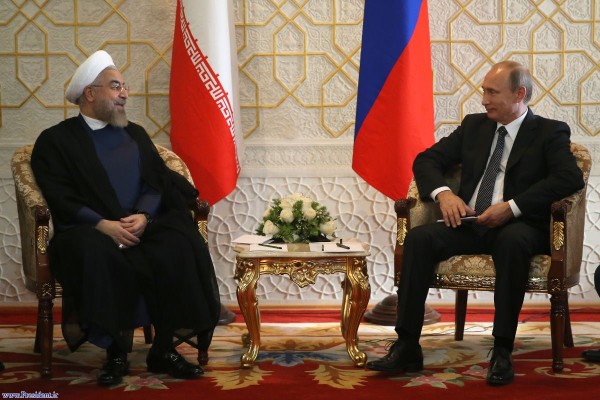
Speaking of the latest expansion of Russian-Iranian cooperation, Deputy Prime Minister of Crimea Georgy Muradov announced that Iran could use the disputed Russian territory’s ports for the transit of oil. This news comes a couple of months after Moscow and Tehran announced that they would carry out joint naval drills in the critical chokepoint of the Persian Gulf, the Strait of Hormuz, which is the world’s most strategically important oil artery and the site where Iran has seized three oil tankers so far this year. Russian efforts to help Iran skirt sanctions and an unprecedented broadening of military cooperation between the two countries have given a major boost to the Russian-Iranian marriage of convenience—even if it is symbolic.
The first sign of growing military coordination between Moscow and Tehran took place in 2016, when Russia launched a fleet of bombers bound for Syria from an Iranian air base. This marked the first time a foreign military had operated from Iranian soil in about 100 years. Article 146 of the Iranian Constitution strictly forbids the stationing of foreign troops, even for peaceful purposes, on Iranian soil. Thus these manoeuvres were more symbolic in nature, and a testament of a growing convergence between Russian and Iranian interests. The interactions of these two states do not necessarily qualify as an ‘alliance’—it’s unclear, for example, how far would Russia extend itself militarily in the event of an attack on Iran, or vice versa—so the Russian-Iranian partnership is perhaps best described as an ‘alignment’.
With diverging historical narratives and ideological backgrounds, Moscow and Tehran are indeed, strange bedfellows. Characterised as everything from a “random partnership” to a “circumstantial alliance”, the Russian-Iranian alignment is marred by ambiguity. Indeed, Moscow’s mercurial manoeuvrings with Iran have manifested in peaks and troughs, vacillating between cooperation and conflict. There is speculation that the Kremlin is simply guided by ruthless realpolitik imperatives and that it would ‘sell out’ Iran for lucrative defence and military contracts with Iran’s regional ‘arch rivals’, like Saudi Arabia and the United Arab Emirates. Moscow purportedly gave the ‘green light’ to Israel to strike Iranian-held targets in Syria, whilst allegedly refusing to upgrade Iran’s battery of air defense missiles to the more sophisticated S-400 system. Apparently, Russia neglected Iran’s Shanghai Cooperation Organisation (SCO) membership (although the blame should fall on China’s shoulders) and allegedly swindled Iran out of trillions of dollars with the putatively lop-sided ‘Convention on the Special Status of the Caspian Sea’ signed in August 2018.
These are some of the arguments frequently recycled to demonstrate that Moscow is skimping on its commitment to Tehran. Rear Admiral Ali Shamkhani, secretary of Iran’s Supreme National Security Council (SNSC), would disagree: in a meeting in with Russian officials in Tehran in July 2019, Shamkhani emphasised the positive course of Russian-Iranian cooperation. He expressed gratitude for Russia’s “decisive and impartial” positions concerning U.S. abrogation of the 2015 nuclear deal (the Joint Comprehensive Plan of Action or JCPOA), Iran’s presence in Syria, the intrusion into Iranian airspace of a U.S. spy drone, and Britain’s seizure of an Iranian tanker off the coast of Gibraltar.
In Moscow on 2 September, during talks with his Iranian counterpart, Javad Zarif, Russian Foreign Minister Sergei Lavrov reiterated the Kremlin’s position, accusing the U.S. of “openly seeking to provoke Iran with the support of some of their regional allies.” Lavrov commended France’s recent efforts to try to break the impasse and to convince the U.S. to offer Iran some sanctions relief.
Another argument is that the degree of expansion or contraction in Russia-Iranian cooperation depends on whether relations between the U.S. and Russia are amicable or hostile at the time. There is some truth to this argument—if we look back at the presidency of Medvedev, when Russia voted in favour of all six Iran-related resolutions passed at the UNSC between 2006 and 2010. However, Russia will not forsake Iran over the U.S. in the current climate, and that is because there is a fundamental disjuncture between Russian and U.S. perceptions of the post-Cold War world order. A substantive and permanent pivot toward the U.S. would require a fundamental reconstitution of U.S. foreign policy toward the Kremlin based on the delivery of concessions according to traditional Russian priorities and preoccupations. It would entail, at the very least, Washington permanently shelving NATO’s eastward expansion, and turning a blind eye to Russia’s geopolitical aspirations in the former Soviet space—an improbable scenario.
Russian-Iranian alignment is based on a careful calibration of geopolitical and strategic priorities that are informed by similar perceptions of the world order. The post-Cold War world order that saw U.S. hegemonic posturing has rendered a strategic alignment between Moscow and Tehran inevitable. Russia and Iran are fundamentally aligned—if not allied—in that they are both anti-hegemonic, opposing the idea of a single state or constellation of states (order) being able to impose particular normative values and power structures as universal, particularly when that idea is imposed through force. Thus, both states place a premium on state sovereignty, both states denounce Western interventionism, and both are perturbed by colour or democracy-promoting revolutions, perceiving them as a way for the Atlantic ideological and power system to advance the interests of Western states. Like their Kremlin counterparts, Iran’s revolutionary elite strongly believe that prevailing international norms are based on double standards, designed to perpetuate the hegemony of Western powers. This anti-imperial foreign policy culture informs Iran’s revolutionary zeitgeist, its strategic preferences, and by extension, bi-lateral relations with, for example, Russia.
On the Russian side, Iran is seen as a key player in its quest to foster an anti-hegemonic alignment, which it hopes will lead to the emergence of an alternative architecture of world affairs, as exemplified by the Eurasian Economic Union (EEU), the Shanghai Cooperation Organisation (SCO), BRICS (Brazil, Russia, India, China, South Africa), and deepening cooperation with the Association of Southeast Asian Nations (ASEAN). As Richard Sakwa has argued, the pattern of world order is changing and the period of the ‘Cold Peace’ between Russia and the West—which was characterised by the failure of Western security organisations to transcend Cold War institutions and habits at a time when Russia had demonstrated openness to adapting to Western norms and institutions—is giving way to the retrenchment of bipolar confrontation between the liberal international order and the resistance of a group of states, including Russia and Iran. This explains the pattern of deeper and broader cooperation between the two states.
Thus, despite conflicting interests and regularly colliding geostrategic pathways, Russia and Iran share a similar geopolitical worldview that is defined by these enduring parameters and shaped by historical and conceptual legacies, cultural-civilisational peculiarities, normative values, and a similar discursive genealogy in relation to the West. As Trine Flockhart has suggested, a complex network of ‘inter-order’ relationships will determine the character of the coming ‘multi-order world’. Iran and Russia are firmly ensconced in this ‘inter-order’. The idea is not to uproot the international order, but rather to make room for states like Russia and Iran that do not fit neatly within the existing constellation. It is in this context that the Russian-Iranian marriage of sometimes inconvenience should be assessed.
Originally published by LobeLog, 09.06.2019, based at the Institute for Policy Studies, a program of Open Society Foundations, under the terms of a Creative Commons Attribution-NonCommercial-NoDerivs 3.0 Unported license.
About the Author