
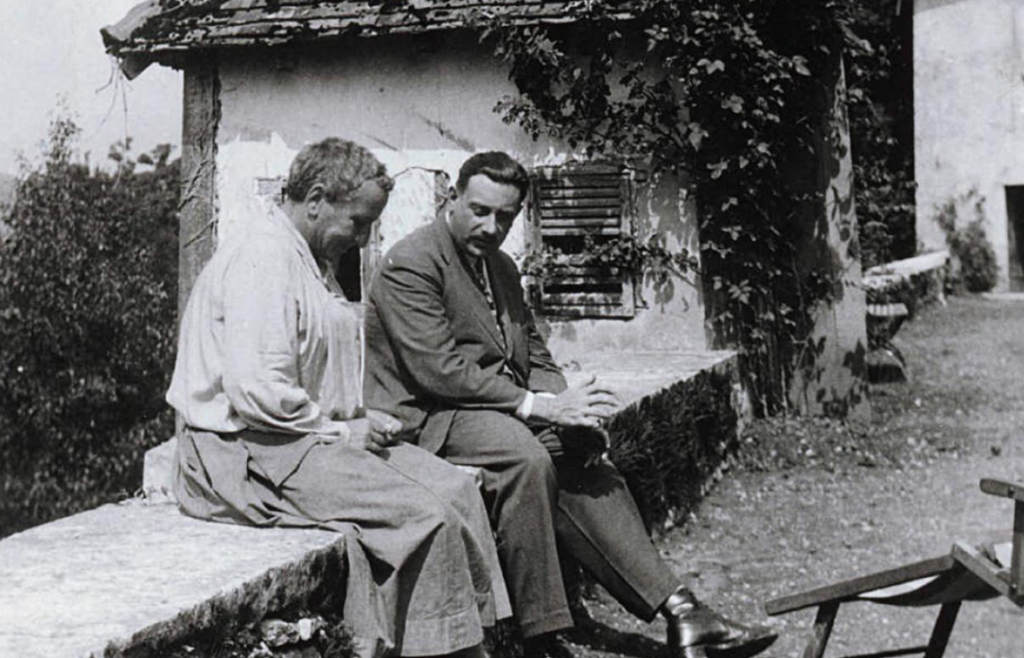
Was the den mother of modernism a fascist?
By Dr. Barbara Will
A. and R. Newbury Professor of English
Dartmouth College
Why were so many prominent modernist writers and philosophers attracted to fascist or authoritarian regimes in the first half of the twentieth century? A list of those who were not—Samuel Beckett, James Joyce, Thomas Mann, and Robert Musil—pales in comparison to a list of those who were—Ezra Pound, William Butler Yeats, T. S. Eliot, Wyndham Lewis, Knut Hamsun, Paul de Man, Louis-Ferdinand Céline, Filippo Marinetti, Martin Heidegger, Robert Brasillach, and a host of others. Add to the latter the name of Gertrude Stein, one of the most avant-garde of modernist writers in the English language, who was also—it turns out—a committed supporter of Philippe Pétain, head of state of the pro-Nazi collaborationist Vichy regime in France during the Second World War.
Gertrude Stein, a Vichy supporter? For most people, including those filling the rooms of several recent major museum exhibits on Stein, this news might come as a surprise. A Jewish-American experimental writer, friend of Picasso and muse to Hemingway, Gertrude Stein seems to embody high modernism in its most creative and progressive form. Her patronage of modernism’s giants—Cézanne, Picasso, and Matisse—made her a radical in her day. Her playful and innovative writing seems to anticipate much of postmodern thought. Her open, unapologetic, same-sex partnership with Alice B. Toklas belongs more to the liberal world of 2012 than to 1912. And yet throughout her life Stein hewed to the political right, even signing up to be a propagandist for an authoritarian, Nazi-dominated political regime.
Stein’s Vichy past has long been known to scholars of her work, if not to the public at large. In 1970, Stein’s biographer Richard Bridgman revealed not only that Stein was a fan of Pétain but had even spent a good part of the war translating his speeches into English in the hopes of having them published in America (they never were). Janet Hobhouse, another early biographer, noted the ironic dissonance between Stein’s fierce critique of the Japanese attack on America at Pearl Harbor and her “sanguine” acceptance of the Nazi occupation of France. And Linda Wagner-Martin, though insisting on Stein’s ties to the Resistance (claimed by Stein herself after the war), also referred to Stein as an apparent propagandist for Vichy.
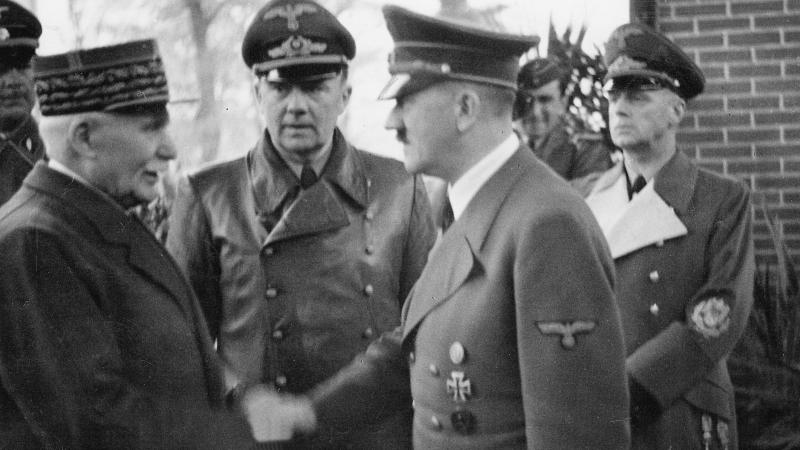
Yet surprisingly, most of Stein’s critics have given her a relatively free pass on her Vichy sympathies. Others have tried to ignore or justify equally inexplicable events: for example, Stein’s endorsement of Adolf Hitler for the Nobel Peace Prize in 1934, or her performance of the Hitler salute at his bunker in Berchtesgaden after the Allied victory in 1945. Until recently, in fact, the troublesome question of Stein’s politics didn’t really figure in debates over her legacy—as opposed, for example, to the vehement debates surrounding Mussolini supporter and modernist poet Ezra Pound.
Stein’s obvious vulnerability as a Jew in Vichy France—a regime that sent more than 75,000 Jews to concentration camps, of whom only 3 percent survived—explains some of this critical response. Even if we acknowledge that Stein was a Vichy propagandist, what right have we to condemn her for doing what she could to save herself in a terrifying situation? Hiding in plain sight might have been the best way to deflect attention away from herself. Given that many of Stein’s neighbors in the small southern town where she lived during the war were Pétainists makes this argument even more convincing. And the fact that Stein apparently joined her neighbors in supporting the French Resistance after 1943 further underscores these formative ties to her community.
On the other hand, we have no evidence to suggest that Gertrude Stein was anything but an enthusiastic supporter of the Vichy regime. In her correspondence during this period, Stein explicitly refers to herself as a “propagandist” for the “new France.” She was apparently excited by the possibility that Pétain himself had approved of her project to translate his speeches. And in one of the only pieces of Vichy propaganda Stein actually brought to press, a 1941 article on the French language in the Vichy journal La Patrie, Stein envisions a productive continuity between the political and cultural project of Pétain’s National Revolution and her own experimental writing. Even after the war, Stein continued to praise Pétain, stating that his 1940 armistice with Hitler had “achieved a miracle” (this, after Pétain had been sentenced to death by a French court for treason).
Stein’s Pétainism thus presents us with a difficult critical dilemma, but an important one. As admirers of Stein’s playful, radical, pre-postmodern writing, we may want to rescue her from her disquieting political views. But to do so greatly simplifies both her complex character and the historical moment in which she and her fellow modernists lived. Close attention to that moment requires suspending some of our most cherished beliefs about the greatest writers and artists of the early twentieth century: their belief in innovation, in revolution, in the profound necessity of going forward. In fact, for modernists like Stein, the path forward into the future often lay in a return to something lost in the wake of modernity. And it is here where the promises of fascism (and of its variants, like Pétainism) proved particularly attractive to certain modernist writers.
In 2007, journalist and author Janet Malcolm published a short book, Two Lives, in which she mused about Gertrude Stein’s connections to a man who may have led her into the orbit of the Vichy regime, a Frenchman named Bernard Faÿ (pronounced fah-ee). Malcolm asked why the modernist Stein would have been drawn to Faÿ, a royalist historian with pronounced far-right political tendencies. Malcolm’s book opened the door to discussing Faÿ’s centrality to the difficult and complex choices Stein made during the Second World War. It also began raising crucial questions about the intersection between artistic modernism and political fascism. My own recent work on Stein and Faÿ has mined the archives to find an exact historical context for this unlikely intersection.
Stein and Faÿ met in 1926, and became so close that Alice Toklas ultimately referred to Faÿ as Stein’s “dearest friend during her life.” For Stein, who not only acquired friends with ease but just as quickly dropped them, the twenty-year friendship with Bernard Faÿ was indeed an anomaly. A French writer and historian of American culture, Faÿ held a prestigious position in Paris as the youngest person ever given a Chair at the elite Collège de France. As Stein’s chief French translator, Faÿ was also the mastermind behind Stein’s highly successful tour of America in 1934–35 following her best-seller The Autobiography of Alice B. Toklas. Stein even dedicated her famous book Lectures in America to Faÿ, since it was by listening to Faÿ lecture at the Collège that Stein said she learned how to speak in public.
But Stein and Faÿ’s friendship was based on more than mutual career support. While Faÿ was helping Stein with legal and literary matters, he was also conversing with Stein about the problems of their day—and about possible solutions. In their individual writings and correspondence, we see a remarkable convergence of right-wing ideas and convictions. Both Stein and Faÿ agree that modernity, understood as the nineteenth-century development of industrial and organizational societies in France and America, has become the source of twentieth-century cultural decline. Both trace the roots of this decline to social changes that took place in the wake of the French and American revolutions, changes that had culminated in the disastrous governments of Franklin D. Roosevelt in America and Léon Blum in France. Both agreed that the eighteenth century, in both America and France, was the absolute zenith of human achievement and possibility. And both embrace their own and each other’s role in guiding their respective societies back to that essential, eighteenth-century mode of life.
These convictions would have remained sub rosa for both Stein and Faÿ had the two friends not been confronted with the moment of Vichy. For it was the emergence of the Vichy regime that would allow both to imagine, at least for a while, that their political convictions might actually be realized in practice. For Bernard Faÿ, who had known Philippe Pétain as the “Victor of Verdun” during the First World War, the Vichy regime with its dictatorial authoritarian creed was a salutary development after a century and a half of “democratic nonsense.” Elitist to the core, a royalist and a devout Catholic, Faÿ felt strongly that only a return to the political system and “spiritual values” of the ancien régime could restore France to its premodern, pre-Revolutionary glory.
Pétain’s Vichy regime seemed to Faÿ to promise just that. With his recovery plan for the nation based on a reactionary platform of “family, work, and fatherland,” Pétain sought to use the defeat of the French at the hands of the Nazis as the stimulus for a complete overhaul of French society. Faÿ eagerly signed on to the program. When Pétain authorized an armistice with Hitler in June 1940, Faÿ found himself transformed from a college professor into one of the central figures in the new regime. He was named director of France’s Bibliothèque Nationale, an enormously prestigious position in Paris. Secretly, he was also made chief henchman in charge of the repression of French Freemasons. The latter—mostly secular, left-wing, and often Jewish—were perceived as particularly loathsome by the Vichy regime. Faÿ’s mission was to identify and expose these groups; and while he was not directly in charge of their arrest and deportation, the information he compiled had insidious results. By the end of the war, six thousand French Freemasons had been directly questioned or surveilled, with many losing their jobs; almost a thousand had been deported to concentration camps and almost six hundred killed.
Faÿ’s central role in the Vichy regime undoubtedly had an effect upon Gertrude Stein’s fate during the Second World War. According to Faÿ himself, he prevailed upon Pétain to protect Stein and Toklas and to give them special dispensation to be left undisturbed during the war. Faÿ apparently secured perks like bread tickets and driving privileges for Stein, and possibly intervened when Stein’s name appeared on the third and final installment of the Nazi’s list of banned books in May 1943. Faÿ also stepped in—at the request of Picasso, who somehow knew exactly whom to contact—when the Nazis showed up at Stein’s apartment in Paris to seize her art collection (it was left undisturbed). In crucial ways, therefore, Faÿ was an indispensable friend to Stein during a period in which she was in considerable danger.

Why did Stein choose to stay in France during these dangerous times, when she was urged to leave both by American officials and by friends and members of her own family? As she explained it in “The Winner Loses,” an essay she wrote about the armistice and published in the Atlantic Monthly in November 1940, Stein was tempted to flee France for America but decided not to because of the assurances of local neighbors. Furthermore, she writes, “it would be awfully uncomfortable and I am fussy about my food.” In the same essay, Stein notes that she relied on prophecies and astrological signs to reassure her about the course of the war, most of which promised a swift German defeat. We can assume that Stein also understood something she never mentions in “The Winner Loses”—that her friendship with Faÿ would offer her a great deal of official protection during the regime.
But to say all this is not to deny the authentic enthusiasm and hope Gertrude Stein had for Philippe Pétain, not only in the beginning of the war (when many French people supported him) but well after Pétain had lost the backing of the majority. Her Pétainism appears to have been a bit more complex than that of Bernard Faÿ. For Faÿ, Pétain clearly represented one side of the so-called “two Frances”: Catholic and royalist rather than secular and republican, opposed, above all, to the French Revolution and its liberal democratic legacy. While Faÿ saw in Pétain a set of traits familiar to the French right, Stein seems to have wanted to make Pétain relevant to a wide American audience. For Stein, Pétain’s National Revolution offered a blueprint for a new kind of revolution in the United States, one that would negate the decadence of the modern era and bring America back to its eighteenth-century values.
In both “The Winner Loses” and the introduction she wrote to accompany her project to translate Pétain’s speeches into English, Stein emphasizes how much the French people welcomed and respected Pétain’s armistice with Hitler. But she also explicitly compares Pétain to mythic American figures: George Washington and Benjamin Franklin. Written in 1941, Stein’s introduction to Pétain’s speeches urges Americans to see the dictator as the very embodiment of an American Founding Father. The composite figure of Washington-Franklin-Pétain allows Stein to create a line of connection between present-day France and a lost eighteenth-century America. Regardless of his skills in leading contemporary France, Pétain’s real strength lies in the fact that he is a throwback. Stein’s introduction to Pétain’s speeches not only works as Vichy propaganda, but more importantly—and bizarrely—presents Americans with a model of leadership to emulate.
The modernist writer Ezra Pound took a similar tack in his propaganda on behalf of Mussolini. In his book Jefferson and/or Mussolini, Pound credited Italian fascism with bringing back “Jeffersonian” economic and agrarian values to the modern world. In looking back nostalgically to the rugged individualism of the American eighteenth century, Pound like Stein and a host of other American writers of the interwar period (John Dewey, Ayn Rand, John Dos Passos) contrasted this lost epoch with a decadent modern landscape. Their idealized American eighteenth century was less a real historical era than an ideological foil against which to contrast all the evils of the modern world: industrialization, mass production, bureaucratic capitalism. And for Pound and Stein at least, the surging movements of European fascism promised a renascence of that old, idealized America.
Pound and Stein were just two of the modernist writers who signed on to a fascist or authoritarian program in the hope that it would lead their societies away from the perceived problems of modern life. But this then raises the question: So what? What do the political views of these and other great modernist thinkers have to do with their art or writing? Not much, we could say, in the case of someone like Stein, whose most experimental writing seems highly abstract, patently disconnected from views and opinions, or even from politics. Or maybe her political views, in fact, have a lot to do with her experimental writing. Tracing the lines of convergence between abstract modernist art and the real social world is hard work—but it is beginning to be done. Speaking of the fascist modernist Wyndham Lewis, Fredric Jameson has criticized the systematic “‘innocence’ of intellectuals” that gives a free pass to those whose work we admire, regardless of the context in which it was written or its ultimate aim. It is high time for us to strip away that innocence, and to produce a more inclusive, complex, and realistic portrait of our modernist predecessors and their work.
Originally published to the public domain by Humanities, the Magazine of the NEH 33:2 (March/April 2012).
About the Author