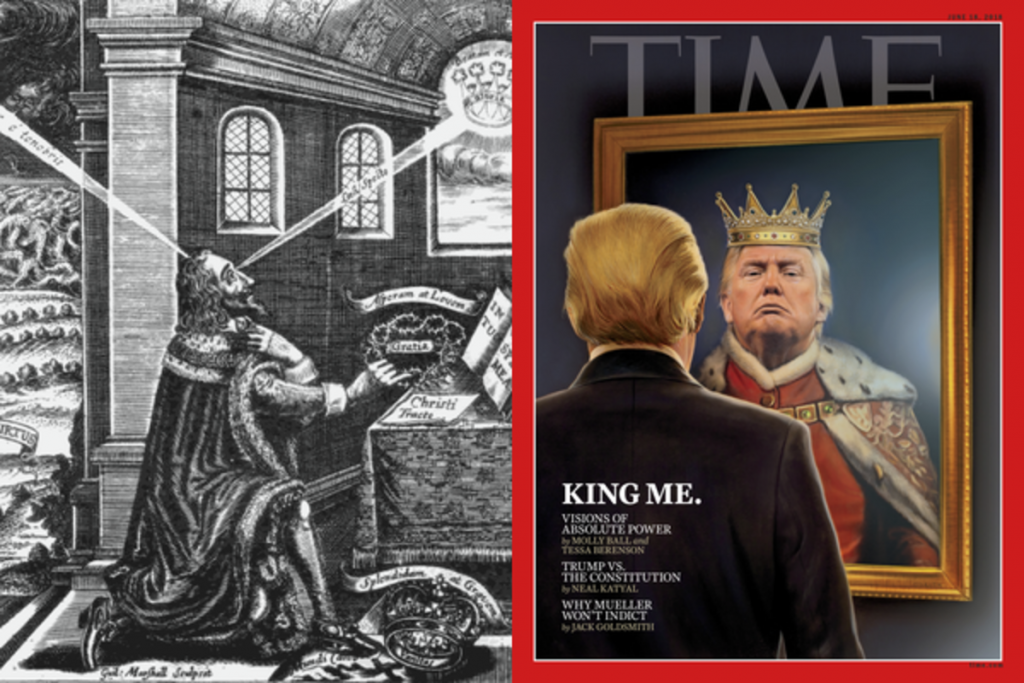
Impeachment is a necessity, but what is required is a reorganization of our politics to ensure that future tyrants will not lead in his stead.

By Dr. Ed Simon
Editor-At-Large
Marginalia Review of Books
Some ten days after the execution of King Charles I, a pamphlet with the Latinate title Eikon Basilike (which means “Royal Image”) appeared in the book stalls of London, attributed to the dead monarch and purporting to be a diary of his imprisonment. Within the book was an allegorical depiction of Charles: the king on penitential knee (nonetheless wearing the elaborate, regal clothes appropriate to his stature) while a ray of divine light penetrated his skull, generatingfor the monarcha vision of a shining crown. Eikon Basilike’s engraver William Marshall included an explanatory poem with the image: of the “boist’rous Windes and rageing waves/So triumph I. And shine more bright/In sad Affliction’s darksom night.” For Charles, a man who despite his tremendous authority was still checked by the ancient rights invested in the legislative branch, it was apparently very hard to be king.
Nobody feels sorrier for themselves than a monarch who discovers that their divine right is an illusion; nobody is more liable to lash out and project the blame for their predicament. For royalist defenders of the king, Charles had been unfairly assaulted by his Parliamentarian enemies; as a ruler gifted with the divine right of kings,all legislative and ecclesiastical prerogative was his, and as such his fall from grace could never be attributed to his own ineptitude or authoritarianism. When he (or his ghostwriter) announced “I would rather choose to wear a crown of thorns with my Saviour, than to exchange that of gold,” I’ve no doubt to read that sentiment as genuine; though when he follows up the subject of golden crowns by emphasizing that they and all that they represent are “due to me,” his political theory is clear. It turned out he was disastrously wrong about that.
In matters of syntax, grammar, punctuation, diction, and spelling, readers of Eikon Basilike will not necessarily see much rhetorical similarity between a sentence like the “aspersion which some men cast upon that action, as if I had designed by force to assault the House and Commons, and invade their privileges is so false, that as God best knows, I had no such intent” and a tweet which read “A Total Scam, by the Do Nothing Democrats. For the good of the Country, the Wirch Hunt (sic) should end now!” When it comes to intent and meaning, however, there’s a lot of overlap. Despite Charles’ erudition, there is a similar sense of aggrievement at being asked to do something that each man doesn’t want to do. Both ran into some trouble with their legislative branch, and both men similarly questioned the vested rights of those respective bodies to act as counterbalance to executive authority. And they’re both angry at being questioned about it.
Historical comparison is a fickle and ambiguous gambit; I don’t want to belabor the similarities beyond comprehension. There are cultural, social, and political differences that are so profound that it would be an act of intellectual malpractice for me to claim that 2019 bears too much similarity with 1649. In more superficial attributes concerning temperament, forbearance, and faith,there’s little that’s similar about the two. A reading of Eikon Basilike demonstrates that as unconvincing and self-serving as Charles’ theological arguments may be, they were genuine; a reading of Trump’s Twitter feed shows him to be a man of seemingly limitless non-faith (even while his evangelical supporters pretend otherwise).
But in another sense the two men do share a certain philosophy of power, whereby that which is invested in the head of state is seemingly limitless and always justified by the simple fact that they’re the ones who are wielding it. For Charles, this was religiously justified – the monarch was touched by God and so was allowed authority over other men. Trump’s reasoning bears more similarity to the fascist rhetorical trope of conflating the leader with some amorphous, ambiguous, faceless sense of “The People” (even while a majority of Americans now support impeachment and removal from office). Nonetheless, the conclusion is the same – nothing that the leader does can be illegal simply because the leader is the one doing it.
While Charles’ writing (or whoever wrote Eikon Basilike) is certainly more sophisticated than that of Trump, the over-weening sense of wounded pride from an autocrat spurned is present in the language of both. Defending himself against the observation that he had violated the rights of Parliament, Charles emphasizes that this claim “is so false.” Evocations of screeching “Fake News!” from 350 years ago, perhaps. Historian Michael Braddick writes in God’s Fury, England’s Fire: A New History of the English Civil Wars that the pamphlet attributed to Charles was “by far the greatest propaganda success following the regicide, calling forth anxious… rival histories.” Confusion sowed by Trump and his defenders serves a similar purpose:to craft an alternative history in real time. Lest I be accused of being the historian who tends to see their own field of study in whatever the headlines for that day are, I should emphasize that it was actually Trump’s defenders who first implicitly made the comparison to Charles, and as such a parsing of what those similarities are is helpful at this dangerous moment.
Sitting next to the vampiric Rudy Giuliani on FOX News’ The Ingraham Angle, Trump surrogate and attorney Joseph diGenova claimed with supreme self-seriousness that “This is regicide by another name, fake impeachment.” It’s helpful to note that impeachment isn’t regicide, it’s not execution, it’s not imprisonment, it’s not even necessarily being removed from your job. It’s an investigation and congressional censure; realistically the most Trump has to fear is being fired (unless some of his past shady dealings still being investigated by the Southern District of Manhattan have him more worried about imprisonment). What’s illustrative about the histrionics implicit in the word “regicide,” however, are what they tell us about how Trump and his supporters see the president. If impeachment is “regicide,” then the conclusion must be that Trump is a king. DiGenova’s use of the word implies that he sees no problem with interpreting Trump as a king, only a problem with those who would dare to question that authority. That this is a deeply worrying way of understanding the executive goes without saying.
“Regicide” is not a word you often hear self-implied in American political discourse. The U.S. founders in many ways worked in the stead of their English antecedents, and consequently were attuned to the theory and rhetoric of that previous century. In this manner they were inheritors of a virulently anti-monarchical politics. In a nation where, despite our many hypocrisies on the actual deployment of such power, we historically blanche at anything that seems too symbolically regal when applied to the office of the presidency, there is something sinister in diGenova’s language. What’s clear is that Trump and his surrogates understand the position as implying complete agency and complete authority over the other branches of government, that their understanding of power in that manner has more to do with Charles’ divine right than it does with the United States’ Constitution.
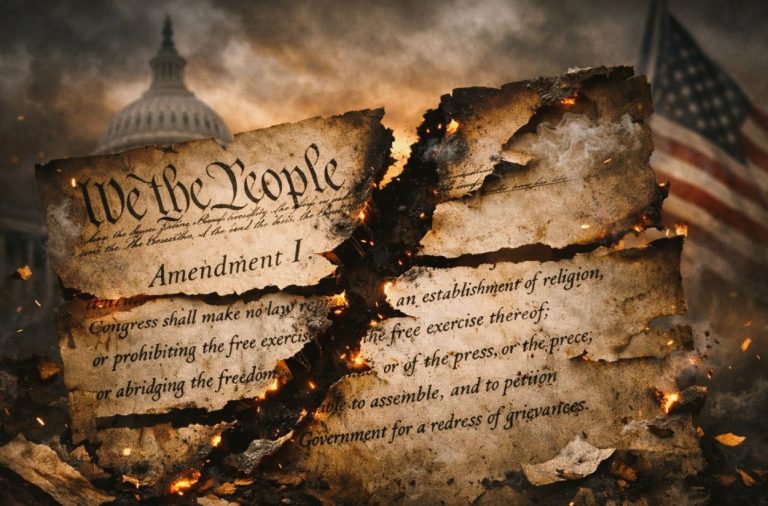
Trump’s defenders are brazenly putting forth a counter-narrative of American law, one that is explicitly anti-American. Council to the President, attorney Pat Cipollone wrote in an October 8th letter to Speaker of the House Nancy Pelosi and three other congressional committee heads that the impeachment hearings are “contrary to the Constitution of the United States and all past bipartisan precedent.” A strange claim in a nation that has impeached two presidents before, and was on the way to impeaching another, and where Article 1, Section 2, Clause 5 of the actual Constitution itself explicitly states that “The House of Representatives… shall have the sole Power of Impeachment.”
There’s a certain smug style in liberal politics which would (and has) claimed that Cipollone’s gambit demonstrates an unfamiliarity with the Constitution, that Trump and his supporters are simply too stupid to understand what’s in the document. I’d venture that that’s a misinterpretation, and a dangerous onebecause what Cipollone is actually doing in that letteris abandoning the dictates of the Constitution by redefining the Constitution out of existence. When Cipollone says that something is “unconstitutional,” that should not be taken literally, he is simply using it as a synonym which means “Something that my boss doesn’t agree with.” When diGenova says “regicide,” he means “Any process which questions Trump’s authority.” Such claims aren’t being made in this way by these men because these men are stupid, they’re being made in this way because these men are conniving, disingenuous, manipulative and incredibly threatening to the politics of a free republic.
An argument could be made that what we’re witnessing is one of those periodic, dialectical flare ups that have occurred in the Anglophone world since Charles’ day (albeit at a hopefully much smaller scale). These are conflicts over who should have more power: a representative legislature or a unitary executive. Demographer Kevin Phillips argued (not without some disciplinary controversy) in 1998’s The Cousins’ War: Religion, Politics, Civil Warfare and the Triumph of Anglo-America that certain events from the English and American revolutions through the American Civil War need to be read as part of the same conflict over questions of power and authority. He writes that the “English Civil War is the necessary starting point, not just for a piece of Britain’s history but for America’s. This is where the events and alignments leading up to the American Revolution began.”
According to Philips, each of those three conflicts followed a certain Manichean script: in the English Revolution of the seventeenth-century there were Parliamentarians who defended their rights against an absolute monarch; there was a similar dynamic in the American Revolution. The American Civil War represented the latest iteration of a democratizing political force as the Union fought to expand republican values against the aristocratic Confederacy. In The Cousin’s War, this dialectic explains Anglophone political history; the periodic pitting of an authoritarian, aristocratic class against nobler, democratizing movements.
Read as such, Trump’s arguments shouldn’t be understood as just disingenuous or misinformed (though they certainly can be those things), but as primarily a restatement of that old lie about the divine right of kings, and as a repudiation of the legislative authority that goes back to the Magna Carta. In Trump, we have an inhabitant of the Oval Office more similar to King George III than George Washington, a man in the shadow of Jefferson Davis rather than Abraham Lincoln. DiGenova and Cipollone’s claims share with Eikon Basilike the sense of aggrievement and privilege, they also share in some sense the same political theory regarding the rights of kings. It’s encouraging to remember that in the past wars enumerated by Philips, the authoritarian side ultimately lost. Yet, after each of those victories there was significant backsliding towards an undemocratic status quo.
Something to keep in mind as we hope, prepare, and plan for Trump’s impeachment: an assault on this president is less radical and perhaps not as important as an assault on the very idea of the presidency. Executive power is fundamentally authoritarian regardless of who wields it; as Astra Taylor writes in Democracy May Not Exist but We’ll Miss it When it’s Gone, “The forces of oligarchy have been enabled, in part, by our tendency to accept a highly proscribed notion of democracy, one that limits popular power to the field of electoral politics, ignoring the other institutions and structures… that shape people’s lives.” Taylor argues that “This is a mistake.”
Following the downfall of Trump, we should neither desire nor countenance any restoration, any return of a simple status quo. From the eclipse of this authoritarian moment we can perhaps dream of more egalitarian, more emancipatory, more democratic arrangements. Such was the desire of the poet John Milton, who eight months after Eikon Basilike wrote his rejoinder Eikonoklastes. Milton enthuses that “We expect therefore something more, that must distinguish free Government from slavish.” His revolution ultimately failed, but ours doesn’t necessarily have to. Any “Resistance” that only imagines the downfall of Trump doesn’t deserve the name, for we must dream bigger than the deposition of kings. Impeachment is a necessity, but what is required is a reorganization of our politics, our economics, and our culture to ensure that future tyrants will not lead in his stead. We require a politics which is finally commensurate with a nation of free women and men.
Originally published by History News Network, 10.20.2019, reprinted with permission for educational, non-commercial purposes.
About the Author