We need to take him and his imperial threats very seriously.

By Phyllis Bennis
Program Director, New Internationalism Project
Institute for Policy Studies
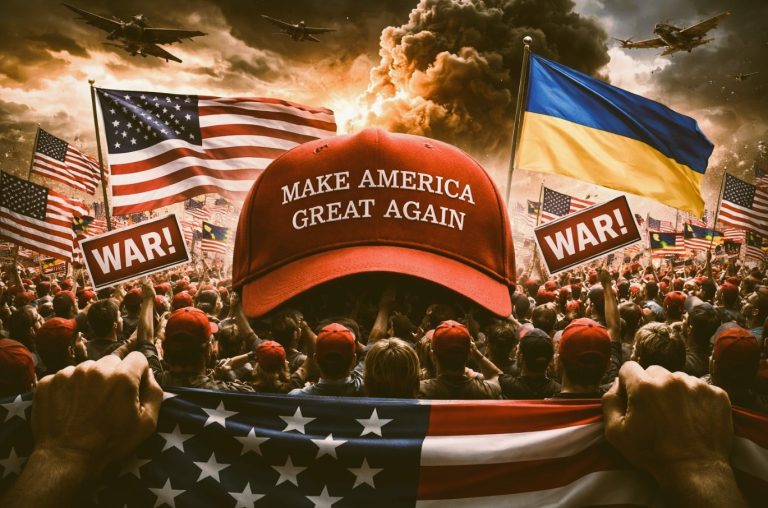
Even as Donald Trump and his MAGA movement have seized virtually complete control of the Republican Party, there remain at least two factions competing for dominance of foreign policy: an isolationist gang and a warmongering interventionist cabal. The strains between them seemingly remain unresolved, and there are real strategic debates and disagreements about what direction Trump’s foreign policy should take.
But what Trump himself is signaling as most important—more than which side wins any particular debate—is the proud (re)commitment to an expansionist (and expanding) U.S. empire dominating the world. That commitment to imperialism, more explicit than we’ve seen for a while, remains a crucial unifying point among his supporters. Disagreements over whether to prioritize economic power and pressure vs. military threats and direct engagement—along with reliance on presidential fiat in either situation—matter far less than the strategic agreement on the ultimate goal.
Empire, after all, is not a new idea—Trump’s version is simply to be much more publicly embraced, indeed celebrated.
It started a few days before Christmas, less than a month before he would be sworn in as president. In a Phoenix speech and later in social media holiday greetings, Trump named the presents he was hoping for: Canada, Greenland, and the Panama Canal. (Soon he would add the Gulf of America and Denali, the “Tall One” in the local Indigenous language, now to be called Mt. McKinley once again, as it was before Biden officially recognized the name that the Koyukon people have called it for centuries.)
As is so often the case with Trump, inconvenient facts—that Canada had no interest in becoming the 51st state, Greenland was not for sale, and the Panama Canal belonged to, well, Panama—had no bearing on his holiday wish list. And for a while it seemed that even in the context of his extremist plans (not to mention the Heritage Foundation’s 900-page opus of implementation instructions for those plans), Trump’s global aspirations seemed just a bit too far over the top to have to take them seriously.
The last time the Panama Canal was a U.S. electoral issue was almost 50 years ago, about three-quarters of a century after France began building the Canal in the 1880s. The U.S. had taken over the project in 1904, and the so-called “Canal Zone”—actually a piece of Panama’s own territory—remained a U.S. colony. Negotiations over ending U.S. control sputtered on and off for decades, and in 1976 Reagan tried to bolster his presidential campaign by loudly rejecting anything that smacked of “giving away” the canal. In language taken directly from the playbooks of far-right racist southern senators Strom Thurmond and Jesse Helms, Reagan thundered “we built it, we bought it, and we’re going to keep it.” It didn’t work. Treaties to end U.S. control of the Canal were signed a year later. And Reagan lost.
Trump had tried to buy Greenland during his first term, but the Greenlanders’ immediate “we’re open for business, not for sale” put an eventual stop to that campaign. And Canadian officials shrugged off the idea of a U.S.-Canadian union as a joke, something Trump had raised numerous times during his first term, only to be consistently rebuffed by Prime Minister Justin Trudeau.
But then came Trump’s inaugural speech. Far from the traditional anodyne calls for post-electoral unity, and even going significantly beyond the “American carnage” themes of his first term, his 2025 speech included not only a full-throated proclamation of U.S. grievances and a glowing image of those problems disappearing under his presidency, but a clear checklist of what he planned to do to get there. It may have seemed laughable to hear Trump lusting after Canada and Greenland, but his vision of U.S. domination—global, not limited to the Arctic and our northern border—as laid out in his inauguration speech, indicates we need to take him and his imperial threats very seriously.
Trump described a set of multi-faceted, interconnected crises. At home, the U.S. government fails to protect its own citizens “but provides sanctuary and protection for dangerous criminals” that have illegally entered the United States. Our health care system doesn’t deliver for people but is the most expensive in the world. Our education system teaches children “to be ashamed of themselves … to hate our country.”
And internationally, the United States has allegedly been so feeble that other nations have taken advantage of our weakness.
But now, Trump went on, “America’s decline is over.” With him in the White House, a “golden age of America begins right now.”
“From this day forward,” he said, “our country will flourish and be respected again all over the world. We will be the envy of every nation, and we will not allow ourselves to be taken advantage of any longer.” In that golden age, the quests of empire will concurrently solve the domestic crises and make the U.S. “the envy of every nation.”
U.S. citizens, now emerging from both personal/national and global carnage, will soon see the simultaneous end to those crises as the country rebuilds its strength at home and reclaims its rightful hegemonic place in the world. “So as we liberate our nation, we will lead it to new heights of victory and success. We will not be deterred. Together, we will end the chronic disease epidemic and keep our children safe, healthy and disease free. The United States will once again consider itself a growing nation.”
And this homage to future growth was very direct—the kind of enlargement “that increases our wealth, expands our territory, builds our cities, raises our expectations and carries our flag into new and beautiful horizons.” All the language of 19th century empire was there: “the spirit of the frontier is written into our hearts.” Americans are “explorers” and “pioneers.”
Despite the claimed long decline, Trump continues to weave U.S. exceptionalism through his rhetoric. “Our American ancestors turned a small group of colonies on the edge of a vast continent into a mighty republic of the most extraordinary citizens on Earth. No one comes close.”
Oh yes, Manifest Destiny and racist western expansion make explicit appearances, as “Americans pushed thousands of miles through a rugged land of untamed wilderness. They crossed deserts, scaled mountains, braved untold dangers, won the Wild West…” Indigenous peoples who were slaughtered to “tame” the land were not mentioned. Seizing half of what was then Mexico was ignored. “We are going to be changing the name of the Gulf of Mexico to the Gulf America,” he said. Because it’s ours. Renaming the Alaska peak Mt. McKinley was not only an attack on the Indigenous communities who had long fought for Denali—it was also designed to honor the U.S. president responsible for expanding the U.S. empire across the oceans, claiming Cuba, Guam, Hawai’i, Puerto Rico, and the Philippines.
And bringing his 19th century-style imperial dreams into the 21st century, Trump promised to “pursue our manifest destiny into the stars, launching American astronauts to plant the Stars and Stripes on the planet Mars.” The moon isn’t good enough anymore. (Of course, at that mention the cameras all swiveled away from Trump to his tech-bro Elon Musk, ensconced with the rest of the billionaire boys club just behind the president.)
Those astronauts almost certainly won’t be sent by NASA, it will be Musk’s SpaceX or another private company that will plant the U.S. flag in space. Neo-colonial resource extractivism isn’t really as “neo” as it sometimes appears; the privatization of colonial exploration and land-seizures is actually an old story. Europe’s royals, in particular, often outsourced their colonial campaigns to private companies—Britain gave key rights to the British East India Company to claim India and encouraged the Jamestown settlement by the Virginia Company, the Dutch East India Company managed the colonization of Indonesia.
It was all done with the approval and collusion of the Roman Catholic church, whose 15th century Doctrine of Discovery assured Europe’s would-be explorers that any land inhabited by non-Christians—no exception for other planets—was fair game for colonial theft. It would not be until March 2023 that Pope Francis formally repudiated the doctrine—but apparently Trump never got the memo.
So while old and new forms of colonialism are a longstanding part of U.S. history, the public pronouncement of a plan not only to carry the U.S. flag to new horizons, but actually to “expand our territory” is new for the 21st century. So while Trump’s calls for absorbing Canada, renaming the Gulf of Mexico, buying Greenland and/or reclaiming Panama’s canal may seem performative (and as specific examples do not seem like serious threats), they do reflect an eagerness to assert global as well as domestic power. And these broad commitments to a future of global domination do not even include the immediate international crises and challenges (Palestine, Ukraine, Taiwan) that Trump has pledged to “solve on day one” (or at least quickly), often at the expense of the peoples most impacted.
Certainly Trump’s long-threatened tariffs will be imposed as part of that power policy, supposedly to replace higher taxes on corporations and billionaires. In his inauguration speech, he bragged that “instead of taxing our citizens to enrich other countries, we will tariff and tax foreign countries to enrich our citizens. … It will be massive amounts of money pouring into our treasury coming from foreign sources.” Not quite the way tariffs work, of course.
But that doesn’t mean tariffs will replace the military. Trump’s plan, once he reverses all efforts to desegregate and build equity into the armed forces, is to “build the strongest military the world has ever seen.” Within 24 hours of his speech, he had issued an executive order to halt all foreign aid—leaving refugees who had gone through and passed exhaustive vetting by United Nations and United States agencies, and were in many cases en route to airports to catch flights to the U.S. to start their already-approved new lives, stuck in limbo with nowhere to turn for safety. But an exception was made to continue billions of dollars of military aid to Israel and to Egypt, and Trump made sure to reverse Biden’s May 2024 temporary hold on a shipment of additional 2,000-pound bombs Israel used to destroy homes and neighborhoods in Gaza and Lebanon.
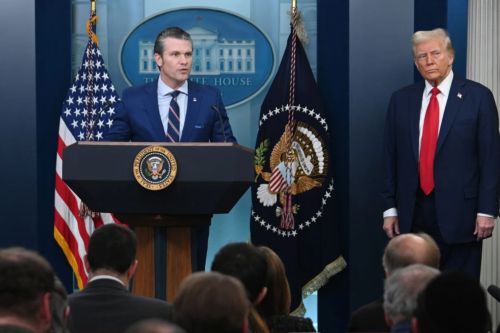
And with the Senate’s confirmation of Pete Hegseth to head the Pentagon, the angry veteran accused of sexual assault and known for financial mismanagement and an utter lack of managerial experience is now empowered to oversee 3.2 million employees and overrule or get rid of any generals he finds annoying. This is the same man who called the rules of war “burdensome” and claimed they “make it impossible for us to win these wars.” Hegseth said he “thought very deeply about the balance between legality and lethality,” and clearly lethality won out. His job, as he understands it, is to ensure that the troops “have the opportunity to destroy…the enemy, and that lawyers aren’t the ones getting in the way.” Between that understanding, the power to dismiss officers who follow the laws of war, and Hegseth’s commitment to follow whatever Trump demands, the world may soon face a potentially out-of-control military, bolstered by 750+ military bases scattered across the globe and a budget approaching a trillion dollars.
With a secretary of defense beholden to a president driven only by personal wealth and power, and unaccountable to any faction of the U.S. ruling class, the danger of a new military escalation looms. At some rather random point in his speech Trump claimed that his “proudest legacy will be that of a peacemaker.” But in his drive for empire, he will be describing an imperial scenario much closer to that passed down by the great historian Tacitus: “the Romans brought devastation, and they called it peace.”
Published by Common Dreams, 01.31.2025, under the terms of a Attribution-NonCommercial-NoDerivs 3.0 Unported license.
About the Author