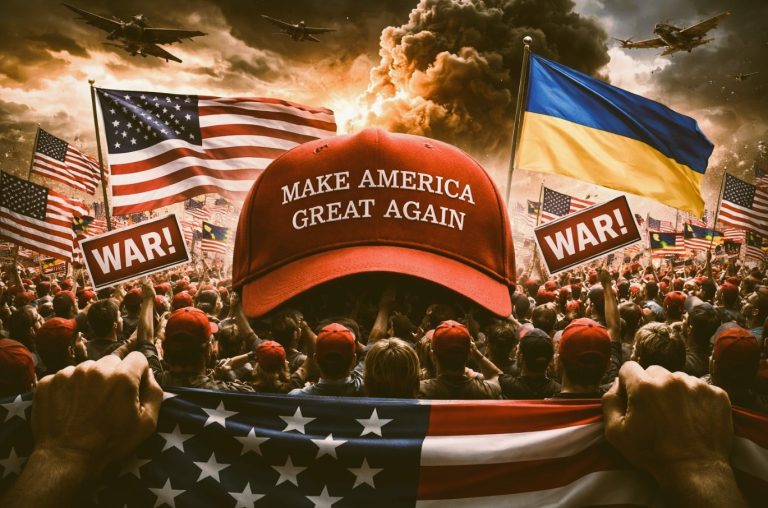
When citizens come to accept a constant state of crisis as normal, democratic erosion no longer feels like a rupture but an adjustment.

By Matthew A. McIntosh
Public Historian
Brewminate
Introduction: A Politics of Manufactured Reality
The Trump administration is increasingly governing through a narrative of national collapse, presenting the United States as a society on the brink of destruction unless extraordinary measures are taken and unquestioning loyalty is enforced. This framing does not simply argue for policy priorities; it constructs an emotionally charged version of reality in which fear, grievance, and moral absolutism dominate public life. Analysts have described this approach as dystopian propaganda, warning that it functions less as persuasion than as a mechanism for reshaping how citizens perceive their country, their neighbors, and the legitimacy of democratic institutions themselves. In this vision, decline is portrayed as both inevitable and reversible only through concentrated executive power and cultural confrontation rather than democratic deliberation.
This strategy has been evident in how the administration communicates immigration, national security, and cultural identity, often relying on imagery and language that evoke existential threat rather than empirical assessment. Commentators examining the administration’s messaging have argued that it deliberately blurs the line between governance and spectacle, using symbolic displays and crisis rhetoric to cultivate a permanent sense of emergency. Such techniques, long associated with authoritarian systems, are designed to narrow the range of acceptable viewpoints by framing dissent as dangerous or unpatriotic rather than legitimate disagreement. Political scholars studying contemporary populism have warned that this shift marks a movement away from pluralistic democracy toward a politics defined by enforced narratives of loyalty and exclusion.
The administration’s control over information flows further reinforces this manufactured reality. Access to officials and events has increasingly been granted to ideologically aligned media figures, while critical outlets are sidelined or attacked, a practice that media experts have equated with propaganda rather than transparency. By elevating friendly voices and restricting others, the government shapes not only what stories are told, but which versions of reality are permitted to circulate widely. Cultural critics have noted that this selective amplification creates an environment in which repetition replaces verification and emotional resonance outweighs factual scrutiny.
Compounding these dynamics is the growing use of digital tools, including artificial intelligence–generated content, to amplify political messaging at scale. Observers have cautioned that emerging technologies make it easier to flood public discourse with emotionally potent narratives that appear authentic while resisting verification. In such an environment, the distinction between information and manipulation becomes increasingly difficult to sustain, weakening the shared factual foundation that democratic societies require. As scholars and journalists have argued, the danger is not merely that falsehoods spread, but that reality itself becomes fragmented into competing myths, each reinforced by power rather than evidence.
These developments point to a governing philosophy that treats reality as something to be engineered rather than debated. The result is a political climate in which fear is normalized, institutional checks are framed as obstacles, and democratic disagreement is recast as existential threat. This is not an accidental byproduct of polarized politics, but a coherent strategy that draws on well-documented authoritarian techniques, adapted for a modern media ecosystem. The question facing the republic is no longer whether such propaganda exists, but how long a democratic system can endure when governance depends on the continuous manufacture of crisis.
From Persuasion to Propaganda: Defining the Shift
Democratic politics always involves persuasion and narrative framing, but propaganda is something narrower and more coercive: it seeks to control the informational environment so that one story crowds out alternatives. Several recent analyses argue that the Trump administration is leaning into a style of governance that uses dystopian propaganda as a tool of power, not merely as campaign theater, with official narratives designed to condition public perception through fear and inevitability rather than open contestation. In that view, the public is not being invited into argument but pressed toward an emotional conclusion.
A central propaganda move is to transform political disagreement into a moral emergency. Instead of competing policy interpretations, the public is given a storyline of national breakdown where opponents are not wrong but dangerous. Commentators have described Trump’s rhetoric as a dystopian view of America, and political analysis has drawn a direct line between that style of crisis narration and authoritarianism and fascism as governing impulses. In that structure, the point is less to persuade than to make alternatives feel illegitimate or unthinkable.
Propaganda also works through repetition and emotional saturation, reducing complex realities into simple cues that become familiar enough to feel true. Cultural criticism has emphasized how public life can be reshaped when politics becomes a function of spectacle and media dynamics rather than evidence, a concern revisited through the lens of Neil Postman’s warnings about politics as entertainment. This is not only about individual claims. It is about a communication style that prioritizes emotional impact over shared standards of verification.
A further indicator is how narrative control becomes institutional, not just rhetorical. When access is distributed selectively, the information ecosystem tilts toward a preferred storyline even without formal censorship. Reporting has described the administration doling out access to select right-wing media personalities, with experts arguing that access itself can become a propaganda mechanism by amplifying aligned voices while marginalizing critical ones. This is structural power, exercised through visibility.
Finally, the modern propaganda environment is inseparable from digital acceleration and synthetic media. When political content can be generated, remixed, and spread at scale, the challenge is no longer only falsehood, but velocity and volume. Commentary on AI-generated Trump propaganda has warned that synthetic media can intensify propaganda’s emotional pull while making verification harder for ordinary readers. In that setting, propaganda does not need to win an argument. It only needs to flood the space until the public’s sense of shared reality erodes.
A Dystopian Vision of America as Governing Strategy
The Trump administration’s portrayal of the United States increasingly rests on a narrative of irreversible decline, one that frames the nation as broken, corrupted, and surrounded by hostile forces. This depiction is not incidental rhetoric but a governing strategy that presents crisis as the permanent condition of American life. Political observers have noted that Trump consistently advances a dystopian view of America, describing social disorder, cultural decay, and national vulnerability in ways that suggest normal democratic processes are insufficient to address the scale of the threat. In this framing, democracy becomes a liability rather than a solution.
Such a vision performs an important political function. By depicting the nation as on the verge of collapse, the administration creates a justification for extraordinary authority and reduced tolerance for dissent. Scholars examining Trump’s post-election governance argue that this rhetoric aligns with broader patterns of authoritarian and fascist politics, in which leaders claim that only decisive, centralized power can prevent total ruin. The future is portrayed not as open or contested, but as predetermined unless power is consolidated in the hands of a singular figure.
This dystopian framing also reshapes how citizens are encouraged to understand one another. Social groups are depicted as existential threats rather than fellow participants in a shared civic project, reinforcing suspicion and hostility as default political emotions. Analysts have warned that when government messaging relies on fear-based narratives, public trust erodes not only in institutions but in society itself. The result is a political culture in which solidarity is replaced by loyalty tests, and disagreement is reclassified as sabotage.
The administration’s use of symbolic spectacle further reinforces this worldview. Policy announcements, enforcement actions, and public appearances are often staged to dramatize danger and confrontation rather than deliberation or compromise. Commentators have argued that this emphasis on spectacle echoes earlier warnings about politics becoming entertainment, a concern revisited in discussions of Neil Postman’s critique of media-driven public life. In such conditions, emotional impact outweighs policy substance, and governing becomes a performance of dominance rather than accountability.
This dystopian narrative is also sustained through selective information flows that reinforce the sense of crisis. Reporting has shown how the administration has been doling out access to select right-wing media personalities, creating an echo chamber in which dire portrayals of the nation circulate with little challenge. Experts have argued that this practice functions as propaganda by narrowing the range of narratives available to the public, ensuring that dystopian interpretations dominate the informational environment.
The long-term consequence of governing through dystopia is not simply heightened polarization, but a transformation in how power is legitimized. When the nation is portrayed as perpetually on the brink, emergency becomes the norm and restraint is cast as weakness. Analysts have warned that such conditions hollow out democratic culture by normalizing fear and resignation, leaving citizens less equipped to imagine alternatives grounded in shared reality rather than imposed narrative. In this sense, dystopia is not only described but actively produced, becoming both the justification for power and the condition it sustains.
Selective Visibility and the Architecture of Media Access
One of the most consequential yet least visible components of modern propaganda is not what is said, but who is allowed to say it. The Trump administration’s media strategy has increasingly relied on selective access as a tool of narrative control, reshaping the informational environment without the need for formal censorship. Reporting has documented how the administration has been doling out access to select right-wing media personalities, privileging ideologically aligned outlets while sidelining critical or independent journalists. Experts have argued that this practice functions less as press engagement than as propaganda infrastructure.
Selective visibility alters public understanding not by silencing dissent outright, but by ensuring that certain narratives circulate with institutional amplification while others struggle to reach mass audiences. Media analysts have warned that when access becomes conditional on ideological loyalty, journalism shifts from scrutiny to reinforcement. The result is an information ecosystem where repetition replaces interrogation, and official narratives face little resistance within the channels most closely connected to power.
This architecture of access also reinforces the administration’s broader dystopian framing of the nation. By elevating voices that echo themes of crisis, cultural decay, and existential threat, selective access amplifies fear-based narratives while marginalizing perspectives that emphasize complexity or institutional constraint. Observers studying propaganda dynamics note that such systems thrive not on the absence of alternative viewpoints, but on their systematic devaluation, creating the impression that dissenting accounts are fringe or untrustworthy.
The danger of this model lies in its normalization. When selective access becomes routine, the boundary between independent media and political messaging erodes, weakening the press’s role as a democratic intermediary. Analysts have cautioned that this erosion does not require explicit repression to be effective; it depends instead on structural incentives that reward alignment and punish skepticism. Over time, selective visibility reshapes public reality itself, narrowing the range of stories that feel plausible and reinforcing a political order sustained by controlled exposure rather than open debate.
Technology, AI, and the Amplification of Political Myth
The administration’s propaganda strategy does not operate in a vacuum. It is accelerated and magnified by a digital media environment that rewards speed, emotional intensity, and repetition over verification. Analysts have warned that contemporary political communication increasingly relies on technological amplification to transform ideological narratives into immersive experiences, allowing political myths to circulate faster than they can be challenged. In this context, propaganda is no longer limited to speeches or press briefings; it is embedded within platforms that blur the line between information, performance, and spectacle.
Artificial intelligence has become a particularly powerful tool in this process. Cultural critics have documented the emergence of AI-generated Trump propaganda, noting how synthetic images, videos, and text can manufacture emotionally resonant scenes that appear authentic while resisting easy verification. These tools allow political narratives to be scaled rapidly and personalized for different audiences, reinforcing mythic portrayals of leadership, threat, and national destiny. The danger, observers argue, is not simply deception, but the erosion of shared standards for determining what is real.
The amplification of political myth is further enabled by platform dynamics that prioritize engagement over accuracy. Commentary on the intersection of culture and democracy has warned that when algorithms reward outrage and fear, authoritarian narratives gain an inherent advantage. Analysts examining the Trump era have argued that such systems encourage a politics of emotional saturation, in which repeated exposure to dystopian imagery conditions audiences to accept crisis as the default state of national life. Over time, myth becomes familiar, and familiarity substitutes for truth.
National security rhetoric has also been drawn into this technological feedback loop. Critics of the administration’s strategic communications have described elements of its national security messaging as a dystopian propaganda stunt, designed less to articulate policy than to dramatize threat and resolve. When such narratives are amplified through digital media ecosystems, they reinforce a worldview in which permanent danger justifies permanent mobilization, leaving little space for democratic oversight or public deliberation.
The cumulative effect of these technologies is not simply misinformation, but myth-making at scale. Scholars and journalists have cautioned that when political authority is reinforced through synthetic media, algorithmic repetition, and emotionally charged spectacle, democratic accountability weakens. The public is not persuaded through evidence, but immersed in a narrative environment that feels self-evident through sheer ubiquity. In this way, technology does not merely transmit propaganda; it reshapes the conditions under which reality itself is perceived, amplifying political myth until it becomes difficult to distinguish from governance itself.
The Republic under Narrative Siege
When governance relies on propaganda rather than accountability, democratic institutions can persist in form while eroding in substance. Analysts examining the Trump administration’s communication strategy have warned that sustained narrative control weakens the public’s ability to evaluate power independently, substituting emotional alignment for civic judgment. Commentators on democratic culture have argued that this shift transforms elections and institutions into rituals of affirmation rather than mechanisms of restraint, leaving constitutional structures intact but increasingly hollow.
This erosion is most visible in how dissent is reclassified. Political disagreement is no longer treated as a legitimate feature of democratic pluralism, but as evidence of disloyalty or subversion. Cultural critics writing about the relationship between culture and democracy have noted that when leaders frame opposition as an existential threat, citizens are pressured to choose sides not on policy grounds, but on identity and fear. In such an environment, compromise becomes betrayal, and democratic norms are recast as obstacles to survival.
Educational and scholarly analyses of modern propaganda have emphasized that democracy depends on a shared factual baseline, even amid disagreement. When that baseline is fractured by competing myths reinforced through power, democratic choice loses coherence. Student and academic research on propaganda and democratic decline has highlighted how sustained exposure to fear-based narratives can normalize authoritarian measures, especially when citizens are told repeatedly that institutions have already failed them. Under these conditions, resignation replaces vigilance, and participation becomes reactive rather than deliberative.
The cumulative effect is a polity under narrative siege, where the greatest damage is not inflicted through overt repression but through exhaustion and confusion. Editorial analysis of Trump-era propaganda has argued that democratic erosion accelerates when citizens are inundated with crisis messaging that leaves little room for reflection or verification. Democracy, in this sense, is not overthrown in a single act, but gradually suffocated as narrative domination displaces shared reality. What remains is a political system that still bears democratic labels but increasingly operates on authoritarian logic.
Historical Parallels without Historical Reductionism
Comparisons between contemporary American politics and past authoritarian regimes often provoke discomfort, and rightly so. History does not repeat itself mechanically, and the United States is not reliving the twentieth century in identical form. Yet scholars of authoritarianism caution that avoiding comparison altogether can be just as misleading as making crude equivalences. Political analysis of Trump’s current governance argues that while the context is different, the methods employed align with well-documented authoritarian patterns, particularly the use of fear, cultural grievance, and narrative absolutism to justify power consolidation, a dynamic examined closely in research on dystopia and fascism in the new government.
Historically, authoritarian movements have rarely announced themselves as such. Instead, they have framed their rise as a response to emergency, corruption, or national humiliation. The invocation of decline has served as a powerful mobilizing force, allowing leaders to claim that extraordinary authority is not a choice but a necessity. Analysts studying Trump’s propaganda strategy have noted parallels with earlier regimes that portrayed the nation as betrayed from within, a technique that shifts public anger away from governing elites and toward internal enemies. These comparisons are not claims of identical outcomes, but observations of structural similarity in how political legitimacy is constructed.
Another recurring historical feature is the erosion of pluralism through narrative domination rather than outright repression. In many authoritarian systems, opposition media and institutions were not immediately banned but gradually discredited, marginalized, or drowned out by official narratives. Contemporary reporting on Trump-era governance has highlighted how cultural conflict and media manipulation play a central role in weakening democratic norms, a pattern explored in broader discussions of culture and democracy under strain. The danger lies less in dramatic rupture than in the steady narrowing of what feels politically imaginable.
At the same time, historical reductionism must be avoided. The United States retains legal structures, civil society organizations, and electoral mechanisms that differentiate it sharply from classic fascist regimes. Scholars emphasize that authoritarianism in democratic contexts often advances through legalistic means, exploiting institutional weaknesses rather than abolishing institutions outright. Research on modern propaganda underscores that contemporary authoritarian movements adapt old techniques to new environments, particularly digital media ecosystems that amplify fear and loyalty without requiring total state control of information.
The value of historical comparison, then, lies not in prediction but in recognition. By identifying familiar patterns in unfamiliar forms, citizens and institutions are better equipped to respond before erosion becomes collapse. Analysts studying dystopian propaganda warn that normalization is the greatest risk: when authoritarian techniques are dismissed as mere rhetoric or partisan excess, they lose their urgency. History does not offer a script, but it does offer a warning. Ignoring those parallels does not preserve democracy; it merely delays the moment when their consequences become unavoidable.
The Cost of Accepting the Narrative
The most dangerous consequence of dystopian propaganda is not belief, but accommodation. When citizens come to accept a constant state of crisis as normal, democratic erosion no longer feels like a rupture but an adjustment. Analysts examining the Trump administration’s communication strategy have warned that propaganda succeeds not by convincing everyone, but by exhausting the public’s capacity to resist, leaving people disengaged, cynical, or resigned. In that environment, power no longer needs to argue its case. It simply asserts it, confident that fatigue has replaced scrutiny.
This resignation is compounded when culture, media, and technology reinforce the same narratives across platforms. Cultural critics have cautioned that when democratic societies absorb politics primarily through spectacle and emotionally charged myth, citizens lose the tools needed to distinguish governance from performance. Warnings about the erosion of democratic culture emphasize that propaganda does not destroy democracy outright; it hollows it from within by weakening shared reality and mutual trust. Once that trust collapses, institutions may remain standing, but their legitimacy becomes fragile and contingent.
The cost of accepting the narrative, then, is not merely political disagreement intensified, but democracy itself diminished. Scholars and journalists analyzing Trump-era propaganda have argued that resisting authoritarian drift requires more than fact-checking individual claims. It demands rejecting the premise that permanent crisis is inevitable and that concentrated power is the only answer. Democracy survives not through passive endurance, but through active refusal to surrender reality to fear. When citizens cease to question the narrative imposed upon them, the republic does not fall in a single moment. It fades, quietly, into something unrecognizable.
Originally published by Brewminate, 12.19.2025, under the terms of a Creative Commons Attribution-NonCommercial-NoDerivatives 4.0 International license.
About the Author