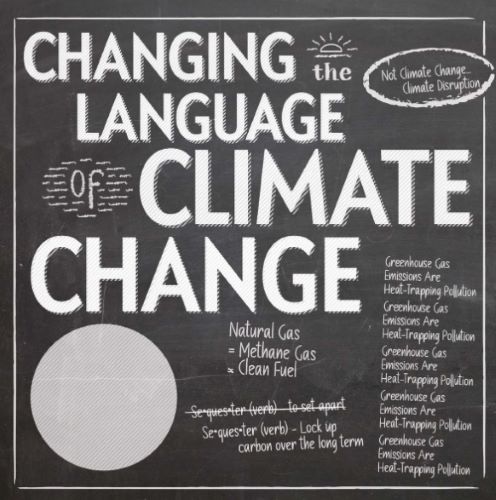
Perhaps it’s really our actions that need to catch up to our words.
The words we choose to describe climate change and the climate impacts around us make a difference. These words have evolved over time, reflecting the state of science behind them.
Words can be motivational, inspiring people to change what they do; they can also be vague, and make minimal impression with little call to action. Back in the 1980s and 1990s, for example, you might recall reading the term “global warming” But do you remember the future warming scenarios mapped out by climate scientists back then?
The warming slopes didn’t look so steep, and the potential impacts were going to be far into the future. Moreover, the language surrounding climate impacts was inconclusive; some impacts sounded mild and even potentially positive. Given the scientific knowledge at the time, the terms “global warming” and “climate change” did not spur much action outside the environmental and natural resources profession. Further, in the 1992 Intergovernmental Panel on Climate Change (IPCC) Climate Change Assessment, language was included on vague “uncertainties” in the projections, which did not inspire confidence.
Jump to 2019, when a major newspaper, The Guardian introduced terms to “more accurately describe the environmental crises facing the world”. Instead of “climate change” the paper chose the terms “climate emergency, crisis or breakdown” and “global heating” over “global warming”. The editor said, “We want to ensure that we are being scientifically precise, while also communicating clearly with readers on this very important issue. The phrase ‘climate change’ sounds rather passive and gentle when what scientists are talking about is a catastrophe for humanity.” This was three years after the United Nation’s International Paris Agreement – to keep global temperature increases between 1.5oC and 2oC above pre-industrial levels – entered into force in 2016.
And here we are now in 2023! We’re only two years away from the date by which the Paris Agreement stated greenhouse gas emissions must peak at the latest and decline by 50% by 2030.
What was once so far away sounding is already the here and now. However, words about climate change continue to confound the public. In fact, a very recent study (Francis et al, 2023) showed how people respond to and interpret different climate terms. The study found that:
‘carbon pollution’ and ‘carbon emissions’ were more associated with health harms, environmental harms, fossil fuels, and poor air quality than greenhouse gas emissions. Specifically, respondents rated both ‘carbon pollution’ and ‘carbon emissions’ as more harmful to people’s health than ‘greenhouse gas emissions’.
So even though ‘carbon emissions’ is the term often used as shorthand for ‘greenhouse gas emissions’, these findings suggest that people associate the terms ‘carbon emissions’ and ‘carbon pollution’ with more harm than the term ‘greenhouse gases’ for describing how human activity is changing the climate.
On March 20, 2023, the latest scientific report from the IPPC (Climate Change 2023: Synthesis Report), was released.
A Washington Post headline read, “World is on brink of catastrophic warming, UN climate change report says.” And the New York Times used “Earth to Hit Critical Warming Threshold by Early 2030s, Climate Panel Says”. Will these latest headlines propel us to action? As we replace older words with newer and more dire-sounding terms to describe the climate crisis, perhaps it’s really our actions that need to catch up to our words, now.
References
- Francis A. Commerçon, Matthew H. Goldberg, Karine Lacroix, Jennifer P. Carman, Seth A. Rosenthal & Anthony Leiserowitz (2023) Evaluating the Terms Americans Use to Refer to “Carbon Emissions”, Environmental Communication, 17:1, 87-100, DOI: 10.1080/17524032.2022.2156907
- https://www.ipcc.ch/report/sixth-assessment-report-cycle/
- https://www.ipcc.ch/site/assets/uploads/2018/05/ipcc_90_92_assessments_far_full_report.pdf
- https://unfccc.int/process-and-meetings/the-paris-agreement
- https://www.ipcc.ch/2018/10/08/summary-for-policymakers-of-ipcc-special-report-on-global-warming-of-1-5c-approved-by-governments/
- https://www.npr.org/2021/09/08/1033362163/enough-with-the-climate-jargon-scientists-aim-for-clearer-messages-on-global-war
- https://www.npr.org/sections/health-shots/2023/01/04/1139782291/time-perception-climate-change-risk
- https://www.un.org/sg/en/content/sg/statement/2018-09-10/secretary-generals-remarks-climate-change-delivered
- https://climatecommunication.yale.edu/publications/evaluating-terms-americans-use-to-refer-to-carbon-emissions/
Originally published by Climate Hubs, U.S. Department of Agriculture, 04.10.2023, to the public domain.
About the Author