How the coffeehouse came to occupy a central place in 17th and 18th-century English culture and commerce.
By Dr. Matthew White
Visiting Research Fellow
University of Hertfordshire
The drinking of coffee is a familiar feature of modern life, little-remarked on as part of our busy morning routines. The coffee-house though, traces its history back over more than 300 years, and offers a fascinating insight into the culture of British politics and business in the 17th and 18th centuries.
The Rise of the Coffeehouse
By the late 15th century, European traders to Turkey and the Middle East were already very familiar with coffee drinking. One early trader in the region, William Bidulph, described the popularity of ‘a kind of drinke made of a kind of Pulse like Pease’ on his travels there, while in the early 1600s another traveller, George Sandys, described the popularity of coffee drinking in the Turkish capital, Constantinople. Here he witnessed the patrons of the many cafes, who sat ‘chatting most of the day’, sipping a beverage that was ‘blacke as soote, and tasting not much unlike it’.[1]
Initially, European enthusiasm for coffee drinking arose from its perceived health benefits. Coffee was celebrated for the stimulating properties it exhibited on the brain, and could be drunk in abundance without suffering the ill-effects of excessive ale or wine drinking. Broader health benefits were also offered by early champions of the drink, including its usefulness as a cure for headaches, gout and skin conditions.[2]

The first purpose-built English coffee-houses were established in the 1650s in Oxford, where the mind-stimulating benefits of the beverage complemented the spirit of sober academic discussion and debate evident at the university there. These early coffee-houses (christened ‘Penny Universities’ by outsiders) were largely the exclusive resort of the educated and well-to-do, places where learned men and their students came to demonstrate their wit and intellectual talents: this feature of coffeehouse culture was also in evidence in London as the drink slowly gained popularity there.[3]

London’s first coffee-house was established in 1652 by a Greek servant to the Levant Company, Pasqua Rosée. This establishment was soon joined by a handful of other coffee-houses based in the City and on the fringes of the rapidly developing West End. Though undoubtedly a novel alternative for those seeking to avoid the often bawdy drunkenness of London’s many taverns and alehouses, mid 17th-century coffee-houses struggled initially to achieve much popularity. For many years they remained the haunt of a well-educated and commercial elite.
Heyday and Popularity
From the 1660s onwards, however, London experienced a boom in the number of its coffee-houses, reaching perhaps 550 separate establishments by the first half of the 18th century.[4] With their relaxed atmosphere and relative cheapness (at just one penny, the cost of a cup of coffee was usually included in the entry price of the establishment), many busy Londoners preferred the informal surroundings of the coffee-house to the stuffiness of the royal court, legal chambers, offices and other places of professional business. Samuel Pepys, for example, noted extensively in his diary the usefulness of his visits to the coffeehouse, where he was able to pick up gossip, listen to debates or simply make useful trade connections. By 1664 Pepys was visiting his favourite coffee-houses near London’s Royal Exchange more than three times each week (and often twice a day), usually to meet his friends or colleagues by prior arrangement, or sometimes simply to overhear the stories of trade and politics told by strangers.[5]
Like Pepys, professional businessmen would keep regular hours at a particular coffee-house, knowing full well that their colleagues and clients could easily seek them out there. Letters could also be sent directly to a coffee establishment, with any sender safe in the knowledge that the recipient could be regularly found there.

Coffee-houses were thus highly significant centres for the dissemination and receipt of the commercial and political intelligence that swirled around London. Indeed, by the late 17th century many London coffee-houses catered specifically for highly specialised commercial interests. Tom’s Coffee-House in the City of London, for example, was the haunt of the capital’s insurers and bankers. Similarly, London’s book publishers gathered eagerly each day at the Latin Coffee-House near St Paul’s Cathedral, in order to circulate information about their own particular trade.[6]
Famously, one coffee shop opened by Edward Lloyd at the corner of Abchurch Lane in the 1680s grew in popularity with merchants and ship owners, who met there each day to gather intelligence of shipping, to auction cargoes and to report maritime disasters. Lloyd’s eventually evolved into a vast agency dealing in maritime insurance brokerage, which still flourishes in the City of London to this day.
Coffee-houses were also busy centres of printed news and intelligence. In 1688, King James II banned the distribution of any newspapers in coffee-houses (other than the official state paper the London Gazette) as a measure designed principally to prevent the circulation of publications believed to be critical of the state. When the legislation controlling the publication of newspapers generally lapsed in 1695, several periodicals were launched in London (usually published two or three times a week), catering to the insatiable demand for fresh information.
By 1702 London possessed its first true daily newspaper, the London Courant; between each publication runners were employed to visit the coffee-houses to spread important news ‘flashes’ that could not wait for the press. Another haunt of London booksellers, the Chapter Coffee-House, housed the ‘Wet Paper Club’, the members of which prided themselves on their ability to receive news so fresh that the printed matter was still wet on the page.[7]

More specialised titles, such as The Spectator and The Tatler, published from the early 18th century onwards, gained huge popularity among the reading public by offering commentary on ‘coffee-house culture’. Both titles contained a potent mixture of news, gossip and moral advice, and as such they were a highly original and innovative publishing phenomenon. The proprietors of coffee-houses supplied many of these newspapers (and also printed books) free of charge to their customers, with each fresh edition passing from hand to hand, or simply read aloud in order to stimulate debate and discussion.

The highly charged masculine and intellectual nature of the coffee-house also overflowed into the literary world. As with politics and trade, specific coffee-houses developed their own attractions to London’s authors, poets, journalists and wits. At Will’s Coffee-House at the end of Bow Street, for example, poet John Dryden held court among the capital’s literary classes, exchanging lampoons and satirical verses with his fellow writers. As a young man, Alexander Pope persuaded his friends to accompany him to Will’s in order to hear Dryden’s words of wisdom, despite Pope’s own lowly background that otherwise precluded him from any contact with the literary elite. (As a practising Catholic, Pope was also forced by law to live outside of London.) Jonathan Swift, on the other hand, found Will’s to be less than impressive. Here he found ‘the worst conversation he ever heard in his life’, conducted by a handful of wits with an air of self-importance.[8]

Literary reputations could thus be made or broken in the vibrant, egalitarian world of the coffee-house. After the death of Dryden in 1700, Button’s Coffee-House in Covent Garden overtook Will’s as the great resort of London authors. Established in 1712 under the patronage of Joseph Addison, Button’s proved popular with Richard Steele, Pope and Swift, among a host of other less-known writers.

Here authors were invited to submit lampoons and satirical papers anonymously to Joseph Addison’s Guardian newspaper, which could be posted through a letterbox shaped like a lion’s head. The shifting allegiances and direct criticisms that sometimes emerged at Button’s could prove highly damaging. It was at Button’s that Pope ‘was subjected to much annoyance and insult’ by critical readers of his work, an experience that led to his own self-imposed exclusion from the establishment.[9]
Sociability, Politeness, and Discourse
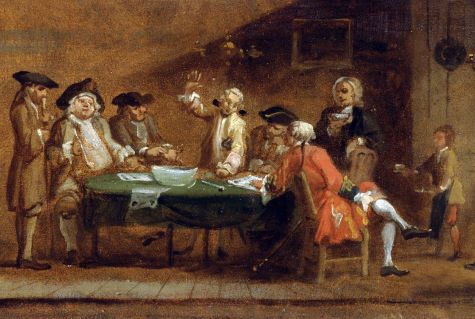
Late 17th-century coffee-houses were noted for their egalitarian and democratic character; people of all ranks sat alongside one another, actively engaging in debate with both friends and strangers alike. The layout of many coffee-houses fostered this rich social mixing. Many coffee-houses possessed long communal tables where patrons were expected to sit and engage in conversation. From all walks of life people came to sip from a bowl of coffee and chat with their neighbours, free from the social conventions of class and deference that were usually extended to social superiors in other settings.
Writing in the early 18th century, Swiss visitor Cesare de Saussure noted how the English coffee-house was generally ‘not over clean or well furnished, owing to the quantity of people who resort to these places’. Among the clientele were not only dandies, scholars, wits and politicians, but also workmen and the less well-off, who ‘habitually begin the day by going to coffee-rooms in order to read the latest news’.[10]
In an age characterised by social division and status this ‘coffee-house culture’ has thus been interpreted as a focus of change in British social and political relations. The socially ‘levelling’ effects of coffee-house conversations were responsible for the growth of a new ‘public sphere’, in which criticism of the court and government could be freely expressed by all comers, without fear of arrest or prosecution – a focal point for vociferous political edebate that we value as a key feature of democracy today.
Similarly, the coffee-house is also considered to have been a centre for the changes which emerged in social manners during the 17th and 18th centuries. Political, philosophical and scientific discussions could take place there free from the resentment experienced in parliamentary and court circles, in a space reserved for serious discussions among like-minded men of all classes. (Evidence of women attending coffee-houses is sparse: they were overwhelmingly frequented by a male clientele.)
Contemporary coffee drinkers recognised this ‘civilising’ atmosphere at the time. Joseph Addison, for example (the publisher of The Spectator magazine), believed that by the early 1700s the coffee-house existed as a refuge from the ‘savagery’ and anonymity of bustling urban society, where new standards of genteel behaviour could grow and flourish.[11] Similarly, Richard Steele described the coffee-house as a rendezvous for ‘all that live near it, who are thus turned to relish calm and ordinary Life’, where men of all ranks could evade the rough and tumble of London life.[12]
This view of innate politeness has, however, been challenged by some historians of coffee-house culture, who reveal that – by contrast – many coffee-houses could be noisy and cantankerous places, sometimes characterised by coarseness and casual violence.[13] One famous venue close to Covent Garden, for example, Moll King’s Coffee-House, was the notorious haunt of London’s lowlife, famed for its bawdy atmosphere and all-night carousing. And not all coffee-houses restricted their fare to hot beverages. Clandestine sales of ales and wine sometimes took place there.

Other historians argue that far from representing a truly democratic space for social interaction, coffee-houses actually cemented the English class system. Many establishments remained the resort of a new, well-to-do commercial middle class, where citizens only came – much as Samuel Pepys did in the 1660s – to polish their manners and forge new contacts.
Decline and Fall
By the close of the 18th century the popularity of coffee-houses had declined dramatically. Already by the 1750s consumption of tea, which many people found to be a sweeter, more palatable drink of choice, was beginning to eclipse that of coffee.[14] Unlike coffee, tea was also surprisingly cheap and simple to prepare in the comfort of the home, without the need for any complex roasting and grinding. Thus tea drinking as a public and sociable act failed to take off in the way that coffee did (at least until the rise of tea salons in the late 19th century), and failed to enliven the social and political life of Georgian Britain in the same way.

By the late 1700s the socially mixed and welcoming character of the coffee-house had changed dramatically. Many coffee-houses had become more exclusive in character, and only opened their doors to a well-heeled clientele able to afford expensive subscription fees. After mid-century many popular coffee-houses were transformed into elite private member clubs, in business for the benefit of wealthy and aristocratic gentlemen only.[15] The welcoming hospitality of the late 17th century had been replaced by a more private, individualistic form of social entertainment.

Part library and part debating room, a coffee-house was always more than simply a place of refreshment. By 1750, new ways of obtaining news, gossip and commercial information – namely from the cheap popular printed news press – had seriously undermined the place of the coffee-house within British culture and politics. Cheap daily newspapers that could be read at leisure in the comfort of the home had damaged the central function of coffee-houses as hubs of intelligence. And with the rise of more commercialised venues for leisure – theatres, pleasure gardens and concerts for example – the death of coffee-house culture was assured.
Endnotes
- Markman Ellis, The Coffee House: A Cultural History (London, 2004), pp. 5–8.
- Edward Robinson, The Early English Coffee House (London, 2nd edn, 1972), p. 66
- Brian Cowan, The Social Life of Coffee: The Emergence of the British Coffeehouse (Yale, 2011), p. 94.
- Stephen Inwood, A History of London (London, 1998), p. 310.
- Ellis, The Coffee House, p. 58.
- Aytoun Ellis, The Penny Universities: A History of the Coffee Houses (London, 1956), p. 106.
- Ellis, The Penny Universities, p. 106.
- John Timbs, Clubs and Club Life in London, Vol. II (London, 1866), p. 320.
- Timbs, Clubs and Club Life, p. 326.
- Cesar de Saussure, A Foreign view of England in the Reigns of George I and George II, trans. and ed. by Madame Van Muyden (1729, republished London, 1902), p. 162.
- Markman Ellis, Eighteenth-Century Coffee House Culture (London, 2017), Vol. 2, p. ix.
- Quoted in Erin Mackie (ed.), The Commerce of Everyday Life: Selections from The Tatler and The Spectator (London, 1998), p. 93.
- B Cowan, ‘The Rise of the Coffeehouse Reconsidered’, Historical Journal, 41(1) (2004), p. 32.
- Mackie, The Commerce of Everyday Life, p. 9.
- Ellis, The Coffee House, p. 214.
Originally published by the British Library, 06.21.2018, under the terms of a Creative Commons Attribution 4.0 International license.
About the Author