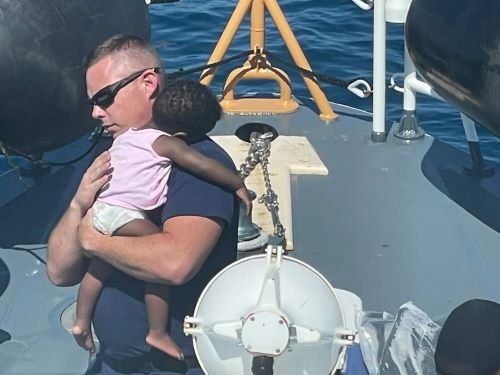
Since the summer of 2021, the U.S. Coast Guard has intercepted surging numbers of migrants.

By Seth Fred Wessler
Reporter
ProPublica
Tcherry’s mother could see that her 10-year-old son was not being taken care of. When he appeared on their video calls, his clothes were dirty. She asked who in the house was washing his shirts, the white Nike T-shirt and the yellow one with a handprint that he wore in rotation. He said nobody was, but he had tried his best to wash them by hand in the tub. His hair, which was buzzed short when he lived with his grandmother in Haiti, had now grown long and matted. He had already been thin, but by January, after three months in the smuggler’s house, he was beginning to look gaunt. Tcherry told his mother that there was not enough food. He said he felt “empty inside.”
More strangers, most of them Haitian like Tcherry, continued to arrive at the house in the Bahamas on their way to the United States. One day police officers came with guns, and Tcherry hid in a corner; they left when a man gave them money. The next time he and his mother talked, Tcherry lowered his bright, wide-set eyes and spoke to her in a quieter voice. “It was like he was hiding,” his mother, Stephania LaFortune, says. “He was scared.” Tcherry told her he didn’t want to spend another night on the thin mattress in the front room with scuffed pink walls. She assured him it would be over soon. A boat would take him to Florida, and then he would join her in Canada, where she was applying for asylum. LaFortune texted Tcherry photos of the city where she lived. The leaves had turned brown and fallen from the trees. Still, she was there, and that’s where Tcherry wanted to be. He waited another week, then two, then three.
Tcherry didn’t laugh or play for months on end, until one day in February, when two sisters, both Haitian citizens, were delivered to the house. One was a 4-year-old named Beana. She wore a pink shirt and cried a lot. The other, Claire, was 8. She had a round face and a burn on her hand; she said that at the last house they’d stayed in, a girl threw hot oil on her. Claire did everything for her sister, helping her eat, bathe and use the bathroom. Like Tcherry, the girls were traveling to join their mother, who was working at a Michigan auto plant on a temporary legal status that did not allow her to bring her children from abroad. Their clothes were as dirty as his. Sometimes Tcherry and Claire watched videos on his phone. They talked about their mothers. “I am thinking about you,” Tcherry said in a message to his mother in early February. “It has been a long time.”
Finally, nearly four months after Tcherry arrived at the house, one of the men in charge of the smuggling operation woke him and the two girls early in the morning. “He told us to get ready,” Tcherry recalls. With nothing but the clothes they wore, no breakfast or ID, they were loaded into a van and were dropped off at a trash-lined canal just outside Freeport, Bahamas. In the muck and garbage, more than 50 people stood waiting as a boat motored toward them. “Not a good boat,” Tcherry told me, “a raggedy boat.” But nobody complained. The 40-foot vessel tilted from the weight as people climbed aboard and pushed into the two dank cabins, sitting shoulder to shoulder or standing because there was no more space. Tcherry felt the boat speeding up, taking them out to sea.
For almost 12 hours they traveled west, packed together in cabins that now smelled of vomit and urine. In the lower cabin, a baby was crying incessantly. A heavily pregnant woman offered up the last of her package of cookies to the child’s mother to help soothe the infant. Tcherry was thirsty and exhausted. Not far from him, he heard a woman say that the children’s parents must be wicked for sending them alone into the sea.
The passengers had been promised they would reach U.S. shores hours earlier. People were starting to panic, sure that they were lost, when passengers sitting near the windows saw lights, at first flickering and then bright — the lights of cars and buildings. “That is Florida,” a young man said as the boat sped toward shore. Tcherry pulled on his sneakers. “If I make it,” he thought, “I will spend Christmas with my family.”
But as quickly as the lights of Florida came into view, police lights burst upon them. A siren wailed. People screamed, a helicopter circled overhead and an officer on a sheriff’s boat pointed a long gun toward them. Uniformed men climbed on board, yelled orders and handed out life jackets. The group of 54 people was transferred to a small Coast Guard cutter. As the sun rose over Florida just beyond them, a man with a tattoo on his arm of a hand making the sign of the benediction began recording a video on his phone. “As you can see, we are in Miami,” he said. “As you can see, we are on a boat with a bunch of small children.” He intended to send the video to relatives waiting for him on land, and he urged them to contact lawyers. But his phone was confiscated, and the video was never sent.
The Coast Guard frames its operations in the sea as lifesaving work: Crews rescue people from boats at risk of capsizing and pull them from the water. But the agency, which is an arm of the Department of Homeland Security, also operates as a maritime border patrol, its ships as floating holding facilities. Since the summer of 2021, the Coast Guard has detained more than 27,000 people, a number larger than in any similar period in nearly three decades. On a single day in January, the agency’s fleet of ships off the Florida coast collectively held more than 1,000 people. The public has no way of knowing what happens on board. Unlike at the U.S.-Mexico border, which is closely monitored by advocates, the courts and the press, immigration enforcement at sea takes place out of public view.
The Coast Guard routinely denies journalists’ requests to witness immigration patrols, but in early March, I learned that several days earlier, a boat carrying dozens of Haitians had been stopped so close to land that they were first chased down by the Palm Beach County sheriff’s marine unit. Among them were three unaccompanied children: two young sisters and a 10-year-old boy. In the months afterward, I obtained a trove of internal Coast Guard documents, including emails and a database of the agency’s immigration interdictions, and I tracked down Tcherry, Claire and Beana and 18 people traveling with them. Many of them told me about the five days they spent detained on Coast Guard ships — an experience, one man said, “that will remain a scar in each person’s mind.”
People intercepted at sea, even in U.S. waters, have fewer rights than those who come by land. “Asylum does not apply at sea,” a Coast Guard spokesperson told me. Even people who are fleeing violence, rape and death, who on land would be likely to pass an initial asylum screening, are routinely sent back to the countries they’ve fled. To try to get through, people held on Coast Guard ships have occasionally taken to harming themselves — swallowing sharp objects, stabbing themselves with smuggled knives — in the hope that they’ll be rushed to emergency rooms on land where they can try to claim asylum.
The restrictions, combined with the nearly 30-year spike in maritime migration, created a crisis for the Coast Guard too, leading to what one senior Coast Guard official described in an internal email in February as “war-fighting levels of stress and fatigue.” Coast Guard crew members described to me their distress at having to reject desperate person after desperate person, but the worst part of the job, several said, was turning away the children who were traveling alone. From July 2021 to September 2023, the number of children without parents or guardians held by the Coast Guard spiked, a nearly tenfold increase over the prior two years. Most of them were Haitian. “The hardest ones for me are the unaccompanied minors,” one crew member told me. “They’re put on this boat to try to come to America, and they have no one.”
The treatment of children is perhaps the starkest difference between immigration policy on land and at sea. At land borders, unaccompanied minors from countries other than Mexico and Canada cannot simply be turned back. They are assigned government caseworkers and are often placed in shelters, then with family members, on track to gain legal status. That system has its own serious failings, but the principle is that children must be protected. Not so at sea. U.S. courts have not determined what protections should extend to minors held on U.S. ships, even those detained well within U.S. waters. The Coast Guard says that its crew members screen children to identify “human-trafficking indicators and protection concerns including fear of return.” A spokesperson told me that “migrants who indicate a fear of return receive further screening” by Homeland Security officials.
But of the almost 500 unaccompanied children held on the agency’s cutters in the Caribbean and the Straits of Florida between July 2021 and early September 2023, five were allowed into the U.S. because federal agencies believed they would face persecution at home, even amid escalating violence in Haiti, including the documented murder and rape of children. One other child was medically evacuated to a hospital in Florida, and six were brought to land for reasons that the internal Coast Guard records do not explain. The rest were delivered back to the countries they left, and it’s often unclear where they go once they return. Some have nowhere to stay and no one to take care of them. On occasion, they are so young that they don’t know the names of their parents or the country where they were born. One official from an agency involved in processing people delivered by the U.S. Coast Guard to Haiti told me “it is an open secret” that the process can be dangerously inconsistent. “Children leave the port,” the official said, “and what happens to them after they leave, no one knows.”
Stephania LaFortune had not wanted to send her 10-year-old son on a boat by himself. She knew firsthand how perilous the journey could be. In May 2021, before the boat she had boarded made it to a Florida beach, some of the passengers jumped into the water to wade through the heavy waves. “They almost drowned,” she told me when I met her in Toronto. LaFortune waited on the beached vessel until U.S. Border Patrol officials came to detain her. In detention, she claimed asylum and was soon released. For months, she searched for other ways to bring Tcherry to her, but LaFortune ultimately determined she had no alternative.
The first time LaFortune left Tcherry, he was 3 years old. Her husband, a police cadet, had been shot in his uniform and left to die in a ditch outside Port-au-Prince, and LaFortune, fearing for her life, departed for the Bahamas. Tcherry stayed behind with his grandmother. Four years later, as violence began to flare again, Tcherry’s mother finally made good on her promise to send for him. She arranged for him to fly to the Bahamas, where she had remarried and had a baby girl. But Tcherry was in the Bahamas not even a year when LaFortune told him that she would be leaving again — not because she wanted to, she assured her sobbing son, but because she had seen how Haitians were harassed and deported, and she simply didn’t believe there was real opportunity there. Tcherry’s stepfather and his younger half sister, who were Bahamian citizens, joined LaFortune months later. She arranged for Tcherry to live with relatives, promising to send for him as soon as she could.
LaFortune’s asylum case in Florida dragged on, so she and her husband and daughter traveled over land to Canada, where they hoped they could get legal status more quickly. While they waited for a decision in their asylum case, the relative Tcherry was staying with said he could no longer take care of a growing boy by himself. After begging others to take her son, LaFortune found a woman she knew back in Haiti who said she was planning to make the trip to Florida herself with her own children. For $3,000, the woman said, she could take Tcherry with them. LaFortune sent the money. The woman took Tcherry to the smuggler’s house and did not return for him.
That house, and the one where Tcherry was moved next, were filled with Haitians fleeing the crisis that began in July 2021, when President Jovenel Moïse was assassinated by a team of mostly Colombian mercenaries hired through a Miami-area security company. The U.S. Justice Department has accused nearly a dozen people, some based in the United States, of setting the assassination in motion. As the Haitian state crumbled, proliferating gangs, many with ties to the country’s political elite, burst from the neighborhoods they’d long controlled and began terrorizing Port-au-Prince and swaths of the rest of the country. Kidnapping, extortion, the rape of women and children, and the torching of homes and neighborhoods became routine weapons of fear. Thousands have been murdered, and in June the United Nations estimated that nearly 200,000 have been internally displaced. Haitians able to gather the resources have left however they can. Many have traveled over land to the Dominican Republic or by air to South and Central America. And thousands have boarded boats bound for the beaches of Florida.
The people on the vessel with Tcherry had reasons, each as urgent as the next, for being there. There was a 31-year-old street vendor whose Port-au-Prince neighborhood had been taken over by gangs; she said that when she tried to flee north by bus, men with guns forced her and other women off the bus and raped them. A man from a district in the north said he’d been beaten more than once by thugs sent by a political boss he’d opposed; both times they threatened to kill him. A man who worked as a Vodou priest in Port-au-Prince said he left because he needed money for his sick daughter, and gangs were confiscating his wages. The pregnant woman who helped comfort the crying baby said she had been kidnapped and raped; she was released only after her family sold land and collected donations to pay for her ransom. Two women were traveling with their daughters, but Tcherry, Claire and Beana were the only young children traveling alone.
Tcherry sat on the deck of a Coast Guard cutter called the Manowar along with the rest of the group, exhausted, scared and confused. Nobody had explained to him what would happen next. Crew members in blue uniforms finally gave them food, small plates of rice and beans, and began to search their belongings and run their photos and fingerprints through federal immigration and criminal databases. Tcherry and the sisters followed the orders of a crew member with blond hair, cut like the soldiers in movies Tcherry had seen, to sit in the shaded spot under the stairs to the bridge.
On the stern of the cutter, a man in his early 30s named Peterson sat watching the children. He had crossed paths with them weeks earlier in one of the houses; seeing they were hungry, he had brought them extra slices of bread and even cut Tcherry’s hair. Claire reminded him of his own young daughter in Haiti. Peterson had not wanted to leave his child, but gangs had recently taken control of roadways not far from his home in the coastal city of Saint-Marc. He had not earned a decent wage for many months, not since he lost his job as a driver at a missionary organization. He had decided to leave for the United States so he could send money back to Haiti for his daughter, who remained behind with her mother.
Now it occurred to Peterson that his connection to Tcherry and the girls could work to his advantage. Surely the Coast Guard wouldn’t return children to Haiti, he thought. Surely they wouldn’t separate a family. “I thought that there might be an opportunity for me to get to the U.S.,” he told me. He approached Tcherry, Claire and Beana and told them they should tell the crew he was their uncle.
Peterson’s small kindness in the smuggler’s house had given Tcherry reason to trust him. When it came time for the blond-haired crew member, Petty Officer Timothy James, to interview the children, Peterson stood close behind. With the help of another Haitian man who spoke some English, Peterson told James that he was their uncle. James asked the children if it was true. Tcherry and Claire, both timid, their eyes lowered, said it was. Beana was too young to understand. James handed her a brown teddy bear, which the crew of the Manowar keeps on board because of the growing number of children they detain, and sent the children back to the stern.
But no more than a couple of hours later, Peterson changed his mind. He’d noticed that the pregnant woman had been evaluated by Florida EMTs, and he moved over to offer her a deal: If she would tell the crew he was her husband and let him join her if they brought her to land, his brother in Florida, who already paid $6,000 for his place on this boat, would make sure she was compensated. “I helped her understand that that is something she could profit from,” he says. The woman agreed, and Peterson, who now needed to tell the truth about the children, divulged to a crew member that he was not their uncle. “I was just trying to help if I could,” he said.
James crouched down beside the children again and told them not to lie. “Why did you leave your home to go to the United States,” he read off a questionnaire. “To go to my parents,” Tcherry replied. To Tcherry, the questions seemed like a good sign. He was unsure whether he could trust these crew members after the officer on the sheriff boat pointed a long gun at them the night before. “I thought they were going to shoot me,” Tcherry says. But James calmly directed the children to sit in the one shaded place on the boat, and gave them cookies and slices of apple. “He was nice,” Tcherry says — the nicest anyone had been since Peterson brought them bread in the house.
James kept reading the form. “What will happen when you get there?” he asked. Tcherry looked up. He latched onto the words “when you get there” and took them as a promise. He asked James when they would be on land. James said the same thing he told everyone on the boat: that the decision was not up to him, that he was just doing his job. Tcherry was convinced James would send him and Claire and Beana to their mothers. He thought of the story his mother had told him about his father’s murder, his body in a ditch by the road, and of his last memory of Haiti, when he passed through a gang checkpoint on the way to the airport. “I saw bandits approaching toward us, and he had a gun pulled,” Tcherry told me. “My heart started beating fast, and I thought he was going to shoot.” He was overwhelmed with relief that he would never have to go back there.
A boat came to bring someone to land. But it was not there to pick up Tcherry or the other children. A Coast Guard medical officer had reviewed the pregnant woman’s vitals and made a decision that because she “may go into labor at any moment,” she would be brought to a hospital in Palm Beach County accompanied by U.S. Customs and Border Protection. Before she was taken away, Peterson said the woman told him she would not claim to be married to him after all. She didn’t want a stranger on her baby’s birth certificate. She offered to say she was his cousin. “I knew that being the cousin would not be enough,” Peterson recalls, “and I have to say that I lost hope.”
The pregnant woman disappeared on a small boat toward land. Those left on the stern began to talk among themselves, asking why the baby, who had barely stopped crying, and the other children had been left aboard the cutter. They said they could not keep going like this, eating only small portions of scarcely cooked and saltless rice and beans, unable to bathe and forced to urinate and defecate in a toilet seat attached to a metal box with a tube off the side of the open deck. They decided they would rise in unison and protest, and they passed the word from one to the next. At around 9 p.m., dozens of people began to yell toward the bridge demanding interpreters, lawyers or just to know what would become of them. From the bow where he stood, James heard faint yelling, and then the voice of the officer in charge over the loudspeaker. “They’re starting an uprising on the fantail,” he said. “I need you back there.”
Timothy James came from a conservative family in a conservative little town in the mountains of North Carolina. He and his wife held handguns aloft in their wedding photos, and his first job after dropping out of college was as a sheriff’s deputy at the jail. James joined the Coast Guard in 2015. “My main goal,” he told me, “was to chase down drug runners and catch migrants” — two groups that were more or less the same, as far as he understood.
He’d been on the job no more than a few weeks before his expectations were upended. “I had no idea what I was talking about,” he told me. There was much less “running and gunning, catching bad guys” than he’d anticipated. Instead, the people he detained would tell him their stories, sometimes with the help of Google Translate on his phone, about violence and deprivation like he had never contemplated. People described what it was like to live on $12 a month. There were children and grandmothers who could have been his own, and young men not so unlike him. They were not trying to infiltrate the country as he’d thought. They were running because “they didn’t have another option,” he says.
James and his colleagues learned the lengths people would go to try to get to land. Since last fall, people detained on cutters have pulled jagged metal cotter pins, bolts and screws from the rigging and swallowed them, apparently trying to cause such severe injury that they’d be taken to a hospital. Last August, near the Florida Keys, three Cuban men were reported to the Coast Guard by a passing towboat operator; most likely fearing they would be brought back to Cuba, they stabbed and slashed their legs with blades and were found in puddles of blood. In January, a man plunged a five-inch buck-style knife that he’d carried onto a cutter into the side of his torso and slashed it down his rib cage. The crew taped the knife to the wound to stop him from bleeding out as he fell unconscious. Most of these people were delivered to Customs and Border Protection and rushed to hospitals on land, where they probably intended to claim asylum. By the time James began working as operations officer on the Manowar last summer, he and other crew members started every leg at sea by scouring the decks for anything that people might use to harm themselves. (According to a DHS spokesperson, “medical evacuations do not mean that migrants have a greater chance of remaining in the United States.”)
People detained on cutters have in rare cases threatened to harm Coast Guard members or others they’re traveling with. In January, a group the Coast Guard detained pushed crew members and locked arms to stop their removal to another cutter, according to an internal record. That same month, a group of Haitians held children over the side of a boat, “threatening to throw them overboard and set them on fire” if the Coast Guard came closer. Weeks later, a group of Cubans brandished poles with nails hammered into them and tried to attack an approaching Coast Guard boat. Conflicts between crew and those they detain have escalated to the point that Coast Guard members have shot people with pepper balls and subdued others with stun maneuvers.
James tensed as he heard the order over the loudspeaker. He thought of the crowd-control techniques he’d learned to immobilize someone, and stepped down the side walkway toward the stern. In front of him were dozens of angry men and a few women, yelling in Haitian Creole. James hesitated and then walked forcefully up to the group, his hands pulled into his sides as if he were ready to throw a punch. Instead, he took a knee. He gestured to the men around him to come join him. He spoke into a cellphone in English, and on the screen he showed them the Google Translate app: “You’ve got to tell everybody to calm down,” it read in Creole. “I can’t help you if I don’t know what’s going on.”
Before they could respond, five other crew members came down the stairs, plastic zip ties and batons hanging from their belts. Tcherry was sitting under the stairs, beside Claire and Beana, who had not let go of the teddy bear. “Shut up, shut up,” one of the crew told the protesters as he stepped in front of Tcherry. “One of them said he was going to pepper-spray their eyes and handcuff them,” Tcherry says. James told his colleagues to wait. The yelling in English and Creole grew louder. A man to Tcherry’s left began to scream and roll on the ground, and then he rolled partway under the handrail. A crew member grabbed the man by the back of the pants and hauled him up. James secured his wrist to a post on the deck. “Nobody’s dying on my boat today,” James said.
Above Tcherry, another crew member stepped onto the landing at the top of the stairs. He held a shotgun and cocked it. James claims that the gun was not loaded, but the threat of violence had its intended effect. The protesters stepped back and went quiet.
James kept speaking into the phone. “What do you want?” he asked the men.
“If we go back, we’re dead,” one man replied. They said they could not endure being on the boat much longer.
“If it were up to me, we’d be taking you to land,” James said. “But it is not up to us.” There was a process to seek protection, he told them. “But what you’re doing now is not that process.”
Coast Guard crews do not decide who will be offered protection and who will be sent back. Their responsibility is only to document what the agency calls “manifestation of fear” (MOF) claims. The Coast Guard instructs them to make note of such claims only when people proactively assert them or when they observe people exhibiting signs of fear, such as shaking or crying. They are not supposed to ask. That may help explain why the agency has logged only 1,900 claims from more than 27,000 people detained in this region between July 2021 and September 2023. Fewer than 300 of those came from Haitians, even though they make up about a third of people held on cutters. Officials in the Coast Guard and in U.S. Citizenship and Immigration Services told me that Haitians face a systemic disadvantage in making a successful claim for protection: Almost no one working on Coast Guard boats can speak or understand Creole. (The Coast Guard told me it has access to contracted Creole interpreters aboard cutters.)
Regardless of the person’s nationality, the process is nearly always a dead end. Each person who makes a claim for protection is supposed to be referred to a U.S. Citizenship and Immigration Services officer, who conducts a “credible fear” screening by phone or in person on a cutter. Between July 2021 and early September 2023, USCIS approved about 60 of the approximately 1,900 claims — around 3%. By contrast, about 60% of asylum applicants on land passed a credible-fear screening over roughly the same period. Unlike on land, people who are denied on ships have no access to courts or lawyers to appeal the decision. And the few who are approved are not sent to the United States at all. Should they choose to proceed with their claims, they are delivered to an immigration holding facility at the U.S. naval base at Guantánamo Bay, where they are evaluated again. They’re told they should be prepared to wait for two years or more, until another country agrees to take them as refugees. Only 36 of the people with approved claims agreed to be sent to Guantánamo. The State Department says there are currently no unaccompanied minors held at the Migrant Operations Center at Guantánamo, but a recent federal contract document says that the facility is prepared to accept them.
The Manowar crew had been tasked by the local Coast Guard office with logging any requests for protection. But the night after the protest had been too chaotic and exhausting for them to do so. In the morning, a larger cutter with more supplies arrived. The people detained on the Manowar would be transferred to that boat. Before they departed, James told them that anyone who intended to seek protection should seek help from the crew on the next boat. “Tell them, ‘I’m in fear for my life,’ just like you told me,” he said. “You tell whoever is processing you that specific thing.”
But subsequent crews logged no such claims, according to records I obtained. One man told me that, in response to his plea for protection, an officer on the next boat wrote a note on a piece of paper, but nobody ever followed up. Another said that an officer told him their claims would be heard later. But there were no more interviews. “We had no opportunity,” a woman in the group says. When I asked the Coast Guard about this, a spokesperson told me the agency meticulously documents all claims. “Since we do not have a record of any of those migrants communicating that they feared for their lives if returned to Haiti, I cannot say that they made MOF claims while aboard,” he said.
Tcherry fell asleep on the larger cutter and woke at around dawn to commotion. He saw an EMT pressing on the chest of a middle-aged woman who lay several yards away from him. She had been moaning in pain the night before. The crew member keeping watch had found her dead, her nose and mouth covered in blood. Another Haitian woman began to sing a hymn as the EMT performing CPR cried. A small boat took the woman’s body away and then returned for another man who had been complaining of pain and could not urinate. “I thought they would take us to land after the woman had died,” Tcherry says. “I thought they would let us go.” But that afternoon, he was transferred to yet another cutter that pulled away from Florida and into the high seas. Tcherry finally understood he was being sent back.
The Coast Guard was first deployed as a maritime border-patrol agency to stop an earlier surge of migration from Haiti. In 1981, President Ronald Reagan made a deal with Jean-Claude Duvalier, the Haitian dictator, that allowed the Coast Guard to stop and board Haitian boats and deliver those detained directly back to Haiti. They would be processed on Coast Guard cutters, far from lawyers who could review their cases. The order, advocates argued at the time, undermined U.N. refugee protections and a U.S. refugee-and-asylum law that Congress passed just the year before. “This effort to push borders into the world’s oceans was new, and it marked a perverse paradigm shift,” Jeffrey Kahn, a legal scholar at the University of California, Davis, wrote recently.
A decade after the Reagan agreement, as Haitians again departed en masse following a military coup, the George H.W. Bush administration further buttressed the sea wall. Bush signed an order that said federal agencies had no obligation to consider asylum claims from Haitians caught in international waters, no matter the evidence of danger or persecution. Lawyers and activists protested, calling the maritime regime a wholesale abdication of human rights doctrine. But the Bush order still stands. By the mid-1990s, its reach expanded to nearly anyone of any nationality caught in the sea, whether out in international waters or a couple of hundred feet from the beach.
Pushing migrants and refugees away from the land borders to avoid obligations under law has now become common practice. In the United States, consecutive policies under Presidents Barack Obama, Donald Trump and Joe Biden have attempted to cast whole swaths of the land south of the border as a legal no-man’s land like the ocean. They have outsourced deterrence, detention and deportation to Mexico and Central America. Trump and Biden have sought to bar people from seeking asylum if they don’t first try to apply for protection in countries they pass through on their way to the United States. Europe, for its part, has pushed people coming by boat through the Mediterranean back to North African shores, where countries have imposed brutal regimes of deterrence.
None of those measures have prevented the latest wave of migration from the Caribbean. In January, amid a generational spike in Haitians and Cubans held on their cutters, the Coast Guard acknowledged that crew members were reaching a breaking point. “We are in extremis,” a senior official wrote to colleagues in a widely circulated internal email in January. “I know you and your teams are pushed beyond limits.” The head of the Coast Guard for the eastern half of the United States, Vice Adm. Kevin Lunday, wrote in February to colleagues that two outside experts had told him their crews were under extreme stress similar to the levels experienced in “sustained combat operations.”
Coast Guard members told me they had become accustomed to retrieving corpses from capsized boats, worn down by water or gnawed on by sharks. It was not uncommon to walk down a stairway or into a bunk room and come upon a crew member sobbing. Crew members waited months for mental health appointments, and the agency was talking openly about suicide prevention. “I don’t see how the current level of operations is sustainable,” Capt. Chris Cederholm, the commander of U.S. Coast Guard Sector Miami, wrote to colleagues, “without the breaking of several of our people.” Some were struggling with what one former crew member called a “moral dilemma,” because they had begun to understand that the job required them to inflict suffering on others. “We hear their stories, people who say they’d rather we shoot them right here than send them back to what they’re running from,” one Coast Guard member says. “And then we send them all back.”
Tim James told me he tried to take his mind off the job by lifting weights and frequenting a cigar bar where service members and cops go to talk about “the suck,” but he soon realized he needed more than weights or whiskey to reckon with the mounting stress, even despair. “I go home, and I feel guilty,” he told me, “because I don’t have to worry about somebody kicking in my front door, you know, I don’t have to worry about the military roaming the streets.” He sought mental health support from a new “resiliency support team” the agency created. But James had not been able to shake the memories of the children he detained, particularly one 7-year-old Haitian girl with small braids. She’d been wearing shorts and a tank top, her feet were bare and she smiled at James whenever their eyes caught. “My mom is dead,” she told James with the help of an older child who spoke a little English. “I want to go to my auntie in Miami.”
In the girl’s belongings the crew found a piece of paper with a phone number she said was her aunt’s. After James interviewed her, they sent her unaccompanied-minor questionnaire to the district office in Florida, and they waited for instructions on what to do with her. Out on the deck, James couldn’t help hoping she’d be taken to shore, to her aunt. But late in the morning the next day, the crew received a list from an office in Washington, D.C., of the people to be sent back. The girl was on the list. James cried on the return trip to port. One of his own daughters was about the girl’s age. “I can’t imagine sending my 7-year-old little kid across an ocean that is unforgiving,” James told me, nearly in tears. “I can’t imagine what my life would be like to have to do that.”
That was just weeks before he encountered Tcherry, Claire and Beana. So when Peterson admitted the children were alone, the news came as a blow. “It’s a pretty hard hit when you think the kids have somebody and then it turns out that they really don’t,” James told me. He could see that Tcherry thought he would be making it to shore. “To see the hope on his face and then have to kind of turn around and destroy that is tough,” James told me. He never learns what becomes of the people he transfers off his cutter: that the pregnant woman gave birth in a hospital to a healthy boy and has an asylum case pending; that the body of Guerline Tulus, the woman who died on the cutter of what the medical examiner concluded was an embolism, remains in a Miami morgue, and that authorities have not identified any next of kin. He does not know what happened to the three children after they were sent back, but many months later, he says, he still wonders about them.
Tcherry followed Claire and Beana up a rickety ramp in the port of Cap-Haïtien, Haiti, past a seized blue and yellow cargo ship into the Haitian Coast Guard station. The ground was littered with plastic U.S. Coast Guard bracelets that previous groups of people had pulled off and thrown to the ground. Officials from the Haitian child-protection authority and the U.N.’s International Organization for Migration watched as Tcherry and the rest of the group disembarked. “They looked scared and they said they were hungry,” a veteran official at IBESR, the Haitian child-protection agency, who was working at the port that day told me. “As a Haitian, I feel humiliated,” he says, “but we can’t really do anything about it. We’ve resigned ourselves.” To him, the people the Americans offloaded in Haiti always looked half dead. “It seems to me that when those children fall in their hands, they should know how to treat them. But that’s not the case.”
Tcherry’s throat hurt and his legs were weak. He had never felt such tiredness. He ate as much as he could from the warm plate of food the UN provided. Slumped over on a bench, he waited for his turn to use the shower in a white and blue wash shed on the edge of a fenced lot behind the Haitian Coast Guard station. The officials brought several people to a hospital and got to work figuring out what to do with the unaccompanied children.
The U.S. Coast Guard and State Department say that the children they send back are transferred into the hands of local authorities responsible for the care of children. “When we have custodial protection of those children, we want to make sure that the necessary steps are taken,” Lt. Cmdr. John Beal, a Coast Guard spokesperson, told me, “to ensure that when we repatriate those migrants, they don’t end up in some nefarious actor’s custody or something.” But no U.S. agency would explain the actual precautions the U.S. government takes to keep children from ending up in the wrong hands, beyond initial screenings aboard cutters. Last year, the Coast Guard stopped tracking the “reception agency” in each country, because according to the Department of Homeland Security, the U.S. government has set up rules establishing which agencies take these children and no longer needs to track them on a case-by-case basis.
Haitian child-protection officials in Cap-Haïtien say their agency always finds relatives to take children, though sometimes after weeks or months. But the official with one of the other agencies involved in the processing of returned and deported Haitians at the Cap-Haïtien port said this claim is simply not true. The official said that children have departed the port with adults and with older children without any agency confirming they have an actual relationship or connection. “This is a serious concern in terms of trafficking,” the official told me. IBESR said those claims were unfounded. “According to the procedure, every child who leaves the port is accompanied by someone,” the IBESR official said, adding that when possible, the agency follows up with families to make sure children arrive safely. But the agency acknowledged there are limits to the support it can provide because of a lack of resources.
Before they left the cutter, Peterson told Tcherry and the sisters that he would take care of them until they could contact their parents, who would figure out where they needed to go. Tcherry agreed. Peterson later told me he’d thought carefully about whether he wanted to get involved in the kids’ affairs once they were off the boat. He’d talked to other adults onboard, and they all agreed that someone needed to step up, that the Haitian government was surely not to be trusted. “If I didn’t do it,” Peterson says, “they would remain with the Haitian state, with all the risks that they could’ve faced, including kidnapping.”
Peterson told the child-protection agency that he was the children’s guardian. The officials said they would need to contact the parents to confirm, so Peterson did the only thing he could think to do: He called the man who had been his conduit to the boat out of the Bahamas. The man sent him photos of the children’s IDs and put Peterson in touch with Claire and Beana’s mother, Inose Jean, in Michigan. She screamed and cried with relief upon learning her daughters were alive. Peterson explained that he’d taken care of the girls at sea and he asked her what to do with them. She said she would call back. Two hours later, she instructed Peterson to take the girls to her friend’s house in Cap-Haïtien.
But Peterson still had no number for Tcherry’s mother. So he told the officials that Tcherry was Claire and Beana’s cousin, and that he’d gotten the image of Tcherry’s ID from Inose Jean. At dusk, Peterson walked with the three children through the metal gate of the Haitian Coast Guard station, at once incensed and relieved that he’d been allowed to take them. “The Haitian authorities didn’t talk to the children’s mothers,” Peterson says. “There was not enough evidence to actually prove I was who I was, or to prove a relationship.” They took a taxi to Jean’s friend’s house, and Claire, who recognized the woman from years earlier, rushed into her arms.
The woman agreed to let Tcherry spend a night there. Peterson went to a cheap hotel with spotty electricity and a dirty pool. The man in the Bahamas finally sent Peterson Tcherry’s mother’s number. “I am the person who stood up to care for Tcherry on the boat,” Peterson told LaFortune. She collapsed onto the bed in her room, the only piece of furniture in the Toronto apartment she shared with her husband and her daughter. She had spent the last six days in a terrified daze, calling the people in the Bahamas she’d paid, begging for any news and fighting images in her mind of her son sinking into the sea. The next morning, after Tcherry woke, Peterson called LaFortune again. Tcherry looked weak and his voice was frail and hoarse. “When will I be with you, Mommy?” he asked.
LaFortune did not for a moment consider trying to put Tcherry on another boat. She told him she would wait until she got asylum in Canada and send for him legally. But Haiti was even more dangerous for Tcherry than when he’d left. One man who was detained with Tcherry, whom I interviewed in Haiti two weeks after he returned there, said he feared he would be killed if he left Cap-Haïtien for his home in Port-au-Prince. After he ran through the roughly $50 the U.N. agency gave each of the returnees, which he used for a hotel, he did go back and was attacked on the street as he traveled to a hospital, he said, to get medicine for his daughter. He sent me photographs of gashes on his body. A second man sent me photos of a deep head wound that he suffered during an attack by the very armed men he had said he was running from. Another woman from the boat who told me she fled because she was raped says she is now “in hiding” in Port-au-Prince, living with relatives and her daughter, whom she does not allow to leave the house.
Others on the boat have been luckier. In late 2022, the Department of Homeland Security started an unusually broad new legal-immigration program that now allows Haitians and Cubans, along with Venezuelans and Nicaraguans, to apply for two-year entry permits on humanitarian grounds from their countries, rather than traveling by land or sea first. The Department of Homeland Security says that since the program began, it has processed 30,000 people a month. More than 107,000 Haitians and 57,000 Cubans have been approved for entry, including a man who was detained with Tcherry. On Oct. 18, he stepped off a plane in Fort Lauderdale with a legal entry permit. He made it just under the wire, given the timing of his interdiction in February. In late April, DHS added a caveat to the new program: Anyone stopped at sea from then on would be ineligible to apply to the parole program. The Coast Guard says the new program and the accompanying restriction have caused the numbers of Cubans and Haitians departing on boats to fall back down to their pre-2021 level. “People have a safe and lawful alternative,” Beal, the Coast Guard’s spokesperson in Florida, told me, “so they don’t feel their only option is to take to the sea.”
Tcherry rode a bus with Peterson over the mountains to Saint-Marc. In the stucco house on a quiet street where Peterson lived with his fiancée and her parents, Tcherry struggled to stop thinking about his experience at sea. “When I sleep, when I sit down, I want to cry,” Tcherry told me days after his arrival there. “They had us for five days. We couldn’t eat well, couldn’t sleep well. Couldn’t brush our teeth.” He thought of his body soaked from the sea spray, of the woman who died. Although Peterson assured him it was not true, Tcherry kept wondering if the officers had just thrown her body into the sea. “He is having nightmares about the boats,” Peterson told me a week after their arrival, “reliving the same moment again and again, and he starts crying.”
LaFortune told Tcherry that she was arranging for him to travel to his grandmother in another part of the country. But it soon became clear to her that the roads were too dangerous, spotted with gang and vigilante checkpoints guarded often by men carrying AK-47s. Peterson told LaFortune that Tcherry could stay with him as long as she needed him to. But as the weeks turned to months, Tcherry felt that Peterson began to change. He said Peterson needed money, and he was asking Tcherry’s mother to send more and more. Peterson was frequently out of the house, working odd jobs, and often could not answer LaFortune’s calls. She grew worried. When she did talk to Tcherry, he was as quiet as he was in the smuggler’s house in the Bahamas.
Two months passed. LaFortune’s asylum case was denied, and she and her husband appealed. Four more months passed. LaFortune’s husband heard news that gangs were closing in on Saint-Marc. LaFortune decided that they must move Tcherry, that it was time to risk the journey on the roads. In September, she sent an old family friend to collect him. They rode on a bus through a checkpoint where the driver paid a fee to a masked man. “I saw a man holding his gun,” Tcherry says. The man made a sign that they could pass.
Tcherry arrived at a busy bus station in Port-au-Prince and looked for his grandmother. He saw her in a crowd and remembered her face, her high forehead and wide smile. “That is my grandma,” he said, again and again. His mutters turned to song. “That is my grandmother, tololo, tololo, that is my grandmother.” He sank into her arms. He held her hand as they boarded another bus and passed through another checkpoint, back to where he began.
Originally published by ProPublica, 12.07.2023, under a Creative Commons Attribution-NonCommercial-NoDerivs 3.0 United States license.
About the Author