It was all about the importance of hosting, because you never knew who was the stranger coming at your door.

By Erica Ciccarone
Writer, Editor, Nonprofit Director
The Parthenon in Nashville is a full-scale replica of the fifth-century BCE temple to Athena in Greece. Constructed partially from plaster for the 1897 Tennessee Centennial Exposition and reconstructed with permanent materials in 1920, Nashville’s Parthenon celebrates the city’s self-styled reputation as the “Athens of the South.” It receives about 300,000 visitors each year, from students on field trips to church groups and tourists from around the world. It’s not uncommon to see a wedding party posing at the feet of the shining, 42-foot-tall statue of Athena that stands in the naos.
When Nashville artist and educator Lisa Bachman Jones was invited to exhibit a series of her watercolors in the Parthenon’s museum gallery a few years ago, she saw an opportunity to make something specific to the site. A new translation of The Odyssey had just been published by Emily Wilson—the first English translation by a woman. She decided to read it and see what came to the surface.
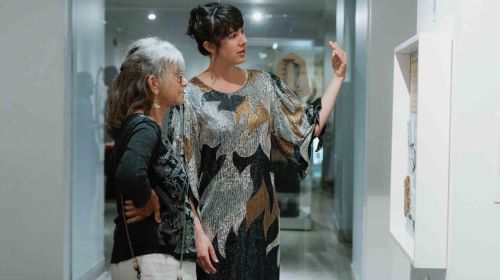
Three years later, “The Odyssey: A Retelling” interprets the ancient text in 28 works. As Jones began reading The Odyssey, she assumed it was a story about a man making his way home and over-coming many ob-stacles. When she dived into the work, she realized, “Oh no, this is about a whole network of people,” she says. Odysseus “thinks he’s the one making it happen. His pride certainly comes through. But, as the reader, I know—and as I assume the original audience that would have been listening knew—it was all about the importance of hosting, because you never knew who was the stranger coming at your door. It could be Zeus himself. And that was fascinating.”
Jones has a special term for hospitality worthy of a god. When extreme generosity is offered to guests, even if they are strangers, she calls it “radical hospitality.”
“What also struck me is how you would be fed, bathed, and have a good night’s sleep [before] you’re finally asked, ‘Who are you? Where did you come from?’”
The primary character who supports Odysseus is the goddess Athena, and the piece of art devoted to her is centered on the gallery’s back wall. Shapes of Athena is the only illustrative piece in the exhibition. Jones uses watercolor, ash, and wax to show the many forms the goddess takes to help Odysseus return home. The shape of the paper reflects the pediments of the Parthenon, and the linear proximity of the figures evokes the long journey Odysseus makes.
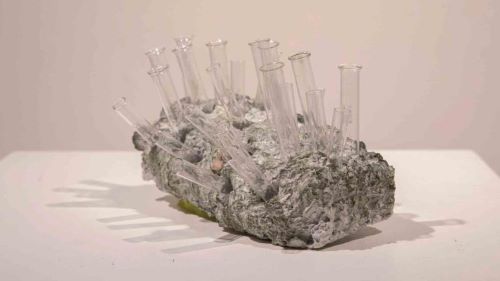
Jones seems most interested in the women of The Odyssey and their work. Both Penelope (Penelope’s Room) and Helen (Helen’s Storeroom) are recalled using unfinished needlepoint that Jones’s grandmother collected from other women. The Parthenon hosted a virtual symposium with University of Tennessee classics professor Justin Arft, who notes the significance of weaving in The Odyssey and of textiles in Jones’s exhibition.
Weaving, says Arft, is a powerful tool, both as an art form and also as a means of deception. “It is the women of the epic—beginning with Athena, but also ranging from Helen, Penelope, Queen Arete and her daughter Nausicaa, and their networks of enslaved women—who are most aligned with the process of making in the epic, if not making the epic itself by their actions, without which Odysseus would probably be dead or inglorious,” Arft explains. Nausicaa’s Laundry and Ogygia Filled With Wings both use this ancient art form.
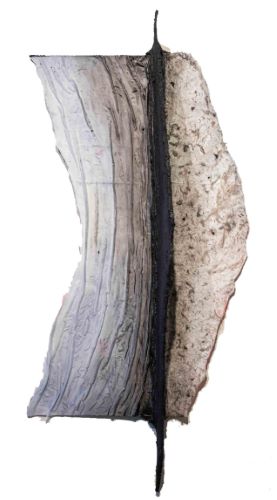
Among the most striking works is Beautiful, Dreadful, which interprets the Circe episode in the poem. Jones painted the island of Aeaea on pulp she made from mail and miscellaneous paper around the house. Beside the painting, a thick, wavy braid of yarn, hair, and wire makes the shape of a crescent moon. After Circe turns Odysseus’s men into pigs, Jones notes, she still feeds them the pigs’ favorite food. In the end, it is Circe who teaches Odysseus how to pass through Charybdis and evade Scylla. She is, one could argue, a good host.
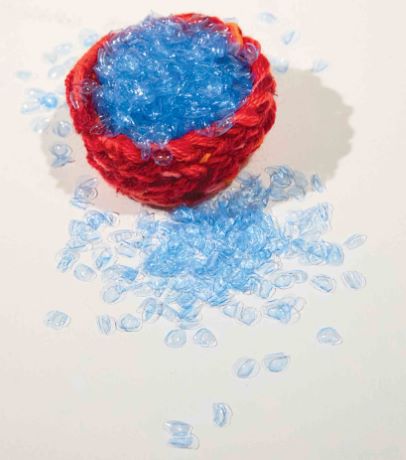
But not everyone follows the rules. Suitors lurk in Odysseus’s halls, drinking his wine, feasting on his cattle, and sleeping with his slaves. They give nothing in return; instead, they bring shame upon the Ithacan’s house. Jones interprets them in The Suitors’ Mouths, a sculpture that resembles the head of a goat, wrapped in fabric that’s printed with raw meat. A crushed silicone cup stands in for the insatiable mouths of these trespassers.
On the whole, “A Retelling” is an ode to the people who help Odysseus on his journey. They are gods and mortals, kings and slaves. “Nobody does anything on their own,” says Jones. “And that’s not to take away from Odysseus and what he did. He wouldn’t have done it without the support of others. . . . That connectivity is really important to me.”
Originally published to the public domain by Humanities, the Magazine of the NEH 44:1 (Winter 2023).
About the Author