History does not judge power by asking whether it was abused at all. It asks how often, how openly, and to what end.

By Matthew A. McIntosh
Public Historian
Brewminate
Introduction: Comparison Is Not Equivalence
Using public office for private gain is not a novelty in American political history. Power has always tempted those who wield it, and the line between public trust and personal benefit has never been perfectly guarded. To acknowledge this, however, is not to flatten all abuses into the same moral category. Comparison is a tool for understanding. Equivalence is a shortcut that obscures it. The distinction matters, especially when history is invoked to excuse the present.
I am focusing on a comparison between Lyndon B. Johnson and Donald Trump precisely because the comparison is instructive, not because it is forgiving. Both men faced credible accusations of exploiting public office for private advantage and both blurred ethical boundaries in ways that troubled contemporaries and later historians. But the similarities end quickly once scale, intent, and consequence are examined with care.
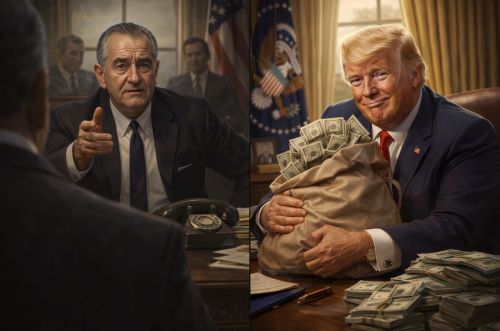
Johnson’s ethical failings unfolded within a political culture that still treated conflicts of interest as deviations from the norm rather than as governing strategy. His actions were often indirect, routed through family holdings and regulatory favoritism, and widely criticized even in their own time. Trump’s conduct, by contrast, has been direct, performative, and unapologetic. Where Johnson exploited gray areas within the system, Trump has repeatedly treated the system itself as an asset to be leveraged.
The danger of careless comparison is that it invites the familiar defense that “everyone does it,” a phrase that collapses moral gradation into cynicism. History does not work that way. It evaluates degree, repetition, visibility, and damage. A petty theft and a sustained looting are not separated by intent alone, but by magnitude and effect. To place Johnson and Trump side by side is not to absolve either but instead to insist that differences matter when assessing ethical collapse.
There is another reason this comparison must be handled precisely. Lyndon Johnson’s presidency, for all its corruption and cruelty in other arenas, was also marked by transformative public achievements that permanently expanded civil and political rights. Donald Trump’s presidency has produced no comparable counterweight. This asymmetry does not erase Johnson’s misconduct, but it does shape historical judgment. Power used selfishly but intermittently is not the same as power organized around self-interest as its primary purpose.
The argument that follows is therefore not an exercise in nostalgia or partisan convenience. It is a refusal to let historical awareness become historical excuse-making. Both men abused power. Only one made personal enrichment and self-glorification a central feature of governance itself. To understand that differ
ence is not to sanitize the past. It is to take it seriously.
LBJ’s Media Empire: Power, Influence, and Ethical Blind Spots
As a powerful Texas senator and later as president, Lyndon B. Johnson built a reputation not only for legislative mastery but for an aggressive understanding of how influence could be converted into advantage. Central to this reputation was the media empire owned by his wife, Lady Bird Johnson, which included radio and television stations that grew rapidly during Johnson’s ascent. The growth itself was not illegal. The means by which it occurred, however, raised persistent ethical questions that Johnson never fully answered.
Businesses and individuals seeking favorable treatment from Johnson’s political office were widely believed to have been steered toward advertising on these stations, often at premium rates. The implication was clear, even when left unstated. Patronage flowed most smoothly toward those who supported the Johnson family’s commercial interests. In an era when politics and business frequently overlapped, this arrangement was not unprecedented, but it was conspicuous enough to draw criticism from journalists and political opponents alike.
Regulatory favoritism compounded these concerns. Johnson’s stations reportedly benefited from unusually favorable treatment by the Federal Communications Commission, an agency over which Johnson wielded considerable informal influence. Licensing approvals, signal expansions, and regulatory leniency helped transform modest holdings into a lucrative enterprise. While such outcomes were rarely traceable to explicit directives, the cumulative effect suggested a system tilted by power rather than guided by neutrality.
It is important to situate these actions within their historical context. Conflict-of-interest laws in the mid-twentieth century were far less stringent than those that exist today. Disclosure requirements were minimal, enforcement mechanisms weak, and public expectations uneven. Johnson operated in a political environment that tolerated a degree of ethical ambiguity while still recognizing, at least rhetorically, that public office should not function as a private marketplace. His behavior pushed against those boundaries but did not erase them.
Historians and ethics scholars have therefore tended to describe Johnson’s conduct as exploitation rather than invention. He took advantage of a permissive system and bent it toward personal benefit, often ruthlessly. Yet even his critics acknowledge that Johnson understood, at some level, that these practices were questionable. They were conducted through intermediaries, shielded by deniability, and rarely celebrated openly. That instinct to conceal, however imperfectly, marks an ethical blind spot rather than an ethical vacuum.
The Moral Counterweight: LBJ’s Civil Rights Legacy
Any serious comparison must account for the fact that Lyndon Johnson’s presidency cannot be reduced to his ethical failings. However compromised his methods were in other areas, Johnson ultimately used presidential power to force through some of the most consequential civil rights legislation in American history. The Civil Rights Act of 1964 and the Voting Rights Act of 1965 were not symbolic gestures. They were structural interventions that dismantled legal segregation and reshaped the relationship between the federal government and its citizens. No assessment of Johnson’s legacy can ignore that reality.
What makes this counterweight morally significant is not merely the outcome, but the cost. Johnson understood that advancing civil rights would fracture the Democratic Party, alienate Southern power brokers, and permanently alter his political base. He proceeded anyway. That decision did not erase his abuses of power elsewhere, but it demonstrated a willingness to spend political capital on behalf of people who could not reward him personally. In historical terms, this matters. Motive does not excuse misconduct, but it does inform judgment.
This distinction is crucial when discussing office for personal gain. Johnson exploited influence, but he did not organize his presidency around self-enrichment alone. His administration still pursued expansive public goals that extended beyond personal benefit, often in direct tension with it. The presidency, for Johnson, remained a governing instrument even when he misused it. That tension produced contradictions, not collapse.
The presence of this moral counterweight is precisely what makes Johnson difficult to categorize and impossible to flatten into simple villainy. History remembers him as a deeply flawed figure who nonetheless altered the nation’s legal and moral framework in lasting ways. That legacy does not absolve his ethical blind spots, but it establishes a boundary. Johnson’s abuse of power occurred alongside transformative public action. What follows in this comparison turns on what happens when that boundary disappears entirely.
Trump’s Model: Personal Enrichment as Governing Principle
If Lyndon Johnson blurred ethical boundaries, Donald Trump erased them. Trump entered office not as a politician who later exploited opportunity, but as a brand that immediately absorbed the presidency into its business logic. From the outset, the distinction between public duty and private gain was treated not as a norm to respect, but as an inconvenience to ignore. The office itself became a revenue-generating platform, openly and continuously.
Unlike earlier presidents who divested or placed assets in genuine blind trusts, Trump retained ownership of a sprawling commercial empire and has used the visibility of the presidency to amplify it. Hotels, licensing deals, and branded properties are destinations for donors, lobbyists, and foreign interests seeking favor. Trump has continued making substantial personal income off the presidency itself, creating a level of financial entanglement that modern American politics had not previously normalized.
This monetization was not subtle. Reporting details how Trump has leveraged the power of office to steer business toward his properties, turning political access into commercial advantage. Where Johnson’s enrichment relied on implication and deniability, Trump’s relies on repetition and visibility. The message was unmistakable: proximity to power had a price, and the price was often paid directly to the president.
The controversy surrounding the Kennedy Center illustrates this governing philosophy in miniature. Efforts to attach Trump’s name to the institution, and to reshape its leadership and programming, are not isolated cultural disputes. They reflect a broader impulse to treat public institutions as extensions of personal legacy and brand. Legal challenges argue that the renaming of the Kennedy Center was unlawful, while reporting traces the resulting backlash and institutional instability.
The consequences have been immediate and measurable. Ticket sales reportedly collapsed following what critics described as a Trump takeover of the Kennedy Center, with longtime patrons withdrawing support and performances disrupted. This was not enrichment through the shadows. It was enrichment pursued openly, even when it damaged the very institutions being appropriated.
What distinguishes Trump’s model most sharply is not greed alone, but normalization. Personal enrichment is not an ethical lapse within his presidency. It is a governing principle defended as transparency, reframed as authenticity, and insulated by loyalists as strength. In this model, there is no tension between public service and private gain because public service has been redefined as private opportunity. That redefinition, more than any single transaction, marks the rupture that separates Trump from his predecessors.
Scale and Visibility: Why “Everyone Does It” Fails Here
The familiar defense that “everyone does it” collapses under even minimal historical scrutiny. Yes, power has always tempted officeholders. Yes, ethical boundaries have been bent before. But history does not judge misconduct as a binary condition. It judges degree, duration, and damage. Lyndon Johnson’s abuses were episodic and bounded, confined largely to a regional media empire and conducted within a political culture that still assumed embarrassment as a consequence. Trump’s conduct, by contrast, has been national, international, continuous, and unapologetic. Scale matters because scale determines impact. Visibility matters because visibility reshapes norms.
LBJ’s enrichment operated through implication and pressure, often relying on intermediaries and regulatory nudges that could be plausibly denied. Trump’s enrichment has been overt and repetitive, conducted in plain sight and defended as a feature rather than a flaw. This difference is not cosmetic. Corruption that hides still acknowledges limits. Corruption that performs has abandoned them. When personal gain becomes a spectacle, it trains institutions and citizens alike to accept behavior that would once have ended careers. Over time, the extraordinary becomes ordinary and the ordinary becomes expected.
This is why the comparison cannot be flattened into cynicism. To say “everyone does it” is to pretend that all abuses exert the same gravitational pull on democratic norms. They do not. A leader who exploits gray areas strains trust. A leader who erases the line between office and self rewrites the rules entirely. History is not fooled by that maneuver. It records not just the act, but the precedent it sets. And in that ledger, scale and visibility are not footnotes. They are the verdict.
Biff Tannen in the Oval Office: When Fiction Becomes Diagnosis
The comparison to Biff Tannen works not because it is insulting, but because it is diagnostically precise. In Back to the Future Part II, Biff does not become powerful through talent, discipline, or public service. He acquires power by exploiting a loophole, then uses that power to enrich himself, intimidate institutions, and bend reality around his ego. The future he creates is not merely corrupt. It is vulgar, transactional, and hollowed out, ruled by spectacle rather than legitimacy. The resemblance is unsettling because it captures a governing style rather than a personality flaw. It’s also intentional as the Biff character was quite literally based on the person of Donald Trump.
What makes Biff such an effective metaphor is his relationship to institutions. He does not abolish them. He occupies them. Law enforcement, media, and civic life continue to exist, but only as extensions of his will. They are props in a world designed to affirm him. This mirrors a presidency in which norms are not formally discarded but functionally neutralized. Rules remain on paper. Accountability exists in theory. In practice, loyalty is rewarded, dissent is punished, and everything is negotiable if it flatters the man at the center.
The contrast with Lyndon Johnson is stark here. Johnson abused systems, but he believed in systems. He manipulated Congress because he believed legislation mattered. He pressured regulators because he understood institutions had authority worth capturing. Trump’s approach is different. Governance is not a means to public ends, nor even to private ends carefully pursued. It is a stage. Institutions are valuable only insofar as they reflect power back at him, burnish his image, or generate profit. When they resist, they are mocked, starved, or reshaped.
Fiction becomes diagnosis when it explains behavior more clearly than ideology. Biff Tannen is not driven by policy, vision, or even coherent self-interest. He is driven by domination and display. That is why the analogy resonates. It captures a presidency defined not by flawed statesmanship, but by acquisitive performance. When the Oval Office becomes a casino floor and the republic becomes a backdrop, satire stops being exaggeration. It becomes shorthand for a truth too obvious to ignore.
Conclusion: Degrees Matter in Moral History
History does not judge power by asking whether it was abused at all. It asks how often, how openly, and to what end. Lyndon Johnson exploited his position for personal advantage, and that exploitation deserves scrutiny and condemnation. But it occurred within a presidency that also produced enduring public goods and accepted, however imperfectly, the idea that ethical boundaries existed. Johnson’s failures strained democratic norms. They did not redefine them.
Donald Trump’s presidency operates in a different moral register. Personal enrichment is not an aberration or a temptation resisted poorly. It is woven into the fabric of governance itself. The office is a tool for self-promotion, institutional capture, and financial gain on a scale and with a visibility unmatched in modern American history. This difference is not one of tone or temperament but instead a difference of category. When enrichment becomes principle rather than deviation, the damage extends beyond any single administration.
This is why historical literacy matters now. Comparisons that collapse distinction into cynicism do not clarify the past; they erase it. To say that “everyone does it” is to abandon the moral vocabulary necessary for democratic judgment. History records patterns, precedents, and consequences. It recognizes that abuses accumulate differently depending on how they are practiced and normalized. Degrees matter because they determine whether corruption is survivable or systemic.
Moral history is not a courtroom where verdicts are binary. It is a ledger of weight and balance. Lyndon Johnson’s name is recorded with contradiction, ambition, cruelty, and reform written side by side. Donald Trump’s will be recorded as something else entirely: a presidency in which self-interest was not merely indulged, but enthroned. That distinction does not soften Johnson’s record. It sharpens Trump’s. And in the long view, it is the difference between a republic bent and a republic taught to break.
Originally published by Brewminate, 12.29.2025, under the terms of a Creative Commons Attribution-NonCommercial-NoDerivatives 4.0 International license.
About the Author