The medieval persecution of heresy reveals a political and intellectual strategy that reaches far beyond theology. Ecclesiastical authority transformed disagreement into incapacity.

By Matthew A. McIntosh
Public Historian
Brewminate
Introduction: When Doctrine Becomes Diagnosis
In medieval Latin Christendom, disagreement over doctrine was rarely treated as an ordinary intellectual divergence. To challenge orthodox teaching was not simply to be wrong; it was to be spiritually impaired. Across the twelfth to fourteenth centuries, ecclesiastical authorities increasingly framed dissent as a form of inner disorder, a corruption of perception that rendered the dissenter incapable of sound judgment. This framing drew on deeply rooted assumptions about the unity of truth, reason, and salvation. If truth was singular and divinely revealed, then deviation could not be the product of honest reasoning. It had to signal a failure within the believer. Heresy came to be understood less as an interpretive disagreement and more as evidence of a damaged spiritual faculty, a condition that distorted thought itself.
The language surrounding heresy makes this transformation clear. Dissenters were described as blind, confused, deceived, possessed, or cognitively distorted by sin. Error was not understood as the product of sincere reasoning gone astray, but as evidence of a damaged spiritual faculty. Once belief was framed in this way, theological debate became unnecessary. Authority no longer needed to refute claims. It only needed to identify symptoms. Heresy ceased to be a position that required engagement and became a condition that required correction, containment, or removal.
Medieval heresy trials functioned less as forums for adjudicating belief than as mechanisms for delegitimizing dissent through spiritual pathologization. The charge of “spiritual madness” transformed disagreement into incapacity, collapsing theological difference into cognitive failure. Those accused were denied the standing necessary to participate in rational theological exchange, not because their arguments had been carefully examined and rejected, but because their minds were deemed unreliable from the outset. Orthodoxy asserted not only doctrinal supremacy but epistemic authority, claiming the right to determine who was capable of understanding truth at all. In doing so, ecclesiastical power relocated conflict away from interpretation and toward diagnosis, where dissent could be neutralized without ever being answered.
By examining how medieval institutions converted dissent into diagnosis, this traces a broader political and cultural pattern: the conversion of disagreement into a symptom rather than a claim. Heresy trials reveal how power protects itself by redefining opposition as disorder, insulating authority from challenge while preserving the appearance of moral care. The result was a system in which truth no longer needed to persuade, because those who questioned it were declared incapable of comprehension.
Intellectual Authority and the Limits of Debate in Medieval Christianity
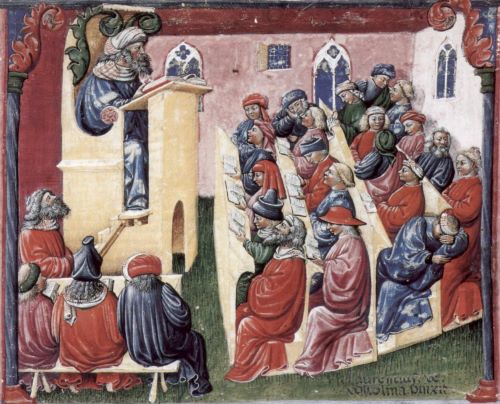
Medieval Christian intellectual culture rested on a conception of truth that sharply constrained the space for legitimate disagreement. Truth was understood as revealed, unified, and ultimately non-negotiable, grounded in divine authority rather than collective deliberation. Theology did not function as an open-ended inquiry in which competing interpretations could coexist indefinitely. It aimed at clarification, systematization, and defense of what was already held to be true. Within this framework, debate was permitted only insofar as it moved toward reaffirmation of orthodoxy. Disagreement that persisted beyond accepted boundaries was no longer interpreted as intellectual labor but as resistance to truth itself.
Scholasticism illustrates both the sophistication and the limits of medieval debate. The method prized logical rigor, careful distinction, and engagement with opposing views, yet it operated within tightly defined parameters. Authorities could be questioned, but revelation could not. Conclusions were tested, but only against premises already sanctioned by the Church. Figures such as Thomas Aquinas exemplified this balance, modeling how reason could serve faith without threatening it. The system assumed that properly ordered reason, guided by correct authority, would converge on the same conclusions. Persistent divergence suggested not an alternative interpretation, but a failure of reason or will.
This convergence assumption had significant consequences. If truth was singular and accessible to rightly ordered minds, then those who rejected orthodox conclusions could not simply be mistaken. They had to be impaired in some way, either morally, spiritually, or cognitively. Error became evidence of disorder. Theological disagreement carried an implicit moral judgment, blurring the line between intellectual failure and spiritual fault. This logic made it increasingly difficult to treat dissent as a good-faith exercise of reason.
Ecclesiastical authority reinforced these assumptions institutionally. Councils, episcopal courts, and later inquisitorial bodies were charged not with exploring the boundaries of doctrine but with preserving its integrity. Their mandate was corrective, not exploratory. When confronted with heterodox belief, the question was not which argument was stronger, but why the dissenter had failed to assent to what was already known to be true. Debate, where it occurred, was asymmetrical from the start. One side spoke from health and truth. The other was presumed deficient.
The limits of debate were not merely practical but conceptual. To persist in dissent was to step outside the category of rational interlocutor. Theological reasoning could be rehearsed, but only as a prelude to correction. Once authorities concluded that error stemmed from corruption of understanding rather than misunderstanding of argument, discussion ceased to serve a purpose. At that point, diagnosis replaced dialogue, and intellectual authority asserted itself not by persuading opponents, but by denying that they were capable of persuasion at all.
Heresy as Cognitive and Spiritual Corruption

Medieval Christian thought increasingly described heresy not simply as false belief but as a condition that damaged the faculties required for belief itself. Error was framed as a distortion of perception, a failure of the soul’s capacity to apprehend truth as it was divinely revealed. The heretic did not merely hold an incorrect position that could be corrected through clarification or argument. He was understood to see the world wrongly, to interpret reality through a corrupted inner lens. This distinction mattered because it relocated the problem of dissent from the level of interpretation to the level of cognition. If the mind itself was compromised, then disagreement could not be resolved through debate alone. The possibility of rational exchange was foreclosed at the outset.
Patristic and medieval authorities supplied a vocabulary for this move. Writers such as Augustine of Hippo described heresy as a willful turning away from truth that darkened understanding over time. Error hardened into habit, and habit into incapacity. To persist in false belief was to confirm one’s own blindness. By the twelfth century, this framework had expanded. Heresy was increasingly portrayed as confusion, deception, or even possession, a state in which external forces distorted cognition and severed the link between reason and revelation.
This fusion of spiritual and cognitive language allowed authorities to collapse multiple categories into one. Sin, ignorance, and irrationality became mutually reinforcing explanations. A dissenter’s inability to accept orthodoxy was taken as proof of moral failure, which in turn explained cognitive error. Theological disagreement became self-validating evidence of corruption. The more clearly a heretic articulated an alternative position, the more that clarity could be interpreted as cunning rather than insight, sophistication rather than understanding.
Figures such as Bernard of Clairvaux sharpened this logic in polemical contexts, portraying dissenters as spiritually unstable and dangerously persuasive precisely because they lacked true understanding. Heresy was treated as a counterfeit rationality, capable of mimicking reason while remaining fundamentally disordered. This made engagement itself suspect. To argue with the heretic was not merely futile but dangerous, as it risked granting legitimacy to a corrupted mode of thought. Diagnosis became the safer and more authoritative response. By defining dissent as cognitive and spiritual corruption, medieval institutions rendered opposition not simply wrong, but epistemically unsafe, something to be contained rather than answered.
Trial Procedures and the Performance of Irrationality

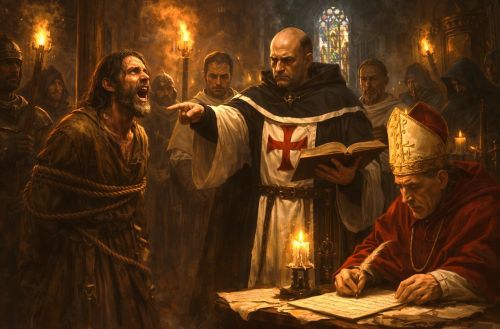
Medieval heresy trials did not merely seek to determine whether an accused individual held incorrect beliefs. They functioned as institutional performances designed to confirm the presumption of disordered thought. From the outset, inquisitorial procedures framed the accused not as a disputant in search of truth, but as a subject whose understanding was already compromised. The trial itself became a mechanism for revealing irrationality rather than testing arguments. What was on display was not the strength or weakness of doctrine, but the supposed instability of the heretical mind.
Interrogation practices reinforced this framing in systematic ways. Questioning was structured to elicit inconsistency, hesitation, or contradiction, all of which could be interpreted as signs of confusion, deceit, or inner disorder. The accused was often asked to restate beliefs repeatedly, sometimes over extended periods and under varying conditions, with slight shifts in wording or emphasis. Any deviation in response could be read as evidence of mental instability rather than the natural result of stress, fear, fatigue, or coercion. Coherence was not assessed on its own terms but measured against an orthodoxy the accused was presumed incapable of fully grasping. Rational explanation became nearly impossible, because the criteria for rationality were defined by the very authority that had already diagnosed deviation.
Confession occupied a central role in this process, but not as a transparent admission of belief or error. It was treated as confirmation of inner corruption and epistemic failure. A confession demonstrated that the accused had recognized their own disordered state and submitted to correction, while resistance to confession signaled further blindness, obstinacy, or demonic influence. Even recantation did not restore intellectual credibility. A repentant heretic was not understood as persuaded through reasoned argument, but as temporarily cured through submission and discipline. The possibility that belief might have been sincerely held, coherently reasoned, and morally grounded was excluded by the logic of the trial itself.
Procedural asymmetry further amplified this effect. The accused rarely had access to counsel in any meaningful sense, nor were they permitted to engage in open doctrinal debate. Witness testimony was often anonymous, preventing direct challenge or clarification. The structure of the trial denied the heretic the basic conditions required for rational defense, while simultaneously interpreting that inability as proof of irrationality. Silence, confusion, or emotional distress became part of the evidentiary record, reinforcing the diagnosis the trial was meant to produce.
Manuals such as Bernard Gui’s Practica Inquisitionis Heretice Pravitatis codified these assumptions and trained inquisitors to recognize signs of cognitive and spiritual disorder. They offered guidance on detecting evasiveness, feigned simplicity, excessive eloquence, or overconfidence, all of which could indicate heretical corruption. Rationality itself was suspect if it appeared too skillful or too self-assured. The ideal subject of orthodoxy was transparent, compliant, and predictable, displaying neither stubborn independence nor interpretive creativity. Anything outside these narrow bounds could be classified as deviant cognition. The trial functioned less as an inquiry into belief and more as a sorting mechanism, distinguishing healthy submission from diseased thought.
By the end of the process, irrationality was no longer merely alleged. It had been performed, recorded, and institutionalized. The accused emerged not as a defeated interlocutor but as a documented case of spiritual and cognitive disorder. Trial records preserved this identity for posterity, ensuring that dissent would be remembered not as a coherent challenge but as evidence of instability. In this way, inquisitorial procedure completed the transformation of disagreement into diagnosis, embedding the presumption of madness into the legal and historical record itself.
Diagnosis Replacing Debate

By the thirteenth century, ecclesiastical authorities increasingly treated heretical belief not as a claim to be weighed but as a condition to be identified. Once dissent was framed as spiritual or cognitive corruption, the purpose of engagement shifted decisively. Theological argument lost its centrality, replaced by evaluative judgments about the state of the dissenter’s soul and mind. Debate presupposes shared rational ground. Diagnosis does not. It assumes asymmetry from the start, positioning authority as healthy and dissent as impaired.
This shift altered the function of expertise within the Church in profound ways. The theologian or inquisitor was no longer primarily an interpreter of texts or doctrines, but an assessor of interior states, charged with discerning corruption beneath speech. Correct belief became synonymous with mental and spiritual health, while deviation signaled disorder of will, intellect, or both. Under this logic, persuasion was unnecessary and potentially dangerous. To argue with a heretic was to grant legitimacy to a corrupted mode of thought and to risk exposure to error. The safer course was identification, correction, and, if necessary, exclusion. Authority preserved itself by redefining engagement as risk and restraint as wisdom, recoding silence as virtue rather than avoidance.
The replacement of debate with diagnosis also justified escalating forms of coercion. If dissent reflected confusion, possession, or hardened blindness, then force could be recast as care. Punishment became treatment. Compulsion appeared as remedy. This moral inversion allowed harsh measures to coexist with claims of pastoral responsibility. Authorities could insist they were acting not against persons but against sickness. In this way, repression was insulated from critique, protected by a language of concern that rendered violence intelligible as healing.
This diagnostic framework reshaped the intellectual landscape itself, narrowing the horizon of what could be said, questioned, or imagined. Spaces for genuine disagreement contracted, not because all theological questions had been resolved, but because questioning itself was reclassified as evidence of disorder. Theological development continued, but only within sanctioned pathways that preserved the appearance of mental and spiritual health. Innovation was permitted so long as it did not threaten diagnostic boundaries. Dissent that exceeded those boundaries was no longer intelligible as thought at all. It was intelligible only as symptom. The consequence was a system in which authority no longer needed to answer its critics, because it had already declared them incapable of understanding the answer.
Social Contagion and the Fear of Spread

Medieval authorities did not treat heresy merely as an individual error but as a collective danger with the potential to undermine entire communities. Dissenting belief was imagined as contagious, capable of spreading through proximity, conversation, and imitation in ways that bypassed conscious persuasion. This fear transformed heresy from a theological problem into a social emergency. Once belief itself was understood as vulnerable to corruption, containment became as important as correction. The goal was not simply to reclaim errant souls through instruction, but to protect the cognitive and spiritual health of the broader Christian body from exposure to disordered thought. In this framework, the presence of heresy posed a risk even before it was articulated.
The metaphor of contagion drew on familiar medieval frameworks. Disease, sin, and disorder were already linked in religious thought, and heresy easily entered that conceptual chain. A single dissenter could infect many. Exposure itself was dangerous. This logic justified surveillance and preemptive action. Communities were encouraged to monitor one another, to report suspicious speech, and to sever ties with those under suspicion. Fear of contamination replaced trust as the organizing principle of social cohesion.
This dynamic reshaped communal life. Neighbors became witnesses. Families became potential vectors. Silence was no longer neutral but suspect, as failure to denounce could imply sympathy or exposure. The burden of orthodoxy shifted outward, diffused across the population. In this environment, heresy did not need to persuade to spread. It only needed to exist. Authority responded by expanding mechanisms of detection, ensuring that deviation was identified before it could circulate.
Inquisitorial systems formalized this logic by treating networks rather than individuals as objects of concern. Investigations sought patterns of association, shared language, repeated contact, and ritual similarity. The goal was to map transmission rather than to test arguments or meanings. A belief repeated by many was not evidence of plausibility or resonance but of infection. Widespread adherence confirmed danger, not legitimacy. The more a doctrine circulated, the more urgently it demanded suppression. Popularity became proof of threat, reinforcing the assumption that heresy spread mechanically rather than intellectually.
Historians have shown how this fear of spread contributed to the formation of a persecuting society. Heresy was grouped with other perceived threats that were likewise framed as corrosive and contagious. What united these targets was not the content of their beliefs or behaviors, but the claim that they undermined social order by their mere presence. Diagnosis justified exclusion, and exclusion was framed as collective defense.
The result was a moral economy in which repression appeared not as excess but as obligation. By construing dissent as contagious disorder, medieval authorities rendered coercion not only permissible but necessary. Failure to act risked collective harm, spiritual decay, and social collapse. This logic closed the remaining space for debate entirely. One does not argue with disease. One isolates it. In treating dissent as something that spread by proximity rather than persuasion, medieval institutions completed the transformation of disagreement into a threat to be managed rather than a claim to be answered.
Institutional Memory and the Erasure of Heretical Argument
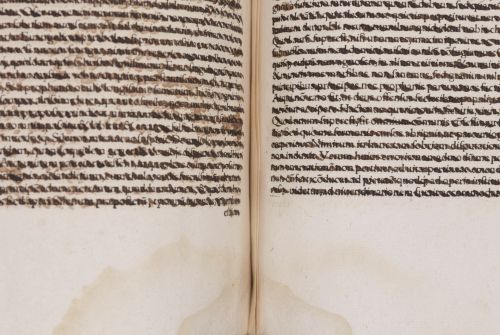
Medieval institutions did not merely suppress heretical movements in their own time. They controlled how those movements would be remembered. Trial records, theological condemnations, and inquisitorial manuals preserved verdicts while discarding arguments. What survived in archives and chronicles was not the substance of dissenting claims, but their classification as error, corruption, or madness. Heresy entered institutional memory already interpreted, stripped of its intellectual content and reduced to a cautionary example.
This asymmetry was not accidental or incidental to recordkeeping practices. Ecclesiastical documentation was structured to confirm orthodoxy, not to preserve debate. Depositions summarized beliefs only insofar as they demonstrated deviation from accepted doctrine. Arguments were paraphrased, compressed, or reframed to fit established taxonomies of error, often detached from the reasoning that made them intelligible. Theological positions articulated by the accused were rarely recorded in full, and when they were, they appeared surrounded by commentary that framed them as confused, perverse, or deliberately deceptive. The documentary process itself functioned as a second judgment, ensuring that dissent entered the historical record already discredited.
This practice reshaped historical understanding at a deeper level. Later theologians, chroniclers, and historians encountered heresy almost exclusively through the lens of condemnation. Because dissenting arguments were absent, fragmented, or distorted, orthodoxy appeared self-evident and internally coherent, while opposition appeared irrational or incoherent by nature. The historical record reproduced the diagnostic logic of the trials themselves. Heretics were remembered not as thinkers engaged in alternative interpretations of Christian truth, but as embodiments of confusion, obstinacy, or spiritual disorder. The absence of argument became evidence of incapacity, reinforcing the original judgment long after the trials had ended.
Scholars have shown how institutional archives do not merely reflect power but enact it, shaping what can be known about the past. In the case of medieval heresy, authority extended beyond coercion into historiography. By determining which voices were preserved and which were erased, ecclesiastical institutions ensured that dissent would survive only as pathology. The absence of heretical argument was itself a political achievement, the final stage of delegitimization.
The long-term consequence of this erasure was a narrowing of intellectual memory. Possibilities that once existed within medieval Christianity were rendered unthinkable in retrospect. The boundaries of acceptable belief appeared timeless rather than contingent, and orthodoxy seemed to have prevailed by inevitability rather than power. In this way, institutional memory completed the work begun in the trial chamber. Dissent was not only defeated and diagnosed. It was forgotten as thought, remembered only as error.
Conclusion: When Truth No Longer Needs to Answer
The medieval persecution of heresy reveals a political and intellectual strategy that reaches far beyond theology. By reframing dissent as spiritual or cognitive disorder, ecclesiastical authority transformed disagreement into incapacity. Heretical belief was not defeated through sustained argument or persuasion, but neutralized through diagnosis. Once dissenters were declared confused, possessed, or mentally corrupted, their claims no longer required engagement. Authority could maintain doctrinal certainty without exposing itself to the risks inherent in debate or reinterpretation.
What made this strategy so powerful was its moral plausibility and institutional reach. The language of spiritual care, correction, and protection masked coercion as responsibility and repression as charity. Punishment appeared as remedy. Exclusion appeared as defense of communal health. By positioning itself as guardian of both truth and sanity, the Church recruited society itself into the work of enforcement. Communities monitored belief. Neighbors denounced neighbors. Clergy and laity alike internalized diagnostic categories that blurred the line between error and illness. The boundary between faith and pathology hardened, and with it the assumption that disagreement signaled inner failure rather than interpretive difference or sincere conviction.
The cost of this transformation was not only the suffering of those accused, but the narrowing of Christian intellectual life. When dissent could no longer speak as thought, theological development became constrained by diagnostic boundaries rather than argumentative ones. Questions that might have generated reform, clarification, or renewal were silenced before they could be articulated. Orthodoxy appeared timeless and inevitable, not because it had answered every challenge, but because challenges had been rendered unintelligible within the categories that governed belief.
The medieval case offers a stark lesson about the fragility of disagreement itself. When truth no longer needs to answer, power has shifted decisively from persuasion to classification. Authority ceases to engage and begins to diagnose. Once classification replaces argument, dissent is no longer a participant in meaning-making but a condition to be managed. The legacy of medieval heresy trials reminds us that the health of any intellectual or political system depends not on the absence of dissent, but on its capacity to treat disagreement as intelligible, answerable, and fully human, even when it threatens established authority.
Bibliography
- Aquinas, Thomas. Summa Theologiae. Translated by the Fathers of the English Dominican Province. New York: Benziger Brothers, 1947.
- Arnold, John H. Inquisition and Power: Catharism and the Confessing Subject in Medieval Languedoc. Philadelphia: University of Pennsylvania Press, 2001.
- —-. “Voicing Dissent: Heresy Trials in Later Medieval England.” Past & Present 245:1 (2019), 3-37.
- Augustine. On Heresies. In The Works of Saint Augustine, edited by John E. Rotelle. Hyde Park, NY: New City Press, 1999.
- Bernard of Clairvaux. Letters. Translated by Bruno Scott James. Kalamazoo: Cistercian Publications, 1986.
- Bynum, Caroline Walker. Holy Feast and Holy Fast: The Religious Significance of Food to Medieval Women. Berkeley: University of California Press, 1987.
- Cavill, Paul. “The Prosecution of Heresy in the Henrician Reformation.” The Journal of Legal History 45:1 (2024), 1-33.
- Christianson, Karen Ann. “Piety, Ritual, and Heresy: The Varieties of Medieval Religious Experience.” Essays in Medieval Studies 29 (2013), 5-6.
- Dickens, Andrea Janelle. Heresy in the Middle Ages: A History of Authority and Exclusion. Minneapolis: Fortress Press, 2024.
- Foucault, Michel. Madness and Civilization: A History of Insanity in the Age of Reason. New York: Vintage Books, 1961.
- —-. Power/Knowledge: Selected Interviews and Other Writings, 1972–1977. New York: Pantheon Books, 1980.
- Given, James. Inquisition and Medieval Society: Power, Discipline, and Resistance in Languedoc. Ithaca: Cornell University Press, 1997.
- Gui, Bernard. Practica Inquisitionis Heretice Pravitatis. Edited and translated by Edward Peters. New York: Columbia University Press, 2008.
- Lambert, Malcolm. Medieval Heresy: Popular Movements from the Gregorian Reform to the Reformation. Oxford: Blackwell, 1977.
- Moore, R. I. The Formation of a Persecuting Society: Authority and Deviance in Western Europe, 950–1250. Oxford: Blackwell, 1987.
- —-. The War on Heresy. Cambridge, MA: Harvard University Press, 2012.
- Nirenberg, David. Communities of Violence: Persecution of Minorities in the Middle Ages. Princeton: Princeton University Press, 1996.
- Pelikan, Jaroslav. The Christian Tradition: A History of the Development of Doctrine. Vol. 3. Chicago: University of Chicago Press, 1978.
- Peters, Edward. Heresy and Authority in Medieval Europe. Philadelphia: University of Pennsylvania Press, 1980.
- —-. Inquisition. Berkeley: University of California Press, 1988.
- Rubin, Miri. Corpus Christi: The Eucharist in Late Medieval Culture. Cambridge: Cambridge University Press, 1991.
- Russell, Jeffrey Burton. Dissent and Reform in the Early Middle Ages. Berkeley: University of California Press, 1965.
- Schmitz-Esser, Romedio. “The Cursed and the Holy Body: Burning Corpses in the Middle Ages.” The Journal of Medieval and Early Modern Studies 45:1 (2015), 131-157.
- Spiegel, Gabrielle M. The Past as Text: The Theory and Practice of Medieval Historiography. Baltimore: Johns Hopkins University Press, 1997.
- Tierney, Brian. The Crisis of Church and State, 1050–1300. Toronto: University of Toronto Press, 1964.
Originally published by Brewminate, 02.11.2026, under the terms of a Creative Commons Attribution-NonCommercial-NoDerivatives 4.0 International license.
About the Author