Francisco Franco’s Spain demonstrates how religion can be transformed from spiritual tradition into instrument of sovereign authority.

By Matthew A. McIntosh
Public Historian
Brewminate
Introduction: Faith under the Flag
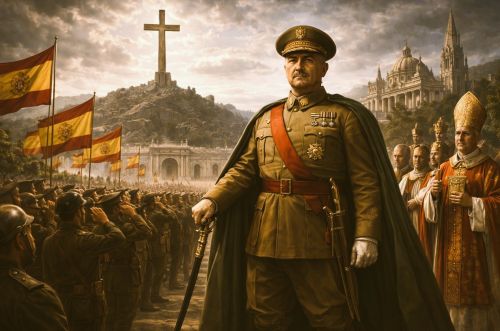
Francisco Franco’s Spain was not merely an authoritarian state that tolerated religion; it was a regime that fused Catholic identity with national sovereignty. From the end of the Spanish Civil War in 1939 until Franco’s death in 1975, Catholic symbolism, doctrine, and institutional authority were woven into the fabric of political life. The regime presented itself not only as a government restoring order after conflict, but as the guardian of Christian civilization. Religion did not stand beside the state as independent moral witness. It stood beneath the flag, integrated into the ideological architecture of power.
The origins of this fusion lay in the trauma of the Civil War. Anti-clerical violence during the Republican period, including the killing of clergy and the destruction of churches, was remembered and amplified as evidence of an existential assault on Catholic Spain. Franco and his supporters framed the conflict not merely as a struggle between political factions, but as a spiritual confrontation between Christian order and secular revolution. The language of crusade saturated Nationalist propaganda, casting the military uprising as a sacred mission to reclaim the nation for God. Franco’s victory in 1939 was interpreted by many ecclesiastical leaders as providential deliverance, a divine intervention that preserved Spain from atheistic chaos. In this narrative, the regime emerged not simply as political victor but as spiritual defender, entrusted with restoring moral hierarchy and religious authority. The memory of wartime violence became the emotional and theological foundation for a long-term alliance between church hierarchy and authoritarian rule.
National Catholicism became the organizing principle of this alliance. Catholicism received privileged legal status, influence over education, and moral authority within public life. In return, the regime gained moral legitimacy and symbolic reinforcement. Franco was presented by many ecclesiastical authorities as the chosen defender of Spain’s spiritual heritage. His personal morality, administrative brutality, and political repression were subordinated to a larger narrative of civilizational protection. What mattered was not the ruler’s sanctity, but his utility in enforcing religious and cultural dominance.
Under Franco, Catholicism was transformed from spiritual tradition into ideological instrument. The alliance between church and regime did not abolish faith, but it reoriented it toward state enforcement. Religious nationalism elevated a deeply authoritarian leader because he advanced institutional power and suppressed perceived enemies of faith. In Franco’s Spain, faith marched beneath the banner of sovereignty, and doctrine acquired the function of political legitimacy.
The Spanish Civil War and the Construction of a Sacred Conflict
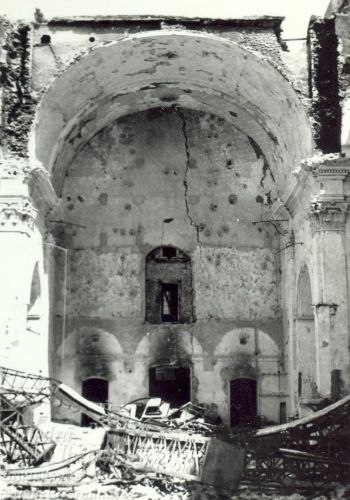
The Spanish Civil War did not begin as a purely religious war, yet it was rapidly interpreted through religious categories. The military uprising of July 1936 emerged from political polarization, social unrest, and ideological conflict between left and right. However, the violence that unfolded in Republican zones, particularly against clergy and religious institutions, reshaped the moral narrative of the conflict. Churches were burned, monasteries were looted, and thousands of clergy were killed. These acts were seized upon by Nationalist leaders as proof that the Republic represented not merely political opposition but spiritual annihilation.
Nationalist propaganda framed the war as a crusade. Bishops issued pastoral letters describing the conflict as a defense of Christian civilization against atheistic Marxism. The language of sacred restoration infused speeches, sermons, and printed materials. Franco’s forces were depicted as instruments of divine will, restoring order to a nation that had strayed from its Catholic identity. This sacral framing did not eliminate political motivations, but it elevated the war into a struggle of cosmic proportions. Violence was justified as purgative necessity.
The Vatican’s response was cautious in diplomatic tone yet sympathetic in orientation. While formal recognition of Franco’s government developed, many within the Catholic hierarchy interpreted the Nationalist cause as aligned with the preservation of religious order. Reports of anti-clerical violence circulated widely across Europe, reinforcing perceptions that the Republic embodied militant secularism hostile to faith. Bishops within Spain publicly endorsed the uprising, presenting it as a defensive reaction against religious persecution. Martyr narratives proliferated, commemorating clergy who had been killed and framing their deaths as testimony to the righteousness of the Nationalist cause. These accounts did not merely record suffering; they sacralized it, transforming tragedy into theological validation. The suffering of clergy became symbolic capital, strengthening the moral legitimacy of Franco’s movement and embedding religious interpretation into the memory of the conflict.
The construction of a sacred conflict simplified complex political realities. The Republic encompassed a wide spectrum of ideologies, including moderate reformers alongside revolutionary factions, and not all anti-clerical violence reflected centralized policy. Yet within Nationalist discourse, nuance yielded to clarity. The enemy was recast as uniformly godless and revolutionary, collapsing political plurality into a singular moral threat. By reducing the war to a binary struggle between faith and atheism, the regime cultivated emotional cohesion and ideological discipline. Franco’s leadership was elevated within this framework not solely as military command but as spiritual guardianship. He was portrayed as the instrument through whom divine justice would restore Spain’s Christian identity. The merging of national and religious identity provided emotional coherence to authoritarian consolidation, marginalizing dissent by equating opposition with sacrilege.
The concept of crusade carried enduring consequences. By framing the war as holy struggle, the regime embedded moral absolutism into its postwar ideology. Victory was not simply military success; it was divine vindication. This interpretation discouraged dissent and stigmatized opposition as not only political betrayal but sacrilegious rebellion. The sacred framing of conflict extended beyond wartime mobilization into peacetime governance, shaping education, public ceremony, and national memory.
The Civil War functioned as the crucible in which National Catholicism was forged. Trauma, martyrdom, and propaganda combined to produce a narrative of divine rescue that endured well beyond the battlefield. Franco emerged from the conflict not merely as head of state but as providential defender of Christian Spain, entrusted with safeguarding its spiritual and moral order. The sacralization of the war legitimized the fusion of church and regime, embedding Catholic identity into the ideological structure of the state. Through commemorations, liturgies, and official narratives, the memory of the conflict was curated as evidence of divine favor toward the victorious regime. In this way, the sacred framing of civil war did more than justify repression; it normalized it as necessary defense of faith. Spanish society was prepared to accept an authoritarian order presented not as political domination but as spiritual restoration.
Institutional Bargain: Church Privilege in Exchange for Legitimacy
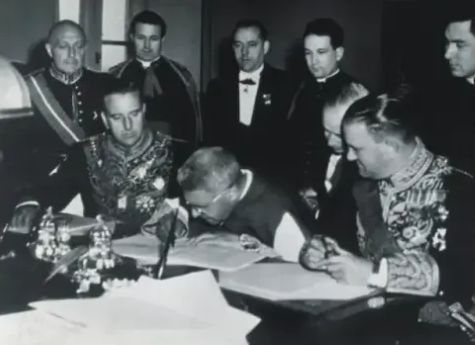
With victory secured in 1939, the wartime language of crusade transitioned into a durable institutional arrangement. The alliance between Franco’s regime and the Catholic hierarchy evolved into what became known as National Catholicism, a fusion of religious authority and state power. This relationship was not merely symbolic; it was structural and transactional. The Church emerged from the Civil War positioned to reclaim influence it had lost during the Republican period. The regime, in turn, required moral legitimacy to stabilize authoritarian rule. The result was an exchange of privilege for sanctification.
The legal framework of this arrangement was consolidated through policies culminating in the 1953 Concordat between Spain and the Vatican. Catholicism was granted official recognition as the religion of the state, and the Church received substantial financial support, tax exemptions, and institutional protections. Religious instruction became mandatory in public schools, placing the formation of youth firmly under ecclesiastical influence. Ecclesiastical authorities exercised authority over marriage law, annulments, and family morality, reinforcing Catholic doctrine as civil norm. Clergy salaries were subsidized by the state, and bishops retained significant input in educational appointments and curriculum oversight. Religious symbols, ceremonies, and feast days were woven into official state observances, blurring distinctions between civic ritual and liturgical expression. These privileges did not simply restore the Church to its pre-Republican standing; they elevated it within an authoritarian framework that guaranteed legal dominance. Catholic institutions operated with state backing, while dissenting religious or secular perspectives were marginalized.
In return, the regime gained ecclesiastical endorsement that framed Franco’s rule as providential and necessary. Bishops publicly supported the government, and official statements reinforced the notion that the regime defended Christian civilization against secular subversion. The Church’s moral authority lent sacred resonance to state ceremonies, commemorations, and public rituals. Franco was frequently portrayed as chosen by God to restore Spain’s spiritual integrity. The regime’s repression, censorship, and political imprisonment were rarely subjected to sustained ecclesiastical condemnation in the early decades of rule.
This exchange was not entirely uniform or unchallenged. Within the Church, varying degrees of enthusiasm and caution coexisted. Some clergy embraced the alliance wholeheartedly, viewing it as restoration of rightful order after years of perceived persecution. Others, particularly those attentive to social justice concerns or influenced by emerging global Catholic currents, expressed unease about the conflation of faith with authoritarian governance. Internal tensions grew as elements within Spanish Catholicism began to question the regime’s repression and social inequities. Yet during the formative decades of Franco’s rule, institutional benefits, legal privilege, and protection from secular opposition proved compelling. The regime’s enforcement power shielded Catholic institutions from challenge, while Catholic endorsement reinforced regime legitimacy. The balance of advantage favored continued cooperation, even where theological reservations existed.
The institutional bargain between Church and state stabilized Franco’s Spain for decades. Catholicism gained privileged position, educational control, and cultural influence. The regime gained moral cover and symbolic reinforcement. Religion was not extinguished under authoritarianism; it was elevated into state ideology. Through mutual reinforcement, faith and sovereignty were bound together, each strengthening the other while narrowing the space for dissent.
Franco’s Personal Morality and Political Utility

Francisco Franco was presented by many ecclesiastical authorities as the defender of Christian civilization, yet his regime was characterized by repression, censorship, patronage networks, and systematic political violence. Tens of thousands of political prisoners filled jails and labor camps in the aftermath of the Civil War. Executions and purges extended well into the postwar years. The regime tightly controlled the press, suppressed regional identities, and eliminated political pluralism. These realities did not align neatly with Catholic social teaching on human dignity and justice. Yet moral dissonance did not prevent sacralization.
Franco’s personal piety, while publicly cultivated, was less central to his legitimacy than his usefulness to the institutional Church. He attended religious ceremonies, invoked Catholic language in public addresses, and surrounded state events with liturgical symbolism, reinforcing the image of devout leadership. However, the regime’s ethical record was defined by authoritarian consolidation rather than evangelical compassion. Policies were enforced through surveillance, imprisonment, and suppression of dissent, even as official rhetoric emphasized moral restoration. For ecclesiastical authorities, the decisive factor was not the ruler’s interior spiritual life but his political role. The state enforced Catholic moral norms, restricted secular and socialist influence, and restored ecclesiastical privilege in education and public life. Religious instruction permeated schools, marriage law reflected Catholic doctrine, and public identity was fused with confessional loyalty. In this framework, the ruler’s moral imperfections were subordinated to his strategic utility. Sanctification followed not personal holiness but institutional advantage.
The logic of political theology became visible in the selective moral emphasis applied to the regime. Anti-clerical violence during the Republic was remembered and condemned with theological intensity, while state repression was framed as necessary defense of order. The narrative of providential restoration overshadowed scrutiny of authoritarian excess. Franco’s image as guardian of faith absorbed critique, presenting stability as virtue and opposition as threat. Moral evaluation became intertwined with political allegiance.
This pattern illustrates how religious nationalism can elevate leaders whose conduct would otherwise provoke ethical concern. Institutional survival and influence can recalibrate moral priorities, emphasizing protection of doctrine and privilege over prophetic critique of power. In Franco’s Spain, the Church’s endorsement did not necessarily deny repression; it contextualized it within a narrative of civilizational preservation. Political utility outweighed personal sanctity, and moral complexity was subsumed beneath the perceived necessity of defending Catholic Spain.
Religion as State Ideology
Under Franco, Catholicism did not simply coexist with the state; it became embedded within its ideological structure. National Catholicism fused religious identity with Spanish national identity, presenting the two as inseparable. To be authentically Spanish was to be Catholic. This equation marginalized alternative identities and narrowed the boundaries of legitimate citizenship. Religion ceased to function solely as spiritual community and instead operated as marker of political belonging.
The education system became a primary vehicle for this transformation. Religious instruction was compulsory in public schools, and curricula were aligned with Catholic moral teaching. Textbooks framed Spanish history through providential narrative, emphasizing the nation’s role as defender of the faith. Clergy exercised influence over educational appointments and content, ensuring doctrinal conformity. Generations of students were socialized into a worldview in which loyalty to the regime and fidelity to Catholicism were mutually reinforcing.
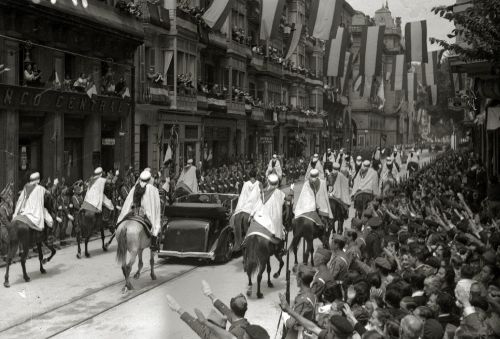
State ceremonies reinforced this ideological fusion in both symbolic and practical ways. Public events incorporated liturgical elements, and national holidays were marked by religious observance that blurred civic and sacred boundaries. Military parades, commemorations of Civil War victory, and official speeches frequently invoked divine blessing, martyr memory, and Christian heritage as legitimizing forces behind political authority. Religious symbols such as crucifixes and images of saints appeared in courtrooms, classrooms, and government offices, visually aligning state power with ecclesiastical sanction. The presence of clergy at official functions signaled that governance itself operated under sacred endorsement. Through repetition and ritual, this symbolic integration normalized the identification of Catholicism with patriotism. Political loyalty acquired theological resonance, and dissent risked appearing not merely unpatriotic but impious.
Censorship further entrenched ideological uniformity. Publications critical of Catholic doctrine or regime policy were restricted, and artistic expression was monitored to prevent deviation from moral norms. The state positioned itself as guardian not only of political stability but of spiritual orthodoxy. Moral policing extended into private life through regulation of marriage, divorce, and family conduct. Religion functioned as normative framework for civil law, reinforcing obedience through ethical expectation.
This fusion also constrained internal Catholic dissent. Clergy who questioned regime policies risked surveillance, transfer, or marginalization, particularly in the earlier decades of Franco’s rule. While later developments influenced by the Second Vatican Council would create space for cautious critique, institutional alignment during the formative years limited prophetic distance from state power. Bishops who benefited from restored privileges were often reluctant to jeopardize ecclesiastical influence through confrontation. The Church’s privileged status depended upon cooperation with state ideology, and public silence frequently functioned as tacit endorsement. Religion’s public authority was amplified, but its capacity for independent moral challenge was circumscribed. The integration of church and state narrowed the margin for dissent within Catholic ranks, reinforcing ideological cohesion even where private reservations existed.
National Catholicism illustrates how faith can be transformed into state ideology without ceasing to be religious. Doctrine remained intact, sacramental life continued, and devotional practice endured. Yet these elements were interwoven with nationalist narrative and authoritarian governance. Religion provided moral vocabulary for the regime, while the regime enforced religious dominance. In this synthesis, faith became instrument of political identity, shaping public life as an extension of sovereign authority.
Clerical Compliance and Internal Tension
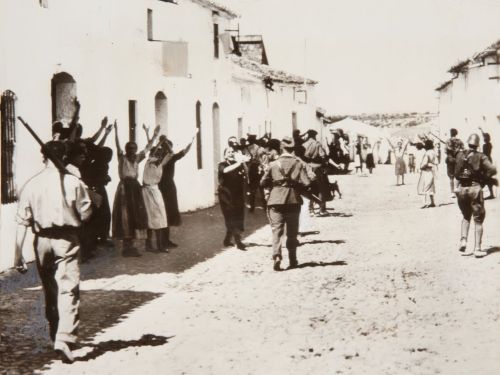
The alliance between the Catholic hierarchy and Franco’s regime was substantial, yet it was neither monolithic nor unchanging. In the immediate postwar years, many bishops publicly affirmed the regime as a providential restoration of Christian Spain. Pastoral letters praised the victory as deliverance from secular disorder, and ecclesiastical leadership embraced the renewed influence granted by National Catholicism. Compliance was reinforced by memory of Republican anti-clerical violence, which made alignment with the regime appear protective and necessary. For much of the 1940s and 1950s, institutional cooperation dominated the ecclesiastical landscape.
Internal tensions began to surface. Younger clergy, influenced by Catholic social teaching, emerging labor activism, and global currents within twentieth-century theology, grew uneasy with the regime’s repression and socioeconomic inequalities. Industrialization, urban migration, and labor unrest exposed fractures in Spanish society that could not easily be reconciled with triumphalist narratives of spiritual restoration. Priests working in working-class neighborhoods encountered poverty and political suppression firsthand, prompting questions about the moral cost of continued alignment. The Second Vatican Council in the 1960s intensified these pressures by emphasizing religious freedom, human dignity, collegiality among bishops, and the autonomy of the Church from political domination. These conciliar reforms reframed the Church’s self-understanding, encouraging engagement with modern society rather than defensive nationalism. Spanish bishops faced a dilemma: continued alignment preserved institutional privilege and stability, but emerging theological commitments encouraged greater moral independence and critical distance from authoritarian structures. The language of crusade that had once unified Church and regime began to sound increasingly out of step with the renewed ecclesial emphasis on conscience, human rights, and social justice.
These tensions did not immediately dismantle the alliance, but they complicated it. Some clergy supported labor movements and regional cultural rights, placing them at odds with regime policy. Others remained firmly aligned with Franco, viewing criticism as destabilizing or disloyal. The episcopate navigated a careful path, gradually distancing itself from overt political endorsement while avoiding direct confrontation. The institutional memory of persecution and the benefits of state privilege moderated dissent.
Clerical compliance under Franco evolved rather than disappeared. Early enthusiasm yielded to cautious recalibration, reflecting both theological development and shifting political realities. The Church’s relationship with the regime demonstrated how institutional alignment can endure even amid internal debate. Religious authority was not static; it negotiated its position within authoritarian structures. The tension between privilege and prophetic witness became increasingly visible as Spain moved toward the later decades of Franco’s rule.
National Catholicism as Political Theology

National Catholicism under Franco was not merely an alliance of convenience; it developed into a coherent political theology that interpreted sovereignty through sacred categories. The regime framed itself as the earthly guardian of a divinely ordained social order, entrusted with preserving Spain’s spiritual integrity after the perceived chaos of the Republic. Spain was imagined as historically and essentially Catholic, not simply as a nation with Catholic majority but as a confessional civilization whose identity was inseparable from the Church. Political authority was situated within a theological narrative of providence, restoration, and mission. Franco’s leadership was interpreted as divinely permitted, if not divinely chosen, to restore moral hierarchy and defend the nation against atheistic modernity. In this framework, the state did not merely administer law; it embodied sacred responsibility, and governance assumed the tone of spiritual guardianship.
This theological framing drew upon older traditions of confessional monarchy and counterrevolutionary Catholic thought. The memory of Spain’s imperial past, the Reconquista, and the defense of orthodoxy against heresy provided historical imagery through which Franco’s regime could be interpreted. By invoking these precedents, National Catholicism positioned the dictatorship as heir to a sacred historical vocation. The state did not simply govern; it defended a transcendent civilizational inheritance.
Obedience to the regime was cast as participation in divine order. Loyalty acquired spiritual resonance, while dissent risked theological suspicion. Political opposition could be framed as rebellion not only against authority but against the spiritual integrity of the nation. The merging of patriotic and religious language created a moral economy in which conformity signaled virtue and resistance appeared morally suspect. Public rituals, educational curricula, and episcopal pronouncements reinforced this fusion, embedding theological vocabulary within everyday civic life. The regime’s authority was enveloped in sacramental symbolism and liturgical presence, reinforcing the sense that governance itself bore sacred sanction. Through repetition and institutional reinforcement, political compliance was elevated into moral duty, binding citizenship to confessional identity.
This political theology narrowed the Church’s capacity for independent moral critique. When state authority was interpreted as instrument of divine purpose, questioning policy risked destabilizing the theological narrative that sustained institutional privilege. The fusion of faith and nationalism blurred distinctions between spiritual witness and political endorsement. Catholic identity became entwined with regime legitimacy, constraining ecclesiastical distance from power.
National Catholicism exemplifies how political theology can operate as ideological consolidation. It provided Franco’s regime with more than moral vocabulary; it offered metaphysical justification. Authoritarian governance was framed as protection of sacred heritage. Theological language absorbed political repression into a story of civilizational defense. Faith was not eradicated, but it was harnessed to a narrative of state authority.
Religion functioned as interpretive structure for authoritarian sovereignty, extending beyond symbolic endorsement into institutional integration. The regime’s legitimacy did not rest solely on force or bureaucratic control but on sacred framing that elevated political rule into spiritual necessity. By intertwining Catholic doctrine with nationalist identity, National Catholicism constructed a worldview in which the survival of the state and the survival of faith appeared inseparable. Religious rituals, moral instruction, and public discourse collectively reinforced the notion that Franco’s governance was essential to preserving Spain’s divine vocation. National Catholicism transformed Catholic tradition into nationalist ideology, reinforcing obedience through theological coherence and emotional resonance. It stands as a case study in how religious nationalism can sacralize power, converting faith into the language of sovereign enforcement and redefining dissent as both political and spiritual deviation.
Comparative Political Theology: The Immoral Defender of the Faith
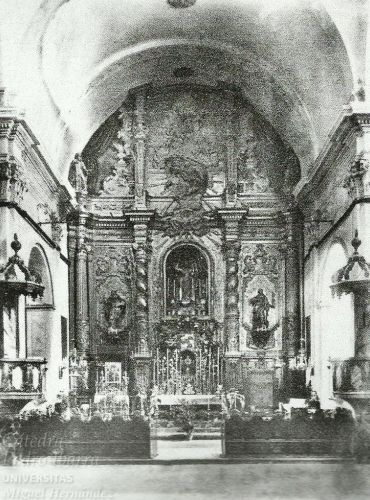
Francisco Franco’s elevation as defender of Christian civilization fits a recurring pattern within political theology: the sacralization of rulers whose personal conduct and governing methods conflict with the ethical ideals of the religious tradition they are said to protect. Franco presided over censorship, political imprisonment, execution, and systemic repression, yet he was framed by significant portions of the Catholic hierarchy as guardian of faith. The disjunction between authoritarian practice and Christian moral teaching did not prevent ecclesiastical endorsement. Instead, the regime’s usefulness in securing institutional dominance and suppressing secular opposition overshadowed concerns about moral contradiction. Sanctification operated not as recognition of virtue, but as validation of political utility.
This pattern reveals how religious institutions sometimes recalibrate moral emphasis when confronted with perceived existential threats. In the aftermath of anti-clerical violence during the Civil War, many church leaders interpreted authoritarian consolidation as necessary defense against a return to secular militancy. The preservation of sacramental life, restoration of church property, control over education, and protection of clerical authority were understood as urgent priorities. Within this framework, the regime’s repressive measures were often rationalized as regrettable but indispensable safeguards of order. Protection of institutional stability took precedence over public denunciation of political imprisonment or censorship. The figure of the “immoral defender” emerges in such contexts as a paradoxical guardian: flawed in personal or political conduct yet indispensable to institutional preservation. Theological language supplies coherence to this paradox by casting the ruler as instrument of divine providence rather than exemplar of Christian ethics. By situating political authority within a narrative of spiritual rescue, ecclesiastical endorsement transforms pragmatic alliance into sacred mission, mitigating ethical tension through appeals to higher necessity.
Comparative cases across history demonstrate similar dynamics. Leaders lacking consistent religious devotion or moral credibility may nonetheless receive sacral endorsement when they advance institutional power. The logic is not purely cynical; it reflects genuine fear of secular displacement and memory of prior persecution. Yet the effect remains structurally similar. Moral evaluation becomes subordinated to strategic outcome. Religious nationalism merges identity and authority, elevating political defenders above prophetic critique.
Franco’s Spain illustrates the enduring tension between faith as moral witness and faith as political instrument. When institutional survival is interpreted as paramount, sanctification may attach to power irrespective of ethical dissonance. The “immoral defender of the faith” becomes a symbol through which religious communities reconcile authoritarian governance with sacred narrative. In this reconciliation, personal virtue recedes behind political function, and the sacred language of defense legitimizes the consolidation of sovereign control.
Modern Parallel: Religious Nationalism and Executive Power
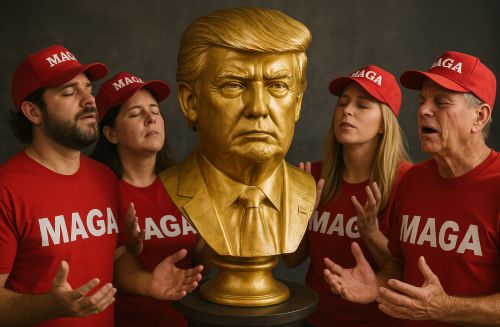
The pattern visible in Franco’s Spain reappears in contemporary American politics in altered but recognizable form. Large segments of white evangelical Christianity have rallied behind President Donald Trump during both his first and second terms, not because of sustained evidence of theological literacy, personal piety, or moral consistency, but because of perceived policy alignment and executive utility. Trump’s public persona, personal history, and rhetorical style often diverge sharply from traditional evangelical moral teaching. Yet these divergences have not prevented his elevation within religious nationalist discourse as a defender of Christian America. The language of spiritual warfare, civilizational threat, and cultural survival has framed political support as moral necessity.
Executive power becomes instrument of religious aspiration. Judicial appointments, regulatory decisions, education policy, and symbolic gestures toward religious identity are interpreted as victories in a broader struggle over national character. Moral evaluation shifts from personal conduct to institutional outcome. The leader is assessed not by conformity to ethical ideals but by effectiveness in advancing a shared agenda. As with earlier cases of political sacralization, utility supplies justification. The defense of religious liberty, opposition to secularization, and restoration of perceived traditional norms overshadow concerns about character.
Religious nationalism amplifies this dynamic by conflating faith with national destiny. Political loyalty becomes intertwined with theological identity, and criticism of executive authority may be framed as hostility toward religious community itself. Public rituals, campaign rhetoric, and media ecosystems reinforce this fusion. The leader is cast as protector of believers against hostile cultural forces, creating a narrative in which support becomes act of communal preservation rather than endorsement of personal virtue.
This alignment does not imply unanimity within evangelical communities, nor does it eliminate internal debate. Many Christians have expressed discomfort with the moral dissonance inherent in the alliance. Yet the structural logic remains visible. Institutional gains, policy influence, and judicial transformation are weighed against ethical inconsistency. The calculus resembles earlier patterns of political theology in which leaders are elevated for what they secure rather than who they are.
The modern parallel underscores the persistent tension between faith as moral witness and faith as instrument of power. When religious identity is fused with executive authority, sanctification can attach to political function despite moral contradiction. The “defender” of faith may be embraced less for spiritual credibility than for capacity to enact desired policy outcomes. In this configuration, religion operates not primarily as ethical critique of power but as legitimizing partner within it, reshaping public theology around the preservation of institutional influence and cultural dominance. The emphasis shifts from prophetic accountability to strategic alignment. Political success becomes interpreted as evidence of providential favor, while moral inconsistency is reframed as secondary to the perceived urgency of cultural defense. As in earlier historical cases, institutional advantage and access to executive authority recalibrate ethical priorities. The resulting political theology privileges outcome over character, influence over introspection, and collective identity over moral coherence.
Conclusion: When Faith Becomes Enforcement
Francisco Franco’s Spain demonstrates how religion can be transformed from spiritual tradition into instrument of sovereign authority. National Catholicism fused sacred identity with political power, redefining loyalty to the regime as fidelity to faith. The alliance delivered institutional security and cultural dominance to the Church while providing the dictatorship with moral validation. In this fusion, religion did not disappear; it intensified. Yet its function shifted. Faith no longer operated primarily as moral witness standing above power, but as theological architecture reinforcing it.
The sacralization of executive authority recalibrated ethical priorities. Repression could be narrated as defense, censorship as protection, and political consolidation as providential necessity. When religious identity is bound tightly to national destiny, dissent acquires the stigma of betrayal not merely of state but of sacred order. This dynamic narrows the space for prophetic critique, as institutional preservation competes with moral accountability. Political theology becomes mechanism of stabilization rather than instrument of conscience.
Comparative patterns across time reveal the durability of this structure. Leaders who advance institutional dominance may be elevated despite ethical dissonance. Religious nationalism supplies narrative coherence to alliances that would otherwise appear morally contradictory. The “defender of the faith” becomes archetype through which communities reconcile political utility with sacred language. Faith adapts to power not by abandoning doctrine but by redefining its public application.
When faith becomes enforcement, it acquires the force of law and the authority of the state. Such alignment can deliver security and influence, but it risks subordinating moral integrity to political advantage. The historical record suggests that once religious identity is fused with executive authority, disentanglement proves difficult. Institutional gains achieved through sovereign alliance may come at the cost of theological independence. The challenge that emerges, across eras and contexts, is whether religious communities can preserve prophetic distance while participating in public life, or whether the allure of power will continue to transform faith into the language of rule.
Bibliography
- Casanova, Julián. Public Religions in the Modern World. Chicago: University of Chicago Press, 1994.
- —-. The Spanish Republic and Civil War. Cambridge: Cambridge University Press, 2006.
- Du Mez, Kristin Kobes. Jesus and John Wayne: How White Evangelicals Corrupted a Faith and Fractured a Nation. New York: Liveright, 2020.
- Gorski, Philip S., and Samuel L. Perry. The Flag and the Cross: White Christian Nationalism and the Threat to American Democracy. New York: Oxford University Press, 2022.
- Payne, Stanley G. Franco and Hitler: Spain, Germany, and World War II. New Haven: Yale University Press, 2008.
- —-. The Franco Regime, 1936–1975. Madison: University of Wisconsin Press, 1987.
- —-. The Spanish Civil War. Cambridge: Cambridge University Press, 2012.
- Preston, Paul. Franco: A Biography. New York: Basic Books, 1967.
- —-. The Spanish Holocaust: Inquisition and Extermination in Twentieth-Century Spain. New York: W. W. Norton, 2011.
- Raguer, Hilari. Gunpowder and Incense: The Catholic Church and the Spanish Civil War. London: Routledge, 2006.
- Richards, Michael. “Catholic Intellectuals and Transnational Anti-Communism: Pax Romana from the Spanish Civil War to the post-1945 World Order.” The English Historical Review 138:594-595 (2023), 1337-1362.
- Thomas, Maria. “Martyrs, Memory and Misrepresentation: The Spanish Catholic Church, Religious Persecution and the Spanish Civil War.” International Journal of Iberian Studies 31:3 (2018), 143-162.
- Whitehead, Andrew L., and Samuel L. Perry. American Idolatry: How Christian Nationalism Betrays the Gospel and Threatens the Church. Grand Rapids: Brazos Press, 2020.
- —-. Taking America Back for God: Christian Nationalism in the United States. Oxford: Oxford University Press, 2020.
Originally published by Brewminate, 02.20.2026, under the terms of a Creative Commons Attribution-NonCommercial-NoDerivatives 4.0 International license.
About the Author