In medieval Japan, seppuku framed voluntary death as ritual honor, revealing how violence, loyalty, and morality intertwined within samurai political culture.

By Matthew A. McIntosh
Public Historian
Brewminate
Introduction: Voluntary Death as Social Institution, not Private Despair
Between the twelfth and nineteenth centuries, forms of ritual self-disembowelment known collectively as seppuku became embedded within the political and ethical life of Japan’s warrior class. What might, from a modern perspective, appear as an act of private despair or psychological collapse functioned within samurai society as something markedly different: a structured and socially intelligible practice. Seppuku was neither random nor merely impulsive. It unfolded within a recognizable framework of obligation, honor, and authority. To understand it historically requires suspending contemporary assumptions about self-inflicted death and examining the moral architecture in which it acquired legitimacy.
In feudal Japan, voluntary death could operate as a means of restoring honor after failure, avoiding capture by enemies, or demonstrating loyalty to a lord. The practice gradually moved from battlefield exigency to institutionalized ritual, complete with prescribed gestures, witnesses, and codified expectations. The act was not interpreted as moral collapse but as disciplined resolve under conditions where reputation, loyalty, and lineage carried enduring weight. Seppuku transformed bodily destruction into symbolic affirmation. The meaning of the act did not reside in the termination of life alone but in its public and ethical framing.
This framing diverged sharply from theological traditions in Christian Europe that defined suicide as sin against divine sovereignty and as a violation of the commandment against killing. Japanese moral thought, shaped by warrior custom, Confucian conceptions of hierarchy, and evolving codes later described under the rubric of bushidō, did not articulate a universal or absolute ban on voluntary death. Instead, legitimacy depended upon circumstance, status, and relational duty. A samurai’s life was not conceived as wholly private property but as bound to networks of loyalty extending upward to lord and domain and outward to family lineage. The critical question was not whether one had taken one’s own life in isolation, but whether the act conformed to expectations of honor, upheld social trust, and aligned with recognized authority. In some cases, voluntary death could cleanse shame, preserve familial standing, or prevent collective disgrace; in others, it could be condemned as reckless or unauthorized. Moral evaluation was contextual and embedded within social structure rather than derived from a singular theological prohibition.
To approach seppuku as merely tragic or exotic is to miss its institutional character. The practice reveals how moral evaluation of self-inflicted death is historically contingent, structured by political order and social expectation rather than by universal abstraction. Within samurai culture, agency at life’s end was not exercised in isolation from community but deeply entangled with it. Voluntary death became intelligible as a disciplined response to failure, disgrace, or command. The ethical question was not simply whether life should continue, but whether one’s continued existence remained compatible with honor and obligation within a stratified social world.
Historical Origins: From Battlefield Necessity to Codified Ritual
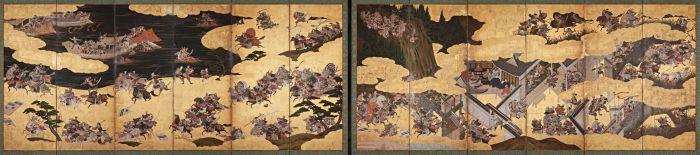
The origins of seppuku lie not in abstract ethical doctrine but in the practical realities of medieval warfare. During the late Heian and early Kamakura periods, Japan’s political order shifted from court-centered aristocratic governance to military rule dominated by warrior elites. Armed conflict among rival clans created conditions in which capture could entail humiliation, torture, or execution at the hands of enemies. Self-inflicted death emerged as a means of preserving personal honor and avoiding disgrace. Early accounts in war tales such as the Heike monogatari describe warriors taking their own lives when defeat was certain, framing the act as an assertion of control in the face of inevitable loss.
These early battlefield suicides were not yet fully ritualized. They were acts undertaken under extreme circumstances, often spontaneous and shaped by the immediacy of combat. The emphasis lay on preventing capture and maintaining reputation rather than on ceremonial precision. Nonetheless, even these initial instances carried symbolic meaning. A warrior who died by his own hand rather than submit to an enemy preserved a measure of dignity for himself and, by extension, for his lineage. Honor in this martial culture was inseparable from public perception, and death could function as a final statement about loyalty and resolve.
As the warrior class consolidated political authority under the Kamakura and later Muromachi shogunates, the practice of voluntary death gradually acquired greater formalization. The rise of a distinct samurai identity brought with it evolving expectations about conduct, hierarchy, and loyalty. Seppuku began to move beyond the chaos of battlefield necessity into a more regulated and symbolically charged practice. Prescribed methods emerged, emphasizing composure, bodily control, and the demonstration of courage in the face of pain. The presence of witnesses became increasingly significant, transforming the act into a performative affirmation of honor before one’s peers and superiors. What had originated as an act of resistance to capture was reframed as a disciplined response to failure, accusation, or command within a structured political order. The development of recognizable ritual elements signaled that voluntary death was being absorbed into the ethical grammar of the warrior class itself.
By the early modern Edo period, seppuku had been incorporated into the legal framework of Tokugawa governance. It could be ordered as a form of capital punishment for samurai, distinguishing them from common criminals who faced execution by other means. This judicial seppuku was not merely punitive; it was status-specific. By permitting a condemned warrior to die by his own hand under controlled conditions, the state acknowledged his rank even while enforcing discipline. The ritual was carefully structured, often involving a kaishakunin who would decapitate the individual after the abdominal incision to prevent prolonged suffering and ensure decorum. Detailed protocols governed attire, setting, and the presentation of the body. What had once been an improvised act on the battlefield was now embedded within bureaucratic procedure, overseen by officials and integrated into the mechanisms of social control. Through regulation, the state transformed voluntary death into an instrument of both punishment and preservation of hierarchical order.
The transformation from necessity to codification reflects broader shifts in Japanese political culture. As warfare became less constant and the Tokugawa state prioritized stability, symbolic gestures took on heightened importance. Seppuku functioned as a visible demonstration of accountability within a rigid hierarchy. The ritual communicated submission to authority even in the moment of death. It reinforced the notion that a warrior’s body remained tied to obligations extending beyond personal survival.
By the nineteenth century, seppuku had accumulated layers of meaning that extended far beyond its martial origins. It signified loyalty, discipline, and the internalization of social duty. Yet its historical trajectory reveals that these meanings were not timeless. They emerged from specific political conditions and evolved alongside transformations in governance and class structure. The institutionalization of seppuku illustrates how voluntary death can shift from pragmatic response to codified moral practice within a changing social order.
Ritual Form and Symbolic Meaning
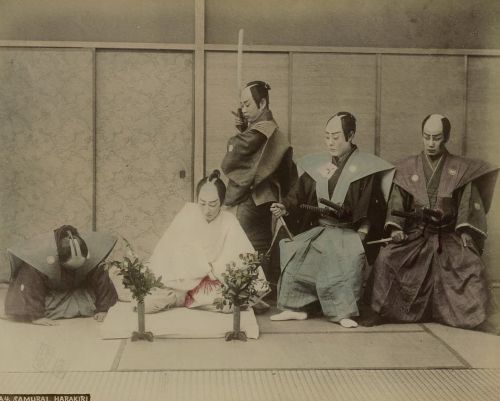
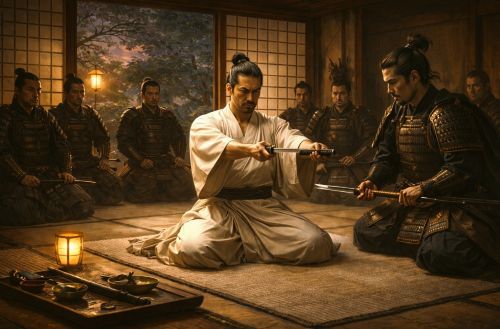
By the early modern period, seppuku had acquired a highly structured ritual form that distinguished it from spontaneous self-killing. The act was choreographed according to recognizable conventions, often carried out in a designated space, before appointed witnesses, and under official supervision. The condemned individual was typically dressed in formal garments and positioned in a manner reflecting composure and readiness. These formalities transformed the event into a public performance of moral resolve rather than a private act of despair. The body became a medium through which discipline and loyalty were displayed.
Central to the ritual was the role of the kaishakunin, the appointed second. His task was to deliver a swift decapitating strike after the initial abdominal incision, minimizing prolonged suffering while preserving the symbolic integrity of the act. The coordination between principal and second required precision and mutual trust, as the timing of the blow carried both practical and moral weight. A poorly executed stroke could prolong agony and undermine the dignity of the ritual, while a premature strike could negate the visible demonstration of resolve expected of the condemned. The kaishakunin was often chosen for skill, loyalty, and composure, reinforcing the hierarchical bonds that structured samurai society. His participation ensured that seppuku was not merely a solitary ordeal but a regulated exchange within a defined social order. Even at the threshold of death, the individual remained embedded in relationships of authority, honor, and obligation.
The physical act itself carried layered symbolic meaning. The abdomen was traditionally associated in Japanese thought with sincerity and inner truth. By cutting open the belly, the samurai was understood to reveal the purity of his intentions and the authenticity of his loyalty. The gesture communicated transparency rather than concealment. It signified that nothing dishonorable was hidden within. In this sense, the violence of the act was reframed as moral disclosure, aligning bodily exposure with ethical clarity.
Ritual elements extended beyond the incision. In many instances, the individual composed a death poem prior to the act, reflecting aesthetic discipline and spiritual composure. The poem often drew upon natural imagery or themes of impermanence, situating the impending death within broader cosmological or seasonal cycles. Such literary expression reinforced the expectation that emotional turbulence should be mastered rather than displayed. The integration of poetry into the ritual did not soften its severity but emphasized that moral agency required both courage and cultivated restraint. The capacity to articulate one’s perspective calmly in the face of death signaled alignment with ideals of self-control central to samurai identity. Through these additional gestures, the ritual extended beyond physical endurance into the realm of intellectual and aesthetic discipline.
Witnesses played a crucial role in validating the ritual. Observers confirmed that the act conformed to prescribed standards and that the individual displayed appropriate courage and decorum. The presence of an audience ensured that seppuku functioned as a communicative act within a broader moral community. Honor was not restored through death alone but through recognition by others that the ritual had been performed correctly. Social acknowledgment completed the ethical meaning of the gesture.
Through this elaborate ritualization, seppuku became a language of embodied symbolism. It conveyed loyalty, repentance, protest, or obedience depending on context, yet always within recognizable boundaries. The codified structure ensured that voluntary death was not interpreted as chaotic self-destruction but as disciplined agency operating inside a carefully regulated moral framework. The ritual stabilized the act’s meaning, limiting ambiguity and reinforcing collective expectations about duty and conduct. In this way, seppuku exemplified how bodily action could be transformed into a socially legible statement about honor and accountability. Its ritual form did not eliminate the violence of self-inflicted death, but it reframed that violence within a shared ethical vocabulary that gave it purpose and coherence.
Honor versus Sin: Divergent Moral Frameworks
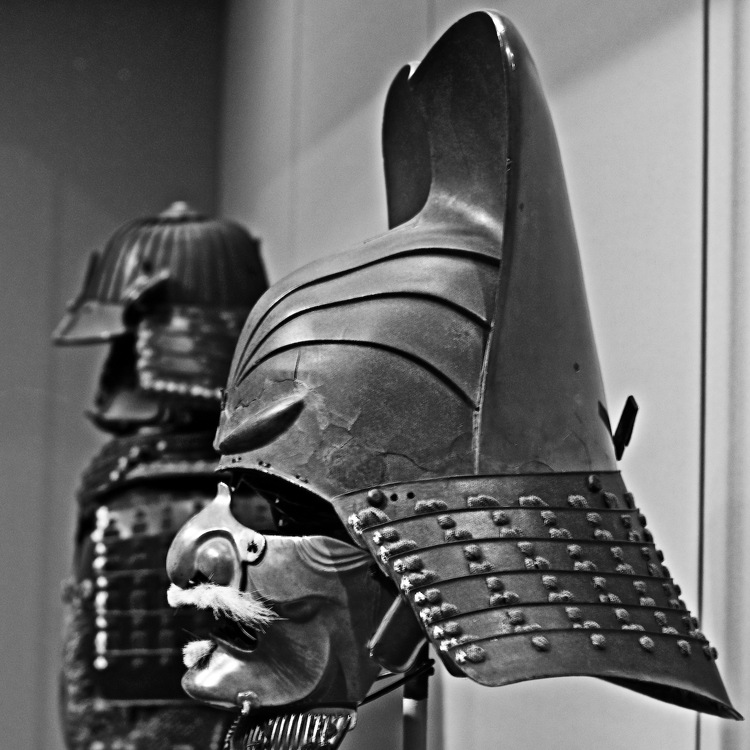
The ethical evaluation of voluntary death in medieval Japan differed fundamentally from that of Christian Europe because the underlying moral vocabularies were distinct. In many strands of Christian theology, suicide was condemned as a grave sin, violating divine sovereignty over life and transgressing the commandment against killing. Life was understood as entrusted by God, and self-destruction constituted rebellion against that authority. By contrast, within samurai culture, voluntary death was not governed by a universal theological prohibition. Its legitimacy was determined less by abstract doctrine than by the relational obligations that structured warrior society. Honor, loyalty, and fidelity to one’s lord provided the primary coordinates of moral judgment.
This difference reflects contrasting conceptions of the self and of ultimate accountability. In the Augustinian and Thomistic traditions of Christian thought, the individual soul stood in direct relation to God, and salvation hinged upon obedience to divine law. Suicide, in this framework, was treated as a violation of natural law, an injury to the community, and a rejection of divine providence. The act was morally intelligible primarily in terms of sin and its consequences for eternal destiny. By contrast, in Japan moral reasoning within the warrior class emerged from a confluence of indigenous custom, Confucian ethics of hierarchy, and Buddhist reflections on impermanence and detachment. The self was not conceptualized chiefly as an isolated moral unit before a transcendent judge, but as a node within layered networks of duty. Loyalty to one’s lord, maintenance of familial honor, and conformity to social expectations structured the field of moral evaluation. The central moral failure was not primarily disobedience to a divine command but betrayal of trust or abandonment of one’s assigned role within a relational order.
Honor operated as a public and relational value rather than a purely internal state. A samurai’s reputation reflected upon his household and domain. Failure, cowardice, or disloyalty threatened collective standing. Seppuku could function as a means of restoring moral equilibrium when other forms of redress were unavailable. The act did not erase wrongdoing in a theological sense but could demonstrate accountability and reaffirm loyalty. The ethical logic differed from penitential traditions in Christianity, where repentance aimed at reconciliation with God rather than preservation of worldly honor.
This divergence does not imply that voluntary death was universally praised in Japan. Context remained decisive. Unauthorized or impulsive self-killing could be condemned as reckless, especially if it deprived one’s lord of service without permission. The legitimacy of seppuku depended upon alignment with recognized authority and social expectation. In this respect, Japanese moral frameworks were structured less by a binary of sin versus innocence and more by gradations of propriety and duty. The act’s meaning derived from its position within a hierarchy rather than from a singular theological verdict.
The contrast between honor and sin as moral lenses reveals how evaluations of voluntary death are historically contingent. In Christian Europe, suicide disrupted divine order and threatened eternal salvation. In samurai Japan, self-inflicted death could, under prescribed conditions, reinforce social order and preserve collective dignity. Neither framework is reducible to the other. Each reflects a distinct configuration of authority, obligation, and ultimate concern. By examining these divergent moral vocabularies, the institutionalization of seppuku becomes intelligible not as moral anomaly but as the product of a specific ethical world in which honor, rather than sin, structured the boundaries of legitimate action.
State Regulation and Legitimate Self-Inflicted Death
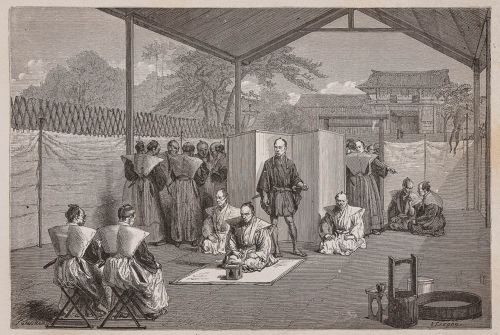
As seppuku became embedded within the structures of samurai governance, it ceased to function solely as a personal or clan-based response to dishonor and entered the domain of formal political regulation. Under the Tokugawa shogunate, judicial seppuku was incorporated into the penal system as a sanctioned form of capital punishment reserved primarily for members of the warrior class. This distinction reinforced social hierarchy. While commoners convicted of serious crimes faced public execution by beheading or crucifixion, samurai were often permitted to end their lives through ritual self-disembowelment under official supervision. The state thereby acknowledged status even in condemnation, converting punishment into a controlled demonstration of discipline and rank.
This regulatory framework reveals that seppuku was not merely tolerated but administered. Orders for judicial seppuku were issued by domain authorities or the shogunate, and the ritual unfolded according to prescribed procedures. The presence of officials and witnesses ensured conformity to established norms. The involvement of a kaishakunin further underscored that the act operated within institutional oversight rather than private initiative. By structuring how and when self-inflicted death could occur, the state limited its legitimacy to recognized circumstances. Unauthorized suicide, particularly when it disrupted administrative obligations, could be treated as disorderly rather than honorable.
State regulation also shaped the social consequences of death. In many cases, the performance of seppuku preserved a family’s standing and mitigated penalties that might otherwise extend to descendants. Because samurai households were integral to domain administration, the management of disgrace had political implications that reached beyond the individual offender. Allowing a condemned retainer to die by ritual suicide could prevent confiscation of lands, protect stipends, or shield heirs from more severe sanctions. In this way, seppuku functioned as a mechanism for containing dishonor within a controlled framework that minimized collateral disruption. The ritualized nature of the act signaled both submission to authority and continued adherence to warrior norms, even in punishment. By regulating the conditions under which self-inflicted death could preserve status, the Tokugawa state balanced discipline with stability, ensuring that enforcement of order did not unravel the hierarchical fabric upon which governance depended.
The institutionalization of seppuku demonstrates that legitimacy in matters of voluntary death was mediated by political power. Agency was present, but it operated within boundaries defined by superiors and codified by law. The warrior did not claim unilateral authority over his life; rather, he acted in response to command, expectation, or sanctioned precedent. In this respect, seppuku illustrates how states can regulate even the manner of self-inflicted death, transforming it from personal act into instrument of order. The ethical meaning of the ritual was inseparable from its placement within structures of governance that determined when such an act upheld honor and when it violated duty.
Protest and Moral Agency

Although seppuku was often associated with obedience and submission, it could also function as a form of protest within hierarchical society. In certain contexts, voluntary death served as a means of remonstration, a final appeal directed upward toward one’s lord or governing authority. This practice, sometimes described as kanshi, transformed self-inflicted death into a moral indictment. The individual did not reject the structure of authority outright; rather, he sought to call attention to perceived injustice or misjudgment by sacrificing his own life. The act operated within the code even as it challenged the conduct of those who stood above him.
Such protest relied upon the moral weight of loyalty. A retainer who died in remonstration did so not as an enemy of his lord but as a devoted subordinate whose conscience compelled him to act. The paradox lay in the combination of obedience and resistance. By accepting death, the protester affirmed the legitimacy of hierarchical order while simultaneously exposing its failures. The act could force superiors to reconsider decisions or confront the ethical implications of their commands. In this sense, seppuku could become a medium through which agency was exercised within constraint rather than against it.
The communicative power of such acts depended upon shared moral expectations. Because samurai culture valorized courage, discipline, and fidelity, a voluntary death carried symbolic force that extended beyond the individual moment. It drew upon a vocabulary already understood by peers and superiors alike. A protest seppuku performed according to established ritual standards signaled seriousness, composure, and unwavering commitment to principle. It could not easily be dismissed as impulsive or hysterical without undermining the very code that defined warrior honor. The structured nature of the act lent credibility to the moral claim embedded within it. In this way, the ritual functioned as embodied argument. Where petitions or counsel might be ignored, the spectacle of disciplined self-sacrifice demanded recognition. The body became the final medium of persuasion, compelling observers to interpret the act within the shared framework of loyalty and responsibility that governed samurai life.
Protest through seppuku remained bounded by authority. It did not license rebellion or collective insurrection. The individual accepted the consequences of his action, including the finality of death, without demanding structural overthrow. Agency was expressed through disciplined self-sacrifice rather than through direct confrontation. This dual character reveals the complexity of voluntary death within samurai ethics: it could reinforce order, administer punishment, and, under constrained conditions, articulate dissent. Seppuku as protest underscores that moral agency operated not outside hierarchy but through its ritual forms.
Gender, Class, and Limits of Participation
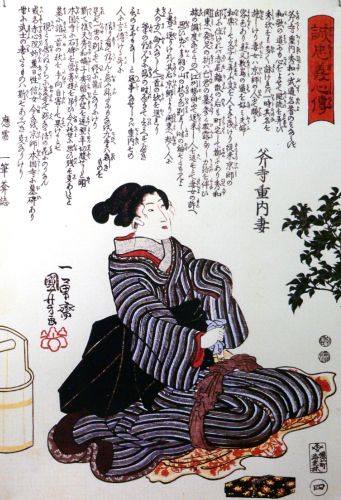
Although seppuku is most closely associated with male samurai, the practice of voluntary death within warrior culture was neither universally accessible nor uniformly defined. Participation was structured by rank and gender. The legitimacy of ritual suicide depended upon one’s position within the social hierarchy, and the ethical meanings attached to the act differed accordingly. Seppuku was primarily a prerogative and obligation of the warrior elite, embedded in a class system that distinguished sharply between samurai and commoners. The very fact that judicial seppuku was reserved for samurai underscores that honor in death was stratified.
Women of the samurai class were not participants in seppuku in the same form as men, yet they were not excluded from voluntary death as a moral category. A distinct practice known as jigai emerged as a gendered counterpart, typically involving cutting the throat rather than disembowelment. Jigai was often associated with avoiding capture, preserving chastity, or protecting family honor during moments of crisis. The method differed, reflecting expectations about modesty and bodily presentation, yet the underlying logic remained tied to duty and reputation. Female participation reveals that voluntary death, while male-coded in its most public form, extended into the domestic and familial sphere under different ritual constraints.
Class boundaries were equally decisive. Peasants, artisans, and merchants did not possess the same recognized avenue for honor-restoring ritual suicide. Unauthorized self-killing among commoners was more likely to be treated as social disorder, misfortune, or private despair rather than as moral demonstration. The privilege of dying “honorably” through regulated ritual was linked to status within the warrior estate and reinforced the social distance between classes. Because samurai identity was tied to service, martial reputation, and hereditary standing, their deaths carried institutional significance that commoner deaths did not. This asymmetry illustrates that legitimacy in voluntary death was not a universal ethical entitlement but a socially restricted practice embedded in feudal hierarchy. Honor was distributed unevenly, and so too was the capacity to reclaim it through ritualized self-inflicted death.
Even among samurai, circumstances shaped interpretation. A voluntary death undertaken without authorization or outside recognized contexts could be condemned as wasteful or destabilizing. The expectation of loyalty required that a warrior’s life remain available for service unless a clear breach of honor or command justified its termination. The social script governing seppuku imposed limits. One could not simply declare a situation dishonorable and act independently without risking censure. Authority remained the arbiter of whether self-inflicted death aligned with duty or violated it.
These stratifications reveal that voluntary death in medieval Japan was deeply conditioned by structures of gender and class. Seppuku did not represent an abstract right to self-determination but a regulated form of conduct tied to specific social roles and expectations. Participation was limited not only by legal status but by inherited position within a rigid hierarchy. The very meaning of honor differed according to rank, and the possibility of restoring it through ritual suicide was correspondingly uneven. By attending to these boundaries, the practice emerges not as a generalized cultural embrace of suicide but as a tightly circumscribed institution shaped by hierarchy, expectation, and differentiated access to legitimacy in death.
Modern Reinterpretations and the Myth of Timeless Bushidō
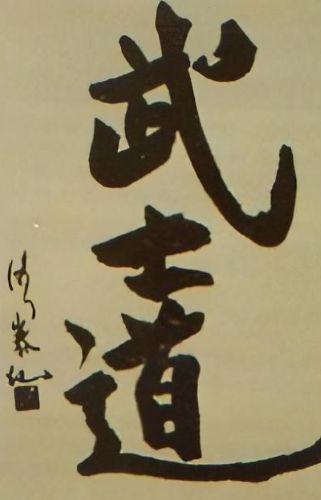
By the late nineteenth century, the meaning of seppuku was reframed within new political and ideological contexts. The Meiji Restoration transformed Japan’s social order, abolishing the formal status of the samurai class and restructuring governance along centralized, imperial lines. In this environment of rapid modernization, earlier warrior practices were reinterpreted as symbols of national character. What had once functioned as a regulated institution within feudal hierarchy became recast as evidence of timeless Japanese spirit. Seppuku, detached from its specific historical conditions, was elevated into emblem.
This transformation was closely tied to the construction of bushidō as a coherent ethical code representing the essence of Japanese identity. While earlier warrior norms were diverse, localized, and evolving rather than unified or systematically codified, modern intellectuals and educators increasingly presented them as components of a single, continuous moral tradition. Texts such as the Hagakure, composed in the early eighteenth century within a particular domain context, were extracted from their historical setting and treated as authoritative statements of national ethos. Selective readings emphasized loyalty, self-sacrifice, and readiness for death while downplaying internal debate, regional variation, and the pragmatic dimensions of warrior life. In this reframing, voluntary death became proof of absolute devotion not merely to a feudal lord but to the emperor and, by extension, the modern nation-state. Historical complexity was streamlined into ideological clarity, and seppuku was recast as visible confirmation of a supposedly unbroken martial spirit.
The romanticization of seppuku intensified in the early twentieth century as nationalism and militarism reshaped public culture. Educational curricula, popular literature, and state rhetoric invoked warrior virtues to cultivate obedience, discipline, and martial readiness among citizens. The image of the samurai willing to embrace death without hesitation was deployed as a model for soldiers and students alike. Acts of self-sacrifice were portrayed as noble expressions of collective devotion, reinforcing narratives of unity and moral superiority. Yet this reinterpretation often obscured the regulated, status-bound, and legally mediated nature of earlier practices. The controlled judicial seppuku of the Tokugawa era, embedded within bureaucratic procedure and class hierarchy, was reimagined as spontaneous patriotic fervor. The historical distinction between feudal accountability and modern nationalist mobilization blurred under the pressure of mythmaking, allowing seppuku to function as a symbolic bridge between medieval warrior codes and contemporary imperial ambition.
Scholarly reassessment in the postwar period challenged these narratives. Historians emphasized the variability of warrior conduct and the contingent development of bushidō as a modern construct rather than an unbroken tradition. They demonstrated that seppuku’s institutional form emerged within specific political frameworks and that its meanings shifted across time. By situating the practice within concrete historical contexts, such scholarship undermined claims of timeless moral essence. The myth of continuity yielded to analysis of transformation.
This historiographical correction does not deny that seppuku carried powerful symbolic weight. Rather, it restores nuance to its interpretation. The practice cannot be reduced to either barbaric spectacle or eternal virtue. It must be understood as a product of evolving social structures, legal systems, and ideological projects. Modern reinterpretations reveal as much about nineteenth- and twentieth-century anxieties as about medieval warrior culture. The invocation of seppuku in later nationalist discourse illustrates how historical practices can be repurposed to serve new political ends.
Recognizing the constructed nature of “timeless bushidō” reinforces the broader argument of this essay. Moral frameworks surrounding voluntary death are not static inheritances but historically contingent formations. Seppuku did not carry identical meaning across centuries; it was shaped by shifting institutions, hierarchies, and state agendas. By tracing both its medieval institutionalization and its modern reinterpretation, the practice emerges not as immutable tradition but as dynamic ethical phenomenon embedded in changing political worlds.
Conclusion: Cultural Contingency and the Ethics of Voluntary Death
The history of seppuku demonstrates that voluntary death cannot be evaluated apart from the moral and political structures within which it acquires meaning. In medieval and early modern Japan, ritual suicide was neither an expression of private despair nor a universal moral failure. It was an institution shaped by warrior hierarchy, codified procedure, and state regulation. Its legitimacy depended upon alignment with honor, loyalty, and recognized authority. To interpret it solely through categories derived from other cultural traditions is to obscure the framework that rendered it intelligible to its participants.
This does not require moral relativism in the sense of suspending all judgment. Rather, it demands historical precision. The condemnation of suicide in Christian theological thought and the conditional acceptance of seppuku within samurai culture reflect distinct conceptions of the self, obligation, and ultimate authority. In one context, life was a trust from God and self-destruction a sin against divine order. In the other, life was embedded within networks of hierarchical duty, and voluntary death could, under prescribed circumstances, affirm that order. The ethical logic of each system arose from different assumptions about sovereignty and accountability.
Seppuku also reveals the degree to which states mediate the meaning of death. Judicial regulation under the Tokugawa shogunate transformed what might otherwise have been private action into instrument of governance. Later nationalist reinterpretations further reshaped its symbolism, demonstrating that practices associated with honor are vulnerable to ideological appropriation. Voluntary death, even when framed as disciplined agency, does not exist outside political structures. Its legitimacy is conferred, limited, and redefined by those who wield authority.
The broader implication is that moral evaluations of self-inflicted death are historically contingent rather than universally fixed. Seppuku was neither timeless virtue nor irrational aberration. It was a practice embedded in specific institutions, codes, and hierarchies that gave it coherence. By examining it within its own ethical world, the contingency of moral frameworks surrounding voluntary death becomes visible. What appears self-evidently tragic in one tradition may function as disciplined duty in another. The task of historical analysis is not to erase difference, but to illuminate how deeply the meaning of death is shaped by the worlds in which it is lived.
Bibliography
Affiliate disclosure: Amazon links on this site are paid links. As an Amazon Associate I earn from qualifying purchases.
- Aquinas, Thomas. Summa Theologiae, II–II, q. 64, a. 5.
- Augustine. The City of God, Book I.
- Benesch, Oleg. Inventing the Way of the Samurai: Nationalism, Internationalism, and Bushidō in Modern Japan. Oxford: Oxford University Press, 2014.
- Botsman, Daniel V. Punishment and Power in the Making of Modern Japan. Princeton: Princeton University Press, 2005.
- Friday, Karl F. Samurai, Warfare and the State in Early Medieval Japan. London: Routledge, 2003.
- Fusé, Toyomasa. “Suicide and Culture in Japan: A Study of Seppuku as an Institutionalized form of Suicide.” Social Psychiatry + Psychiatric Epidemiology 15 (1980), 57-63.
- Hurst, G. Cameron III. “Death, Honor, and Loyalty: The Bushidō Ideal.” Philosophy East and West 40, no. 4 (1990): 511–527.
- Ikegami, Eiko. The Taming of the Samurai: Honorific Individualism and the Making of Modern Japan. Cambridge, MA: Harvard University Press, 1995.
- Maiese, Aniello, Lorenzo Gitto, Massimiliano dell’Aquila, and Giorgio Bolino. “A Peculiar Case of Suicide Enacted Through the Ancient Japanese Ritual of Jigai.” The American Journal of Forensic Medicine and Pathology 35:1 (2014), 8-10.
- Rankin, Andrew. Seppuku: A History of Samurai Suicide. Tokyo: Kodansha, 2011.
- Smith, Andrew R. “Mishima’s Seppuku Speech: A Critical-Cultural Analysis.” Text and Performance Quarterly 10:1 (1990), 1-19.
- The Tale of the Heike (Heike monogatari). Translated by Royall Tyler. New York: Viking, 2012.
- Yamamoto Tsunetomo. Hagakure: The Book of the Samurai. Translated by William Scott Wilson. Tokyo: Kodansha International, 1979.
Originally published by Brewminate, 02.25.2026, under the terms of a Creative Commons Attribution-NonCommercial-NoDerivatives 4.0 International license.
About the Author