Invention promises progress, but history shows how machines, weapons, discoveries, and systems can escape intention and return as death, regret, or warning.

By Matthew A. McIntosh
Public Historian
Brewminate
Introduction: The Petard as Metaphor
To be “hoist with his own petard” is one of the sharper phrases Shakespeare gave the language: a compact image of reversal, consequence, and explosive irony. In Hamlet, the petard was a small explosive device used to breach gates or walls, and to be “hoist” by it meant to be blown upward by one’s own instrument of destruction. The phrase has survived because it names something larger than battlefield accident. It captures the moment when human cleverness circles back upon its maker, when design becomes fate, and when the instrument built for mastery exposes the limits of mastery itself. In the history of invention, the metaphor is irresistible, but it must be used carefully. Not every inventor who suffered because of a discovery was foolish. Not every regret proves guilt. Not every dangerous invention was born from malice. The deeper pattern is not simple poetic justice, but the unstable relationship between intention, use, accident, and historical consequence.
I examine inventors, scientists, engineers, and technological entrepreneurs whose creations harmed them, haunted them, or escaped the moral boundaries they imagined for them. Some were literally killed by their own machines or experiments. William Bullock died after being caught in the machinery of the rotary printing press he helped perfect. Otto Lilienthal fell from the gliders that made him one of aviation’s first great pioneers. Franz Reichelt’s parachute suit, meant to save falling aviators, failed beneath the Eiffel Tower before a public audience. Max Valier was killed by the explosive promise of rocket propulsion, while Henry Smolinski and Harold Blake died in the wreckage of a flying car that joined American technological fantasy to structural misjudgment. In these cases, the body of the inventor became part of the experiment. The machine was not yet safely separated from its maker. The inventor touched, tested, trusted, and sometimes died within the dangerous intimacy of early design.
Other cases are less literal but historically more troubling. Alfred Nobel did not die from dynamite, but he lived to see explosive technology become inseparable from organized destruction, and his fortune later funded prizes meant to honor achievement, peace, and human benefit. Marie Curie did not invent radiation, but her pioneering work on radioactivity exposed her body to invisible dangers that science itself had not yet learned how to contain. Albert Einstein did not build the atomic bomb, yet his public authority and his signature on the Einstein-Szilard letter helped push the United States toward nuclear research in the shadow of Nazi Germany. Robert Oppenheimer did help build the bomb, and then watched as scientific brilliance became state power, military doctrine, secrecy, and permanent dread. Mikhail Kalashnikov designed a rifle he understood as a weapon of defense, only to see it become one of the most widely used instruments of killing in modern history. Their stories are not identical, and they should not be flattened into one moral fable. Yet each reveals the same historical wound: invention does not remain obedient to intention.
That wound has only deepened in the modern age. Technologies now travel through states, corporations, armies, markets, media systems, and digital platforms with a speed and scale no single creator can govern. Ethan Zuckerman’s regret over pop-up advertising may seem trivial beside dynamite or nuclear weapons, but it belongs to the same broader history of unintended consequence: a small technical solution becomes a large social irritation, then part of a business model that reshapes attention itself. Stockton Rush and the Titan submersible disaster bring the older petard metaphor into the twenty-first century, where the language of disruption and innovation can become a substitute for humility, testing, and institutional restraint. The question, then, is not whether invention is good or evil. That question is too blunt for the evidence. The better question is what happens after invention leaves the mind and enters the world. A device may begin as a solution, a tool, a cure, a convenience, or a promise. History asks what it becomes when ambition, fear, profit, war, and human frailty take hold of it.
William Bullock and the Industrial Machine That Consumed the Body
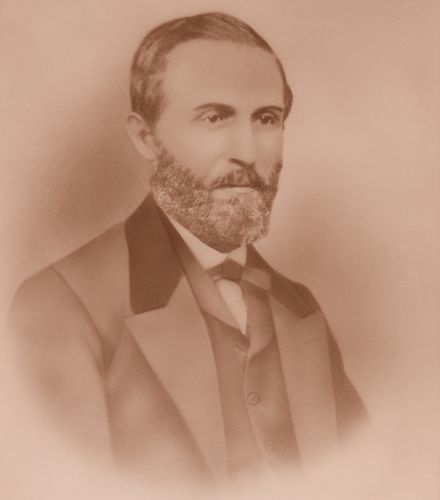
William Bullock’s death belongs to the first and most literal category of technological reversal: the inventor physically consumed by the mechanism he helped bring into being. His improved rotary web press was not merely a better printing machine. It was part of the nineteenth-century transformation of print from craft to industry, from slower sheet-fed production to a continuous mechanical process capable of feeding, printing, cutting, folding, and multiplying paper at speeds earlier printers could scarcely have imagined. The Library of Congress notes that Bullock’s system used a continuous roll of paper, or web, which passed through rotary presses and was cut to size in the printing process, while also helping establish the “perfecting” process of printing both sides of the page. That technical shift mattered because the modern newspaper depended not only on writers, editors, and readers, but on machines that could make daily mass publication physically possible. Bullock’s press stands at the intersection of democracy, commerce, mechanization, and danger: the machine that accelerated public information also exposed the human body to a new industrial intimacy with speed, metal, belts, rollers, and cutting mechanisms.
The accident that killed Bullock in 1867 has often been retold as almost too perfect an example of poetic irony, but its historical significance is larger than irony. While working on a press being installed for the Philadelphia Public Ledger, Bullock reportedly tried to kick a driving belt onto a pulley. His leg was caught and crushed in the mechanism; gangrene followed, and he died on April 12, 1867, during an operation to amputate the injured limb. The story is grisly, but it should not be treated as a carnival anecdote, because it reveals how nineteenth-century industrial invention often required physical nearness to danger. Machines did not yet belong to the sealed, sensor-protected, safety-regulated world later generations would expect. They were adjusted, corrected, coaxed, and sometimes fought by bodies standing close enough to be pulled inside. In Bullock’s case, the inventor did not die because his machine failed in its larger purpose. He died because it worked according to the harsh logic of industrial motion, indifferent to the man who designed it.
The rotary press also complicates the moral texture because Bullock’s invention was not, in itself, an instrument of obvious harm. Unlike dynamite, the atomic bomb, or the AK-47, the web rotary press did not announce itself as a technology of destruction. Its promise was civic, commercial, and informational. It helped make the newspaper cheaper, faster, more abundant, and more central to public life. Yet this is precisely why Bullock’s story matters. The history of technological consequence cannot be limited to weapons or spectacular catastrophes. Even benign or emancipatory inventions are embedded in material systems that redistribute risk, conceal labor, and normalize danger as the price of efficiency. A faster press meant more newspapers, wider circulation, expanded advertising, tighter deadlines, and a larger industrial apparatus behind the printed page. It also meant that public knowledge increasingly depended on workers and inventors who stood beside machines powerful enough to injure or kill them in an instant. The reader encountered the result as information; the pressman encountered it as machinery. The urban subscriber saw the morning paper as a sign of modern connection, while the men who made that paper possible worked among belts, rollers, gears, blades, steam power, and unforgiving momentum. Bullock’s body became part of the hidden cost of modern communication, the cost usually concealed beneath the apparent smoothness of progress. In that sense, the rotary press belongs not only to the history of journalism, but also to the history of industrial risk: it shows that the expansion of public speech depended on a mechanical environment where human bodies remained vulnerable to the very systems that enlarged human reach.
In that sense, Bullock’s death opens the my first major argument: invention is never only an idea. It is also a workplace, a rhythm, a set of moving parts, a relation between human judgment and mechanical force. The nineteenth century loved the language of improvement, and in many ways it had reason to do so. The rotary press helped create the conditions for mass literacy, political immediacy, urban news culture, reform journalism, scandal sheets, and the shared daily consciousness of modern publics. But Bullock’s fate reminds us that progress was not abstract. It was greased, bolted, belted, and dangerous. The industrial machine enlarged the reach of the human voice while narrowing the margin between operator and injury. If the petard metaphor begins anywhere, it begins here: not with guilt, not with remorse, not yet with war or apocalypse, but with the inventor standing beside his own machine and discovering that the power to multiply words could also crush flesh.
Alfred Nobel, Dynamite, and the Problem of Useful Violence
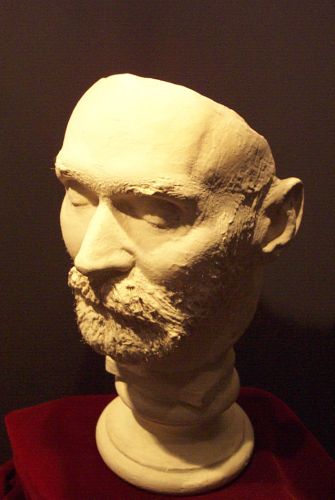
Alfred Nobel’s place in this history is more morally complicated than Bullock’s, because Nobel was not killed by his invention. He was not caught in the machinery, crushed by a press, or consumed by a failed experiment. His reversal came through the afterlife of utility itself. Dynamite was not created as a theatrical instrument of evil. It was patented in 1867 as a more stable way to use nitroglycerin, a powerful explosive whose volatility had already made it both promising and terrifying. Nobel’s achievement lay in making destructive force more manageable, transportable, and commercially useful. In that form, dynamite could blast tunnels, clear rock, build roads, open mines, reshape landscapes, and serve the nineteenth century’s faith that controlled violence against matter could become progress. The problem was that controlled explosive power did not remain morally contained by its intended setting. A charge that could break stone could also break bodies. A technology built for construction could be adapted to war, coercion, sabotage, and spectacle. Nobel’s case forces a harder question than whether an invention was “good” or “bad.” It asks what happens when usefulness itself depends on disciplined violence.
Nobel understood explosives not as an outsider dabbling in danger, but as the heir to a family culture of engineering, military contracting, chemistry, and industrial ambition. His father, Immanuel Nobel, worked as an inventor and engineer, including in projects connected to mines and military technology, and Alfred grew up in an environment where technical imagination was inseparable from practical utility. The household world that shaped him did not divide invention into pure science on one side and applied force on the other. Machines, chemicals, weapons, mines, factories, and infrastructure belonged to the same expanding nineteenth-century grammar of power. Nobel’s own career developed in a world where chemistry, industry, empire, and warfare were not cleanly separated fields, and where the same breakthrough could be celebrated in one setting as progress and feared in another as destruction. That background matters because dynamite emerged from a century that admired power when power could be harnessed. Steam power, railways, steelworks, canals, bridges, mines, and urban expansion all required new methods of forcing nature into human designs. Mountains were cut open, rivers redirected, tunnels drilled, harbors enlarged, and landscapes reordered in the name of commerce, mobility, and national development. Blasting was not merely destruction; it was improvement by violent means. Nobel’s genius was to take nitroglycerin, whose earlier handling had produced catastrophic accidents, and convert it into a product that could be manufactured, shipped, sold, and used with greater predictability. Yet this is precisely where the moral ambiguity begins. To make a dangerous force safer is not the same as making it harmless. Invention may reduce one kind of risk while enlarging another, especially when a technology’s improved reliability makes it easier to spread. Dynamite disciplined explosive force, but discipline increased availability; availability widened use; widened use multiplied consequences. The achievement was real, but so was the shadow cast by achievement.
The familiar story of Nobel as the man who read his own premature obituary and recoiled from being called a “merchant of death” remains powerful, but it needs restraint. In 1888, when Nobel’s brother Ludvig died, at least one French newspaper reportedly mistook Alfred for the deceased and condemned him in language that associated his wealth with killing. The anecdote has often been used to explain the Nobel Prizes as a direct act of repentance, as though one newspaper headline converted an arms-linked industrialist into a benefactor of humanity overnight. That version is too neat. Nobel’s intellectual life, literary interests, friendships, health, solitude, and long-standing concern with reputation all mattered. So did his relationship with Bertha von Suttner, the peace advocate whose work later helped shape the moral atmosphere around the Nobel Peace Prize. Still, the obituary story endures because it captures a real historical anxiety: Nobel had reason to wonder what his name would mean after death. Would he be remembered as a chemist, engineer, entrepreneur, cosmopolitan intellectual, and patron of achievement, or as a man who made killing more efficient? The answer was not fully his to decide, which is the very point. The inventor may patent a device, but he cannot patent its memory.
Nobel’s 1895 will attempted to intervene in that memory by directing much of his fortune toward annual prizes for those who had conferred the “greatest benefit to humankind” in physics, chemistry, physiology or medicine, literature, and peace. That phrase matters because it frames the prizes not merely as awards for brilliance, but as a moral counterweight to brilliance without benefit. The inclusion of peace gives Nobel’s legacy its unresolved tension. It would be too simple to describe the Nobel Prizes as guilt money, but it would be equally false to detach them entirely from the destructive possibilities of the fortune that funded them. They are better understood as an attempt at moral redirection. Nobel could not undo the military and destructive uses of explosives, nor could he control the future of industrial chemistry. What he could do was convert private wealth into a public institution organized around recognition, memory, and human service. Even that act remained imperfect. The prizes could not cleanse the nineteenth century’s faith in technological power, and they did not prevent the twentieth century from becoming more mechanized, explosive, and catastrophic than Nobel’s own age. But they did make his name stand permanently at the crossing point between invention and conscience.
Dynamite belongs near the beginning here not because Nobel was simply punished by his creation, but because he reveals a subtler form of being hoisted. He was lifted by dynamite into wealth, fame, and international influence, yet that same invention threatened to define him as an agent of death. His case shows that technological regret often begins not with failure, but with success. Dynamite worked. That was the danger. It worked in mines and tunnels, in construction and demolition, in legitimate industry and violent adaptation. Its usefulness made it portable across moral boundaries. Nobel’s life exposes one of the central dilemmas of modern invention: the more powerful and reliable a technology becomes, the less its maker can govern its meanings. Unlike Bullock’s press, which consumed the inventor’s body, Nobel’s dynamite consumed the stability of intention. It proved that a tool can begin as practical improvement and still enter history as an accusation.
Otto Lilienthal and the Sacrificial Logic of Flight
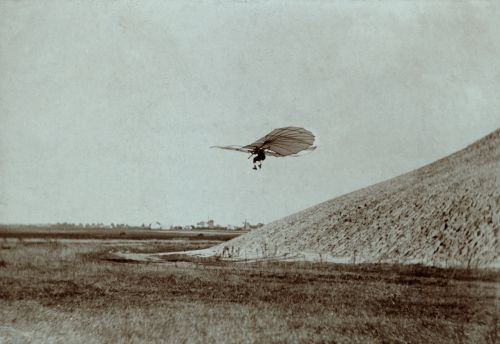
Otto Lilienthal’s death belongs to the history of invention as bodily experiment. Like Bullock, he was not destroyed by remorse or by the distant misuse of a technology he created. He was killed because the machine and the maker had not yet been separated by the safety systems, simulations, wind tunnels, regulatory protocols, and institutional testing cultures that later aviation would take for granted. Lilienthal’s gliders were not merely objects he designed; they were instruments he inhabited. His body supplied balance, judgment, motion, and risk. Between 1891 and 1896, he made close to 2,000 brief flights in a series of glider designs, becoming the most important aeronautical experimenter before the Wright brothers. That repetition matters. Lilienthal was not a reckless dreamer who leapt once into legend. He was a disciplined investigator who turned his own body into the measuring device by which heavier-than-air flight became thinkable.
Lilienthal’s work began not with spectacle but with observation, especially of birds. His 1889 study, Der Vogelflug als Grundlage der Fliegekunst, later translated as Birdflight as the Basis of Aviation, treated flight as a problem of form, lift, wind, and repeatable experiment. He and his brother Gustav studied wing curvature and air pressure, seeking principles that could be translated from natural flight into human apparatus. This mattered because nineteenth-century flight was still surrounded by a fog of myth, ridicule, speculation, and disappointment. Balloons had already carried human beings into the air, but ballooning did not solve the harder problem of controlled, heavier-than-air movement. Flying machines appeared in sketches, fantasies, patent claims, and popular imagination, yet many remained untested dreams or dangerous contraptions. Lilienthal’s achievement was not simply that he flew, but that he helped move aviation from fantasy toward empirical procedure. He measured, built, launched, fell, revised, and flew again, creating a cumulative experimental record rather than a single dramatic stunt. Long before powered flight at Kitty Hawk, Lilienthal demonstrated that a human being could repeatedly leave the ground, glide, land, adjust, and try again. His photographs circulated internationally, giving visual proof that heavier-than-air flight was not merely a philosophical possibility or a literary dream. Those images mattered almost as much as the flights themselves, because they turned private experimentation into public evidence. They made the human body in flight visible, reproducible, and persuasive. In a culture still divided between ballooning, mechanical speculation, and outright skepticism, Lilienthal made flight visible as practice.
Yet the very seriousness of his method required danger. Early aviation did not offer the inventor a safe distance from the experiment. The glider had to be carried, launched, balanced, and controlled by the man inside or beneath it. Lilienthal shifted his weight to steer, trusting his body to read air currents faster than theory could fully explain them. Each flight was both data and exposure. A successful glide produced knowledge, but only because the inventor had entered the uncertainty himself. This is where Lilienthal’s story reveals the sacrificial logic of early flight: the path to mastery over air passed through repeated surrender to it. The experimenter could study birds, calculate surfaces, refine wing shapes, and build launching hills, but the final test remained brutally physical. Air was invisible, unstable, and unforgiving. A gust, stall, misjudgment, or loss of balance could convert elegance into collapse in seconds.
On August 9, 1896, that conversion came. Lilienthal crashed during a glider flight near Stölln, reportedly after his aircraft stalled and he fell from a height sufficient to fracture his spine. He died the following day in Berlin. The phrase most often attached to his death, “Sacrifices must be made,” has become part of aviation legend, though historians have rightly treated it with caution. Its uncertain status is itself revealing. Whether or not Lilienthal spoke those exact words, later memory wanted him to have spoken them, because the phrase dignified the cost of technological advance. It made the broken body meaningful. It turned death into contribution. That is a dangerous but historically common transformation. Modernity often remembers dead inventors as martyrs of progress, not because their deaths were necessary in any simple sense, but because societies prefer sacrifice to accident. Sacrifice gives danger a purpose. Accident merely exposes vulnerability.
Lilienthal’s importance, then, is not reducible to his fatal crash. His work helped establish the practical foundation from which later aviators learned, and Wilbur and Orville Wright studied his example closely even as they corrected his limitations. But his death also warns against the romance of invention as heroic self-offering. Flight was not won by courage alone. It required data, correction, engineering humility, and eventually systems of control that reduced the need for bodily sacrifice. Lilienthal stands at the threshold between dream and discipline: a man who made flight real by repeatedly risking himself inside the experiment. If Bullock shows the industrial machine consuming the body through mechanical force, Lilienthal shows the experimental machine consuming the body through aspiration. The petard here is not malice, weaponry, or guilt. It is the beautiful and perilous belief that human beings could enter the air before they had fully learned how to survive there.
Franz Reichelt and the Spectacle of Failed Safety
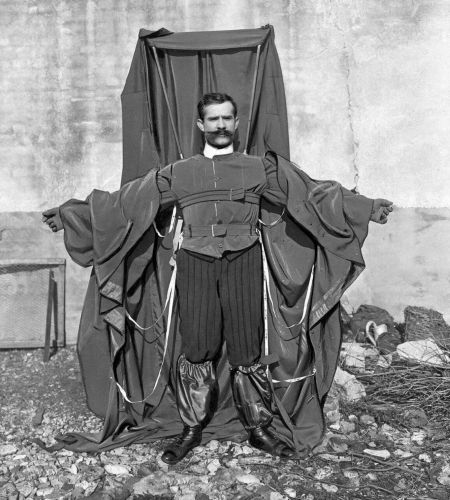
Franz Reichelt’s death belongs to a different register of technological tragedy than Lilienthal’s. Lilienthal’s flights were repetitive, disciplined, and cumulative, even when dangerous. Reichelt’s fatal test, by contrast, became a public drama of confidence, warning, spectacle, and collapse. An Austrian-born tailor living in Paris, Reichelt had designed a wearable parachute suit intended to save aviators in emergencies. That purpose matters. His invention was not a weapon, nor a machine of conquest, nor even an attempt to reach new heights for their own sake. It was meant to preserve life in an age when aviation itself was still new, unstable, and lethal. The early airplane made the sky newly accessible, but it also made falling newly urgent as a technical and moral problem. Pilots, mechanics, spectators, journalists, and inventors all understood that flight had outrun its own safety culture. Reichelt’s garment emerged from that anxious world, where the desire to protect aviators could easily merge with ambition, publicity, and personal certainty. Yet his own faith in the garment overcame caution, expert skepticism, and the boundary between testing an idea and surrendering one’s body to it. On February 4, 1912, he climbed the Eiffel Tower, stepped from its first platform, and died before the watching crowd when the parachute suit failed to open.
The tragedy lay partly in the confusion between safety as concept and safety as proof. Reichelt had reportedly tested versions of his design using dummies and low-height drops, but the results were not sufficiently reliable to justify a human jump from the Eiffel Tower. Police permission appears to have been granted under the expectation that a dummy would be used, not that Reichelt himself would leap. Witnesses and friends tried to dissuade him, and contemporary accounts emphasize the tension between public anticipation and private alarm. Reichelt’s insistence on performing the test himself made the event more than an experiment. It became a declaration of belief. He did not merely want to show that the parachute suit might work; he wanted his own body to certify it. In that moment, the inventor became both engineer and evidence, both designer and test subject, both promoter and sacrifice. The device intended to save falling men could only be vindicated, in his mind, by risking a falling man.
The presence of cameras and spectators made Reichelt’s death especially modern. Earlier inventors had died in workshops, fields, laboratories, aircraft, and industrial sites, but Reichelt’s fatal test unfolded as a media event. His fall was filmed, reported, replayed, and absorbed into public memory as a short, horrifying lesson in technological overconfidence. This matters because the spectacle altered the meaning of failure. A failed private test might have become a technical setback, an occasion for redesign, or a warning to proceed differently. A failed public test became final, theatrical, and irreversible. Reichelt’s death reveals how publicity can distort engineering judgment. The desire to demonstrate can outrun the discipline to verify. An audience can harden resolve when prudence requires retreat. The camera can transform uncertainty into performance. Here, the petard metaphor becomes almost painfully exact: a device imagined as rescue became the instrument of death, and that death became part of the invention’s public record.
Reichelt’s story should not be reduced to eccentricity, though it is often told that way. He was operating in a moment when aviation had created new dangers faster than institutions had created reliable safeguards. Parachute technology was still developing, and the problem he tried to solve was real. Pilots did fall. Aircraft did fail. The air had become a place of promise and terror, and inventors rushed to supply protective devices for a world that was learning to leave the ground before it had learned how to survive falling from it. Reichelt’s mistake was not that he imagined emergency descent as a solvable problem. It was that he mistook conviction for validation. His death belongs beside Lilienthal’s, but with a darker emphasis. Lilienthal shows the disciplined risk of experimental aviation; Reichelt shows the lethal danger of turning experimental safety into public spectacle before the invention has earned trust.
Marie Curie and the Invisible Price of Discovery
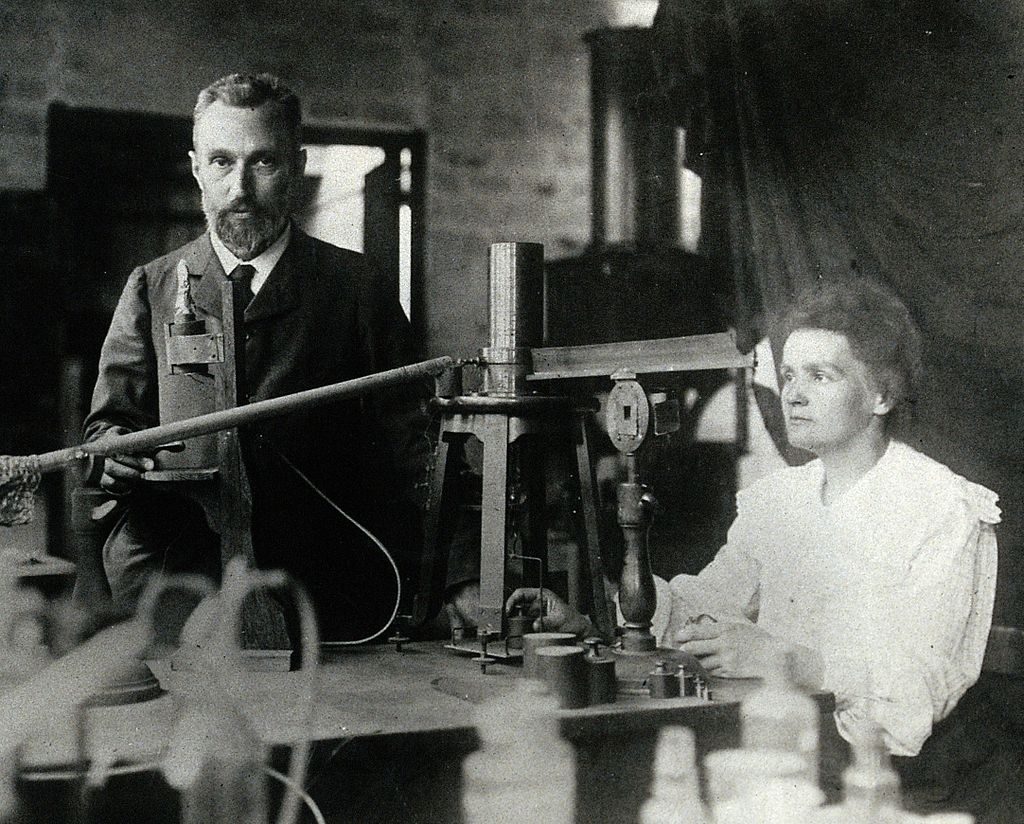
Marie Curie belongs here because her case changes the meaning of technological consequence. She was not killed by a machine she designed, nor by a spectacular public test, nor by an invention that turned morally against her. Her tragedy was quieter, slower, and in some ways more profound. Curie helped reveal a force that the human senses could not perceive, and that invisibility made its danger historically different from gears, flames, explosions, or falling aircraft. Radiation did not announce itself with noise or impact. It did not crush the limb or tear the wing. It entered the body silently, accumulated over years, and made the laboratory itself into a place of unseen exposure. In Curie’s life, discovery and danger were almost indistinguishable, because the science that could name radioactivity had not yet developed the full protective culture necessary to survive it.
Curie’s work with Pierre Curie at the end of the nineteenth century transformed physics and chemistry by demonstrating that radioactivity was not merely an odd property of uranium, but a phenomenon rooted in the structure of matter itself. Her isolation of polonium and radium required extraordinary labor, much of it physically punishing and chemically hazardous. Tons of pitchblende residue had to be processed to obtain tiny quantities of radioactive material, and the work took place in conditions that later generations would recognize as dangerously inadequate. Yet to judge Curie by later radiation standards would be historically unfair. She and her contemporaries did not fully understand the biological cost of what they were handling. Radium glowed with an almost magical beauty, and that visible glow helped create a public culture of fascination before the dangers were widely grasped. The element seemed to promise scientific revolution, medical treatment, industrial novelty, and even popular wonder. It was sold, displayed, celebrated, and commercialized before the full evidence of harm forced a darker reckoning.
The physical price of Curie’s discovery was written slowly into her own body. She died in 1934 of aplastic anemia, a disease widely associated with her prolonged exposure to ionizing radiation. Her notebooks, papers, and laboratory materials remained so contaminated that they would later require special handling. That fact has become almost symbolic, but it should not be reduced to a macabre curiosity. It means that Curie’s intellectual legacy is materially inseparable from the hazard she helped uncover. The archive itself bears witness. Her papers do not simply describe radioactive substances; they retain the residue of them. Here the petard metaphor becomes subtle but devastating. Curie was not “blown up” by her discovery. She was slowly inhabited by it. The invisible force she studied crossed the boundary between experiment and experimenter, between object and body, between scientific knowledge and biological consequence. The danger did not remain inside the vial, the ore residue, the laboratory bench, or the glowing sample that so fascinated observers. It traveled through touch, proximity, habit, and time, entering the routines of work before those routines were recognized as perilous. Curie carried radioactive materials in circumstances that now seem astonishingly unsafe, but that astonishment belongs to later knowledge. Her world had not yet built the institutional language of shielding, dosage limits, contamination protocols, or occupational exposure standards. What looks to modern eyes like carelessness was also the condition of being first. The discoverer was moving through a field whose hazards became legible only after bodies, instruments, and archives had already absorbed them. Her death reminds us that discovery can advance before safety, and that the first generation to understand a phenomenon may also be the generation most exposed to its dangers.
Curie’s story also complicates the moral categories of regret. Unlike Nobel, Einstein, Oppenheimer, or Kalashnikov, she did not face the same problem of an invention redirected into organized destruction during her lifetime. Her work did eventually contribute to nuclear physics, radiological medicine, radiation therapy, industrial applications, and, indirectly, the larger atomic age. But Curie herself is better understood as a figure of epistemic sacrifice rather than moral recoil. She did not need to regret discovering radioactivity for her life to reveal the danger of discovery. The tragedy lies in the gap between knowledge and protection. Science often identifies forces before it can safely manage them, and Curie’s career stands at that dangerous threshold. The same radium that helped open new medical possibilities also produced burns, cancers, anemia, industrial poisonings, and commercial abuses when its risks were underestimated or ignored. In that sense, Curie’s life reminds us that not all harmful consequences arise from bad intention. Some arise because wonder arrives before caution.
The invisible price of Curie’s work makes her indispensable to a broader history of invention and consequence. Bullock’s press crushed visibly. Lilienthal and Reichelt fell visibly. Nobel’s dynamite exploded visibly. Curie’s danger was different because it made modernity confront a new kind of risk: a force powerful enough to transform science, medicine, industry, and war, yet hidden from ordinary perception. Her case marks a transition from mechanical danger to invisible hazard, from machines that injure by contact to energies that alter the body at a level beneath sensation. It also deepens my central claim. The inventor or discoverer does not always pay because the invention fails. Sometimes the price is paid because the discovery succeeds before its consequences can be morally, medically, or institutionally contained. Curie gave science a new language for matter, but her body bore the cost of learning that matter could be more dangerous than human senses were built to know.
Max Valier and the Volatile Romance of Rocket Propulsion
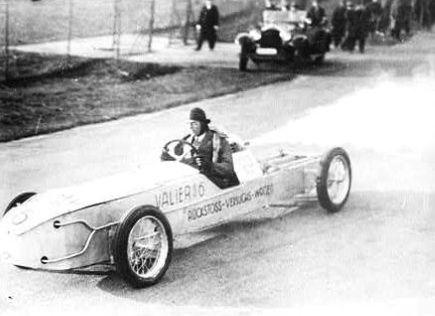
Max Valier belongs to the interwar world in which rocketry was still suspended between science, spectacle, transportation fantasy, and explosive danger. Unlike Curie, whose peril was invisible and cumulative, Valier worked with forces that announced themselves violently. He was drawn to rockets as symbols of motion beyond ordinary limits: faster cars, faster aircraft, planetary travel, and eventually escape from Earth itself. His importance was not only technical. He helped popularize the ideas of Hermann Oberth, whose theoretical work on spaceflight inspired a generation of German-speaking rocket enthusiasts, and he became one of the most visible public advocates for rocket propulsion in the 1920s. Valier’s career reveals another form of technological risk: the danger of making the future seem close before the engineering, materials, and safety culture needed for that future had fully arrived.
Valier’s rocket cars and demonstrations were part experiment and part theater. Working with Fritz von Opel and Friedrich Sander in the Opel-RAK program, he helped bring rocketry before the public as speed, spectacle, and modernity in motion. Rocket-powered vehicles raced across tracks, generated headlines, and made propulsion visible as excitement rather than abstract calculation. That publicity mattered because early rocketry needed patrons, audiences, and cultural legitimacy. It had to persuade people that rockets were not merely fireworks or fantasies, but machines with a future. Yet the same public drama that made rocketry attractive also risked oversimplifying its danger. Solid-fuel rocket demonstrations could create the image of progress as acceleration, flame, and applause, while the deeper engineering problems remained severe. Combustion instability, fuel handling, pressure, cooling, materials, and control were not romantic matters. They were unforgiving technical realities. Valier’s gift was that he could make rockets imaginable to the public; his peril was that imagination often moved faster than safe mastery.
By 1930, Valier had turned increasingly toward liquid-fueled rockets, recognizing that solid propellants could not fulfill the grander promises of spaceflight and high-performance propulsion. Liquid fuels offered greater potential, but they also introduced more dangerous systems of pumps, tanks, combustion chambers, oxidizers, pressure, ignition, and chemical volatility. On May 17, 1930, while testing a liquid oxygen and gasoline rocket motor in Berlin, Valier was killed when the engine exploded on the test stand. He has often been described as the first fatality of liquid-fuel rocket development, a phrase that gives his death a clear place in the genealogy of modern spaceflight. But the phrase should not make the death seem inevitable. It was historically significant because it revealed how little margin for error existed in the early rocket laboratory. A rocket motor is not simply an engine; it is a controlled explosion pretending to be transportation. When control fails, the boundary between experiment and detonation vanishes.
Valier’s death marks a turning point because rocketry’s later history would become inseparable from both cosmic aspiration and military terror. The same field that attracted dreamers of interplanetary travel would soon be drawn into the world of ballistic missiles, state laboratories, war planning, and eventually Cold War space competition. Valier did not live to see that transformation, and he should not be made responsible for it in the way Oppenheimer must be discussed in relation to the bomb or Kalashnikov in relation to the rifle. His place is earlier and more ambiguous. He represents the romantic phase of rocket propulsion, when the dream of escaping earthly limits still looked like a heroic extension of speed, engineering, and imagination. Yet his death already contained the warning. Rockets promised ascent, but they were born from blast. They invited humanity to look upward, but they did so by harnessing forces that could tear apart the bodies closest to them. In Valier, the petard becomes propulsion itself: the dream of controlled explosion carrying the inventor forward until the explosion ceased to be controlled.
Thomas Midgley Jr. and the Inventor as Environmental Irony
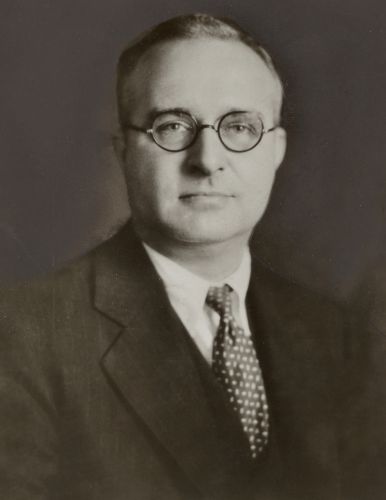
Thomas Midgley Jr. occupies one of the strangest and most troubling positions in the history of invention. At first glance, his death seems to fit the literal pattern: after contracting polio, he designed a system of ropes and pulleys to help lift and move himself in bed, became entangled in it, and died of strangulation in 1944. That detail has made him a frequent subject of dark historical irony, an inventor killed by a device meant to restore a measure of independence to his disabled body. Yet to stop there would make his story smaller than it is. Midgley’s historical significance rests less on the mechanism that killed him than on the substances he helped bring into the modern world: tetraethyl lead as an anti-knock gasoline additive and chlorofluorocarbons as refrigerants. His own death was tragic and grotesquely symbolic, but the deeper irony is environmental. Few inventors have been so personally linked to technologies that seemed elegant, profitable, and useful in their own time, yet later became markers of large-scale ecological and public health damage.
Midgley’s work on tetraethyl lead emerged from the early twentieth-century automobile age, when engineers and corporations sought ways to make engines run more smoothly, more powerfully, and more commercially. Knocking engines were a technical problem, and leaded gasoline appeared to solve it with remarkable efficiency. Midgley, working within the industrial research culture of General Motors, helped identify tetraethyl lead as a practical additive, and the product entered the marketplace under corporate pressure, scientific confidence, and a willingness to minimize toxicological warning signs. The substance was not harmless, and its danger was not wholly unknown. Lead had a long history as a poison, and workers involved in early production suffered severe illness and death. Still, the economic and technical appeal of leaded gasoline proved powerful. The automobile promised speed, mobility, modern convenience, and national growth, and tetraethyl lead seemed to make that promise easier to deliver. In this case, the petard was not a machine exploding in the inventor’s hands. It was a chemical solution that dispersed itself through exhaust pipes, streets, air, soil, and bodies across generations. Its harm became vast precisely because it was ordinary, daily, and infrastructural.
Midgley’s later role in the development of chlorofluorocarbons deepens the irony because these compounds, too, were celebrated as solutions to real problems. Refrigeration had long depended on dangerous substances such as ammonia, sulfur dioxide, and methyl chloride, which could poison or kill when leaks occurred. Chlorofluorocarbons appeared safer for immediate human use: nonflammable, chemically stable, and practical for refrigeration, air conditioning, and aerosol applications. In the short term, this was not an absurd achievement. It helped make cooling more reliable, comfortable, and commercially widespread, contributing to transformations in food preservation, domestic life, medicine, architecture, and migration into warmer regions. Yet the very stability that made chlorofluorocarbons attractive at ground level made them destructive in the upper atmosphere. Once released, they could persist long enough to reach the stratosphere, where ultraviolet radiation broke them apart and released chlorine atoms that damaged the ozone layer. The great lesson of the CFC story is that safety is not a single location. A compound safe in the kitchen, factory, or refrigerator may be dangerous in the atmosphere. Midgley’s second major invention exposed a new scale of consequence: the harmful afterlife of a substance may unfold far from the site where its benefits are first enjoyed.
Midgley’s death by his own assistive pulley system gives his biography the narrative closure of a cruel fable, but the real historical meaning lies in the mismatch between inventive intention and planetary effect. He did not set out to poison children with atmospheric lead or thin the ozone layer. He worked as a problem-solver within an industrial world that rewarded immediate utility, marketability, and technical performance. That does not absolve the systems around him, especially where evidence of harm was ignored, suppressed, or managed as a public relations obstacle. But it does make the case more historically serious than simple villainy. Midgley represents a modern inventor embedded in corporate science, where discovery moved quickly into mass production and where consequences could be displaced into the environment long before they were fully acknowledged. His body was killed by a personal mechanism of mobility. His legacy was shaped by chemical mechanisms of diffusion. If Bullock’s danger was mechanical, Nobel’s explosive, Curie’s invisible, and Valier’s volatile, Midgley’s was environmental: the invention that does not merely strike the inventor, but enters the shared world and waits.
Albert Einstein, the Bomb, and the Burden of Indirect Responsibility

Albert Einstein belongs here precisely because he did not build the atomic bomb. His case is not the story of an inventor destroyed by a machine or a scientist directing a weapons laboratory. It is instead the story of intellectual authority entering the machinery of state power. Einstein’s famous equation, E = mc², has often been treated in popular memory as though it led in a straight line to Hiroshima, but that simplification distorts both physics and history. The atomic bomb depended on nuclear fission, chain reactions, uranium enrichment, plutonium production, industrial engineering, military organization, and the vast institutional apparatus of the Manhattan Project. Einstein was not part of that project, and his pacifist commitments made him an unlikely architect of mass destruction. Yet he did play a consequential role in 1939 when he signed the letter, drafted largely by Leó Szilárd, warning President Franklin D. Roosevelt that uranium might make possible “extremely powerful bombs” and that Nazi Germany might already be investigating such weapons. His responsibility was indirect, but not imaginary. He lent his name, reputation, and scientific authority to a warning that helped move the United States toward atomic research.
The moral force of Einstein’s case lies in the historical conditions that made his action understandable. In 1939, Adolf Hitler’s Germany was not an abstract threat. Nazi expansion, antisemitic persecution, refugee science, and the possibility of German nuclear research created a climate in which inaction could also feel morally dangerous. Einstein, himself a Jewish refugee from Germany, did not urge Roosevelt toward the bomb out of militarism or technological enthusiasm. The letter was an act of fear shaped by the brutal political realities of fascist Europe. This distinction matters because it keeps us from flattening regret into hindsight. Einstein’s later discomfort did not mean the original fear was frivolous. The great tragedy of the atomic age is that some of its first moral decisions were made under conditions of genuine uncertainty, where the nightmare of Nazi possession of nuclear weapons seemed worse than the nightmare of democratic states pursuing them first. The inventor, scientist, or public intellectual may act to prevent one catastrophe and thereby help create the conditions for another.
After Hiroshima and Nagasaki, Einstein became one of the most visible scientific voices warning against nuclear war, militarized secrecy, and the political misuse of science. He famously remarked that had he known Germany would not succeed in developing an atomic bomb, he would have done nothing to encourage its creation. That statement should not be read as theatrical self-condemnation, but as an acknowledgment of changed knowledge. Einstein had acted under the shadow of one danger and then watched another become real. His regret was not the regret of a technician who saw his device malfunction, nor of a commander who ordered destruction. It was the regret of someone whose prestige helped unlock a door he could not later close. In the postwar years, he supported international control of atomic energy, world government, and public education about nuclear danger, joining other scientists who understood that Hiroshima had altered not merely warfare but civilization’s relationship to its own intelligence. The bomb made scientific knowledge appear both triumphant and catastrophic, proof that human beings could penetrate the structure of matter and use that knowledge to erase cities. Einstein’s public warnings came from a recognition that the old separation between pure inquiry and political consequence had collapsed. Physics was no longer only a field of theoretical elegance, laboratory experiment, or cosmological wonder. It had become part of diplomacy, military planning, national security bureaucracy, and species-level risk. He understood that the atomic bomb had transformed the relation between science and survival. Knowledge had become geopolitical power, and once that happened, private conscience alone could no longer govern its consequences.
Einstein’s place in the petard metaphor is conceptual rather than mechanical. He was not hoisted by a device of his own making, but by the authority of his own name. The public image of genius that made his warning effective also made his later regret historically resonant. He had not intended to inaugurate a nuclear arms race, but intention became secondary once scientific knowledge moved through government memoranda, military budgets, laboratories, uranium plants, test sites, and war planning. His case reveals one of modernity’s most unsettling burdens: responsibility can attach not only to the person who builds the machine, but also to the person whose warning, theory, signature, or status helps authorize the system that builds it. If Curie shows discovery advancing before safety, Einstein shows conscience acting before full consequence. He reminds us that the moral life of invention begins not only at the workbench or in the laboratory, but also in the letter, the advisory committee, the emergency appeal, and the moment when fear persuades knowledge to serve power.
Robert Oppenheimer and the Scientist Who Saw the Machine Become Policy
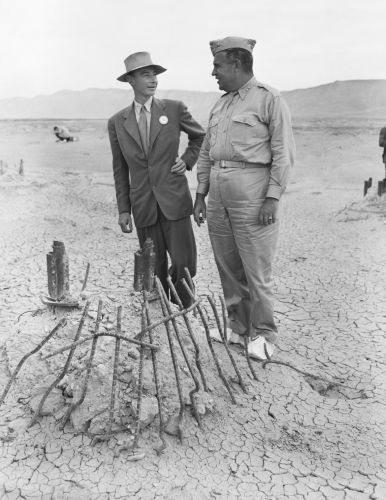
Robert Oppenheimer belongs after Einstein because he represents the movement from indirect responsibility to direct scientific leadership. Einstein’s authority helped warn the United States that atomic weapons might be possible; Oppenheimer helped make them real. As scientific director of the Manhattan Project’s laboratory at Los Alamos, he coordinated physicists, chemists, engineers, mathematicians, military officials, and technicians in the creation of a weapon unlike any previously used in war. His role was not that of a lone inventor standing beside a personal machine. It was that of an intellectual organizer inside an enormous wartime system. This distinction matters. The atomic bomb was not the product of one mind, one workbench, or one patent. It was the product of state mobilization, industrial scale, military secrecy, theoretical physics, metallurgical labor, chemical separation, military logistics, and political urgency converted into deliverable force. Oppenheimer stood at the point where those systems met. He had to translate between civilian scientists and military command, between speculative theory and practical engineering, between intellectual brilliance and wartime discipline. Los Alamos depended on his ability to hold together a community of unusually gifted, difficult, anxious, ambitious, and morally divided people under extraordinary pressure. Oppenheimer’s genius lay partly in understanding enough of the science to lead the scientists, and enough of the institution to keep the work moving. That made his later burden different from Einstein’s. He could not plausibly say that he merely opened a door. He had helped build the room behind it.
The Manhattan Project forced science into a new relationship with the state. Before the war, theoretical physics had often been imagined as distant from practical violence, a realm of equations, particles, spectra, and abstract inquiry. That separation had never been absolute, but the bomb shattered it beyond repair. At Los Alamos, knowledge became command structure. Equations became engineering problems. Laboratory uncertainty became military deadline. The scientist no longer worked only for truth, publication, or disciplinary honor; he worked inside a classified apparatus whose purpose was destruction before the enemy could destroy first. Oppenheimer did not enter that apparatus as a simple militarist. Like many scientists involved in the project, he was shaped by fear of Nazi Germany, awareness of fascist violence, and the belief that an Allied bomb might be necessary to prevent a worse outcome. Yet the very legitimacy of that fear made the later moral problem sharper. The bomb was built under emergency conditions, but once built, it did not disappear when the emergency changed. The machine survived the fear that justified it.
The Trinity test on July 16, 1945, marked the moment when theoretical possibility became visible apocalypse. In the New Mexico desert, the first atomic explosion revealed not merely a successful weapon but a new condition of history. Oppenheimer later became associated with the line from the Bhagavad Gita, “Now I am become Death, the destroyer of worlds,” though that quotation has often been overused, simplified, and detached from the wider complexity of his thought. More revealing than any single phrase is the transformation that followed. The bomb, once tested, immediately became policy. It entered deliberations about Japan, the Soviet Union, postwar diplomacy, military planning, and American power. Hiroshima and Nagasaki were not laboratory events. They were political and military acts carried out against cities, civilians, soldiers, buildings, memories, and futures. Oppenheimer’s creation had left the desert and entered history as state action. The scientist who had managed uncertainty in the laboratory now confronted the certainty that knowledge, once weaponized, would be used by institutions according to reasons larger and colder than scientific curiosity.
After the war, Oppenheimer’s position became more conflicted and more public. He did not become an uncomplicated pacifist, nor did he deny the strategic world in which atomic weapons now existed. Instead, he tried to shape nuclear policy through advisory work, arms control, and opposition to what he saw as dangerous escalation, especially the drive toward the hydrogen bomb. His resistance to the hydrogen bomb was not merely technical; it reflected a fear that the United States was moving from wartime necessity into a permanent logic of annihilating capability. Here, Oppenheimer saw the machine become policy in its fullest sense. The atomic bomb was no longer a project with an endpoint. It had become an institutional habit, a strategic language, and a political identity. Nuclear weapons created bureaucracies, doctrines, budgets, loyalties, suspicions, and enemies. They also created a culture in which the scientist’s moral hesitation could be recoded as political unreliability. Oppenheimer’s 1954 security hearing, which stripped him of his clearance, exposed the cruelty of that transformation. The state that had relied on his brilliance to make the bomb now punished his ambivalence about what the bomb had made possible.
Oppenheimer’s tragedy, then, is not simply that he regretted helping create a terrible weapon. It is that he discovered too late that scientific authority could help summon forces it could not govern. The petard here was not the bomb alone, but the political world built around the bomb. Oppenheimer was hoisted by the very system that had elevated him: secrecy, urgency, national security, ideological suspicion, and the conversion of technical achievement into permanent geopolitical power. His life reveals a central truth of modern invention: once a device becomes policy, its inventor becomes secondary to the institutions that possess it. The bomb did not remain Oppenheimer’s moral problem. It became America’s military doctrine, the Soviet Union’s target of imitation, the Cold War’s organizing terror, and humanity’s standing threat against itself. In that sense, Oppenheimer’s story sharpens Einstein’s. Einstein shows how conscience can act before consequence is visible. Oppenheimer shows how consequence, once made visible, can still be captured by power and turned into policy despite conscience.
Kalashnikov and the Weapon That Outlived Its Maker’s Intentions
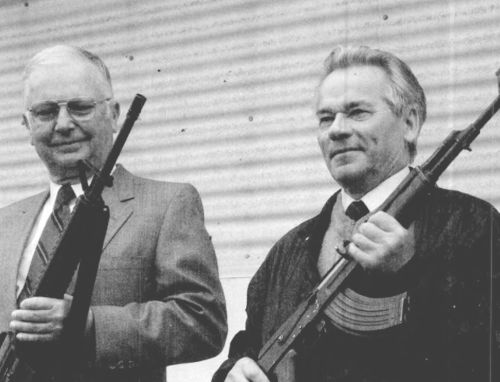
Mikhail Kalashnikov’s place here depends on a different form of technological reversal: not the inventor killed by his device, but the inventor morally pursued by its success. The AK-47 was not a failed invention. It was, by the brutal standards of military design, one of the most successful weapons ever made. Durable, simple to operate, relatively cheap to manufacture, and capable of functioning in harsh conditions, it became a defining firearm of the twentieth century and beyond. Kalashnikov designed it in the aftermath of the Second World War, within a Soviet military culture shaped by invasion, devastation, and the need for reliable infantry weapons. He understood his work as patriotic, defensive, and practical. The rifle was not imagined by him as an emblem of warlords, insurgencies, child soldiers, coups, massacres, and illicit arms markets. Yet that is precisely the problem. The weapon’s excellence as a machine made it historically uncontrollable as a moral object.
Kalashnikov repeatedly defended himself by arguing that he had created the rifle to protect his homeland, not to arm criminals or fuel suffering across the globe. That distinction is not meaningless. The Soviet Union had suffered catastrophic losses during the German invasion, and the emotional world of Soviet weapons design cannot be detached from that trauma. A soldier-engineer who had seen the consequences of war could plausibly believe that a dependable rifle was a tool of survival. But weapons are not like ordinary tools, even when they are described in the language of defense. Their purpose is injury, intimidation, or death, and their moral meaning changes as they move from arsenal to battlefield, from state control to proxy war, from national army to revolutionary movement, militia, cartel, or criminal network. Kalashnikov’s rifle became powerful not only because it worked, but because it traveled. It crossed borders, ideologies, climates, and causes with terrifying ease. It appeared in anti-colonial struggles, communist revolutions, state armies, guerrilla campaigns, civil wars, terrorist violence, and popular iconography. Its simplicity made it democratic in the darkest sense: it lowered the technical barrier to lethal force.
Late in life, Kalashnikov’s public reflections revealed the spiritual and moral instability of that legacy. In a 2012 letter to Patriarch Kirill of the Russian Orthodox Church, he reportedly asked whether he bore responsibility for the deaths caused by his rifle, even if those who used it did so for purposes he had not intended. That question matters more than any simple declaration of regret. It shows an aging inventor confronting the gap between design intention and historical outcome. He did not renounce every part of his life’s work, nor did he suddenly become a pacifist in any uncomplicated sense. His anguish was more specific and more revealing: can the maker of a weapon separate himself from its users when the weapon succeeds beyond all boundaries of control? The religious framing of his question sharpened the issue because it moved responsibility beyond law, patriotism, or professional pride. It brought the rifle out of the language of state service and into the language of sin, conscience, and judgment. That shift matters. A government can decorate an inventor, a factory can manufacture his design, and an army can justify its use, but none of those institutions can fully answer the inward question of moral authorship. Kalashnikov’s anxiety was not simply whether he had obeyed his nation or served its soldiers. It was whether creating an efficient instrument of death placed some portion of later bloodshed upon his soul, even when the hands that fired it belonged to others. Before God, intention may matter, but consequence does not vanish. Kalashnikov’s late remorse stands as one of the clearest examples of the inventor haunted not by malfunction, but by effectiveness.
The AK-47 outlived Kalashnikov’s intentions because modern weapons do not remain inside the moral world that produces them. Once manufactured at scale, copied, exported, modified, and circulated, they enter histories their designers cannot govern. Kalashnikov could insist that politicians, armies, and violent users bore responsibility for how the rifle was used, and that claim has force. But it does not erase the larger tragedy. The rifle’s virtues as a technology, reliability, ease, ruggedness, portability, and mass reproducibility, became inseparable from its capacity to multiply violence in places far removed from its original Soviet setting. Kalashnikov’s petard was success detached from sovereignty. He made a weapon that worked too well, traveled too far, and became too symbolically available to belong to him anymore. If Nobel’s dynamite showed that useful violence could escape moral containment, Kalashnikov’s rifle showed that portable violence could escape political containment. The inventor survived the weapon, but he did not survive its meaning.
Henry Smolinski, Harold Blake, and the Dream of the Flying Car

Henry Smolinski and Harold Blake belong to the history of invention as technological fantasy made physical. Their AVE Mizar was not merely a vehicle; it was an attempt to solve one of the most persistent dreams of twentieth-century mobility, the flying car. Few ideas better capture the modern desire to collapse limits. The automobile promised private freedom on roads. The airplane promised conquest of distance through the air. The flying car promised both at once: domestic convenience joined to aerial escape, the driveway connected to the runway, the ordinary citizen lifted into a future of personal aviation. That dream had circulated for decades in magazines, exhibitions, speculative engineering, and popular imagination, but it repeatedly collided with the same stubborn fact. A car and an airplane are not the same kind of machine. They obey different structural demands, safety assumptions, control systems, weight tolerances, and failure consequences. To merge them successfully required more than optimism. It required a discipline equal to both worlds.
The Mizar, developed by Advanced Vehicle Engineers in the early 1970s, attempted to combine the body of a Ford Pinto with the wings, tail, and rear engine structure of a Cessna Skymaster. The choice itself reveals the hybrid logic of the project. The Pinto offered an inexpensive compact car platform, recognizable and marketable in an American culture already organized around automobile ownership. The Cessna components offered an established aviation architecture that could be attached to the automobile section for flight and removed for road use. On paper, the concept seemed to turn existing technologies into a new category of personal transportation. It promised not a wholly new machine designed from first principles, but a practical marriage of familiar objects. That was part of its appeal. Consumers could imagine the roadgoing portion because it looked like a car they already understood; aviation enthusiasts could imagine the flying portion because it borrowed from known aircraft technology. The project drew strength from recognizability, from the sense that the future might not require an entirely alien device but could be assembled from machines already present in American life. Combining familiar parts does not necessarily produce a reliable system. The safety of each component in its original context did not guarantee the safety of the composite machine. The Pinto was not designed to be an aircraft fuselage. Aircraft wings were not designed to be casual accessories to a road vehicle. The act of joining them created a new engineering problem, not simply a clever shortcut. What appeared to be efficient adaptation may instead have produced a category error: a vehicle whose parts carried the authority of proven technologies while the whole remained dangerously unproven.
The fatal crash on September 11, 1973, exposed the danger of that mismatch. During a test flight near Camarillo, California, Smolinski and Blake were killed when the prototype broke apart after a structural failure involving the wing attachment system. The basic horror of the accident is easy to grasp: the machine meant to join road and sky failed precisely at the point where those two dreams had been physically connected. That failure makes the Mizar an especially vivid example of technological overconfidence. It was not the engine alone, the car alone, or the aircraft alone that killed them. It was the interface. The connection between systems became the weak point where aspiration exceeded structural integrity. In that sense, the Mizar’s disaster offers a broader lesson about invention. Many failures do not arise from ignorance of parts, but from misplaced confidence in combination. A machine assembled from known technologies may still produce unknown dangers when the relationship between those technologies is not fully understood.
The flying car also belongs to a distinct American romance of mobility. By the 1970s, the United States had already been reshaped by highways, suburbs, airports, consumer automobiles, and the language of personal freedom through transportation. The flying car promised to carry that culture one step further. It imagined the individual liberated not only from railroad schedules or urban density, but even from the road network itself. Yet that fantasy concealed the collective systems that make mobility safe: traffic rules, maintenance regimes, airspace control, pilot training, certification, inspection, crashworthiness, weather judgment, and emergency planning. A road vehicle can suffer a mechanical problem and pull over. An aircraft cannot simply stop in the air. A driver can be licensed under one standard; a pilot requires another. The dream of the flying car often minimizes those differences because the fantasy is personal, while the safety reality is institutional. Smolinski and Blake’s project exposes the gap between individual technological desire and the social infrastructure required to make that desire survivable.
Their deaths should not be treated as comic footnotes in the history of failed invention. The phrase “flying Pinto” invites ridicule, especially given the Pinto’s later reputation, but ridicule dulls the sharper point. Smolinski and Blake were working within a long tradition of ambitious transportation experiments, and their failure reveals the hazards of making the future from incompatible pieces of the present. They were not merely pursuing a novelty; they were giving mechanical form to a century of promises about private mobility, technological freedom, and the coming conquest of inconvenience. That makes their failure historically revealing rather than merely strange. The flying car dream persists because it speaks to a deep modern impatience with limits: traffic, distance, dependence, regulation, and the ordinary friction of shared space. But machines that promise to abolish limits often create new ones, especially when they cross domains governed by different forms of danger. The Mizar’s failure was not only a structural accident. It was a warning about technological imagination when it borrows the romance of aviation and the familiarity of the automobile without fully submitting to the safety demands of either. The petard in their case was not a single explosive device, a poisonous substance, or a weapon that escaped moral control. It was integration itself. They were hoisted by the belief that two technologies, each intelligible in its own domain, could be fused into a safe and marketable whole without producing a new order of risk. Their story brings me back to the body inside the experiment, but with a modern twist: the inventor is no longer merely standing beside the machine or gliding beneath a wing. He is sitting inside a hybrid dream, trusting the joint between imagination and engineering to hold.
Ethan Zuckerman and the Small Invention That Became a Digital Nuisance

Ethan Zuckerman brings us into a different kind of technological consequence, one less dramatic than explosion, poisoning, aircraft failure, or nuclear dread, but deeply revealing in its own quieter way. His role in creating the pop-up advertisement during the early commercial web has often been told as a minor origin story for a major annoyance. That difference in scale matters. Pop-up ads did not kill their maker, destroy cities, poison the atmosphere, or arm insurgencies. Yet they belong here because they show how even small design choices can become historically consequential when embedded in a system capable of endless replication. The web magnifies minor decisions. A bit of code, once copied, normalized, and monetized, can become part of the daily architecture of experience for millions of people. Zuckerman later described the pop-up as a tool devised to solve a particular advertising problem: advertisers wanted their messages separated from page content, especially when placement beside certain material might imply endorsement or association. The solution was technically clever, commercially useful, and socially irritating. It created a new window, and with it a new form of intrusion. The very smallness of the invention is what makes it instructive. It shows that technological regret does not always begin with grand ambition or catastrophic force. Sometimes it begins with a workaround, a client demand, a business model, and a programmer trying to solve one immediate problem without yet seeing the larger pattern the solution will help create.
The pop-up advertisement’s importance lies not only in its annoyance but in what it revealed about the web’s emerging economic structure. The early internet carried utopian hopes of openness, connection, democratic communication, and low-cost publication. Yet those ideals quickly met the practical problem of money. Websites needed revenue, users resisted direct payment, and advertising became the compromise that allowed the web to appear free while quietly reorganizing attention as a commodity. In that context, the pop-up was not an isolated nuisance; it was a symptom of a deeper bargain. It showed that the user’s experience could be interrupted, redirected, and monetized in the name of keeping digital spaces financially viable. Zuckerman’s later apology matters because it was not simply a confession about one irritating format. It was an acknowledgment that a technical decision helped normalize a wider pattern: the conversion of attention into inventory. The screen became a contested space, and the user’s focus became something to capture, sell, measure, and invade.
This makes Zuckerman’s regret historically useful precisely because the harm was not catastrophic in the conventional sense. Technological consequence is often easiest to see when bodies fall, engines explode, bombs detonate, or poisons accumulate. Digital consequences can be more diffuse. They appear as irritation, distraction, surveillance, habituation, and the slow reshaping of expectation. A pop-up ad is easy to close, but the logic behind it is harder to escape. Once designers, advertisers, and platforms learned that interruption could produce revenue, the web became increasingly structured around attention capture. Pop-ups led to blockers; blockers led to new ad formats; ad formats merged with tracking; tracking fed targeting; targeting deepened the economic incentive to know, predict, and manipulate user behavior. Zuckerman did not invent all of that, and he should not be burdened with responsibility for the entire architecture of surveillance capitalism. But his apology is valuable because it marks one of the rare moments when a digital builder publicly recognized that a small technical solution had helped feed a larger and uglier ecosystem.
Zuckerman’s place in the petard metaphor is social rather than bodily. He was not hoisted by an explosion or destroyed by a machine. He was hoisted by scale. The pop-up ad became irritating because it worked well enough to spread, and because the web’s business model rewarded its spread until users fought back with browser settings, extensions, and collective resentment. This is a modern form of invention’s afterlife: not the singular disaster, but the endlessly repeated inconvenience; not the heroic fatal test, but the tiny design choice multiplied across millions of screens. In Zuckerman’s case, regret becomes less about guilt than about recognition. The inventor looks back and sees that a clever workaround became part of a system that made digital life worse. That may seem modest beside Nobel, Oppenheimer, or Kalashnikov, but it captures something essential about the technological present. Not every petard explodes. Some open in a new browser window, again and again and again.
Stockton Rush, Titan, and the Cult of Disruptive Risk

Stockton Rush brings us into the twenty-first century, where the petard metaphor no longer belongs only to workshops, laboratories, weapons programs, or experimental airfields. It now belongs to the culture of disruption itself. Rush, the chief executive officer of OceanGate, died on June 18, 2023, with four others when the Titan submersible imploded during a descent to the wreck of the Titanic in the North Atlantic. The disaster had the terrible clarity of older invention tragedies: a designer-operator killed inside the machine he championed. Yet Titan was not merely a failed craft. It was the product of a particular modern rhetoric that celebrates boundary-breaking, distrusts “legacy” expertise, treats regulation as an obstacle to vision, and confuses risk-taking with courage. In Rush’s case, the machine that descended toward the most famous maritime wreck in history became a wreck of its own, not because the deep sea is inherently unknowable, but because extreme environments punish arrogance with exceptional speed.
The Titan disaster is especially revealing because deep-sea exploration had already developed a serious safety culture before OceanGate. Human-occupied submersibles are not casual vehicles. At great depth, pressure is not a metaphor; it is an absolute physical reality. The ocean does not negotiate with confidence, branding, investor enthusiasm, or entrepreneurial charisma. Titan’s design, including its carbon fiber pressure hull joined to titanium components, attracted scrutiny before the fatal dive, and critics had raised concerns about certification, testing, and the decision to operate outside established classification norms. The later findings of the United States Coast Guard made the historical lesson sharper. Its Marine Board of Investigation concluded that the disaster was preventable and identified inadequate design, certification, maintenance, and inspection as primary contributing factors, while also citing a toxic workplace culture, ineffective whistleblower protections, and regulatory gaps around novel submersible operations. The National Transportation Safety Board likewise found that Titan’s pressure hull failed during the dive and emphasized failures in testing, engineering, and safety management. These findings matter because they shift the story away from mystery and toward accountability. Titan did not simply vanish into the abyss. It entered the abyss carrying unresolved warnings.
Rush’s public posture made the case symbolically powerful because he often presented himself as someone willing to challenge conventional caution. That posture has deep roots in modern innovation culture. The heroic entrepreneur is imagined as the person who sees beyond bureaucrats, experts, committees, and timid incumbents. Sometimes that challenge produces real advances. But in high-risk engineering, especially where human lives depend on materials under extreme stress, skepticism toward established safety practice can become lethal. The language of disruption works poorly at crush depth. Software can be patched after release; a pressure vessel carrying passengers cannot. A startup may celebrate iteration, but the ocean does not permit beta testing in the same moral sense. Titan’s tragedy exposes the danger of transferring Silicon Valley habits of speed, improvisation, and anti-regulatory bravado into environments where failure is immediate and total. The issue was not innovation against stagnation. It was humility against performance. It was whether the desire to prove a new approach could coexist with the obligation to demonstrate, verify, certify, and listen.
Rush’s death closes the chronological arc with brutal symmetry. Like Bullock, he was killed by a machine he helped bring into service. Like Reichelt, he transformed safety claims into public spectacle. Like Smolinski and Blake, he trusted a hybrid technical dream whose integration problems were not fully mastered. Like Nobel, Oppenheimer, and Kalashnikov, he saw technology enter moral territory larger than private intention, though in his case the reckoning came instantly and personally. The petard here was not merely Titan’s hull. It was the belief system surrounding it: the conviction that visionary risk can outrun institutional caution without demanding a price. That belief is one of the defining temptations of the present. Modern invention still needs courage, but courage without discipline becomes theater, and theater in extreme environments becomes fatal. Titan reminds us that the future is not made safer by mocking restraint. Sometimes restraint is the only thing standing between ambition and implosion.
Thematic Synthesis: Four Ways Inventors Are Hoisted
The following video from “Obscura Inventions” covers some fatal inventions:
The figures here should not be collapsed into a single morality tale, because their reversals differ in kind, scale, and moral texture. William Bullock, Otto Lilienthal, Franz Reichelt, Max Valier, Thomas Midgley Jr., Henry Smolinski, Harold Blake, and Stockton Rush were physically killed by machines, devices, or systems they helped create, test, or trust. Alfred Nobel, Albert Einstein, Robert Oppenheimer, Mikhail Kalashnikov, and Ethan Zuckerman confronted a different kind of consequence: not the immediate destruction of the body, but the afterlife of an invention or technical decision once it entered war, markets, public memory, or social systems. Curie stands partly apart from both groups, because she was neither a regretful weapons-maker nor a reckless test subject, but a discoverer whose body absorbed the invisible hazard of a field still learning its own dangers. These cases show that to be “hoist” by one’s own invention does not always mean to be killed by it. It can mean to be injured, haunted, morally exposed, historically redefined, or made helpless before consequences that began as solutions.
The first form of hoisting is bodily and immediate. Bullock’s press, Lilienthal’s gliders, Reichelt’s parachute suit, Valier’s rocket motor, Midgley’s pulley system, the Mizar flying car, and Titan all dramatize the dangerous nearness of inventor and invention. In these stories, the creator remains physically entangled with the device before safety has been fully institutionalized. The body stands beside the press, hangs beneath the glider, steps from the tower, leans near the test stand, rests inside the assistive machine, sits within the hybrid vehicle, or descends inside the pressure hull. The invention has not yet become distant infrastructure. It is still intimate, experimental, and unforgiving. These cases reveal a basic truth that triumphant histories of technology often soften: invention begins before mastery is complete. The first generation of makers frequently occupies the zone between possibility and protection, where technical imagination has advanced farther than the safeguards needed to contain it. Their deaths are not all the same. Some emerged from disciplined experimentation, some from misplaced confidence, some from structural misjudgment, and some from institutional failure. But each shows the body paying for the gap between the imagined machine and the reliable machine.
The second form is moral hoisting, where the inventor survives but intention does not. Nobel’s dynamite, Einstein’s letter, Oppenheimer’s bomb, and Kalashnikov’s rifle all belong to this category, though they differ sharply in responsibility. Nobel sought to make explosive force more stable and useful, then saw that usefulness become inseparable from destruction and his own public memory. Einstein did not build the bomb, but his scientific authority helped legitimize the emergency that produced it. Oppenheimer directly led the scientific creation of the atomic weapon and then watched it become policy, doctrine, and permanent geopolitical threat. Kalashnikov designed a rifle for national defense and lived to see it become a global icon of portable killing. These examples show that intention is historically important, but never historically sovereign. A device made for construction can become a weapon. A warning written from fear can help authorize a new military order. A wartime project can survive the war and harden into strategy. A patriotic rifle can move through black markets, insurgencies, states, and symbols far beyond the maker’s control. Moral hoisting occurs when invention escapes the ethical frame in which it was first justified.
The third form is invisible or delayed hoisting, where consequence unfolds slowly, diffusely, or beyond ordinary perception. Curie’s radiation exposure, Midgley’s leaded gasoline and chlorofluorocarbons, and Zuckerman’s pop-up advertisement all operate in this register, despite their obvious differences in seriousness. Radiation entered Curie’s world before safety protocols had caught up to scientific wonder. Leaded gasoline dispersed poison through ordinary mobility, turning the automobile age into a public health catastrophe whose costs were borne unevenly and often invisibly. Chlorofluorocarbons seemed safe in immediate domestic and industrial settings while producing atmospheric damage at planetary scale. Pop-up advertising, far less grave in bodily terms, shows the same structural pattern in miniature: a localized technical solution mutates into a replicated social nuisance and helps disclose a larger economy of attention capture. In all these cases, danger is not concentrated in a single spectacular moment. It accumulates, circulates, normalizes itself, or hides in systems. The harm is real, but it may be too gradual, too distributed, or too profitable to be recognized quickly. This kind of hoisting is especially modern because modern technologies often do their work at scales larger than human perception: molecular, atmospheric, bureaucratic, digital, or global.
The fourth form is reputational and historical hoisting, where the inventor’s name becomes inseparable from consequences that exceed biography. Nobel is remembered through prizes that partly answer the moral ambiguity of dynamite. Oppenheimer became the emblem of the scientist who gave the state apocalyptic power. Kalashnikov’s name became a brand of global violence, stamped not only on weapons but on flags, movements, and myths. Midgley became a symbol of unintended environmental harm on a scale his immediate technical achievements could not have predicted. Rush’s name now stands for the danger of disruptive confidence when applied to lethal environments without adequate restraint. This final form of hoisting matters because history rarely allows inventors to control the stories attached to them. Patents, demonstrations, public statements, apologies, prizes, investigations, accidents, and later scholarship all compete to define what an invention meant. The maker may insist on intention, but memory weighs outcome. That is the harshest lesson running through these lives. Human beings invent within narrow moments, but inventions live in wider histories. The petard is not only the device that explodes beneath its maker. It is the future itself, rising with all the force of uses, misuses, profits, deaths, regrets, and meanings the inventor could not finally command.
Conclusion: Invention, Humility, and the Afterlife of Human Cleverness
The stories gathered here do not condemn invention. That would be too easy, too pious, and historically false. Human beings invent because they suffer limits: darkness, distance, hunger, illness, danger, slowness, labor, isolation, vulnerability, and death. The printing press multiplies words. Dynamite clears stone. Gliders teach the body how to read air. Parachutes promise rescue from falling. Radium opens matter to new forms of knowledge and treatment. Rockets imagine escape from gravity. Antiknock fuel, refrigerants, flying cars, nuclear physics, rifles, digital advertising systems, and deep-sea vessels all begin, in one way or another, as answers to problems. The tragedy is not that humans try to solve things. The tragedy is that cleverness so often mistakes the solution for the end of responsibility. A device works, and that success can become intoxicating. It can make the maker, the investor, the state, the corporation, or the public forget that use is not the same as wisdom, and that power is not the same as control.
The petard metaphor endures because it refuses the comforting fantasy that invention remains obedient to its creator. Bullock’s press did not care that Bullock had improved the circulation of news. Lilienthal’s glider did not distinguish between disciplined experiment and fatal vulnerability. Reichelt’s parachute suit did not honor the nobility of its purpose. Valier’s rocket motor did not spare the man who saw in propulsion a future beyond ordinary speed. Curie’s radium did not separate intellectual courage from cellular damage. Midgley’s chemicals did not remain confined to engines and refrigerators. Einstein’s warning did not stop at warning, and Oppenheimer’s bomb did not remain a wartime emergency. Kalashnikov’s rifle did not stay within the patriotic story its maker told about it. Zuckerman’s pop-up did not remain a narrow advertising workaround. Titan did not reward confidence because confidence had been sincerely held. In each case, the invention entered a world denser, more dangerous, and less controllable than the inventor’s first intention.
Humility, then, is not hostility to innovation. It is the discipline that invention requires if it is to remain humanly bearable. Humility asks what might happen if the device works too well, spreads too widely, or enters institutions hungry for profit, speed, secrecy, violence, or spectacle. It asks who bears the risk when the inventor is wrong. It asks whether safety has been demonstrated or merely asserted, whether regret is being postponed, whether invisible costs are being hidden by visible benefits, and whether the people most exposed to harm have any power over the decision to proceed. This kind of humility is not glamorous. It does not photograph well beside rockets, submarines, aircraft, laboratories, or triumphant machines. It looks like testing, regulation, peer review, worker protection, public health, whistleblower safeguards, environmental caution, ethical deliberation, and the willingness to stop before ambition becomes entitlement. But those are not obstacles to progress. They are the conditions under which progress deserves the name.
Invention is one of the great expressions of human imagination, but imagination without memory becomes dangerous. The afterlife of human cleverness belongs not only to inventors, but to everyone who inherits what they make: readers, workers, soldiers, patients, children, passengers, users, civilians, and generations who breathe the air or live beneath the consequences. That is why these lives matter together. They remind us that the question is never simply, “Can it be built?” Human beings have answered that question with astonishing brilliance. The harder question is, “What will it become once built, and who will pay when the answer is not what we hoped?” The inventor’s petard may explode in the workshop, descend from the tower, fail in the sky, leak into the blood, circulate through markets, or open endlessly on a screen. However it appears, it teaches the same severe lesson: cleverness creates power, but only humility can keep power from becoming regret.
Bibliography
- Altick, Richard D. The English Common Reader: A Social History of the Mass Reading Public, 1800–1900. Chicago: University of Chicago Press, 1957.
- Anderson, John D. A History of Aerodynamics and Its Impact on Flying Machines. Cambridge: Cambridge University Press, 1997.
- Badash, Lawrence. Radioactivity in America: Growth and Decay of a Science. Baltimore: Johns Hopkins University Press, 1979.
- Bainbridge, William Sims. The Spaceflight Revolution: A Sociological Study. New York: Wiley-Interscience, 1976.
- Bergengren, Erik. Alfred Nobel: The Man and His Work. London: Thomas Nelson and Sons, 1962.
- Bird, Kai, and Martin J. Sherwin. American Prometheus: The Triumph and Tragedy of J. Robert Oppenheimer. New York: Alfred A. Knopf, 2005.
- British Pathé. “Death Jump: Eiffel Tower.” Archival film footage, 1912.
- Brunton, Finn. Spam: A Shadow History of the Internet. Cambridge: MIT Press, 2013.
- Bryson, Bill. A Short History of Nearly Everything. New York: Broadway Books, 2003.
- Bullock, William. “Printing-Machine.” U.S. Patent 38,200, issued April 14, 1863.
- Chivers, C. J. The Gun. New York: Simon & Schuster, 2010.
- Corn, Joseph J. The Winged Gospel: America’s Romance with Aviation, 1900–1950. New York: Oxford University Press, 1983.
- Crouch, Tom D. A Dream of Wings: Americans and the Airplane, 1875–1905. New York: W. W. Norton, 1981.
- —-. The Bishop’s Boys: A Life of Wilbur and Orville Wright. New York: W. W. Norton, 1989.
- —-. Wings: A History of Aviation from Kites to the Space Age. New York: W. W. Norton, 2003.
- Curie, Eve. Madame Curie: A Biography. Translated by Vincent Sheean. New York: Doubleday, Doran and Company, 1937.
- —-. Radioactive Substances. Translated by Charles Baskerville. New York: Chemical Publishing Company, 1904.
- —-. “Radium and the New Concepts in Chemistry.” Nobel Lecture, December 11, 1911.
- Edgerton, David. The Shock of the Old: Technology and Global History since 1900. Oxford: Oxford University Press, 2006.
- Einstein, Albert. Einstein on Peace. Otto Nathan and Heinz Norden, eds. New York: Simon & Schuster, 1960.
- Einstein, Albert, and Leó Szilárd. Letter to President Franklin D. Roosevelt. August 2, 1939.
- Einstein, Albert, Bertrand Russell, Max Born, Percy W. Bridgman, Leopold Infeld, Frédéric Joliot-Curie, Herman J. Muller, Linus Pauling, Cecil F. Powell, Joseph Rotblat, and Hideki Yukawa. “Russell-Einstein Manifesto.” London, July 9, 1955.
- Ellul, Jacques. The Technological Society. Translated by John Wilkinson. New York: Knopf, 1964.
- Ezell, Edward Clinton. The AK47 Story: Evolution of the Kalashnikov Weapons. Harrisburg, PA: Stackpole Books, 1986.
- Fant, Kenne. Alfred Nobel: A Biography. Translated by Marianne Ruuth. New York: Arcade Publishing, 1993.
- Gibbs-Smith, Charles Harvard. Aviation: An Historical Survey from Its Origins to the End of World War II. London: Her Majesty’s Stationery Office, 1970.
- Goldsmith, Barbara. Obsessive Genius: The Inner World of Marie Curie. New York: W. W. Norton, 2005.
- Groves, Leslie R. Now It Can Be Told: The Story of the Manhattan Project. New York: Harper, 1962.
- Herken, Gregg. Brotherhood of the Bomb: The Tangled Lives and Loyalties of Robert Oppenheimer, Ernest Lawrence, and Edward Teller. New York: Henry Holt, 2002.
- History of Information. “William Bullock’s Web Press from His Patent.” Accessed May 17, 2026.
- Hodges, Michael. AK47: The Story of the People’s Gun. London: Sceptre, 2007.
- Hughes, Thomas P. Human-Built World: How to Think about Technology and Culture. Chicago: University of Chicago Press, 2004.
- Hwang, Tim. Subprime Attention Crisis: Advertising and the Time Bomb at the Heart of the Internet. New York: FSG Originals, 2020.
- Isaacson, Walter. Einstein: His Life and Universe. New York: Simon & Schuster, 2007.
- Jasanoff, Sheila. The Ethics of Invention: Technology and the Human Future. New York: W. W. Norton, 2016.
- Kahaner, Larry. AK-47: The Weapon That Changed the Face of War. Hoboken, NJ: John Wiley & Sons, 2006.
- Kalashnikov, Mikhail. Letter to Patriarch Kirill of Moscow and All Russia. 2012.
- —-. The Gun That Changed the World. Cambridge: Polity Press, 2006.
- Kranzberg, Melvin. “Technology and History: ‘Kranzberg’s Laws.’” Technology and Culture 27:3 (1986), 544–560.
- Lance, Rachel. In the Waves: My Quest to Solve the Mystery of a Civil War Submarine. New York: Dutton, 2020.
- Ley, Willy. Rockets, Missiles, and Space Travel. New York: Viking Press, 1951.
- Library of Congress. “Printing Newspapers 1400–1900: A Brief Survey of the Evolution of the Newspaper Printing Press.” Headlines and Heroes, April 21, 2022.
- Lichtman, Marshall A. “Alfred Nobel and His Prizes: From Dynamite to DNA.” Rambam Maimonides Medical Journal 8:3 (2017).
- Lilienthal, Otto. Birdflight as the Basis of Aviation: A Contribution Towards a System of Aviation. Translated by A. W. Isenthal. London: Longmans, Green, and Co., 1911.
- Markowitz, Gerald, and David Rosner. Lead Wars: The Politics of Science and the Fate of America’s Children. Berkeley: University of California Press, 2013.
- McChesney, Robert W. Digital Disconnect: How Capitalism Is Turning the Internet against Democracy. New York: New Press, 2013.
- McNeill, J. R. Something New Under the Sun: An Environmental History of the Twentieth-Century World. New York: W. W. Norton, 2000.
- McNeill, J. R., and Peter Engelke. The Great Acceleration: An Environmental History of the Anthropocene since 1945. Cambridge: Harvard University Press, 2015.
- Midgley, Thomas IV. From the Periodic Table to Production: The Life of Thomas Midgley, Jr., the Inventor of Ethyl Gasoline and Freon Refrigerants. Corona, CA: Stargazer Pub Co, 2001.
- Molina, M. J., and F. S. Rowland. “Stratospheric Sink for Chlorofluoromethanes: Chlorine Atom-Catalysed Destruction of Ozone.” Nature 249 (1974), 810–812.
- Mott, Frank Luther. American Journalism: A History, 1690–1960. 3rd ed. New York: Macmillan, 1962.
- National Air and Space Museum. “Lilienthal Glider.” Smithsonian Institution.
- National Transportation Safety Board. Aviation Accident Report: Advanced Vehicle Engineers Mizar, Camarillo, California, September 11, 1973. Washington, DC: National Transportation Safety Board, 1973.
- —-. Hull Failure and Implosion of Submersible Titan, North Atlantic Ocean, 370 Nautical Miles Southeast of St. John’s, Newfoundland and Labrador, Canada, June 18, 2023. Marine Investigation Report MIR-25-36. Washington, DC: National Transportation Safety Board, 2025.
- Naughton, John. From Gutenberg to Zuckerberg: Disruptive Innovation in the Age of the Internet. London: Quercus, 2013.
- Needleman, Herbert L. “The Removal of Lead from Gasoline: Historical and Personal Reflections.” Environmental Research 84:1 (2000), 20–35.
- Neufeld, Michael J. The Rocket and the Reich: Peenemünde and the Coming of the Ballistic Missile Era. New York: Free Press, 1995.
- New Mexico Museum of Space History. “Max Valier.” Accessed May 17, 2026.
- Nobel, Alfred. “Last Will and Testament.” Paris, November 27, 1895.
- Nye, David E. Technology Matters: Questions to Live With. Cambridge: MIT Press, 2006.
- Oberth, Hermann. The Rocket into Planetary Space. Translated by V. W. Brooks. Berlin: R. Oldenbourg, 1929.
- Onosko, Tim. Wasn’t the Future Wonderful? A View of Trends and Technology from the 1930s. New York: Dutton, 1979.
- Oppenheimer, J. Robert. “Atomic Weapons and American Policy.” Foreign Affairs 31:4 (1953), 525–535.
- Pais, Abraham. Subtle Is the Lord: The Science and the Life of Albert Einstein. Oxford: Oxford University Press, 1982.
- Perrow, Charles. Normal Accidents: Living with High-Risk Technologies. Updated ed. Princeton: Princeton University Press, 1999.
- Polenberg, Richard, ed. In the Matter of J. Robert Oppenheimer: The Security Clearance Hearing. Ithaca: Cornell University Press, 2002.
- Quinn, Susan. Marie Curie: A Life. New York: Simon & Schuster, 1995.
- Redniss, Lauren. Radioactive: Marie & Pierre Curie, A Tale of Love and Fallout. New York: It Books, 2010.
- Reichhardt, Tony. “The Last Words of Otto Lilienthal.” Air & Space Magazine, Smithsonian Institution, August 10, 2016.
- Rentetzi, Maria. Trafficking Materials and Gendered Experimental Practices: Radium Research in Early Twentieth Century Vienna. New York: Columbia University Press, 2008.
- Rhodes, Richard. The Making of the Atomic Bomb. New York: Simon & Schuster, 1986.
- Ringertz, Nils. “Alfred Nobel: His Life and Work.” Nobel Foundation, 2001.
- Shakespeare, William. Hamlet. Edited by Ann Thompson and Neil Taylor. London: Arden Shakespeare, 2006.
- Sherwin, Martin J. A World Destroyed: Hiroshima and Its Legacies. 3rd ed. Stanford: Stanford University Press, 2003.
- Smith, Alice Kimball. A Peril and a Hope: The Scientists’ Movement in America, 1945–47. Chicago: University of Chicago Press, 1965.
- Smolinski, Henry, and Harold Blake. “Flying Automobile.” U.S. Patent 3,837,598, issued September 24, 1974.
- Sparrow, Giles. Aircraft: The Definitive Visual History. London: Dorling Kindersley, 2013.
- Stohl, Rachel, and Suzette Grillot. The International Arms Trade. Cambridge: Polity Press, 2009.
- Suttner, Bertha von. Lay Down Your Arms: The Autobiography of Martha von Tilling. Translated by T. Holmes. London: Longmans, Green, and Co., 1894.
- Tenner, Edward. Why Things Bite Back: Technology and the Revenge of Unintended Consequences. New York: Knopf, 1996.
- Turow, Joseph. The Daily You: How the New Advertising Industry Is Defining Your Identity and Your Worth. New Haven: Yale University Press, 2011.
- Twyman, Michael. Printing 1770–1970: An Illustrated History of Its Development and Uses in England. London: Eyre & Spottiswoode, 1970.
- United Nations Office for Disarmament Affairs. International Small Arms Control Standards. New York: United Nations, 2012.
- United States Atomic Energy Commission. In the Matter of J. Robert Oppenheimer: Transcript of Hearing before Personnel Security Board. Washington, DC: United States Government Printing Office, 1954.
- United States Coast Guard. Report of the Marine Board of Investigation into the Implosion of the Submersible Titan. Washington, DC: United States Coast Guard, 2025.
- United States Environmental Protection Agency. EPA Takes Final Step in Phaseout of Leaded Gasoline. Washington, DC: United States Environmental Protection Agency, 1996.
- Valier, Max. Der Vorstoß in den Weltenraum: Eine technische Möglichkeit. Munich: R. Oldenbourg, 1924.
- Vaughan, Diane. The Challenger Launch Decision: Risky Technology, Culture, and Deviance at NASA. Chicago: University of Chicago Press, 1996.
- Winner, Langdon. The Whale and the Reactor: A Search for Limits in an Age of High Technology. Chicago: University of Chicago Press, 1986.
- Winter, Frank H. Prelude to the Space Age: The Rocket Societies, 1924–1940. Washington, DC: Smithsonian Institution Press, 1983.
- Wollen, Peter, and Joe Kerr, eds. Autopia: Cars and Culture. London: Reaktion Books, 2002.
- Wright, Wilbur. “Some Aeronautical Experiments.” Journal of the Western Society of Engineers 6:4 (1901), 489–510.
- Wu, Tim. The Attention Merchants: The Epic Scramble to Get inside Our Heads. New York: Alfred A. Knopf, 2016.
- Zuboff, Shoshana. The Age of Surveillance Capitalism: The Fight for the Future at the New Frontier of Power. New York: PublicAffairs, 2018.
- Zuckerman, Ethan. “The Internet’s Original Sin.” The Atlantic, August 14, 2014.
Originally published by Brewminate, 05.21.2026, under the terms of a Creative Commons Attribution-NonCommercial-NoDerivatives 4.0 International license.
About the Author