Painted in hiding from the Nazis, Felix Nussbaum’s Triumph of Death depicts a civilization in ruins. His final work preserves a Jewish artist’s defiance in the face of annihilation.

By Dr. Laura Morowitz
Professor of Art History
Wagner College
Introduction
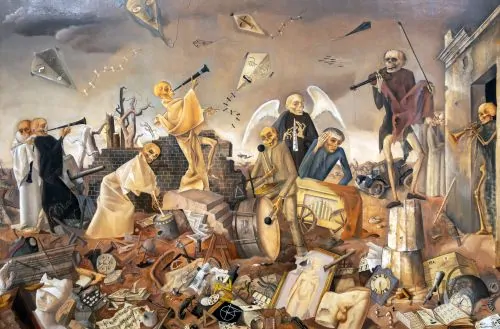
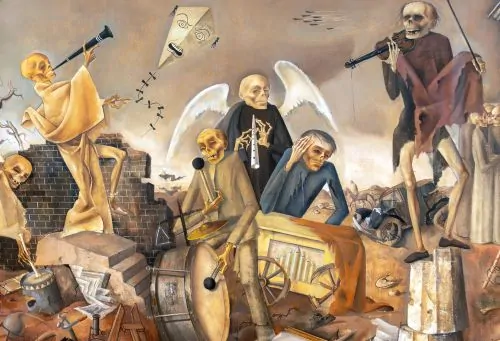
In Felix Nussbaum’s Triumph of Death, corpses form a rag-tag music band. They blow on horns and dance on the ruins of what was once a solid structure, now strewn with the debris of objects from different centuries. Everything in the landscape has been stripped and destroyed, and the skies are filled with a fleet of racing bombers and strangely animated kites. The painting, created in hiding, was the last one Nussbaum would make before being deported and murdered in Auschwitz in the fall of 1944. The work intentionally recalls the medieval theme of the Dance of Death (Totentanz), in which skeletons represent the ubiquity and inevitability of death. But while the medieval artist attempted to express the inescapability of death for every living being, Nussbaum’s work is an outcry against the death of civilization itself.
While he could not be certain anyone—let alone the millions who now visit this site—would ever view it, Nussbaum painted this work, like the many others he left behind, as a form of defiance, the only means of resistance left to him. A German Jew, Nussbaum was hunted relentlessly in Nazi Europe. He chronicled his persecution in astonishingly powerful and skillfully painted images. In doing so he resisted in two ways: by defying, with his creativity and humanity, the Nazi attempt to dehumanize him, and by leaving a record of his existence in the face of total annihilation.
Nussbaum: Artist as Resistance
Nussbaum was born in Osnabrück, Germany in 1904 and did his artistic training in Hamburg and Berlin, where he met his future wife, the Polish-born painter Felka Platek. His work fits into the New Objectivity movement of its time, highly realistic with elements of Expressionism and early Surrealism. With the rise of the Nazis in Germany, Felix and Felka were forced into exile, settling in Belgium. When Belgium fell to the Nazis in 1940, Nussbaum was arrested and sent to the internment camp of Saint-Cyprien. On a forced train ride back to Germany he escaped, returning to Belgium where he and Felka hid, kept alive by friends who supplied them with food and paint supplies.
It is profoundly difficult to imagine, in circumstances of utter fear, despair, and hunger, how Nussbaum created paintings that drew on the entire history of his training and took on themes of existential meaning. Not surprisingly, many of his paintings in hiding include self-portraits, as he was deprived of the world beyond and forced to face his own destruction.
The horror and despair of Nussbaum’s imprisonment in Saint-Cyprien is viscerally captured in his Self-Portrait in the Camp of 1940.
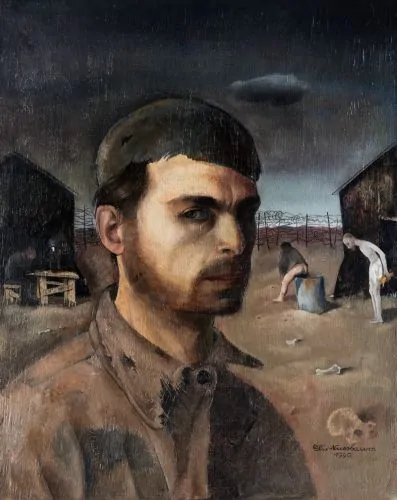
Surrounded by barbed wire, the dry, dusty ground of the camp is littered with bones and ghostly figures, one of whom defecates, half naked, in a barrel. In this nightmarish scenario the barren Saint-Cyprien is a place deprived of all hope, yet we cannot but view it knowing that Nussbaum would spend the last moments of his life in a place far worse and beyond human comprehension. It is hard to bear the full impact of his expression and the depth in his eyes—of sorrow, shock, and accusation.
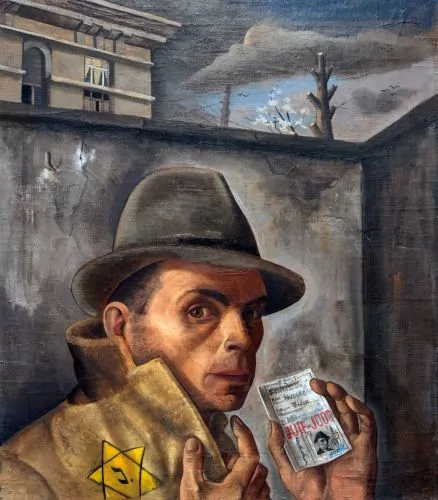
If Self-Portrait in the Camp captures the physical agony of Nussbaum’s internment, Self-Portrait with Identity Card reveals his psychological agony. In this painting we see Nussbaum on the street, attempting to hide behind a stone wall. As he holds up his ID card, we realize that he has been caught and that we occupy the role of his captor. We, the viewer, are his interrogator and yet, we also serve as the mirror into which he looks to paint his own visage. We see what he has become: a fugitive, furtive, desperate, utterly trapped. Nussbaum makes this clear in the way that the ID card exactly replicates his own self-portrait, or rather the way his own self-portrait now replicates his official ID. They have become one and the same and he cannot think his existence beyond them. Only the one tree branch with blossoms reveals any glimmer of hope.
Death’s Triumph
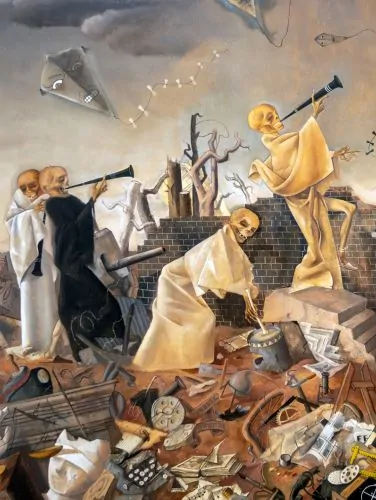
In 1944 Nussbaum began to paint his Triumph of Death, drawing on the tradition of German artists before him, such as Albrecht Dürer and Hans Holbein the Younger. In his writings, Nussbaum expressed a burning desire to live and yet the work seems to be the final masterpiece of someone taking leave of this world. It is less a commentary on Nussbaum’s own fate than on the fate of Europe itself.
Grimacing skeletons, dressed in the medieval robes of the Reaper, fiddle, drum, and blow a tune we cannot hear. The world has been largely bleached of color, depicted in an array of beige and browns and leached-out blues. Yet a broken down car—contemporary for Nussbaum’s time—toward the right horizon of the painting indicates that the painting comments on modern life as well.
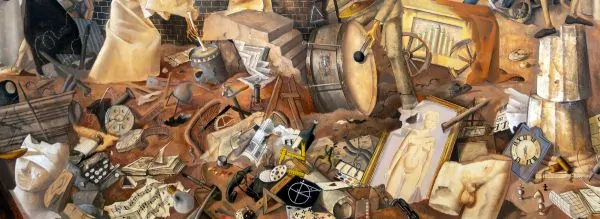
A sprawling array of smashed, crumpled, torn, and broken objects litters the foreground of the work. Among them are pieces of Greek sculpture, musical scores, mathematical tools, playing cards, clocks, scientific apparatuses, a tray of watercolors, and a destroyed reel of film: the assembled discards of European culture, now reduced to rubble. Typewriters, chess pieces, and smashed telephones are relics of another age, when learning, beauty, and communication still mattered. In Nussbaum’s tragic work, he mourns the death of a centuries-old European civilization, whose values and traditions lie as crushed and broken as the objects it once gave rise to.
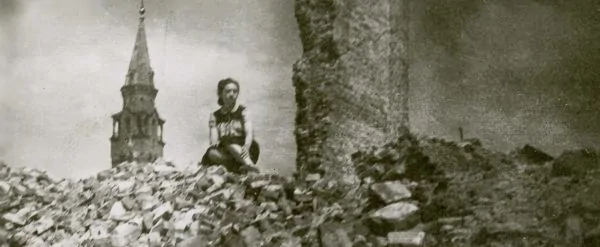
It is hard to know precisely what the kites are meant to represent, but in the absence of humans, they seem to act out anger, shock, and sadness at the world’s fate. They add a strange, even surreal, note to the work, revealing Nussbaum’s training and connection to the artists of his generation. So, too, it is hard to know the extent to which Nussbaum was aware of the conditions in the Jewish ghettos established in Nazi-occupied Poland. Yet, the brick wall and the assorted smashed household items recall—at least for this viewer—the demolished walls and endless piles of rubble that marked all that was left of the Warsaw ghetto after its destruction, following the uprising and resistance of the Jewish population imprisoned within it.
Art as Resistance in the Holocaust
During the Holocaust, there were many artists, both trained and spontaneous, who likewise resisted the destruction of their humanity and their memory through the creation of art works. 30,000 works made by those persecuted by the Nazis survived the Holocaust, likely a mere fraction of those that were made and that have disappeared forever. Works of art were made in ghettos, transit camps, and even, unfathomably, in concentration and death camps. There is no common denominator in style or set subject although there are commonalities.
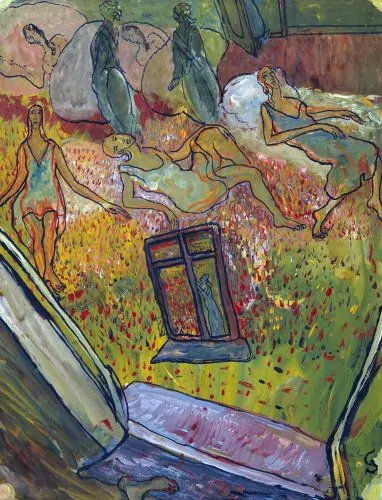
Like Nussbaum, the Berlin-born artist Charlotte Salomon spent her time in hiding engaged in the creation of a brilliant series of 769 gouaches entitled Life? or Theater?, capturing the events of her too-short life in bold and dream-like images. Salomon was murdered upon her arrival at Auschwitz on October 10, 1943. She was five months pregnant.
In February of 1944 Nussbaum’s parents were murdered at Auschwitz. On July 20, Nussbaum and Felka were caught in hiding, deported, and on August 2 arrived at Auschwitz; she was sent immediately to the gas chambers, while Nussbaum’s exact date of murder is uncertain. By September Nussbaum’s brother, sister-in-law, and their nine-year old daughter, Marianne, had also perished in Auschwitz, leaving no-one alive in his immediate family.
“If I perish,” Nussbaum had pleaded to his friends, “Don’t let my paintings die.” Like all art works made by victims during the Holocaust, Triumph of Death serves as testimony of both humanity’s immeasurable courage and its unbearable cruelty.
Bibliography
- The Felix Nussbaum House
- View Charlotte Salomon’s complete Life? or Theater? from the Jewish Museum, Amsterdam
- Pat Lipsky, “A Painter of the Holocaust for our Times,” Tablet (June 17 2019).
Originally published by Smarthistory, 09.15.2026, under a Creative Commons Attribution-NonCommercial-ShareAlike 4.0 International license.
About the Author