The issue of inter-state relations illustrates the political relevance of changing concepts of borders in early modern Europe.

By Dr. Maria Baramova
Assistant Professor of Modern Balkan History
Sofia University
Abstract
This article discusses concepts and realities of “borders” in early modern Europe. It outlines the basic shifts in the relevant terminology with particular emphasis on juridical and political discourses. It focuses on the relative importance of zonal and linear notions of borders, as well as on the growing significance of the natural environment in contemporary thought on the topic. The issue of inter-state relations, in particular as regards the Ottoman Empire, is used to illustrate the political relevance of changing concepts of borders.
Introduction
“Good fences make good neighbours”, the saying goes. While we are not concerned with high walls or neighbourhood relationships, the metaphor nonetheless suggests a number of important questions: What were the basic aspects of borders in medieval times? Was there a major shift from the frontiality concept of the pre-modern state to a more linear model of borders? What did the term “border” signify generally? Were these lines dividing one thing from another real or imaginary?
In general, borders are understood as divisions between cultures, languages, and political and confessional systems. However, throughout most of the early modern period – as well as in antiquity and the Middle Ages – they were not conceived of as straight lines marking territories and political dominions. The Roman limes, for instance, the classical division of the “Roman civilization” and the “barbarian world”, represented in practice a nebulous contact zone between conquered lands and those which had withstood invasion, rather than a clearly defined line of division.1 The border concept appears to have gained importance with the emergence of the concept of territorial states in the sixteenth and seventeenth centuries when borders became much more visible and began to be considered and discussed in the context of various aspects of state ideology. Topographical features (such as rivers and mountains) and manmade landmarks (fortresses, etc.) began to increasingly serve as borders. Over the medieval and early modern periods, clear geographical borders were established between the realms of Christianity and Islam, as well as between Catholicism and Orthodoxy.
It should be noted that a comprehensive study of concepts of borders in early modern times is yet to be published, though works covering local, regional and micro-historical aspects are numerous. As a result of the widely varying approaches employed, it is impossible to offer a systematic historiographical summary here. Consequently, the following survey will focus on four major features of the development and spread of the linear concept of borders: (1) etymological aspects, (2) the impact of the doctrine of “natural borders”, (3) new juridical concepts and (4) regional divergences in the case of the Ottoman Empire.
Etymological Aspects
Turning to the question of semantics and the historical development of the term “border”, we note that etymologically the terms граница/ granica (Slavic languages),frontier (English), Grenze (German), frontière (French) and frontera (Spanish)2 signify political frontiers between states. The meanings of these words evolved over time with the changing concept of “frontier”. The expressions frontière and Grenze in the modern sense of frontier began to appear only in the late Middle Ages. As late as the fifteenth century, the term frontier began to acquire the meaning “front part of an army”.3 In the same way, the French frontière signified a military border, as distinct from the more civil concept of limites.4 The term only began to be used in the modern sense of “frontier” in the fifteenth century. In the sixteenth century, there was a further semantic shift in the use of the word “frontier” in the European context. The emerging frontiality manifested itself – among others ways – in Luther’s use of the word Grenze (from the Slavic granica) instead of the medieval Mark in his Bible translation.5 The etymology of the Slavic word granica is “edge” or “end” of something.6 Indeed, the name Ukraine itself – meaning simply “march” – includes the frontiality concept, denoting initially the zone dividing Polish-Lithuania – and later Muscovy – from the Tatars.7
Frontality, Linearity, and “Natural Borders”

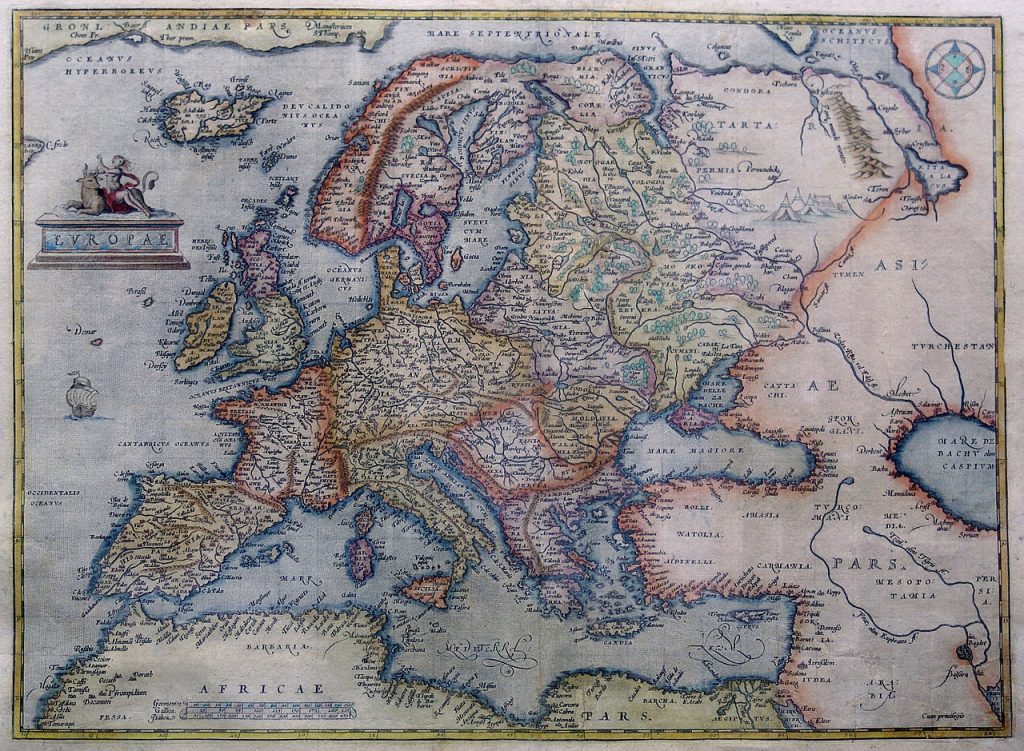
In early modern times, the frontier concept increasingly incorporated topographical features into the political reality. In the sixteenth and, even more so, the seventeenth centuries, the idea of “natural borders” began to dominate all aspects of the frontier concept. In an abstract sense, it is as though the ideal political space began to be defined in terms of physical geography. Similarly, in cartography the representation of space saw an increasing correlation between physical and political geography. Maps from antiquity and the Middle Ages characteristically lack precise political borders. Until the seventeenth century, indeed, maps contained representations of continents, regions and major cities, but lacked almost all notion of political borders between states.8 While there was a noticeable change in the sixteenth century with regard to the depiction of political borders on maps, such depictions nonetheless remained rare, with political frontiality being represented by rivers, mountains and other topographical features. According to Wolfgang Schmale, with the improvement of measurement techniques in the seventeenth century “das mentale und kulturell-politische Phänomen Grenze wird gewissermaßen materialisiert und zum Bestandteil der Geographie”.9 In the early modern period and particularly in the eighteenth century, the concept of “border” lost its vagueness and acquired linear form. Linearity became the basic principle for visualizing and “expressing” frontiers. Zedler, who compiled the first general encyclopaedia of the modern age, described frontiers in 1735 as follows:
öffentliche Zeichen und sichtbare Gemercke, dadurch die Landschafften und liegende Güter erkenntlich und ordentlich von einander unterschiedlich werden. Sie werden auch Marcken und Untermarcken genennet, darum, daß sie Gemerck und Andeutung geben, wie weit sich ein Land oder Gut erstrecke … Darnach vor das andere werden auch offter Mahlen die Güter, und vornemlich die Herrschafften und Gebiete nicht durch aufgerichtete, und mit der Hand-Arbeit gemachte Marck-Steine, sondern von der Natur an die Hand gegebene Grenzen und Marcken von einander unterschieden, das sind selbstgewachsene Marcken, als die Gebürge und hohe Spitzen, oder Rücken derer Berge. Bisweilen sind auch zu Grenzen gesetzt die Thäler, die Landstrassen und Fußsteige, die flüssenden Wasser und Bächlein10
Following Zedler’s example, encyclopaedias in the nineteenth century predominantly defined “border” as an imaginary line defining the outer part of something and where it ends. Moreover, it is the point where the ends of several objects meet, thus creating a line connecting the border points.11 Indeed Zedler’s definition was informed by the idea of “natural borders” – though not the ideology – mentioning topographical features, as well as a series of manmade markers such as stones, barriers, pillars, fences, walls, etc., which apparently had a visual purpose.12 This differs significantly from the political theory of limites naturelles, which was prevalent in France from the seventeenth century. The early modern period saw the emergence of state ideologies which endowed state territory and the central absolutist authority with a cult status. In the eyes of politicians of the time, the border was elevated to a key factor, forming an “area of ideology”, in particular with respect to natural borders. The definition of the French historical area in the hexagon between the Pyrenees and the Rhine underlined the homogeneity of that space as a natural territory and corresponded with the perception of ethnic unity.13 Similar processes can be observed in Swedish foreign policy in the sixteenth and seventeenth centuries, when the Baltic Sea became an element of state ideology. In a similar manner, the desire to determine the outer borders of the Holy Roman Empire of the German Nation also led to an elevation of topographical features: The great European rivers Rhine and Danube circumscribed the space containing the German identity.14
Juridicial Concepts

The European renaissance of the Roman judicial tradition in the sixteenth century gave rise to a new theoretical discussion about frontiers and how they are defined. The concept of frontier was transformed into an issue of governmental importance and featured prominently in a number of legal documents.15 From the sixteenth to the eighteenth centuries, the idea of “natural borders” took roots in juridical discourses, as reflected in juridical texts. In the evolving field of international law, for instance, the term fines naturales, which was associated with concrete natural features like rivers, mountain ranges, swamps and deserts, was increasingly employed to denote a particular type of political borders in contrast to more artificial lines of division (termini, limes). This use of terms was largely established by the writings of Hugo Grotius (1583–1645) and Samuel Pufendorf (1632–1694).16
Yet Johann Oetinger’s (1577–1633) Tractatus de jure et controversiis limitum, dating from the first half of the seventeenth century, had already brought the frontier concept noticeably closer to modern concepts of the term.17 Oetinger’s theory employed the notion of sovereignty, using models from natural law. He attempted a justification of existing borders with reference to the “four monarchies” doctrine.18 The will of the Lord divides the land between the nations by means of natural borders:
Den Erdboden hat der gütige Gott den Menschen zu bessitzen / a vnd also weißlich außgetheilt / daß die Völcker nach ihrer Art vnterschiedliche Wohnungen darinnen haben können. Darumb ist derselbe nicht gleichförmig in einerley Gestallt / sondern mit allerley mannigfaltigen Gelegenheiten geschaffen / vnd in absonderliche Geländ von Natur vnterscheiden / welche wir Landschafften heissen. b Dann wir sehen daß ein Land etwan mit Gebürgen / ein anders mit Waldungen eingeschlossen: Dieses mit fliessenden Wassern / jenes mit Thälern vmbgeben. Etliche Länder liegen in schönen ebnen Feld; Etliche gar mitten im Meer / vnd sind also gleichsam durch Natürliche Gränzen von einander selbsten abgesöndert. Nun ist zwar Anfangs die Erde zu einem gemeinen Vatterland vnd Geburtstatt allen Menschen geordnet:19
In the late eighteenth century, juridical thought made a clear distinction between natural and manmade frontiers. Karl Gottlob Günther (1752–1832), for example, wrote the following in his work on European international law:
Die Grenzen des Landes sind entweder solche, wo die Natur selbst die Unterscheidungszeichen an die Hand giebt, welche die Nazionen zur Richtschnur annehmen, und heissen natürliche (limites naturales, occupatorii) oder solche, welche durch Kunst und menschlichen Fleis aufgerichtet werden, künstliche (artificiales). Eine dritte Gattung, welche durch Bestimmung abgemessener Rechte in Verträgen festgesetzt werden, heissen politische Grenzen (politici, mensurati). Dieienigen Territorien, welche natürliche Grenzen haben, werden von Grotius territoria arcifinia, die beiden andern hingegen limitata genannt.20
In reality, natural barriers such as rivers and mountains need not necessarily be insuperable obstacles and border contours are not a natural phenomenon. Borders are rather a manifestation of competing territorial claims backed up by military force, though based to some extent on geographical reality. For instance, rivers dividing spheres of domination were often defined as borders in peace treaties and international agreements. In the early modern period, border discourses – political and juridical, as well as historical – were heavily influenced by the growing number of pan-European military conflicts, such as the Thirty Years’ War of the seventeenth century and the Spanish and Austrian Wars of Succession in the eighteenth century. Not surprisingly, decisions about the future of territories, their eventual division among states, the shaping of new borders, and so on, were issues of primary importance at peace congresses. In this respect, the influence of the newly created media (newspapers, magazines, Flugblätter) should not be underestimated, as they gave a platform to publicists from which they affected the visualization of borders and frontiality in the public consciousness.
Regional Divergences: The Ottoman Empire

As regards the transformation from “nebulous” to “linear” concepts of borders, we should bear in mind that while this process is quite obvious in central, western and northern Europe, in the European southeast dominated by the Ottoman Empire more vague distinctions prevailed until the end of the seventeenth century. Even when signing the Peace Treaty of Carlowitz21 with the Habsburg Empire in 1699, the Ottomans were hesitant to agree to the establishment of a border commission to draw the new frontiers where no dividing natural features existed – specifically, in the land of the Banat of Temesvar, which remained under the Sultan’s rule.22 This peculiar paradox arose out of a particular aspect of European-Ottoman relations from the fifteenth to the seventeenth centuries: the Islamic concept of war and peace.23
The state of the Ottoman Turks became a great power soon after its inception through the ideology of military expansion. The border concept was practically absent. Instead, in the thirteenth and fourteenth centuries the so-called “udj-culture”24 gained prevalence in Asia Minor, aimed not at the preservation of existing frontiers but rather at a continual border expansion through force.25 This tradition remained strong during the course of Ottoman expansion in southeast Europe. To varying degrees over time, the border constituted a continuously changing entity, driven by the armed forces and almost independent of the central authorities.26 A prominent feature of “udj-culture” was thus an offensive, rather than defensive, stance in relation to existing borders. It was underpinned by the militant ideology of Islam: the gaza, or permanent war for the true faith. In the mid-fifteenth century Sultan Mehmed the Conqueror (1432–1481) tried to limit the authority of the “udj-begs” by placing the whole army under central command. As a result, through the sixteenth century the Ottoman border serhad gradually evolved, though the essence of the frontier concept changed only slightly.27
Despite the fact that border zones (rivers, mountains, seas, etc.) belonged neither to the world of war nor to the world of Islam according to Hanefite Law, it is apparent that the Danube in this very period was still regarded as a part of the dar ul harb.28 This is explained by the fact that, from the end of the fourteenth century to the mid-sixteenth century, the Ottomans were devoted to continuous expansion, which was irreconcilable with the defining of a frontier. In practice, it represented an area of perpetual collision between Christians and Muslims, essentially bearing out the Islamic concept of the world of war. The doctrine of Holy War against the foes of the faith stated that “eternal peace” could not be established with Christian states, meaning that the peace agreements which ended wars were always seen as temporary and the border had the effective status of a demarcation line (Waffenstillstandsgrenze). It was not until the end of the seventeenth century when the Ottomans suffered their first military disaster that they began to develop the same understanding of the frontier which already prevailed in European international relations.
Conclusion
The great geographical discoveries and the emergence of modern cartography in the early modern period, as well as the establishment of the idea of the territorial state, radically changed concepts of frontiers and spatial divisions. The diffuseness which had dominated throughout antiquity and the Middle Ages was gradually replaced by a concept of border as line, both linear and fixed. The cartographic revolution made it possible to establish clear borders employing both topographical features and manmade landmarks. It also enabled the precise plotting of frontiers on maps in relation to political dominions and physical geography. In this way the old diffuse and, to a large extent, abstract divisions were transformed into visible and visualized entities. It is thus possible to speak of a border topos in the social consciousness from the sixteenth to eighteenth centuries.
Appendix
Notes
- Cf. Ellis/Eßer, Early Modern Frontiers 2006, pp. 14–15; Schneider, Lineare Grenzen 1993, pp. 51–68; Abdulafia, Medieval Frontiers 2002.
- Lat. Limites, Fines, Termini.
- The Spanish term frontera also gradually acquired the notions of militarized borderland through Spain’s situation as a permanent battleground, at least in Reconquista ideology. Cf. Power, Introduction 1999, pp. 4–8.
- See Febvre, Frontière 1988, pp. 27–37.
- Grimm, Deutsches Wörterbuch 1935, vol. 9, col. 124–126.
- Russ. granica, ukr. hranýća, bulg. gránica, kr. grànica, sloven. grânica, čech. hranice, poln. granica.
- See Vasmer, Etymologisches Wörterbuch 1953, p. 304; cf. Berneker, Slavisches etymologisches Wörterbuch 1908–1913.
- Vogler, Borders and Boundaries 2006, pp. 28–30.
- Schmale, Grenze 1998, p. 57.
- Zedler, Universallexicon 1735, vol. 11, col. 831–832.
- See for example Ersch, Allgemeine Encyclopädie 1871, Art. “Grenze (Recht der Grenzen)”, vol. 90, pp. 211–233.
- Schmale, Grenze 1998, pp. 58–60.
- About the idea of France’s natural frontiers, see Sahlins, Natural Frontiers 1990, pp. 1423–1451.
- See Rüther, Flüsse als Grenzen 2007, pp. 39–40; cf. Gantet, Grenzen des Heiligen Römischen Reichs 2007, pp. 61–66.
- See Scattola, Grenze der Neuzeit 1997, pp. 58–61.
- Cf. Grotius, De jure beli 1853, vol. 2, p. 271 et seqq. [See also, Grotius, Rights of War and Peace 2005, vol. 2, pp. 477–478]; Pufendorf, Of the Law of Nature and Nations 1703, p. 355.
- Cf. Oetinger, Tractatus De Iure Et Controversiis Limitum 1642.
- Scattola, Grenze der Neuzeit 1997, p. 55 (n. 72).
- Oetinger, Tractatus 1642.
- Günther, Europäisches Völkerrecht 1792, pp. 172–175. See also Bartenstein, Natur- und Völkerrecht 1790, pp. 158–159.
- Digitialized peace treaty of Carlowitz, 26/01/1699, Institute of European History, Project Europäische Friedensverträge der Vormoderne [03/12/2010].
- Hammer, Geschichte des Osmanischen Reichs 1931, vol. VII, p. 24 et seqq.; cf. Parvev, Habsburgs and Ottomans 1995.
- For some general studies on the Islamic perception of peace and war, see Kelsay, Just War and Jihad 1991.
- The Turkish word udj means frontier, under the Ottomans more specifically a military post. For more about the so called “udj-culture” see Melikoff, Ghazi 1999. In the English-American historiography, however, the term “border society” is often used instead.
- For the first time the idea of the so called “border society” has been suggested in the beginning of the 20th century by the Austrian historian Paul Wittek. See Wittek, The Rise of the Ottoman Empire 1967; Wittek, La Formation 1982. Wittek’s thesis was criticized and revised by Colin Imber. Imber, Paul Wittek’s “De la défaite” 1986, pp. 65–81. Reprinted in: Imber, Ottoman History and Law 1996, pp. 291–304; Imber, The Ottoman Empire 2002. About the whole discussion, see also Kafadar, Between Two Worlds 1995; Heywood, Frontier in Ottoman History 1999, pp. 228–250.
- More about akıncis’ organization, see Lowry, Early Ottoman State 2003; Kiprovska, Akıncıs in Ottoman Rumelia 2004, pp. 11–23.
- Cf. Radushev, Osmanskata granična periferia [The Ottoman Border Periphery] 1997, pp. 187–213; Gradeva, War and Peace along the Danube 2004, pp. 131–132.
- Caurroy, Législation 1848, pp. 5–45. See also Panaite, The Ottoman Law 2000, pp. 77–86.
Bibliography
- Abdulafia, David et al. (eds.): Medieval Frontiers: Concepts and Practices, Aldershot et al. 2002.
- Bartenstein, Johann Christoph von: Natur- und Völkerrecht entworfen von einem großen Staatsminister, Wien et al. 1790.
- Berneker, Erich: Slavisches etymologisches Wörterbuch, Heidelberg 1908–1913.
- Caurroy, Eustache Du: Législation musulmane, Sunnite, rite Hanèfi, in: Journal Asiatique IV/ 12 (1848), pp. 5–45.
- Ellis, Steven G. / Eßer, Raingard: Introduction: Early Modern Frontiers in Comparative Context, in: Steven G. Ellis (ed.): Frontiers and the Writing of History, 1500–1850, Hanover 2006, pp. 9–20.
- Ersch, Johann Samuel et al. (eds.): Allgemeine Encyclopädie der Wissenschaften und Künste mit Kupfern und Charten, Leipzig 1871, vol. 90, pp. 211–233, online: http://resolver.sub.uni-goettingen.de/purl?PPN349061262 [09/11/2009].
- Febvre, Lucien: Frontière: Wort und Bedeutung, in: Lucien Febvre: Das Gewissen des Historikers, Berlin 1988, pp. 27–37.
- Gantet, Claire: Die äußeren Grenzen des Heiligen Römischen Reichs: Wahrnehmungen und Repräsentationen in der zweiten Hälfte des 17. Jahrhunderts, in: Etienne François et al. (eds.): Die Grenze als Raum, Erfahrung und Konstruktion: Deutschland, Frankreich und Polen vom 17. bis zum 20. Jahrhundert, Frankfurt am Main et al. 2007, pp. 53–76.
- Gradeva, Rossita: War and Peace along the Danube: Vidin at the End of the Seventeenth Century, in: Rossita Gradeva: Rumeli under Ottomans, 15th–17th Centuries: Institutions and Communities, Istanbul 2004 (Analecta Isisiana 76), pp. 107–132.
- Grimm, Jacob / Grimm, Wilhelm: Deutsches Wörterbuch, Leipzig 1935, vol. 9, col. 124–126, online: www.dwb.uni-trier.de [09/11/2009].
- Grotius, Hugo: Hugonis Grotii de jure belli et pacis libri tres, London 1853, vol. 2.
- Grotius, Hugo: The Rights of War and Peace: Edited and with an Introduction by Richard Tuck, from the Edition by Jean Barbeyrac, Indianapolis 2005, vol. 2.
- Günther, Karl Gottlob: Europäisches Völkerrecht in Friedenszeiten nach Vernunft, Verträgen und Herkommen, mit Anwendung auf die teutschen Reichsstände, Altenburg 1792.
- Hammer-Purgstall, Joseph von: Geschichte des Osmanischen Reiches: Grossentheils aus bisher unbenützten Handschriften und Archiven, Pest 1831, vol. 7.
- Heywood, Colin: The Frontier in Ottoman History: Old Ideas and new Myths, in: Daniel Power et al. (eds.): Frontiers in Question: Eurasian Borderlands, 700–1700, London 1999, pp. 228–250.
- Imber, Colin: Studies in Ottoman History and Law, Istanbul 1996 (Analecta Isisiana 20).
- Imber, Colin: Paul Wittek’s “De la défaite d’Ankara à la Prise de Constantinople”, in: Osmanlı Araştırmaları 5 (1986), pp. 65–81.
- Imber, Colin: The Ottoman Empire 1300–1650: The Structure of Power, Kirsville 2002.
- Kafadar, Cemal: Between Two Worlds: The Construction of the Ottoman State, Berkley 1995.
- Kelsay, John: Just War and Jihad: Historical and Theoretical Perspectives on War and Peace in Western and Islamic Traditions, Westport et al. 1991 (Contributions to the study of religion 28).
- Kiprovska, Mariya: The Military Organization of Akıncıs in Ottoman Rumelia, Ankara 2004 (Unpublished MA Thesis).
- Lowry, Heath: The Nature of the Early Ottoman State, Albany 2003.
- Melikoff, Irene: Art. “Ghazi”, in: Encyclopaedia of Islam: CD-ROM Edition, Leiden 1999.
- Oetinger, Johannes: Tu en agiois, Joannis Oetingeri Franci, Geographi & Secretari[i] Wirtembergici, Tractatus De Iure Et Controversiis Limitum; Ac Finibus Regundis: Oder Gründlicher Bericht, Von den Gräntzen vnd Marcksteinen, wie durch dieselbe der Königreich, Landschafften, … nach Außweisung der gemeinen Rechten, vnd eines jeden Lands Gewonheit, vnterschieden, eingesteint, vnd die darauß entstehenden Nachbarliche Stritt vnd Mißverständ, erörtert vnd beygelegt werden sollen: In zweyen Büchern beschrieben, Darinnen auch vom Obrigkeitlichen Gewalt, Regalien, Ehehafftinen der Städt und Gemeinden, Dienstbarkeiten, Weydgang, Flüssen, Fischnetzen, … vnd dergleichen nutzlichen Materien gehandlet wird …, Ulm 1642.
- Panaite, Viorel: The Ottoman Law of War and Peace: The Ottoman Empire and Tribute-Payers, New York 2000 (East European Monographs 562).
- Parvev, Ivan: Habsburgs and Ottomans between Vienna and Belgrade, 1683–1739, Boulder 1995 (East European Monographs 431).
- Power, Daniel: Introduction: Frontiers: Terms, Concepts, and the Historians of Medieval and Early Modern Europe, in: Daniel Power et al. (eds.): Frontiers in Question: Eurasian Borderlands, 700–1700, London 1999, pp. 1–31.
- Pufendorf, Samuel, Freiherr von: Of the Law of Nature and Nations, Oxford 1703.
- Radushev, Evgenij: Osmanskata granična periferia (serhad) v Nikopolskija sandžak prez părvata polovina na XVI v. [The Ottoman Border Periphery (Serhad) in the Sandjak of Nikopol during the First Half of the 16th Century], in: Bălgarskijat šestnadeseti vek, Sofia 1997, pp. 187–213.
- Rüther, Andreas: Flüsse als Grenzen und Bindeglieder: Zur Wiederentdeckung des Raumes in der Geschichtswissenschaft, in: Jahrbuch für Regionalgeschichte 25 (2007), pp. 29–44.
- Sahlins, Peter: Natural Frontiers Revisited: France’s Boundaries since the Seventeenth Century, in: American Historical Review 95/5 (1990), pp. 1423–1451.
- Scattola, Mario: Die Grenze der Neuzeit: Ihr Begriff in der juristischen und politischen Literatur der Antike und Frühmoderne, in: Markus Bauer et al. (eds.): Die Grenze: Begriff und Inszenierung, Berlin 1997, pp. 37–71.
- Schmale, Wolfgang: “Grenze” in der deutschen und französischen Frühneuzeit, in: Wolfgang Schmale / Stauber, Reinhard (eds.): Menschen und Grenzen in der Frühen Neuzeit, Berlin 1998, pp. 50–75.
- Schneider, Reinhard: Lineare Grenzen: Vom frühen bis zum späten Mittelalter, in: Wolfgang Haubrichs et al. (eds.): Grenzen und Grenzregionen: Frontières et régions frontalières: Borders and Border Regions, Saarbrücken 1993 (Veröffentlichungen der Kommission für Saarländische Landesgeschichte und Volksforschung 22), pp. 51–68.
- Vasmer, Max: Russisches etymologisches Wörterbuch, Heidelberg 1953, vol. 1, p. 304.
- Vogler, Günter: Borders and Boundaries in Early Modern Europe: Problems and Possibilities, in: Steven G. Ellis et al. (eds.): Frontiers and the Writing of History, 1500–1850, Hannover 2006, pp. 20–38.
- Wittek, Paul: La Formation de l’Empire Ottoman, edited by Victor L. Ménage, London 1982.
- Wittek, Paul: The Rise of the Ottoman Empire, 3rd ed., London 1967.
- Zedler, Johann Heinrich: Grosses vollständiges Universallexicon aller Wissenschaften und Künste, Halle et al. 1735, vol. 11, col. 827–859, online: www.zedler-lexikon.de [09/11/2009].
Originally published by EGO: Journal of European History Online, 12.03.2010, under a Creative Commons Attribution-NonCommercial-NoDerivs 3.0 Unported license.
About the Author