It began in the late 19th century.

By Dr. Gabrielle Clark
Assistant Professor of Political Science and Public Law
California State University, Los Angeles
Introduction
I am a public law scholar who studies the history of foreign workers in America. In the book I’m now writing, I describe the long-standing conflict between employers and workers over granting foreigners permission to work in the U.S. That struggle has yielded both compromises and new layers of bureaucracy for more than 100 years.
Swinging the Gates Shut – Then Open a Crack
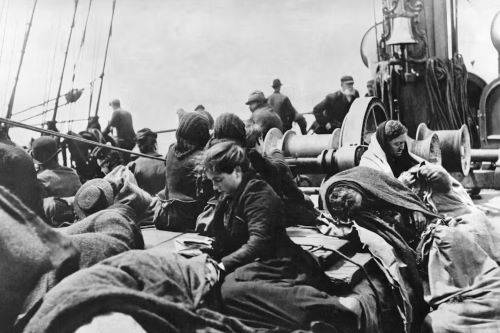
The fight over the employment of foreign labor began in the late 19th century when Congress passed several laws to stop labor migration in response to pressure from American workers.
These restrictions further hardened with the passage of the Johnson-Reed Act of 1924. That law tightly curtailed immigration on the basis of national origins quotas. Employers in need of foreign labor began to ask the Bureau of Immigration, an agency that eventually became the U.S. Citizenship and Immigration Services, for exceptions to the new restrictions.
Employers also lobbied for foreign temporary workers as a legal loophole.
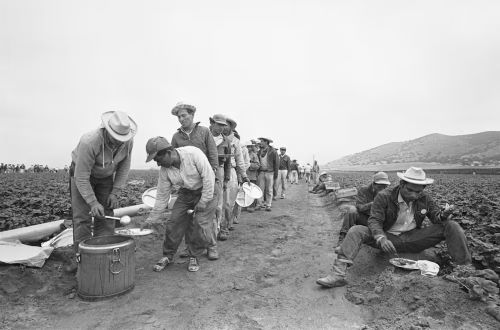
The biggest early example of their success was the Bracero program. From 1942 to 1964, about 4 million Mexican men got jobs as farmworkers in California and other Western states. They were given the right to legally stay in the country on short-term, renewable contracts.
Since then, farmers, labor unions and civil rights groups have been fighting over the rules protecting American labor under the H-2 visa, which Congress established on behalf of farmers and other employers in 1952 – generally replacing the Bracero program.
Although the government now issues most H-1Bs to temporary migrants with tech jobs, the visa’s origins date back to the days before computers.
The Bureau of Immigration, the government agency responsible for issuing permits at the time, often approved employer requests after the Johnson-Reed Act’s passage. But organized labor tended to object.
In 1932, for example, the American Federation of Musicians persuaded Congress to impose limits on these ad hoc permits under the Musicians Immigration Clarification Act. Only artists of “distinguished merit and ability” – like the famous Austrian violin virtuoso Fritz Kreisler – received visas reserved for accomplished and creative foreigners.

In the 1930s, Ford Motor Co. also asked for authorization to hire engineers from abroad. The Boston Symphony Orchestra wanted to hire foreign musicians. Hollywood sought exemptions so it could scout abroad for actors such as Charlie Chaplin, Marlene Dietrich and Greta Garbo.
Standards for Foreign Professionals
In 1952, Congress borrowed the “distinguished merit and ability” standard to restrict the new H-1 visa to professionals with global reputations in sports, the arts and the sciences. Lawmakers also ensured that each permit would be valid only for a single year.
The one-year limit and “distinguished merit and ability” standard kept the number of foreign workers with H-1 visas low until 1969.
The numbers shot up after employer groups, such as the U.S. Chamber of Commerce and the National Foreign Trade Council, lobbied Congress and the agency by then known as the Immigration and Naturalization Service to loosen the rules.
Extending Their Stay
The federal government obliged by extending the visa limit to three years and loosening H-1 requirements in the early 1970s. A bachelor’s degree would from then on suffice as evidence of “distinguished merit.” But by 1989, employer groups decided that they wanted even more flexibility in the law.
Congress accommodated them by creating the “specialty occupation” requirement, which does not require a bachelor’s degree, leading to the advent of the H-1B visa. About one-third of the people whose H-1B applications were approved in 2023 didn’t have a bachelor’s or higher degree.
Lawmakers also further loosened the rules by allowing H-1B workers to extend their visas to six years or more and to apply for permanent residency while in temporary status.
The AFL-CIO, an umbrella group that most U.S. unions belong to, sought to make it harder to obtain the new visa to limit its potential harm to U.S. workers. It wanted the government to adopt a mandate that employers first attempt to recruit Americans. The AFL-CIO also lobbied for new wage requirements subject to Department of Labor enforcement.
Business groups objected to what they saw as excessive red tape and costly paperwork, calling for “more flexibility and less restrictions.”
The government reached a compromise between organized labor and employers in 1990. Congress dropped the AFL-CIO’s request that employers recruit Americans before H-1Bs, but it set a yearly cap on the number of visas issued – initially 65,000 – and a minimum wage for workers with this kind of visa.
More Tensions with Big Tech
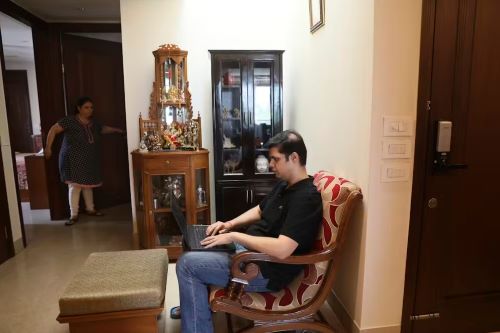
After 2000, Congress continued to fine-tune this equilibrium between the demands made by U.S. workers and their employers. Business got higher caps, while universities and nonprofits received a permanent exemption from them. Organized labor pushed for and won new protections enforceable by the Department of Labor.
To many unions and other groups representing workers, however, this was not enough.
As the number of people with H-1B visas employed at one time climbed to nearly 600,000 in 2009, unions’ objections reached a fever pitch.
Immigration reform efforts of all kinds had stalled in Congress. This meant proposed H-1B reforms, such as the mandate that employers recruit Americans first, went nowhere.
The fight, which now pitted Big Tech against the old left and the increasingly loud anti-immigrant right, moved to the White House. The Obama and Trump administrations imposed new limits on foreign labor contractors. Industry groups sued in federal courts, with some success, to block those restrictions.
For example, the U.S. District Court for the District of Columbia vacated a Trump administration policy that required each employer petition to include every work contract an H-1B worker would have over a three-year period. The idea behind the policy had been to make it virtually impossible for foreign labor contractors to obtain H-1B visas. Trade associations representing information technology services companies prevailed in this case.
President Joe Biden announced new guidelines in December 2024 that mostly maintained the status quo.
I suspect that Congress will revisit the H-1B visa again. When it does, if history is any guide, lawmakers will set higher caps on the number of visas available, pegged to more stringent regulations.
Originally published by The Conversation, 01.14.2025, under the terms of a Creative Commons Attribution/No derivatives license.
About the Author