The expression “secret societies” evokes a Wittgensteinian family resemblance of a great variety of organisations with all sorts of similarities.

By Dr. Jaap Kloosterman / 06.19.2013
International Institute of Social History
Introduction
Attempts to circumscribe our topic are naturally hampered by the fact that secrecy is a many-sided thing. The expression “secret societies” evokes a Wittgensteinian family resemblance of a great variety of organisations with all sorts of similarities, yet not a single feature common to all. As a result, most existing definitions are accompanied by abundant provisos, qualifications, and exceptions. For a historical survey, the easiest way to get a grasp of the subject is first to trace the history of the term. Then we shall look in turn at the two sides of the secret society: Its bringing together of men who are hiding something.
Birth of a Concept: Secret Societies during the 18th Century

Dissertatio academica de secretis societatibus litterariis (1772), National Library of Finland
This contribution will approach its elusive subject by first looking at the emergence of the expression “secret societies” in publications of the 18th century. This will then allow us to discuss the different social phenomena the term referred to at the time, in order to move on to their functions and development up to the 20th century. The expression “secret societies” in its alliterative and often plural form – also found in French (sociétés secrètes) and German (geheime Gesellschaften) – dates back to the final quarter of the European 18th century. This is paradoxically documented by what looks like its first appearance in a monograph title, De secretis societatibus litterariis, written by the philosopher Johan Bilmark (1728–1801) at the Royal Academy of Åbo (Turku) in 1772. Although the author illustrated his argument with a series of historical examples, his main aim was to applaud the recent birth of Aurora. This name refers to a literary-musical association in Åbo that like its model, the Swedish society Utile Dulci, was not an open organisation, but initiated members into a number of degrees.1 In other words, Bilmark’s title should be translated as “On secret literary societies” rather than as “On literary secret societies”.2

Against the Jesuits 1759: Standing in a long tradition, the opening page of this pamphlet depicts the Societas Jesu as a conspiracy, referring to an attempt to kill Joseph I of Portugal (1713–1777) on September 3, 1758, which is the “évènement” (“event”) in the title. The text (which is part of a pamphlet volume entitled on the spine Jésuites / Voleurs / Parricide, i.e. “Jesuits / Thieves / Parricide”) presents many Jesuit authors as systematically defending regicide as a political instrument. Their order was suppressed in Portugal in 1759. / International Institute of Social History
The real beginnings of the modern term probably go back to the Berlinische Monatsschrift of the mid-1780s. At that time, the journal, published by Friedrich Nicolai (1733–1811), pointed its arrows at the Jesuit order. Even though the Societas Jesu had been suppressed in the Bourbon-governed countries and abolished by Pope Clemens XIV (1705–1774) in 1773, it was suspected to survive underground and to combat Protestantism and the Enlightenmentthrough “eine Menge geheimer schädliche[r] Gesellschaften”.3 The ensuing discussionsoon encompassed the fate of the Order of the Illuminati which had been founded in 1776 by Adam Weishaupt (1748–1830). He was a professor of canon law at the University of Ingolstadt who took his inspiration from both the Jesuits and the Masons. His “geheime Gesellschaft”, as Weishaupt labelled it, sought to win members among the elite and to conquer good positions in order to influence government. In 1785, however, it was closed down by the Bavarian Elector Karl Theodor (1724–1799), to the delight of the Catholics and the indignation of their enemies.4

Secreta monita (1661), Bayerische Staatsbibliothek

Beweis von der Wirklichkeit der Zusammenkunft in Bourgfontaine (1793), Bayerische Staatsbibliothek

Against the Illuminati 1787: Governments decrying the horrors of secret societies were an important source of knowledge about them. Karl Theodor (1724–1799), the Elector of Bavaria, ordered the publication of documents of the Illuminati after their gradual suppression from 1784 onwards. / International Institute of Social History
These matters raised a lot of dust. Since the 1750s, opponents of the Jesuits had been reprinting the infamous Monita secreta, a collection of falsified “secret instructions” of the order that first appeared in Kraków in 1614, and the Jesuit fathers had retaliated by repeating their accusation of a Jansenist conspiracy which had supposedly been planned at Bourgfontaine in 1621.5 The Bavarian government published compromising documents of the Illuminati, to which some members responded in defence: In the five years following 1785, no less than 50 publications in Germany and abroad discussed the nature of the group.6 By then, the revolutionary events in France had begun to create even more favourable conditions for spreading the concept of “secret societies”.
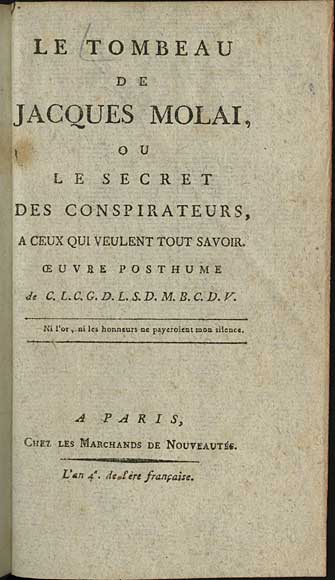
Le Tombeau de Jacques Molai (1796), International Institute of Social History

Mémoires pour servir à l’histoire du Jacobinisme (1798–1799), BnF Gallica
Ever since the French Revolution had been studied and interpreted, some had sought to identify certain groups that could be held responsible for its course. These individuals were not only thought of as more or less unwitting abettors – such as the Calvinists and philosophes in many a Catholic’s eyes – but also as determined long-time plotters. The originators of these theories had very diverse backgrounds. One of them, Jacques Le Sueur, was better known as the prolific dramatist Beaunoir (actually Alexandre-Louis-Bertrand Robineau (1746–1823)). He, who himself was a defrocked priest and a Mason, published the novelistic work Les Masques arrachées (“The Masks Removed”) in which he accused a certain number of Freemasons and Jesuits of having started the revolutions in France and Brabant. Charles-Louis Cadet de Gassicourt (1769–1821), who was a bastard of Louis XV (1710–1774) and would later become the apothecary of Napoleon I (1769–1821), also was and always remained a Mason. In Le Tombeau de Jacques Molai (“The Grave of Jacques Molai”, 1796), he proposed a genealogical line from the Templars and Assassins through the Jesuits and Freemasons to the Illuminati. John Robison (1739–1805), the author of Proofs of a Conspiracy against all the Religions and Governments of Europe (1798), was not only a Mason but also a friend of the inventor James Watt (1736–1819) and a professor of philosophy at the University of Edinburgh. By contrast, Lorenzo Hervás y Panduro (1735–1809), a celebrated Spanish linguist who wrote Causas de la revolución de Francia (“Causes of the French Revolution”) in 1794, was also a Jesuit priest. So was Augustin de Barruel (1741–1820), whose Mémoirespour servir à l’histoire du Jacobinisme (“Memoir Providing a History of Jacobinism”, 1798–1799) most famously described the “conspiracy theory” about the French Revolution. All these and quite a few other authors cemented the idea that numerous secret societies existed and constituted unseen, yet powerful tools of subversion.7

Histoire des sociétés secrètes de l’Armée (1815), Internet Archive
Besides, the German Bundesroman, the English Gothic novel, and a mass of popular literature both stimulated and reflected the fascination of noble or sinister brotherhoods.8 Ever since the late 18th century, such books spread entertaining knowledge about the secret societies’ workings. Sometimes it was not easy to tell fact from fiction, as in Charles Nodier’s (1780–1844) tale of anti-Bonapartist conspiracies, but his Histoire des sociétés secrètes de l’Armée (“History of the Secret Societies of the Army”, 1815) portrayed organisations that had a positive image at the moment of publication, after the fall of Napoléon Bonaparte.9 In many places, however, secret societies were considered to be bad regardless of their political role: In Prussia, for example, the Tugendbundstreit, a debate in 1815–1816 concerning the semi-clandestine Tugendbund (“League of Virtue”), raised the suspicion of conspiracy in spite of the members’ impeccably patriotic attitude during the French Wars.10
At the same time, the suggestion that secret societies had caused the end of the monarchy in France did nothing to belittle their reputation among reformers. The Americanos who took up the struggle for independence from Spain were among the first to embrace the model.11 And when the outlines of post-Napoleonic Europe became clear, it would seem to many as if liberals and democrats were involved in a pas de deux with autocracy, in which conspiracy also played a major role. In 1819, after the theology student Karl Ludwig Sand (1795–1820), a member of the secret Unbedingten (“Uncompromising Ones”), had murdered the writer August von Kotzebue (1761–1819), the German Confederation held a conference at Carlsbad (Karlovy Vary) which issued a series of decrees against “demagoguery” and established a Central Commission of Investigation in Mainz.12

Belgian Freedom ca. 1830: This Dutch caricature shows the “dedication of the Belgian liberty pole” after the creation of an independent Provisional Government in 1830. Notorious “conspirators” played their role in the Belgian revolution: The man at the bottom is Louis de Potter (1786–1859), a friend of Philippe Buonarroti (1761–1837); the man with the cornered hat above him, seen on the back, is Juan van Halen (1788–1864), a military veteran of secret societies in Spain and Russia. / International Institute of Social History
In 1820, a military conspiracy in Spain reinstated the liberal Constitution of Cádiz, which had already been proclaimed in 1812 but abolished two years later. This encouraged the Carbonari in the Two Sicilies and a clandestine group of Portuguese liberals to rise in demand of constitutions as well. Piedmont followed this example in 1821.13 In response, Russia, Prussia, and Austriadecided at the congresses of Troppau (Opava, 1820), Laibach (Ljubljana, 1821), and Verona (1822) to begin a military intervention in Italy and Spain, in the latter case with French troops. But in 1822, these troops themselves showed signs of being subverted by the Charbonnerie (“Charcoal Burners”), as we can see in the case of the four sergeants of La Rochelle, who were executed for conspiracy and then became popular heroes.14 Meanwhile, the Philiki Etairia (“Friendly Society”) had started the Greek War of Independence (1821–1829). And during the Decembrist uprising of 1825, Russian officers inspired by Freemasonry and the Tugendbund revolted in St Petersburg.15By that time, the “secret societies” were to all intents and purposes a household word, and special police forces to combat them were being created in consequence.16 The 1830 revolution in France, with its echoes in Belgium, Germany, Poland, and Italy, further enhanced the societies’ prestige.17
Expansion: Secret Societies Outside Europe

Constitutions of the Free-Masons (1723), University of Nebraska – Lincoln
The “secret societies” now had also acquired a history, first of all as a result of their being closely associated with Freemasonry. Indeed, in The Constitutions of the Free-Masons (1723), James Anderson (ca. 1680–1739) connected Masonic history with Adam, following the craft guilds in linking their origins to the oldest suitable Biblical figure.18 All through the 18th century, Masonic and para-Masonic associations created genealogies with varying degrees of probability, involving the 17th-century Orden des Rosenkreutzes (“Rosicrucian Order”) as well as the Knights Templars suppressed in the 14th century.19 In the 1780s, some French and German Masons attempted to clarify their origins, but could not reach a conclusion before their efforts were ended by the French Revolution.20 The historical works on Freemasonry that started to be produced after the Napoleonic era usually encompassed non-Masonic “secret societies”, if only to emphasize that these were different and Masonry ought not to suffer from the repressive measures taken against them.21 Since the mid-19th century, all major European languageswere endowed with one or more multi-volume works that searched history for possible forerunners and established a canon which continues to inspire most present-day overviews of the field.22

Secret Societies in Ethnology 1902: This map represents the distribution of secret societies, “typical” age classes, and “typical” men’s houses world-wide as identified around 1900. From the early 19th century onwards, the European secret societies functioned as a model for the classification of certain associations outside Europe. / International Institute of Social History
One result of this search was the “discovery” of secret societies outside Europe. In 1818, Joseph von Hammer-Purgstall (1774–1856), a pioneering Austrian Orientalist, used newly-found documents to suggest significant parallels between European secret societies and the PersianAssassins.23 In 1821, William Milne (1785–1822), a Protestant missionary, coined the term Triads for certain Chinese associations he likened to Freemasonry; and in the 1830s, the Thugs or Stranglers of India, suspected of heinous cultish crimes, started their long journey into Western popular culture.24 Soon the young discipline of ethnography found a startling number of “secret societies” all over the world, and at the beginning of the 20th century felt confident enough to deliver its first general theories.25 Thus, Europeans not only shaped the perception of indigenous associations in their colonies, but were shaped by them in turn.26
With the emergence of the new science of religion, the term “secret society” was increasingly applied to non-political organisations as well. Various debates on new and not-so-new questions – for example, on the disciplina arcani (“Discipline of the Secret”) of the early Christian Church – kindled an interest in the “mystery religions” of Antiquity, whose cult associations were now reexamined.27 At the same time, the middle of the 19th century saw what has been called the Occult Revival or the Theosophical Enlightenment, which resuscitated or inspired the sort of esoteric organisations that had proliferated in the 18th century.28 Meanwhile, across the Atlantic, more and more white American men were joining what were openly called “secret societies”, especially after the Civil War. Some of these associations had been imported from Europe, but others were newly founded, as in the case of the Order of the Iroquois of the anthropologist Lewis Henry Morgan (1818–1881) or the Improved Order of Red Men, both inspired by Native American initiation rituals. At the end of the 19th century, almost one out of every five adult men in the United States had joined one of the tens of thousands of lodges belonging to hundreds of fraternal orders. From the mid-1890s onwards, these were all neatly listed in an annual statistical manual, which conveniently specified the conditions of the insurance packages that many associations offered.29 Many Europeans now considered secret societies to be an almost natural phenomenon “of all ages and countries”, for better or for worse.30
The Age of Associations: Secret Societies in the 19th Century
From a more restricted perspective, the European secret society may be seen as one among many types of voluntary associations that emerged from the 17th century onwards. Building on a tradition shaped by guilds, confraternities, and congregations, the new organisations usually had selective admission procedures, often including initiation rituals, and retained a more or less “closed” character. In this context, Freemasonry was not as exceptional as has sometimes been suggested. In Britain, it differed from other associations more by its respectability than by anything else and was “never in any real sense a secret society”. Thus, it was exempted, though only just, from the Unlawful Societies Act of 1799.31 Likewise, in pre-revolutionary Provence, Masonry was above all an attractive alternative for elite circles who wished to get organised apart from the more inclusive confréries. Masonic lodges made up 77 of the 301 Aufklärungsgesellschaften (“Enlightenment Societies”) found in 18th-century Central Germany, as against 15 self-styled “secret societies” with much stronger political opinions, all dating from the last quarter of the century. After the American Revolution, Masons in the United States were for fifty years regarded as decency incarnate.32

Catholics against Freemasonry 1912: A major anti-Masonic (and anti-Semitic) journal, the Revue internationale des Sociétés secrètes, published from 1912 to 1914 and 1920 to 1939, was founded by Ernest Jouin (1844–1932), a Catholic priest. Its first issue opened with the statement: “De nos jours, la société secrète est la maîtresse du monde. En douter serait puéril; s’en désintéresser serait coupable.” (“These days, the secret society rules the world. To doubt this would be childish, to ignore it would be a crime.”) / International Institute of Social History
In spite of this, Freemasonry acquired the image of the secret society par excellence. One important reason was the early and long-lasting opposition of the Roman Catholic Church, which first condemned the “liberi Muratori seu Francs Massons” in the bull In eminenti (1738). After the French Revolution, this attitude hardened, only to find itself vindicated when political developments in Italy, France, and Spain in the second half of the 19th century made many Catholics feel that semi-Masonic governments had declared war on organised religion. In the fight against republican secularism, which continued well into the 20th century, few cared to differentiate between Freemasonry and the “secret societies”, and the terms became virtually synonymous.33

This portrait shows Giuseppe Mazzini (1805–1872), a major exponent of the Italian Risorgimento and organiser of secret societies. The photograph, which was once in the possession of Eugène Steens (1815–1898), a Belgian freethinker and socialist, was taken in London, where Mazzini intermittently spent many years in exile from the 1830s on. The photographer, Leonida Caldesi (1823–1891), was an Italian political refugee and Freemason who had become a society photographer in London; his partnership with Ernest Blanford operated in 1860–1862. / International Institute of Social History

Michail Aleksandrovič Bakunin (1814–1876), a founding father of modern anarchism, was born in Russia but spent most of his life in exile. He organised several secret societies around 1848 and again from the early 1860s onwards. / International Institute of Social History
Another problem the Craft had to face was that – at times – it was in fact used for subversive purposes. Already in the 1770s, rumour had it that many German lodges were steered by the hidden hand of the Jesuits; and when it turned out that it was the Illuminati who actually had tried to do just that, the possibility of the existence of “unknown superiors” could no longer be denied. Indeed, at around the same time, Count Honoré-Gabriel de Riquetti de Mirabeau (1749–1791) advocated that French lodges should be secretly taken over and reformed.34 The Illuminati were intertwined with Freemasonry to an extraordinary degree, but many founders of 19th-century secret societies such as Filippo Buonarroti (1761–1837), Louis-Auguste Blanqui (1805–1881), Giuseppe Mazzini (1805–1872), and Michail Bakunin (1814–1876)were or had been Masons, or had a disproportionate number of Masons among their acquaintances, and used this network for their endeavours.35
Early 19th-century Polish Freemasonry actively promoted national independence, later to be followed by lodges in other countries, most notably Italy.36 Persons in political exile often constituted irregular lodges, and unorthodox currents like the French Martinists37 clearly articulated political aims. Even without the “Satanist” mystifications of Léo Taxil (1854–1907) at the end of the century, it cannot have been easy for outsiders to discern what represented the Masonic mainstream and what did not.38 This is even more true for the lodges created by contemporaneous reformers on the periphery of Europe to further their modernist projects.39 In the American colonies belonging to Spain and Portugal, the patriotic societies that helped win independence were similarly identified with Freemasonry for a long time.40
Several of these cases illustrate that the fundamental weakness of Freemasonry in the face of its critics was precisely its strength as an organisational model which was well-suited for clandestine purposes. Its graded structure, which was protected by oaths and initiations, proved enormously attractive. Even opponents such as Ferdinand de Bertier’s (1782–1864) Catholic Chevalerie or the political police of various countries adopted these and other principles – including the guise of compartmentalization (division into isolated units) and the distribution of knowledge on a need-to-know basis. Established institutions like the Compagnonnage, the brotherhoods of French journeymen, did not escape the influence of Masonry, either.41 Yet nowhere was it felt as strongly as in the secret societies, ever since the days of the Illuminati.

This “coffin notice”, supposedly written by members of the Molly Maguires, was posted in 1875 in Schuylkill County during the “Long Strike”. It was later presented as evidence to the Pennsylvania legislature in 1875 and appears as an appendix to the originally published trial records. / University of Missouri Kansas City
Mostly, the appearance of Masonic characteristics in an association is not due to unmediated borrowing, but rather to the fact that such characteristics had been widely disseminated from the beginning – the first of innumerable “revelations” about Freemasonry was printed less than a decade after Anderson’s Constitutions – and were easily assimilated by men to whom they looked familiar. In this way, the founders of secret societies usually avoided the so-called “liability of newness”, the introduction of entirely new types of organisation with the “high costs in time, worry, conflict, and temporary inefficiency” that come with the new roles members have to learn.42 Throughout the 18th century, Masonic lodges had demonstrated their great elasticity by accommodating a broad variety of individuals and aims. In the 19th century, this model was adopted and copied on a large scale. Migrants also tend to prove this rule when they take associational customs with them. As an example, the Molly Maguires, a secret society of Irish miners in Pennsylvania in the 1870s, drew directly on the traditions of their Irish home counties, albeit in the framework of local lodges of the Ancient Order of Hibernians, an Irish-American brotherhood that normally followed the “fraternal” model imported from Britain.43
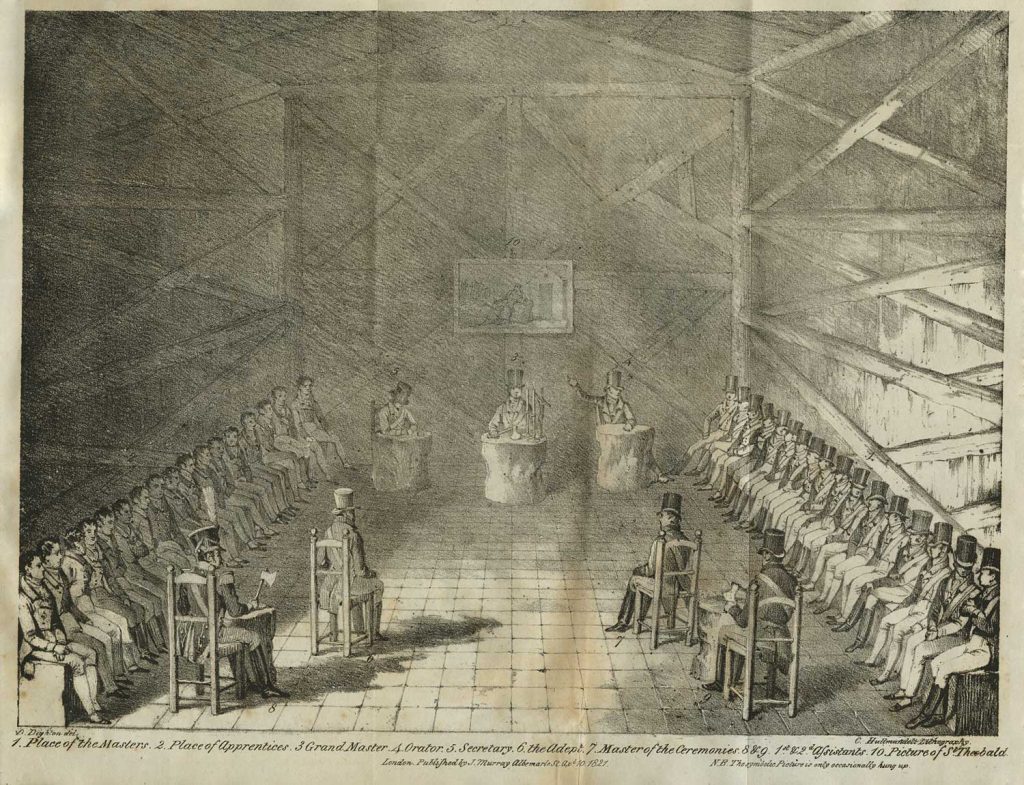
Initiation of a Carbonaro ca. 1821: This drawing depicts the initiation of a Carbonaro, resembling that of a Freemason with regard to its rituals and formalities. The hermit Theobald (ca. 1017–1066), whose portrait is on the wall in the back, was the patron saint of the Carbonari. / International Institute of Social History
As this example shows, several traditions may fuse and be adapted to local circumstances. Here the most famous case is the Carboneria, which appeared in the Kingdom of Naples after its occupation by the French in 1806 and later radiated throughout Italy, attracting many tens of thousands of members. Its similarities to Freemasonry on the one hand and to the Charbonniers of the Franche-Comté on the other have been the subject of long-lasting debate.44Although these similarities are undeniable, efforts to trace them back to a single source are ineffective. Even if a particular “founding moment” were established to everybody’s satisfaction, it would be unlikely to account for the Carbonari‘s many peculiar features and the numerous differences among the buoni cugini (“good cousins”, i.e. members) in the various towns and regions of Italy. Many vendite (“lodges”, i.e. assembly places) soon became an intrinsic part of the social texture, following existing fault lines in the local communities. Their differences, however, would probably have been even greater without the unifying pressure of the Masonic model.
Webs of Deceit: Internal Structures and Cooperations
The impact of traditional forms of organisation is partly explained by the fact that secret societies are normally created on the basis of pre-existing social networks. This is related to the crucial importance of trust among their members, who are after all selected on the supposition that they can keep a secret. It would seem that the structure of the older networks and the degree to which the leadership controlled the necessary resources both exert considerable influence on the level of centralisation and hierarchisation of the new organisation.45 Since the societies are typically caught between hierarchy (some members know more secrets than others) and equality (the shared secret creates a bond), problems of decision-making may ensue. This in turn may support or produce a special type of charismatic leadership that acts as a “substitute for authority in anti-authority organisations”.46
The demands of secrecy are an obvious impediment to the growth of secret societies and the degree of cooperation between them. One consequence is that more than the usual caution is needed when assessing claims about their size and mutual relations. Such claims frequently overstate the case as a result of a natural complicity between supporters and detractors, who both have grounds to exaggerate the possible impact of the organisations. As an example, the Austrian Chancellor Klemens von Metternich (1773–1859) was convinced that the European secret societies were all united under a comité directeur (“head committee”) with its seat in Paris. As if to prove him right, Gioacchino Prati (1790–1863), a lieutenant of Buonarroti’s, wrote that he had been a member of “the centre with which … all political events which took place on the continent have been connected”.47 Yet even if this putative centre had indeed existed, one would be hard put to name even a single goal it might have achieved, except, that is, for bolstering Austrian efforts to improve the police forces of Europe. Powerful headquarters “vseznajušego i nikomu neizvestnogo” (“knowing everything yet known to none”) 48 were a phantasy – a dream to some and a nightmare to others.
What did exist, born from the chronic instability of the Restoration, was an informal network of networks that has been termed a “liberal International”.49 It had largely been fostered by the Continental governments themselves when they forced their opponents into exile at a limited number of safe havens such as Geneva, London, Brussels, or at times Paris. Unsurprisingly, the concentration of more or less like-minded refugees in a tolerant or even sympathetic environment gave rise to an exchange of news and ideas, and occasional cooperation in practical matters. Since political exile was a permanent condition in Europe throughout the period, the refugee networks sometimes changed – liberals and nationalists were followed by socialists and anarchists –, but suspicion remained constant. The appearance of cross-border organisations of workers, in a context of class conflict which was violently illustrated by the Paris Commune of 1871, renewed accusations of conspiracy. The International Working Men’s Association, founded in 1864, was declared a secret society in various countries. In fact, though, institutions like the trade unions at the basis of the IWMA, even when they had clandestine beginnings, signalled the gradual transition from predominantly closed to open forms of organisation.50
In spite of Metternich’s misgivings – or those uttered by Benjamin Disraeli (1804–1881) in Britain51 – it would seem that coordination, as it existed between secret societies, took place ad hoc between individual organisers, and never or only very rarely under the aegis of anything resembling an interorganisational structure. After all, building a secret society is in itself a formidable task, and keeping it alive is difficult. Apart from the question of funding, founders face the problem of maintaining interest among its members, especially if their aims are long-term; and losing members is inherently risky.52 As a rule, therefore, the secret society is an ephemeral structure. It is not surprising that the documented attempts to coordinate two or more organisations (like Mazzini’s Giovine Europa (“Young Europe”), founded in 1834 to unite the national liberation movements of various European countries) hardly got off the ground.53
This state of affairs is not incompatible with the fact that knowledge and networks could be conveyed from one conspirator to the next, leaving an impression of continuity and expansion. Consider the case of Bakunin, whose life as a wandering person in exile was not untypical among the organisers of secret societies. Born in a Russian family that counted several prominent Decembrists among its members, in his youth he fell for the ideas of Johann Gottlieb Fichte (1762–1814) about the “vocation of the scholar”,54 which shaped his own conception of the duties of a moral elite. In the 1840s, he met representatives of virtually all major conspiratorial traditions in Germany, Switzerland, Italy, Poland, Belgium, and France; he even went on a walking tour in the Swiss Alps with August Follen (1794–1855), the former Burschenschafter (member of a German student fraternity). Bakunin organised secret societies in 1848–1849 and, after his return from Siberia in 1861, until the mid-1870s. He had become a Freemason and used his Masonic contacts, notably in Sweden and Italy, when he tried to create an underground international organisation from 1863 onwards. Having absorbed much of the living history of these societies, he in turn inspired groups in Spain, Italy, and Russia that followed his example for many years to come. In this way, Bakunin was part of a chain that linked practices rather than organisations.
Ways of Hiding: Associations and Their Strategies
All in all, secrecy would seem to be the only common denominator discernible among secret societies, yet even this is not a simple matter. Organisations may hide their aims, their rules, their rites, their members, a combination of this, or their very existence. They can do so under external pressure or following their own free will. And this can change over time, or at any rate be perceived in a different light by changing observers, for the definition of secrecy itself was in constant flux in much of Europe since the waning of the Middle Ages. The increasing profitability of commercial secrets as well as of their disclosure, the secularization of political thought, the religious struggles with consequences as diverse as Nicodemism (i. e., pretending to have another religion in order to avoid prosecution) and the Baroque, the meandering rise of modern science, the birth of public opinion – all of these developments were incessantly tugging at the borders of public and private secrecy and openness.55
In this confusing context, it helps to distinguish between two different modes of secrecy in associations. The first, which might be labelled “clandestinity”, is a condition usually imposed by the prohibitions or hostility of powerful outsiders, even if this may have been provoked by the victim itself, as in the case of a criminal gang. Minority groups anywhere often are or have been involuntarily clandestine for some time. By contrast, the second mode, proper “secrecy”, is defined from the inside. Here, the organisation possesses privileged knowledge it wants to hide from those deemed unfit or unworthy, for its ideas “patiuntur … iacturam cum loquacibus et incredulis animis ingeruntur”.56 Indeed, some associations would even consider themselves not as in possession of, but as giving limited access to an inexpressible secret.57
This distinction translates into another loose classification which was first suggested with regard to the evolution of Buonarroti’s secret societies. A course from a “French” to a “German” type of secret society can be distinguished. The first, so named because of its “tipica confluenza di un elemento giacobino e di un elemento militare” (“typical accordance of a Jacobinical and a military element”), followed the model of the “vera e propria cospirazione politica” (“true and proper political conspiracy”). It found its expression in the 1796 Conjuration des Égaux(“Conspiracy of Equals”) founded by François Noël (Gracchus) Babeuf (1760–1797). The second and later type, resembling the concept of an association that “non è più solo meccanismo di urto, ma anche sviluppo e palestra di quella ‘filosofia’ che deve render possibile la riforma della società”, demanded a quasi-permanent, semi-professional activity that might be called “metapolitica per la netta distinzione che vi si introduce fra la società civile sulla quale agire e il gruppo settario liberatosi dalla corruzione e dall’ignoranza”.58 In the terms of our earlier differentiation, the “French” type tended towards clandestinity, the “German” type towards secrecy.
Although the differences between “clandestine” and “secret”, “French” and “German” can be easily overstated, two ideal types are unmistakably recognizable among the political secret societies of 19th-century Europe. Organisations of the “French” type were aiming at the conquest of political power in the short run, if necessary through a pronunciamento.59Accordingly, in France, Spain, and Italy, liberal officers were for a long time overrepresented in secret societies, and all-military conspiracies were far from rare. Of course, these associations – from the Charbonnerie to the Blanquists and from La Giovine Italia (“Young Italy”) to the Fenians60 – held strong political ideas, but their programmes were practical rather than philosophical. Their membership was always larger, and often much larger than that of the “German”-type associations. They were in many ways still-clandestine forerunners of the modern political parties, but also symbols of national independence and unity over much of Europe.61
“German”-type associations were smaller and rarer. The London-based Communist League, founded by Karl Marx (1818–1883) and Friedrich Engels (1820–1895) in 1847, was among them. So were the post-1863 organisations of Bakunin, who like Buonarroti evolved from a “French” to a “German” model. Nor would it be too bold to include the Bolshevik party created by Vladimir I. Lenin (1870–1924) in 1903.62 All of them were not so much conceived for the short-term goal of insurrection as for the strategic leadership of a long revolutionary process that was not expected to be completed during their founder’s lifetime. On the contrary, it was supposed to continue for a considerable time after the insurrectional moment. They had a fundamentally international, universalist perspective, which substantiated their claim to be the vanguard of a vast historic movement. In this respect, it seems that their origins coincide more or less with the birth of artistic and intellectual avant-garde groups, at the same time marginal and elitist, with a similarly universalist outlook.63
Towards the Margins: Secret Societies after 1900
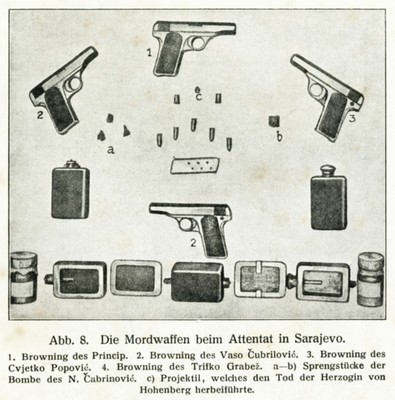
The Gun of Sarajevo 1914: At the top, we can see the Browning used by Gavrilo Princip (1894–1918) to assassinate the Austrian Archduke Franz Ferdinand (1863–1914) in Sarajevo on June 28, 1914. Princip was a member of the secret society Smrt ili Život (“Death or Life”), often confused with the Serbian association known as Crna ruka (the “Black Hand”). After his trial, the gun was given to Anton Puntigam (1859–1926), a prominent Jesuit from Sarajevo, who argued that French Freemasonry was behind the killing. In 2004, the Societas Jesu offered the gun to the Heeresgeschichtliches Museum (Military History Museum) in Vienna. / International Institute of Social History
In spite of the continuous acerbic polemics surrounding the secret societies, there can be little doubt that by the last quarter of the 19th century the phenomenon had begun to decline, at least in Western Europe. With the extension of the right to vote, the improvement of education and the growth and acceptance of open associations, secret societies became less attractive to the radical liberals and socialists who had been their most ardent organisers. Secrecy began to follow a path already implied by Immanuel Kant (1724–1804) when he wrote that the existence of secret societies is an indicator of a lack of freedom.64 Where representative democracy was absent or slow to appear, clandestinity could be a rational response to a repressive state; indeed, the very existence of the clandestine condition was an indictment of that state and an argument in favour of the opposition.65 It is true that political secret societies continued to be created on the margins of Europe, but from the late 19th century onwards they began to reject the label. Paradoxically, in 1914, when their power seemed to reach its zenith as a member of Smrt ili Život (“Death or Life”) fired the bullet that would kill Franz Ferdinand of Austria (1863–1914), triggering the First World War which would bring down four empires, the halcyon days of the secret societies were over.
Appendix
Notes
- Degrees are ranks reflecting a member’s personal development.
- Bilmark, De secretis societatibus 1772. The text was written for the examination of Carl Christopher Ekman (1747–1818), later a mayor of Nystad (Uusikaupunki). On Bilmark, see Brusiin, Bilmark-Studien 1971.
- “a number of secret harmful societies” ([Anonymous], Proselytenmacherei 1785, p. 65; quoted in Hippchen, Verschwörung und Verbot 1998, p. 55).Note that the term occurs already, also in an anti-Jesuit context, in Adolph von Knigge’s (1752-1796) pseudonymous pamphlet Ueber Jesuiten 1781, p. 7, and see pp. 32f.
- For the extensive literature on the Illuminati from 1784 to 2006, see Markner / Schüttler, Bibliographie 2006. An interesting addition is Gregory, Wissen und Geheimnis 2009.
- Pavone, Astuzie dei Gesuiti 2000; Grassl, Aufbruch zur Romantik 1968; Van Kley, Jansenists 1975; Klausnitzer, Poesie und Konspiration 2007, chap 1.3. Anti-Jesuit accusations of conspiracy continued throughout the 19th century; see Leroy, Mythe jésuite 1992; Cubitt, Jesuit Myth 1993; Healey, Jesuit Specter 2003; Franco, Mito dos Jesuítas 2006. See also Fabre / Maire, Antijésuites 2010.
- Agethen, Geheimbund und Utopie 1984, p. 81.
- Le Sueur, Masques arrachées 1790; Cadet de Gassicourt, Tombeau de Jacques Molai 1796; Robison, Proofs of a Conspiracy 1797; Hervás, Causas de la Revolución 1807; Barruel, Mémoires 1803. See also the pamphlet by Barruel’s English translator (Clifford, Application of Barruel’s Memoirs 1798). On Barruel, see Schaeper-Wimmer, Augustin Barruel 1985; Riquet, Augustin de Barruel 1989. – The literature on conspiracy theories is vast; among historical studies directly relevant to our topic, see Roberts, Mythology 1972; Bieberstein, These von der Verschwörung 1976; Wood, Conspiracy 1982; Lemaire, Origines françaises 1985; Porset, Hiram sans-culotte? 1998; Coward / Swann, Conspiracies and Conspiracy Theory 2004; Révauger, Franc-maçonnerie et politique 2006; Cazzaniga, Complotto 2006; Campbell / Kaiser / Linton, French Revolution 2007.
- Thalmann, Romantik des Trivialen 1970; Voges, Aufklärung und Geheimnis 1987; Schings, Brüder des Marquis Posa 1996; Müller-Seidel / Riedel, Weimarer Klassik 2002; Wagner, Turmgesellschaft 2006; Hogle, Gothic Fiction 2002. For an example of an English “bluebook” or “penny dreadful”, see [Anonymous], Mysterious Spaniard 1807.
- Nodier, Sociétés secrètes de l’Armée 1815. See Guillon, Complots militaires 1894, chapter VIII; Oliver, Charles Nodier 1964, pp. 78–81; Lund, Nodier et le roman de l’histoire 1981.
- Kraus, Schmalz 1999, pp. 189–242. The Tugendbund (short for Sittlich-Wissenschaftlicher Verein, i.e. “Moral and Scientific Association”) was part of the reform movement that sprang up in the wake of Prussia’s defeat against Napoleon in 1806. Formally approved of (1808) and later disbanded (1810) by Friedrich Wilhelm III (1770–1840), it propagated civic virtue in the open, while secretly trying to organise resistance against the French.
- Their activities were most notable in what would later become Mexico and Argentina; see for instance Guedea, Mexican Independence 2000.
- Luys, Anfänge der deutschen Nationalbewegung 1992. – Unbedingte was the name of a group of students at the University of Gießen inspired by Carl (1796–1840) and August Follen (1794–1855); they were among the most radical elements of the Burschenschaften, the student unions that had supplied many fighters to the struggle against Napoleon.
- Arnabat, Sociedades secretas 2006; Valín, Masonería y revolución 2008; Castells, Constitución gaditana 1989; Pascual, Circolazione di miti politici 2007; Mogarro, José da Silva Carvalho 1990; Berti / Della Peruta, Carboneria 2004.
- Spitzer, Old Hatreds 1971; Lambert, Charbonnerie 1995. – The French Charbonnerie, an underground merger of various groups, brought together some 30,000 opponents of the Bourbon Restoration in 1821–1823.
- Clogg, Struggle for Greek Independence 1973; Bokova, Epocha tajnych obščestv 2003. The Philiki Etairia, founded in Odessa in 1814, consisted largely of diaspora Greeks; its leader Alexandros Ypsilantis (1792–1828) started the insurrection of 1821.
- On the political police, see Liang, Rise of Modern Police 1992; Napoli, Naissance de la police 2003; Emerson, Metternich 1968; Siemann, Deutschlands Ruhe 1985; Nolte, Demagogen und Denunzianten 2007; Pegenaute, Trayectoria 1978; Monas, Third Section 1961; Squire, Third Department 1968.
- As illustrated by Perreux, Au temps des sociétés secrètes 1931.
- Schmidt, Symbolische Konstituierung 2007, p. 127. At the same time, Anderson removed other traditions from the story (see Schuchard, Restoring the Temple 2002; idem, Emanuel Swedenborg 2012).
- On the Templar myth, see Partner, Murdered Magicians 1981. On the first Rosecrucians, see Dickson, Tessera of Antilia 1998; Edighoffer, Rose-Croix 1998; Tilton, Quest for the Phoenix 2003.
- Schüttler, Intervention des deutschen Illuminatenordens 1992; Bode, Journal 1994; Porset, Philalèthes 1996. Johann Joachim Christoph Bode (1731–1793) was an important member of the Illuminati.
- See, for example, [Thory], Acta Latomorum 1815; Lenning, Encyclopädie der Freimaurerei 1822–1828; [Anonymous], Catalogue 1834; Bègue-Clavel, Histoire pittoresque 1843; Kloss, Bibliographie der Freimaurerei 1844.
- Zaccone, Histoire des sociétés secrètes 1847–1849; De Castro, Mondo secreto 1864; Heckethorn, Secret Societies 1875, vol. 1–2; De la Fuente, Historia de las sociedades secretas 1870–1871; Deschamps, Sociétés secrètes 1874–1876; Schuster, Geheime Gesellschaften 1906. For more on these authors and their books, see Kloosterman, Hidden Centres 2009.
- Hammer-Purgstall, Geschichte der Assassinen 1818. On Hammer, see Galter / Haas, Joseph von Hammer-Purgstall 2008; Fichtner, Terror and Toleration 2008. The Assassins, in fact the Shi’i community of Nizari Isma’ilis that came into being in 1094–1095, suffered from the combined hostility of Sunni Islam and the Christian Crusaders, who first learned about them in the 12th century and knew their leader as the Old Man of the Mountain. See Daftary, Assassin Legends 1995.
- Murray, Origins of the Tiandihui 1994; Singha, Despotism of Law 1998; Van Woerkens, Voyageur étranglé 1995; Wagner, Thuggee 2007. Whereas the Triads were mostly migrant organisations, the Thugs took to a form of often kin-based seasonal banditry patronized by local rulers. Both groups became a source of fascination in the West. Ever since the Confessions of a Thug (1839) by Philip Meadows Taylor, the Indian highwaymen have figured in novels and movies, most notably perhaps in Steven Spielberg’s (*1946) Indiana Jones and the Temple of Doom (1984). And since the Buddhist monastery of Shaolin is significant for the foundation myth of the Chinese societies, these have been associated with the sort of martial arts made popular by the actor Bruce Lee (1940–1973). Sax Rohmer (1883–1959) combined the Chinese and Indian villains in his stories of Fu Manchu from 1912 onwards.
- See, for example, Schurtz, Altersklassen 1902. See also Webster, Primitive Secret Societies 1908; Van Gennep, Rites de passage 1909.
- See also Johnson, Criminal Secrecy 1991; Anderson / Johnson, Revealing Prophets 1995, chapter 1; Wedgwood, Nature and Functions 1930; Herdt, Secret Societies 1990.
- Martin, Secrecy in Hellenistic Religious Communities 1995, p. 118, speaks of “the sensationalizing of secrecy as a category of religious explanation”. See also Bowden, Mystery Cults 2010.
- McIntosh, Eliphas Lévi 1972; Godwin, Theosophical Enlightenment 1994. For the older tradition, see Frick, Erleuchteten 1973; Frick, Licht und Finsternis 1975–1978; Le Forestier, Franc-maçonnerie templière 1987; Viatte, Sources occultes 1979; Faivre, Accès de l’ésotérisme 1986–1996.
- Carnes, Secret Ritual 1989; Gist, Secret Societies 1940; Clawson, Constructing Brotherhood 1989.
- Cf. Heckethorn, Secret Societies 1875, vol. 1–2.
- Clark, British Clubs and Societies 2000, p. 312; Prescott, Unlawful Societies Act 2002; Beaurepaire, William Pitt 2005.
- Agulhon, Pénitents et Francs-Maçons 1968, pp. 206–211; Zaunstöck, Sozietätslandschaft 1999, p. 99; Bullock, Revolutionary Brotherhood 1996.
- In general, see Ferrer Benimeli, Masonería, Iglesia e Ilustración 1976–1977; Clark / Kaiser, Culture Wars 2003; Porset / Révauger, Franc-maçonnerie et religions 2006; Borutta, Antikatholizismus 2011. For Southern Europe, see Poulat / Laurant, Antimaçonnisme catholique 2006; Jarrige, Antimaçonnerie en France 2006; Pruneti, Sinagoga di Satana 2002; Cazzaniga, Massoneria 2006; Ferrer Benimeli, Contubernio judeo-masónico-comunista 1982; Martín, Arquitectos de la República 2007; Gomes, Catolicismo e tradicionalismo 2009. It should be noted that this debate contributed to the creation of a false dichotomy in which Masons and Illuminati represent Enlightenment values against various forms of presumed irrationality; but see for instance Neugebauer-Wölk, Esoterische Bünde 1995; idem, Aufklärung und Esoterik 1999; Mulsow, Weishaupt als Philosoph 2002.
- Agethen, Geheimbund und Utopie 1984 (pp. 279–287 for the rumours on the Jesuits); Porset, Mirabeau 1996.
- Saitta, Buonarroti 1972; Eisenstein, First Professional Revolutionist 1959, chapter 3.2; Combes, Franc-Maçonnerie et Blanquisme 1986; Damiani, Bakunin 1977; Polo Friz, Michele Bakunin 1989.
- Bieberstein, Bedeutung der Freimaurerei 1980; Polo Friz, Massoneria italiana 1998; Novarino, All’Oriente di Torino 2003.
- The Martinists were an order established in the 1880s which claimed to build on the occult ideas of Martinès de Pasqually (died 1774) and Louis-Claude de Saint-Martin (1743–1803).
- Bossu, Loge de proscrits 1958; Galtier, Maçonnerie egyptienne 1989; Harvey, Beyond Enlightenment 2005; Weber, Satan Franc-Maçon 1964. See also Conti, Massoneria e radicalismo 2005. For a Masonic complaint, see Baylot, Voie substituée 1985.
- Lambton, Secret Societies 1958; Landau, Prolegomena 1965; Zarcone, Secret et sociétés secrètes 2002.
- Vázquez, Masonería en México 2011; idem, Imagen pública 2011; Ferrer Benimeli, Aproximaciones 2012. The debate about the Lautaro lodge and its role in the struggle for independence in Argentine, Chile and Peru is typical; for a summary, see Castro Olivas, Libertadores 2011, chapter 1.2.
- Bertier, Souvenirs inédits 1990; Truant, Rites of Labor 1994.
- Stinchcombe, Social Structure and Organizations 1972, p. 148.
- Kenny, Molly Maguires 1998. See also Lause, Civil War 2011. For another example, see Cohen, Politics of Elite Culture 1981, which shows how Sierra Leone politics in the 1970s pitted (imported) elite Creole Freemasonry against (indigenous) non-elite Poro societies. On the British “export” of Masonry, see Harland-Jacobs, Builders of Empire 2007.
- Starting with Luzio, Massoneria 1925, and Leti, Carboneria e Massoneria 1925; see the relevant chapters in Berti / Della Peruta 2004. On the Charbonniers, see Merlin, Bons cousins charbonniers 2005; on their possible role in Naples, see Mastroberti, Pierre Joseph Briot 1998, chapter 6. See also the recent regional studies of De Cristofaro, Carboneria in Basilicata 1991; Gin, Sanfedisti 2003; Dicara, Elite di periferia 2004.
- Erickson, Secret Societies and Social Structure 1981; Fidel, Military Conspiracy 1980.
- Ellis, Charismatic Leadership 1991, p. 314. See also Douglas / Wildavsky, Risk and Culture 1982, chapter 6.
- Sked, Metternich 2008, p. 130; Prati, Autobiography 1837–1839, here 10 February 1838.
- Bakunin, K oficeram russkoj armii 1870, p. 5.
- Isabella, Risorgimento in Exile 2009.
- For the general development, see Hoffmann, Geselligkeit und Demokratie 2003.
- Disraeli told the House of Commons in 1856: “It is useless to deny, because it is impossible to conceal, that a grand part of Europe … is covered with a network of these secret societies, just as the superficies of the earth are now being covered with railroads”; see Her Majesty’s Stationery Office, Hansard 1803–2005, 3rd series, vol. 143, p. 774. His words were later used as an epitaph by Webster, Secret Societies 1924, p. IV.
- Buonarroti considered meetings to be essential, even though they courted danger. He insisted that they had to be not just useful but “agréables et intéressantes” (“pleasant and interesting”); he also organised festivities and wrote, “On ne doit pas négliger de parler aux sens; le raisonnement ne suffit pas toujours, et souvent un geste, un mouvement, un chant, un tableau font sur le cœur humain surtout jeune plus d’impression durable que les discours les mieux conçus et les plus remplis de vérité” (“One must not neglect the stimulation of the senses; reason is not always sufficient, and often a gesture, a movement, a song, or a painting leaves a greater impression on a human heart, especially on a young one, than the best and most truthful speeches”, Saitta, Buonarroti 1972, vol. II, pp. 157–160). Andryane, Souvenirs 1839, contains sketches of some such meetings.
- For a positive view, see Mastellone, Progetto politico 1994.
- Cf. Fichte, Bestimmung des Gelehrten 1794.
- Long, Openness, Secrecy, Authorship 2001; Eamon, Science and the Secrets of Nature 1994; Senellart, Arts de gouverner 1995; Snyder, Dissimulation 2009; Zagorin, Ways of Lying 1990; De la Flor, Pasiones frías 2005; Burke, Social History of Knowledge 2000; Shapin, Social History of Truth 1994; Habermas, Strukturwandel 1962; Engel, Geheimnis 2002. On secrecy in general, see Hölscher, Öffentlichkeit und Geheimnis 1979; Tefft, Secrecy 1980; Assmann / Assmann, Schleier und Schwelle 1997–1999; Petitat, Secret et formes sociales 1998; Cavaillé, Mensonge 2010.
- Agrippa, De occulta philosophia 1992, p. 406 (“suffer loss, when they are poured into prating and incredulous minds”; translation: James Freake (1651)). As Friedrich Nietzsche (1844–1900) said in 1886, “Man liebt seine Erkenntnis nicht genug mehr, sobald man sie mittheilt” (“One no longer loves one’s knowledge sufficiently after one has communicated it”, translation: Helen Zimmern; Nietzsche, Jenseits von Gut und Böse 1886, chapter IV, maxim 160).
- See Guénon, Aperçus sur l’initiation 1946.
- Saitta, Buonarroti 1972, vol. II, pp. 149, 112f. (“that is no longer only a mechanism of force but also creates a room for the philosophy which must make social reform possible”, “metapolitics because of the straight distinction which is made between the civil society in which to act and the sectarian group liberated from corruption and ignorance”).
- See Castells, Utopía insurreccional 1989.
- Dommanget, Blanqui 1960; Mastellone, Mazzini 1960; McGarry / McConnell, Black Hand 2009. – After Blanqui’s death in 1881, his followers formed a political party that would eventually be absorbed in the French socialist party. La Giovine Italia was Mazzini’s political organisation from 1831 till 1848; from 1834 onwards it was conceived as a part of Giovine Europa. Fenians was the name given to the members of the Irish Republican Brotherhood founded in 1858 to bring about a democratic republic; they would play a major role in the struggle for Irish independence.
- MacKenzie, Violent Solutions 1996; Schieder / Dann, Nationale Bewegung 1978; Bieberstein, Geheime Gesellschaften 1979; Reinalter, Politische Vereine 2005.
- Hund, Geschichte des Bundes der Kommunisten 1993; Scheibert, Bakunins Entwurf 1968; Rudnickaja / D’jakov, Rukopis M.A. Bakunina 1974; Furlani, Bakunin e la sua associazione segreta 1977; Mervaud, Société internationale secrète 1979; Kun, Tournant décisif 1980; Geyer, Lenin 1962.
- Much of the analysis in Poggioli, Teoria dell’arte d’avanguardia 1962, applies to the “German”-type secret societies. See also Kreuzer, Boheme 1971; Eßbach, Junghegelianer 1988; Morowitz / Vaughan, Artistic Brotherhoods 2000; Heinich, Elite artiste 2005.
- Kant, Über den Gemeinspruch 1978, p. 163.
- See also Simmel, Soziologie 1908, chapter 5, for a discussion of the relation between private and public secrecy.
Bibliography
Primary Sources
Agrippa, Cornelius: De occulta philosophia libri tres, ed. by Vittoria Perrone Compagni, Leiden et al. 1992 [1st ed. 1533].
Anderson, James: The Constitutions of the Free-Masons, London 1723, online: http://digitalcommons.unl.edu/libraryscience/25/ [11/01/2013].
Andryane, Alexandre: Souvenirs de Genève: Complément des Mémoires d’un prisonnier d’Etat, Brussels 1839, vol. 1–2, online: vol. 1: http://archive.org/details/souvenirsdegenv03andrgoog; vol. 2: http://archive.org/details/souvenirsdegenv02andrgoog [09/01/2013].
[Anonymous]: Beitrag zur Geschichte itziger geheimen Proselytenmacherei, in: Berlinische Monatsschrift 1 (1785), pp. 59–79, online: http://www.ub.uni-bielefeld.de/cgi-bin/neubutton.cgi?pfad=/diglib/aufkl/berlmon/122851&seite=00000070.TIF [10/01/2013].
[Anonymous]: Secreta monita ou advis secrets de la société de Jésus, Paderborn 1661, online: http://www.mdz-nbn-resolving.de/urn/resolver.pl?urn=urn:nbn:de:bvb:12-bsb10568700-8[11/01/2013].
[Anonymous]: The Mysterious Spaniard, or the Ruins of St Luke’s Abbey: A Romance, London 1807, online: http://www.litgothic.com/Texts/spaniard.html [09/01/2013].
[Bakunin, Michail:] K oficeram russkoj armii, [Genève] 1870, in: Michel Bakounine: Oeuvres complètes, CD-ROM edition, Amsterdam 2000.
Barruel, Augustin de: Mémoires pour servir à l’histoire du Jacobinisme: Nouvelle et dernière édition, Hamburg 1803, vol. 1–5 [1st ed. 1798–1799, online: vol. 1: http://gallica.bnf.fr/ark:/12148/bpt6k49434c, vol. 2: http://gallica.bnf.fr/ark:/12148/bpt6k49435q; vol. 3: http://gallica.bnf.fr/ark:/12148/bpt6k494362; vol. 5: http://gallica.bnf.fr/ark:/12148/bpt6k49437d [09/01/2013]].
Bègue-Clavel, François-Timoléon: Histoire pittoresque de la Franc-maçonnerie et des sociétés secrètes anciennes et modernes, Paris 1843 [1st ed. 1842], online: http://gallica.bnf.fr/ark:/12148/bpt6k3990355 [09/01/2013].
Bertier, Ferdinand de: Souvenirs inédits d’un conspirateur: Révolution, Empire et première Restauration, ed. by Guillaume de Bertier de Sauvigny, Paris 1990.
Bilmark, Johan: Dissertatio academica de secretis societatibus litterariis, Åbo 1772, online: https://oa.doria.fi/handle/10024/51102 [09/01/2013].
Bode, Johann Joachim Christoph: Journal von einer Reise von Weimar nach Frankreich im Jahr 1787, ed. by Hermann Schüttler, Neuried 1994.
[Clifford, Robert:] Application of Barruel’s Memoirs of Jacobinism to the Secret Societies of Ireland and Great Britain: By the Translator of that Work, London 1798, online: http://www.iisg.nl/collections/secretsocieties/documents/bro-1268-3.pdf [09/01/2013].
Fichte, Johann Gottlieb: Einige Vorlesungen über die Bestimmung des Gelehrten, Jena et al. 1794.
[Gassicourt, Charles-Louis Cadet de:] Le Tombeau de Jacques Molai, ou le secret des conspirateurs, Paris 1796, online: http://www.iisg.nl/collections/secretsocieties/f1007-50.php[09/01/2013].
Guillon, Edouard: Les Complots militaires sous le Consulat et l’Empire d’après les documents inédits des archives, Paris 1894, online: http://gallica.bnf.fr/ark:/12148/bpt6k36748z [09/01/2013].
Hammer-Purgstall, Joseph von: Die Geschichte der Assassinen, aus morgenländischen Quellen, Stuttgart et al. 1818, online: http://archive.org/details/diegeschichtede00purgoog [09/01/2013].
Heckethorn, Charles: The Secret Societies of All Ages and Countries, London 1875, vol. 1–2, online: vol. 1: http://archive.org/details/cu31924092567050; vol. 2:http://archive.org/details/secretsocietieso02heckuoft [09/01/2013].
Her Majesty’s Stationery Office (eds.): Hansard: Parliamentary Debates, London 1803–2005; 3rd series, vol. 143, p. 774, online: http://hansard.millbanksystems.com/commons/1856/jul/14/italy-motion-for-address [11/01/2013].
Hervás y Panduro, Lorenzo: Causas de la revolución de Francia en el año 1789 y medios de que se han valido para efectuarla los enemigos de la Religión y del Estado, Madrid 1807, vol. 1–2, online: http://www.cervantesvirtual.com/obra/causas-de-la-revolucion-de-francia-en-el-ano-1789-y-medios-de-que-se-han-valido-para-efectuarla-los-enemigos-de-la-religion-y-del-estado-vol-i–0/[09/01/2013].
Kant, Immanuel: Über den Gemeinspruch: Das mag in der Theorie richtig sein, taugt aber nicht für die Praxis, in: Werkausgabe, ed. by Wilhelm Weischedel, Frankfurt am Main 1978, vol 11: Schriften zur Anthropologie, Geschichtsphilosophie, Politik und Pädagogik 1 [1st ed. 1793], online: http://www.zeno.org/nid/2000919195X [09/01/2013].
[Knigge, Adolph von]: Ueber Jesuiten, Freymaurer und deutsche Rosencreutzer: herausgegeben von Joseph Aloisius Maier, der Gesellschaft Jesu ehemaligen Mitgliede, Leipzig 1781.
Le Sueur, Jacques: Les Masques arrachées ou vies privées de H. van der Noot et van Eupen, de S.E. le Cardinal de Malines et de leurs adhérens, London et al. 1790.
Nietzsche, Friedrich: Jenseits von Gut und Böse, Leipzig 1886, online: http://gutenberg.spiegel.de/buch/3250/1 [11/01/2013].
[Nodier, Charles:] Histoire des sociétés secrètes de l’Armée et des conspirations militaires qui ont eu pour objet la destruction du gouvernement de Bonaparte, Paris 1815, online: http://archive.org/details/histoiredessocie00nodiuoft [09/01/2013].
[Prati, Gioacchino:] An Autobiography: The Medical Adviser’s Life and Adventures: Written expressly for the Penny Satirist, in: The Penny Satirist, 1 June 1837–7 September 1839.
Robison, John: Proofs of a Conspiracy against all the Religions and Governments of Europe, Carried on in the Secret Meetings of Free-Masons, Illuminati and Reading Societies etc, Edinburgh 1797, online: http://archive.org/details/proofsofconspira00r [10/01/2013].
Sauvage, Henri Michel: Beweis von der Wirklichkeit der Zusammenkunft in Bourgfontaine, wo die gräuelvollen Anschläge der Jansenisten zum Verderben des Christenthumes und zum Sturz der katholischen Staaten sind geschmiedet worden; 1, without place, 1793, online: http://www.mdz-nbn-resolving.de/urn/resolver.pl?urn=urn:nbn:de:bvb:12-bsb10029271-4[11/01/2013].
Taylor, Philip Meadows: Confessions of a Thug, London 1839, vol. 1–3, online: vol. 1: http://www.empire.amdigital.co.uk/Documents/Details/Confessions%20of%20a%20Thug%20Volume%201_; vol. 2: http://www.empire.amdigital.co.uk/Documents/Details/Confessions%20of%20a%20Thug%20Volume%202; vol. 3: http://www.empire.amdigital.co.uk/Documents/Details/Confessions%20of%20a%20Thug%20Volume%203[10/01/2013].
[Thory, Claude-Antoine]: Acta latomorum, ou chronologie de la Franche-maçonnerie française et étrangère [etc], Paris 1815, vol. 1–2, online: vol. 2: http://archive.org/details/actalatomorumou00frangoog [10/01/2013].
Secondary Sources
Agethen, Manfred: Geheimbund und Utopie: Illuminaten, Freimaurer und deutsche Spätaufklärung, Munich 1984.
Agulhon, Maurice: Pénitents et Francs-Maçons de l’ancienne Provence, Paris 1968.
Anderson, David M. / Johnson, Douglas H.: Revealing Prophets: Prophecy in Eastern African History, London et al. 1995.
[Anonymous]: Catalogue de livres manuscrits et imprimés sur la Franc-Maçonnerie et les sociétés secrètes provenant du cabinet de feu M. [André-Joseph-Etienne] Lerouge […], Paris 1834.
Arnabat Mata, Ramón: Las Sociedades secretas durante el Trienio Liberal, in: Santiago Castillo et al. (eds.): Las Figuras del Desorden: Heterodoxos, proscritos y marginados, CD-ROM edition, Madrid 2006.
Assmann, Aleida et al. (eds.): Schleier und Schwelle, Munich 1997–1999, vol. 1–3.
Baylot, Jean: La Voie substituée: Recherche sur la déviation de la Franc-maçonnerie en France et en Europe, Paris 1985 [1st ed. 1968].
Beaurepaire, Pierre-Yves: William Pitt, les franc-maçons anglais et la loi sur les sociétés secrètes de 1799, in: Annales historiques de la Révolution française 342 (2005), online: http://ahrf.revues.org/1935 [09/01/2013].
Berti, Giampietro et al. (eds.): La Carboneria: La nascita della nazione: Intrecci veneti, nazionali e internazionali, Rovigo 2004.
Bieberstein, Johannes Rogalla von: Die These von der Verschwörung 1776–1945: Philosophen, Freimaurer, Juden, Liberale und Sozialisten als Verschwörer gegen die Sozialordnung, Bern et al. 1976.
Bieberstein, Johannes Rogalla von: Die Bedeutung der Freimaurerei für nationalemanzipatorische Gesellschaften in Polen und Russland 1815–1825, in: Zeitschrift für Ostforschung 4 (1980), pp. 639–653.
Bieberstein, Johannes Rogalla von: Geheime Gesellschaften als Vorläufer politischer Parteien, in: Peter Christian Ludz (ed.): Geheime Gesellschaften, Heidelberg 1979, pp. 429–460.
Bokova, Vera M.: Epocha tajnych obščestv: Russkie obščestvennie ob”edinenija pervoj treti XIX v., Moscow 2003.
Borutta, Manuel: Antikatholizismus: Deutschland und Italien im Zeitalter der europäischen Kulturkämpfe, 2nd ed., Göttingen 2011.
Bossu, Jean: Un Loge de proscrits à Londres sous le Second Empire et après la Commune, in: L’Idée libre 47,1 (1958), pp. 21–26; 47,2 (1958), pp. 69–73; 47,3 (1958), pp. 127–132; 47,4 (1958), pp. 176–181; 47,6 (1958), pp. 256–265; 47,7 (1958), pp. 300–301.
Bowden, Hugh: Mystery Cults in the Ancient World, London 2010.
Brusiin, Otto: Einführung in das Studium der Philosophie Johan Bilmarks, Turku 1971 (Bilmark-Studien 1).
Bullock, Steven C.: Revolutionary Brotherhood: Freemasonry and the Transformation of the American Social Order, 1730–1840, Chapel Hill, NC et al. 1996.
Burke, Peter: A Social History of Knowledge: From Gutenberg to Diderot, Cambridge et al 2000.
Campbell, Peter R. et al. (eds.): Conspiracy in the French Revolution, Manchester et al. 2007.
Carnes, Mark C.: Secret Ritual and Manhood in Victorian America, New Haven, NJ 1989.
Castells Oliván, Irene: La Constitución gaditana de 1812 y su proyección en los movimientos liberales europeos del primer tercio del siglo XIX, in: Trocadero 1 (1989), pp. 117–132.
Castells Oliván, Irene: La Utopía insurreccional del liberalismo: Torrijos y las conspiraciones liberales de la Década Ominosa, Barcelona 1989.
Castro Olivas, Jorge Luis: El Secreto de los Libertadores: Sociedades secretas y masonería en el proceso de emancipación peruano: La logia Lautaro en el Perú, Lima 2011.
Cavaillé, Jean-Pierre, Bibliographie: Mensonge, tromperie, simulation et dissimulation, in: Les Dossiers du Groupe de Recherches Interdisciplinaires sur l’Histoire Littéraire (GRIHL) 2010, online: http://dossiersgrihl.revues.org/2103 [09/01/2013].
Cazzaniga, Gian Mario: Il complotto: Metamorfosi di un mito, in: Gian Mario Cazzaniga (ed.): Storia d’Italia: La Massoneria, Torino 2006 (Annali 21), pp 312–330.
Cazzaniga, Gian Mario (ed.): Storia d’Italia: La Massoneria, Torino 2006 (Annali 21).
Clark, Christopher et al. (eds.): Culture Wars: Secular-Catholic conflict in nineteenth-century Europe, Cambridge 2003.
Clark, Peter: British Clubs and Societies 1580–1800: The Origins of an Associational World, Oxford 2000.
Clawson, Mary Ann: Constructing Brotherhood: Class, Gender, and Fraternalism, Princeton, NJ 1989.
Clogg, Richard (ed.): The Struggle for Greek Independence: Essays to Mark the 150th Anniversary of the Greek War of Independence, London et al. 1973.
Cohen, Abner: The Politics of Elite Culture: Explorations in the Dramaturgy of Power in a Modern African Society, Berkeley, CA 1981.
Combes, André: Franc-Maçonnerie et Blanquisme, in: Blanqui et les Blanquistes, Paris 1986, pp. 137–151.
Conti, Fulvio: Massoneria e radicalismo in Europa dall’età dei Lumi alla Grande Guerra, in: Maurizio Ridolfi (ed.): La Democrazia radicale nell’ottocento europeo: Forme della politica, modelli culturali, riforme sociali, Milano 2005 (Annali: Anno 39), pp. 33–56.
Coward, Barry et al. (eds): Conspiracies and Conspiracy Theory in Early Modern Europe: from the Waldensians to the French Revolution, Aldershot 2004.
Cubitt, Geoffrey: The Jesuit Myth: conspiracy theory and politics in nineteenth-century France, Oxford 1993.
Daftary, Farhad: The Assassin Legends: Myths of the Isma’ilis, London et al. 1995.
Damiani, Franco: Bakunin nell’Italia post-unitaria 1864-1867: Anticlericalismo, democrazia, questione operaia e contadina negli anni del soggiorno italiano di Bakunin, Milano 1977.
De Castro, Giovanni: Il mondo secreto, Milano 1864, vol. 1–9.
De Cristofaro, Maria Antonietta: La Carboneria in Basilicata, Venosa 1991.
De la Flor, Fernando R.: Pasiones frías: Secreto y disimulación en el Barroco hispano, Madrid 2005.
De la Fuente, Vicente: Historia de las sociedades secretas antiguas y modernas de España y especialmente de la Franc-Masonería, Lugo 1870–1871, vol. 1–3.
Deschamps, Nicolas: Les Sociétés secrètes et la société, ou philosophie de l’histoire contemporaine, Avignon 1874–1876, vol. 1–3.
Dicara, Vito: Elite di periferia: Conflitti locali e carboneria a Caltagirone tra monarchia amministrativa e guerra indipendentista, Caltanissetta 2004.
Dickson, Donald R.: The Tessera of Antilia: Utopian Brotherhoods and Secret Societies in the Early Seventeenth Century, Leiden et al. 1998.
Dommanget, Maurice: Blanqui et l’opposition révolutionnaire à la fin du Second Empire, Paris 1960.
Douglas, Mary / Wildavsky, Aaron: Risk and Culture: An Essay on the Selection of Technological and Environmental Dangers, Berkeley, CA et al. 1982.
Eamon, William: Science and the Secrets of Nature: Books of Secrets in Medieval and Early Modern Culture, Princeton, NJ 1994.
Edighoffer, Roland: Les Rose-Croix et la crise de la conscience européenne au XVIIe siècle, Paris 1998.
Eisenstein, Elizabeth L.: The First Professional Revolutionist: Filippo Michele Buonarroti (1761–1837): A Biographical Essay, Cambridge, MA 1959.
Ellis, Richard J.: Explaining the Occurrence of Charismatic Leadership in Organizations, in: Journal of Theoretical Politics 3,3 (1991), pp. 305–319.
Emerson, Donald E.: Metternich and the Political Police: Security and Subversion in the Hapsburg Monarchy (1815–1830), Den Haag 1968.
Engel, Gisela et al. (eds.): Das Geheimnis am Beginn der europäischen Moderne, Frankfurt am Main 2006 (Zeitsprünge 6).
Erickson, Bonnie H.: Secret Societies and Social Structure, in: Social Forces 60 (1981), pp. 188–210.
Eßbach, Wolfgang: Die Junghegelianer: Soziologie einer Intellektuellengruppe, München 1988.
Fabre, Pierre-Antoine et al. (eds.): Les Antijésuites: Discours, figures et lieux de l’antijésuitisme à l’époque moderne, Rennes 2010.
Faivre, Antoine: Accès de l’ésotérisme occidental, Paris 1986–1996, vol. 1–2.
Ferrer Benimeli, José Antonio: Aproximación a la historiografía de la masonería latinoamericana, in: Revista de Estudios Históricos de la Masonería Latinoamericana y Caribeña 4,1 (2012), pp. 4–121.
Ferrer Benimeli, José Antonio: El Contubernio judeo-masónico-comunista: Del satanismo al escándalo de la P-2, Madrid 1982.
Ferrer Benimeli, José Antonio: Masonería, Iglesia e Ilustración: Un conflicto ideológico-político-religioso, Madrid 1976–1977, vol. 1–4.
Fichtner, Paula Sutter: Terror and Toleration: The Habsburg Empire Confronts Islam, 1526–1850, London 2008.
Fidel, Kenneth: The Dynamics of Military Conspiracy, in: Stanton K. Tefft (ed.): Secrecy: A Cross-Cultural Perspective, New York 1980, pp. 178–196.
Franco, José Eduardo: O Mito dos Jesuítas em Portugal, no Brasil e no Oriente (séculos XVI a XX), Lisboa 2006, vol. 1–2.
Frick, Karl R.H.: Die Erleuchteten: Gnostisch-theosophische und alchemistisch-rosenkreuzerische Geheimgesellschaften bis zum Ende des 18. Jahrhunderts: Ein Beitrag zur Geistesgeschichte der Neuzeit, Graz 1973.
Frick, Karl R.H.: Licht und Finsternis: Gnostisch-theosophische und freimaurerisch-okkulte Geheimgesellschaften bis an die Wende zum 20. Jahrhundert, Graz 1975–1978, vol. 1–2.
Furlani, Silvio: Bakunin e la sua associazione segreta dei fratelli scandinavi del 1864, in: Rivista storica italiana 89 (1977), pp. 610–651.
Galter, Hannes D. et al. (eds.): Joseph von Hammer-Purgstall: Grenzgänger zwischen Orient und Okzident, Graz 2008.
Galtier, Gérard: Maçonnerie égyptienne, Rose-Croix et Neo-Chevalerie: Les fils de Cagliostro, Paris 1989.
Geyer, Dietrich: Lenin in der russischen Sozialdemokratie: Die Arbeiterbewegung im Zarenreich als Organisationsproblem der revolutionären Intelligenz, 1890–1903, Köln 1962.
Gin, Emilio: Sanfedisti, Carbonari, magistrati del re: Il Regno delle Due Sicilie tra restaurazione e rivoluzione, Napoli 2003.
Gist, Noel P.: Secret Societies: A Cultural Study of Fraternalism in the United States, Columbia 1940 (The University of Missouri Studies 15,4).
Godwin, Joscelyn: The Theosophical Enlightenment, Albany, NY 1994.
Gomes, J. Pinharanda: Catolicismo e tradicionalismo face ao liberalismo e ao maçonismo (1820–1850), in: Arnaldo de Pinho (ed.): Catolicismo e Liberalismo em Portugal (1820–1850), Lisbon 2009, pp. 93–291.
Grassl, Hans: Aufbruch zur Romantik: Bayerns Beitrag zur deutschen Geistesgeschichte 1765–1785, München 1968.
Gregory, Stephan: Wissen und Geheimnis: Das Experiment des Illuminatenordens, Frankfurt am Main et al. 2009.
Guedea, Virginia: The Process of Mexican Independence, in: American Historical Review 105,1 (2000), pp. 116–130.
Guénon, René: Aperçus sur l’initiation, Paris 1946.
Habermas, Jürgen: Strukturwandel der Öffentlichkeit: Untersuchungen zu einer Kategorie der bürgerlichen Gesellschaft, Neuwied 1962.
Harland-Jacobs, Jessica L.: Builders of Empire: Freemasonry and British Imperialism, 1717–1927, Chapel Hill, NC 2007.
Harvey, David Allen: Beyond Enlightenment: Occultism and Politics in Modern France, DeKalb, IL 2005.
Healey, Róisín: The Jesuit Specter in Imperial Germany, Boston, MA 2003.
Heinich, Nathalie: L’Elite artiste: Excellence et singularité en régime démocratique, Paris 2005.
Herdt, Gilbert: Secret Societies and Secret Collectives, in: Oceania 60 (1990), pp. 360–381.
Hippchen, Christoph: Zwischen Verschwörung und Verbot: Der Illuminatenorden im Spiegel deutscher Publizistik (1776–1800), Köln et al. 1998.
Hölscher, Lucian: Öffentlichkeit und Geheimnis: Eine begriffsgeschichtliche Untersuchung zur Entstehung der Öffentlichkeit in der frühen Neuzeit, Stuttgart 1979.
Hoffmann, Stefan-Ludwig: Geselligkeit und Demokratie: Vereine und zivile Gesellschaft im transnationalen Vergleich 1750–1914, Göttingen 2003.
Hogle, Jerrold E. (eds.): The Cambridge Companion to Gothic Fiction, Cambridge 2002.
Hundt, Martin: Geschichte des Bundes der Kommunisten 1836 bis 1852, Frankfurt am Main et al. 1993.
Isabella, Maurizio: Risorgimento in Exile: Italian Émigrés and the Liberal International in the Post-Napoleonic Era, Oxford 2009.
Jarrige, Michel: L’Antimaçonnerie en France à la Belle Epoque: personnalités, mentalités, structures et modes d’action des organisations antimaçonniques 1899–1914, Milano 2006.
Johnson, Douglas H.: Criminal Justice: The Case of the Zande “Secret Societies”, in: Past & Present 130 (1991), pp. 170–200.
Kenny, Kevin: Making Sense of the Molly Maguires, New York et al. 1998.
Klausnitzer, Ralf: Poesie und Konspiration: Beziehungssinn und Zeichenökonomie von Verschwörungsszenarien in Publizistik, Literatur und Wissenschaft 1750–1850, Berlin 2007.
Kloosterman, Jaap: Hidden Centres: The Rise and Fall of the Secret Societies, conference paper for the German Historical Institute, Moscow 2009, online: http://socialhistory.org/sites/default/files/docs/publications/secrsoc-moscow2.pdf [09/01/2013].
Kloss, Georg: Bibliographie der Freimaurerei und der mit ihr in Verbindung gesetzten geheimen Gesellschaften, Frankfurt am Main 1844.
Kraus, Hans-Christof: Theodor Anton Heinrich Schmalz (1760–1831): Jurisprudenz, Universitätspolitik und Publizistik im Spannungsfeld von Revolution und Restauration, Frankfurt am Main 1999.
Kreuzer, Helmut: Die Boheme: Analyse und Dokumentation der intellektuellen Subkultur vom 19. Jahrhundert bis zur Gegenwart, Stuttgart 1971.
Kun, Miklós: Un tournant décisif dans la vie de Bakounine: Données inédites sur son évolution idéologique et sur son activité conspiratrice, in: Acta Historica Academiae Scientiarum Hungaricae 26 (1980), pp. 27–75.
Lambert, Pierre-Arnaud: La Charbonnerie française 1821–1823: Du secret en politique, Lyon 1995.
Lambton, Ann K.S.: Secret Societies and the Persian Revolution of 1905–6, in: Albert Hourani (ed.): Middle Eastern Affairs, Number 1, London 1958 (St Anthony’s Papers 4), pp. 43–60.
Landau, Jacob M.: Prolegomena to a Study of Secret Societies in Modern Egypt, in: Middle Eastern Studies 1,2 (1965), pp. 135–186.
Lause, Mark A.: A Secret Society History of the Civil War, Urbana, IL 2011.
Le Forestier, René: La Franc-maçonnerie templière et occultiste aux XVIIIe et XIXe siècles, ed. by Antoine Faivre, Paris 1987, vol. 1–2.
Lemaire, Jacques: Les Origines françaises de l’antimaçonnisme (1744–1797), Brussels 1985.
Lenning, C. [Friedrich Mossdorf]: Encyclopädie der Freimaurerei, nebst Nachrichten über die damit in wirklicher oder vorgeblicher Beziehung stehenden geheimen Verbindungen [etc], Leipzig 1822–1828, vol. 1–3, online: http://dl.ub.uni-freiburg.de/diglit/hesse1822ga [09/01/2013].
Leroy, Michel: Le Mythe jésuite: De Béranger à Michelet, Paris 1992.
Leti, Giuseppe: Carboneria e Massoneria nel Risorgimento italiano: Saggio di critica storia, Genova 1925.
Liang, Hsi-Huey: The Rise of Modern Police and the European State System from Metternich to the Second World War, Cambridge 1992.
Long, Pamela O.: Openness, Secrecy, Authorship: Technical Arts and the Culture of Knowledge from Antiquity to the Renaissance, Baltimore, MD 2001.
Lund, Hans Peter: Nodier et le roman de l’histoire: Les Philadelphes: Histoire des sociétés secrètes de l’Armée, in: Société d’Histoire Littéraire de la France (ed.): Charles Nodier: Colloque du deuxième centenaire: Besançon, mai 1980, Paris 1981, pp. 41–55.
Luys, Karin: Die Anfänge der deutschen Nationalbewegung von 1815 bis 1819, Münster 1992.
Luzio, Alessandro: La Massoneria e il Risorgimento italiano: Saggio storico-critico, Bologna 1925, vol. 1–2.
McGarry, Fearghal et al. (eds.): The Black Hand of Republicanism: Fenianism in modern Ireland, Dublin 2009.
McIntosh, Christopher: Eliphas Lévi and the French Occult Revival, London 1972.
MacKenzie, David: Violent Solutions: Revolutions, Nationalism, and Secret Societies in Europe to 1918, Lanham, MD et al. 1996.
Markner, Reinhard / Schüttler, Hermann: Bibliographie zum Illuminatenorden, 2006, online: http://markner.blogspot.com/2006/06/bibliographie-zum-illuminatenorden.html [09/01/2013].
Martín, Luis P.: Los Arquitectos de la República: Los Masones y la política en España, 1900–1936, Madrid 2007.
Martin, Luther H.: Secrecy in Hellenistic Religious Communities, in: Hans G. Kippenberg et al. (eds): Secrecy and Concealment: Studies in the History of Mediterranean and Near Eastern Religions, Leiden 1995, pp. 101–121.
Mastroberti, Francesco: Pierre Joseph Briot: Un giacobino tra amministrazione e politica (1771–1827), Napoli 1998.
Mastellone, Salvo: Mazzini e la “Giovine Italia” (1831–1834), Pisa 1960, vol. 1–2.
Mastellone, Salvo: Il Progetto politico di Mazzini (Italia – Europa), Firenze 1994.
Merlin, Pierre: Bons cousins charbonniers: Autour d’un catéchisme de la “société secrète” 1835, Nancray 2005.
Mogarro, Maria João: José da Silva Carvalho e a revolucão de 1820, Lisboa 1990.
Monas, Sidney: The Third Section: Police and Society in Russia under Nicholas I, Cambridge, MA 1961.
Morowitz, Laura et al. (eds.): Artistic Brotherhoods in the Nineteenth Century, Aldershot 2000.
Mulsow, Martin: “Steige also, wenn du kannst, höher und höher zu uns herauf”: Adam Weishaupt als Philosoph, in: Walter Müller-Seidel / Wolfgang Riedel: Die Weimarer Klassik und ihre Geheimbünde, Würzburg 2002, pp. 27–66.
Murray, Dian H. / Qin, Baoqi: The Origins of the Tiandihui: The Chinese Triads in Legend and History, Stanford, CA 1994.
Napoli, Paolo: Naissance de la police moderne: Pouvoirs, normes, société, Paris 2003.
Neugebauer-Wölk, Monika (ed.): Aufklärung und Esoterik, Hamburg 1999.
Neugebauer-Wölk, Monika: Esoterische Bünde und Bürgerliche Gesellschaft: Entwicklungslinien zur modernen Welt im Geheimbundwesen des 18. Jahrhunderts, Göttingen 1995.
Nolte, Jakob: Demagogen und Denunzianten: Denunziation und Verrat als Methode polizeilicher Informationserhebung bei den politischen Verfolgungen im preußischen Vormärz, Berlin 2007.
Novarino, Marco: All’Oriente di Torino: La rinascita della Massoneria italiana tra moderatismo cavouriano e rivoluzionarismo garibaldino, Firenze 2003.
Oliver, A. Richard: Charles Nodier: Pilot of Romanticism, Syracuse, NY 1964.
Partner, Peter: The Murdered Magicians: The Templars and Their Myth, Oxford 1981.
Pascual Sastre, Isabel María: La circolazione di miti politici tra Spagna e Italia (1820–80), in: Alberto Mario Banti / Paul Ginsborg: Storia d’Italia: Il Risorgimento, Torino 2007 (Annali 22), pp. 797–824.
Pavone, Sabina: Le astuzie dei Gesuiti: Le false Istruzioni segrete della Compagnia di Gesù e la polemica antigesuita nei secoli XVII e XVIII, Roma 2000.
Pegenaute Garde, Pedro: Trayectoria y testimonio de José Manuel del Regato: Contribución al estudio de la España de Fernando VII, Pamplona 1978.
Perreux, Gabriel: Au temps des sociétés secrètes: La propagande républicaine au début de la Monarchie de Juillet (1830–1835), Paris 1931.
Petitat, André: Secret et formes sociales, Paris 1998.
Poggioli, Renato: Teoria dell’arte d’avanguardia, Bologna 1962.
Polo Friz, Luigi: La Massoneria italiana nel decennio post unitario: Lodovico Frapolli, Milano 1998.
Polo Friz, Luigi: Michele Bakunin e la Massoneria italiana, in: Rassegna storica del Risorgimento 1 (1989), pp. 41–56.
Porset, Charles: Mirabeau franc-maçon, La Rochelle 1996.
Porset, Charles: Les Philalèthes et les convents de Paris: Une politique de la folie, Paris 1996.
Porset, Charles et al. (eds.): Franc-maçonnerie et religions dans l’Europe des Lumières, Paris 2006.
Porset, Charles: Hiram sans-culotte? Franc-maçonnerie, Lumières et Révolution: Trente ans d’études et de recherches, Paris 1998.
Poulat, Emile / Laurant, Jean-Pierre: L’Antimaçonnisme catholique: Les Franc-Maçons par Mgr de Ségur, Paris 2006.
Prescott, Andrew: The Unlawful Societies Act of 1799, in: M.D.J. Scanlan (ed.): The Social Impact of Freemasonry on the Modern Western World, London 2002, online: http://www.freemasons-freemasonry.com/prescott15.html [10/01/2013].
Pruneti, Luigi: La Sinagoga di Satana: Storia dell’antimassoneria 1725–2002, Bari 2002.
Reinalter, Helmut (ed.): Politische Vereine, Gesellschaften und Parteien in Zentraleuropa 1815–1848/49, Frankfurt am Main et al. 2005.
Révauger, Cécile (ed.): Franc-maçonnerie et politique au siècle des Lumières: Europe-Amériques, Pessac 2006 (Lumières 7).
Riquet, Michel: Augustin de Barruel: Un Jésuite face aux Jacobins francs-maçons 1741–1820, Paris 1989.
Roberts, John M.: The Mythology of the Secret Societies, London 1972.
Rudnickaja, E.L. / D’jakov, V.A.: Rukopis M.A. Bakunina “Meždunarodnoe Tajnoe Obščestvo Osvoboždenija Čelovečestva” (1864 g.), in: Akademija nauk SSSR: Institut istorii (ed.): Revolucionnaja situacija v Rossii v 1859–1861 gg., Moscow 1970, pp. 295–355.
Saitta, Armando: Filippo Buonarroti: Contributo alla storia della sua vita e del suo pensiero, Roma 1972, vol. 1–2 [1st ed. 1949].
Schaeper-Wimmer, Sylva: Augustin Barruel SJ (1741–1820): Studien zu Biographie und Werk, Frankfurt am Main et al. 1985.
Scheibert, Peter: Bakunins Entwurf einer internationalen revolutionären Organisation (Oktober 1864), in: Heinz Maus (ed.): Gesellschaft, Recht und Politik, Neuwied et al. 1968, pp 333–341.
Schieder, Theodor et al. (eds.): Nationale Bewegung und soziale Organisation I: Vergleichende Studien zur nationalen Vereinsbewegung des 19. Jahrhunderts in Europa, München et al. 1978.
Schings, Hans-Jürgen: Die Brüder des Marquis Posa: Schiller und der Geheimbund der Illuminaten, Tübingen 1996.
Schmidt, Patrick: Die symbolische Konstituierung sozialer Ordnung in den Erinnerungskulturen frühneuzeitlicher Zünfte, in: Patrick Schmidt et al. (eds.): Stadtgemeinde und Ständegesellschaft: Formen der Integration und Distinktion in der frühneuzeitlichen Stadt, Berlin 2007, pp. 106–139.
Schuchard, Marsha Keith: Emanuel Swedenborg, Secret Agent on Earth and in Heaven: Jacobites, Jews, and Freemasons in Early Modern Sweden, Leiden et al. 2012.
Schuchard, Marsha Keith: Restoring the Temple of Vision: Cabalistic Freemasonry and Stuart Culture, Leiden et al. 2002.
Schüttler, Hermann: Die Intervention des deutschen Illuminatenordens auf dem Konvent der Philalethen in Paris 1787, in: Helmut Reinalter (ed.): Aufklärung und Geheimgesellschaften: Freimaurer, Illuminaten und Rosenkreuzer: Ideologie – Struktur und Wirkungen, Bayreuth 1992, pp. 71–84.
Schurtz, Heinrich: Altersklassen und Männerbünde: Eine Darstellung der Grundformen der Gesellschaft, Berlin 1902.
Schuster, Georg: Die geheimen Gesellschaften, Verbindungen und Orden, Leipzig 1906, vol. 1–2.
Senellart, Michel: Les Arts de gouverner: Du regimen médiéval au concept de gouvernement, Paris 1995.
Shapin, Steven: A Social History of Truth: Civility and Science in Seventeenth-Century England, Chicago, IL et al. 1994.
Siemann, Wolfram: “Deutschlands Ruhe, Sicherheit und Ordnung”: Die Anfänge der politischen Polizei 1806–1866, Tübingen 1985.
Simmel, Georg: Soziologie: Untersuchungen über die Formen der Vergesellschaftung, Leipzig 1908.
Singha, Radhika: A Despotism of Law: Crime and Justice in Early Colonial India, New Delhi et al. 1998.
Sked, Alan: Metternich and Austria: An Evaluation, Basingstoke 2008.
Snyder, Jon R.: Dissimulation and the Culture of Secrecy in Early Modern Europe, Berkeley, CA et al. 2009.
Spitzer, Alan B.: Old Hatreds and Young Hopes: The French Carbonari against the Bourbon Restoration, Cambridge, MA 1971.
Squire, Peter S.: The Third Department: The Establishment and Practices of the Political Police in the Russia of Nicholas I, Cambridge 1968.
Stinchcombe, Arthur L.: Social Structure and Organizations, in: James G. March (ed.): Handbook of Organizations, Chicago, IL 1972, pp. 142–193.
Tefft, Stanton K. (ed.): Secrecy: A Cross-Cultural Perspective, New York 1980.
Thalmann, Marianne: Die Romantik des Trivialen: Von Grosses “Genius” bis Tiecks “William Lovell”, München 1970.
Tilton, Hereward: The Quest for the Phoenix: Spiritual Alchemy and Rosecrucianism in the Work of Count Michael Maier (1569–1622), Berlin et al. 2003.
Truant, Cynthia Maria: The Rites of Labor: Brotherhoods of Compagnonnage in Old and New Regime France, Ithaca, NY et al. 1994.
Valín Fernández, Alberto: Masonería y revolución: Del mito literario a la realidad histórica, Santa Cruz de Tenerife 2008.
Van Gennep, Arnold: Les Rites de passage: Étude systématique des rites, Paris 1909.
Van Kley, Dale: The Jansenists and the Expulsion of the Jesuits from France 1757–1765, New Haven, NJ et al. 1975.
Van Woerkens, Martine: Le Voyageur étranglé: L’Inde des Thugs, le colonialisme et l’imaginaire, Paris 1995.
Vázquez Semadeni, Maria Eugenia: La Imagen pública de la masonería en Nueva España, 1761–1821, in: Relaciones 32,125 (2011), pp. 167–207.
Vázquez Semadeni, Maria Eugenia: La Masonería en México, entre las sociedades secretas y patrióticas, 1813–1830, in: Revista de Estudios Históricos de la Masonería Latinoamericana y Caribeña 2,2 (2010–2011), pp. 20–33.
Viatte, Auguste: Les Sources occultes du romantisme: Illuminisme, théosophie 1770–1820, Paris 1979, vol. 1–2.
Voges, Michael: Aufklärung und Geheimnis: Untersuchungen zur Vermittlung von Literatur- und Sozialgeschichte am Beispiel der Aneignung des Geheimbundmaterials im Roman des späten 18. Jahrhunderts, Tübingen 1987.
Wagner, Kim A.: Thuggee: Banditry and the British in Early Nineteenth-Century India, Basingstoke et al. 2007.
Wagner, Julia: Die Turmgesellschaft in Wilhelm Meisters Lehrjahre, in: Goethezeitportal, 2006, online: http://www.goethezeitportal.de/fileadmin/PDF/db/wiss/goethe/meisterslehrjahre_wagner.pdf[07/01/2013].
Weber, Eugen: Satan Franc-Maçon: La mystification de Léo Taxil, Paris 1964.
Webster, Hutton: Primitive Secret Societies: A Study in Early Politics and Religion, New York 1908.
Webster, Nesta H.: Secret Societies and Subversive Movements, London 1924.
Wedgwood, Camilla H.: The Nature and Functions of Social Societies, in: Oceania 1,2 (1930), pp. 129–145.
Wood, Gordon S.: Conspiracy and the Paranoid Style: Causality and Deceit in the Eighteenth Century, in: The William and Mary Quarterly 39,3 (1982), pp. 401–441 [reprinted in: Wood, Gordon S.: The Idea of America: Reflections on the Birth of the United States, New York, NY 2011, pp. 81–123].
Zaccone, Pierre: Histoire des sociétés secrètes politiques et religieuses: L’Inquisition, les Jésuites, les Francs-juges, les Templiers, les Francs-maçons, le Conseil des Dix, les “Carbonari”, les Etrangleurs: Suivie d’un précis historique sur le Compagnonage, Paris 1847–1849, vol. 1–5.
Zagorin, Perez: Ways of Lying: Dissimulation, Persecution and Conformity in Early Modern Europe, Cambridge, MA 1990.
Zarcone, Thierry: Secret et sociétés secrètes en Islam: Turquie, Iran et Asie centrale XIXe-XXe siècles: Franc-Maçonnerie, Carboneria et confréries soufies, Milan 2002.
Zaunstöck, Holger: Sozietätslandschaft und Mitgliederstrukturen: Die mitteldeutschen Aufklärungsgesellschaften im 18. Jahrhundert, Tübingen 1999.
Originally published by EGO: Journal of European History Online under a Creative Commons Attribution-NonCommercial-NoDerivs 3.0 Unported license.
About the Author