Curated/Reviewed by Matthew A. McIntosh
Public Historian
Brewminate
The Speech
Laughter flooded the House Chamber, rising from both sides of the floor and cascading down from the crowded galleries. Atop the marble rostrum Speaker Joseph G. Cannon of Illinois, looking to regain order, banged his gavel so hard that he cracked the top of his desk. The cause of this ruckus stood frozen at the chamber’s entrance looking bewildered and embarrassed—a House Doorkeeper and a White House clerk who had just interrupted debate with an announcement from President Theodore Roosevelt.
The origins of this unusual moment began exactly one month earlier when President Roosevelt’s last Annual Message to Congress arrived at the House of Representatives—at the time, Presidents sent written messages to the House instead of delivering the State of the Union in person. A clerk read the message to a sparse scattering of Members of varying attentiveness.
About two-thirds of the way into the text, however, the President’s words suddenly caught everyone’s attention. In a seemingly innocuous section of a rather routine message, Roosevelt complained about restrictions that Congress had imposed on the Secret Service. Specifically, the President objected to a recent House appropriations amendment prohibiting the use of Secret Service agents beyond their duties combatting counterfeiters and protecting the President. “The chief argument in favor of the provision was that the Congressmen did not themselves wish to be investigated by Secret Service men,” Roosevelt charged. The President concluded that if necessary “a special exception could be made in the law prohibiting the use of the Secret Service force in investigating members of the Congress.”
The reaction in the House was explosive. “All the rest of the message put together did not rouse the interest or the excitement this reference to Congressmen and the Secret Service did,” the New York Times reported. “It made the Congressmen hot, mighty hot. It made others smile as they saw what a crack between the eyes the President had hit some of his special antagonists at the Capitol.” A Washington Post reporter wrote, “It is idle to attempt to conceal the fact that both senators and members of the House are indignant over the language used by the President, and while none would discuss the matter for publication, many privately asserted that the President went out of his way to arraign Congress.” No one could fathom why the President would pick a fight with Congress just months before his hand-picked successor, William H. Taft, took office.
Over the following days Speaker Cannon worked on a suitable response to the President’s broadside. Senate leadership rejected a joint congressional censure of the President, preferring the House take the first step. And if Republicans failed to issue a strong rebuke, the House Democratic minority threatened to act. Cannon bought time by supporting New York Representative James B. Perkins’s motion for a select committee to consider a response to Roosevelt’s accusation. “The statements made by the President of the United States cannot be lightly disregarded,” Perkins told the House. “It can be justly said, I think, that these expressions were unfortunate.” Without dissent, the House voted to create the new committee “by a thunder of ‘ayes.’ ” The Speaker appointed three Republicans (Perkins, Edwin Denby of Michigan, and John W. Weeks of Massachusetts) and two Democrats (John Sharp Williams of Mississippi and James T. Lloyd of Missouri).
An Exchange of Blows
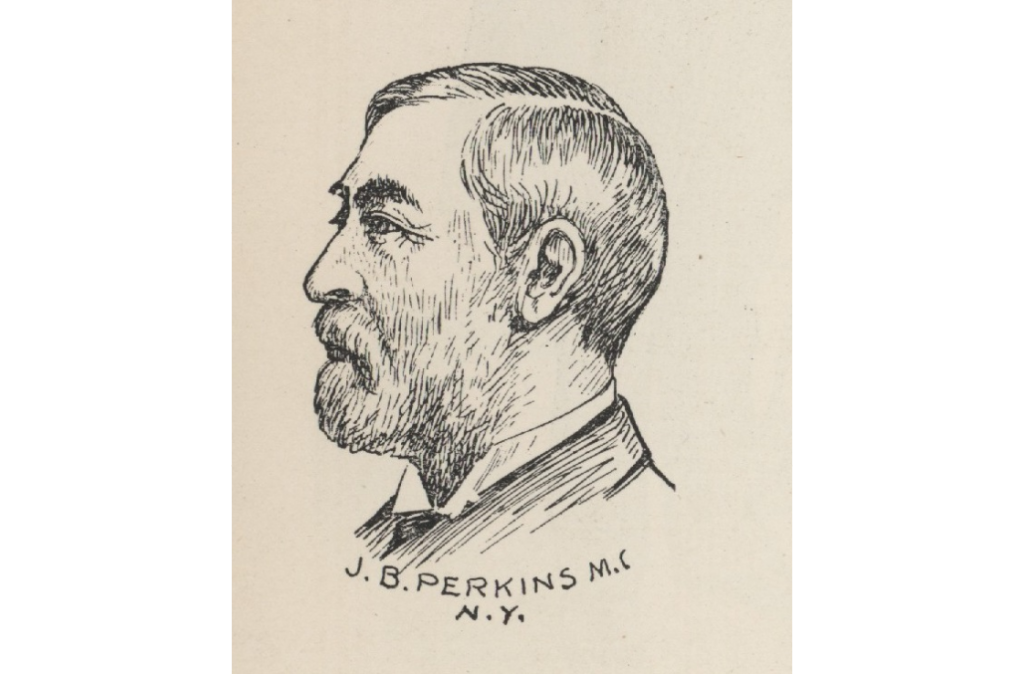
A week later, the Perkins committee returned with a resolution suggesting that Roosevelt’s annual message had constituted a “seemingly unprovoked and unjustified attack upon the honor, the honesty, and the reputation of the legislative branch of the Government.” It demanded that the President supply “any evidence” for his accusation that Members and Senators were afraid of a Secret Service investigation, and any evidence of corruption that would spark such an investigation. The sentiment was bipartisan. “The American people have the right to know,” stated Williams, the Democratic Leader, “if the American Congress be corrupt . . . and the President having made the statement to the effect that the entire body of the National Legislature has been actuated by the corrupt motive of shielding criminal Congressmen, we have thought it was right . . . to give him all opportunity to establish the fact that he had some reason for making that statement.” The resolution was adopted overwhelmingly.
Roosevelt took his time responding to the House, especially as newspapers around the country detected growing support for the President. When his reply arrived in the House on January 4, 1909, almost three weeks after the Perkins committee resolution, Members listened to the message closely. At first, grim laughter periodically interrupted the clerk, but Members soon listened with increasing anger. The President was astonished that the House had misunderstood his message, so he quoted the entire Secret Service section again. A “careful reading,” Roosevelt added, would have dispensed with the charge that Members feared a Secret Service investigation. “I have always not only deprecated but vigorously resented the practice of indiscriminate attack upon Congress, and indiscriminate condemnation of all Congressmen,” including the “wise and unwise, fit and unfit, good and bad alike.”
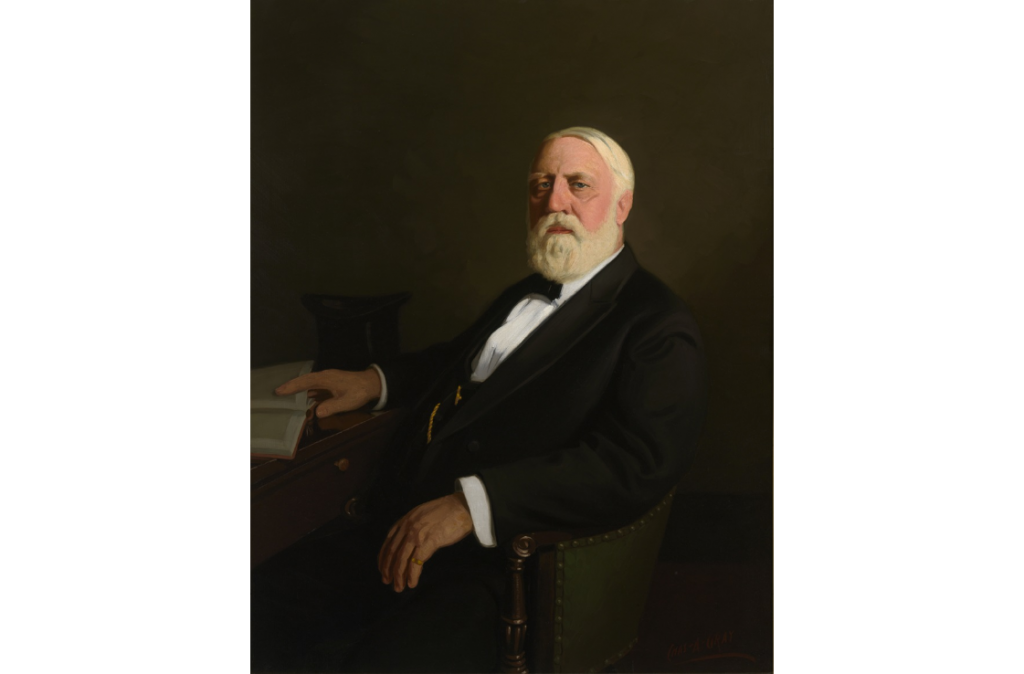
Roosevelt recalled in detail how the House Appropriations Committee added the restriction against the use of the Secret Service, and he blamed a 1905 article for planting the idea that agents would be used to investigate Members of Congress—an article, he pointed out, written by a member of Speaker Cannon’s own staff. He concluded by reminding Congress of how essential the Secret Service had been in bringing criminals to justice—including an associate of Representative Walter I. Smith of Iowa, one of the Congressmen who pushed to rein in the Secret Service. The President closed by demanding a pay raise for the Secret Service chief.
The House received the message in “dead silence,” and Perkins asked that it be referred to his committee. When the House adjourned a reporter observed that “members on both sides remained talking excitedly on the floor of the chamber like a swarm of infuriated bees.” The press raced to catch the reactions of individual Members. “There never was such a message,” said Joseph W. Keifer of Ohio. “I don’t feel particularly like talking about it myself, as I was not one of those he jumped on. I just came in along with the rest of the House who, according to the President, either through dementia or imbecility or something equally as good followed the lead of [the Appropriations Committee] without knowing what we were doing. We were only knaves in his first message, but now we are fools, too. There never was such a message.” Presidential defenders were scarce. “The truth of the whole matter is that the President does not know how to make a graceful apology,” was all that James R. Mann of Illinois could say.
Over the next four days Capitol Hill buzzed about Roosevelt’s message and possible responses to it. The Perkins committee worked behind closed doors, but House Members “understood that drastic measures [were] being considered.” Word came that the committee would make its report on January 8, and soon Members were “preparing speeches to follow the report of the ‘spanking committee.’ ”

On the day scheduled for the Perkins committee report, Members and visitors filled the House Chamber expecting an entertaining and explosive debate. Administration figures, however, were nowhere to be found—even the President’s son-in-law, future Speaker Nicholas Longworth of Ohio, avoided the House that day.
Perkins spoke to a tense chamber. “We are unanimously of the opinion that the portions of the message objected to do constitute a breach of privileges of this House,” he announced to cheers from his colleagues. Edwin Denby followed by chastising the President for a message that fell within the “realm of personal abuse, suspicion, and innuendo.”
The committee reported a privileged resolution with three components in light of Roosevelt’s messages. The first would have the House decline “to consider any communication from any source which is not in its own judgment respectful.” Translation: the House would simply ignore messages from the President if they didn’t convey the proper deference. The second recommendation promised to table the part of “the President’s annual message as relates to the Secret Service.” And the third called on the House to table Roosevelt’s entire response from January 4. What the committee proposed was similar to what the Senate had done in 1834 when it refused to receive messages it had found abusive from President Andrew Jackson.
Timely Arrivals

Just as Denby finished speaking, the Doorkeeper announced the arrival of presidential messages which caused the laughter which caused Speaker Cannon to pound his gavel so hard he broke his desk which finally caused the House to quiet down. Cannon quickly determined the messages were all about routine issues, and debate resumed.
Congressman Weeks pronounced to applause that unless the House approved the committee recommendations “it would not only convict itself of a lack of proper self-respect, but it would indicate a degree of supineness [sic] which would make it contemptible in the eyes of the people of this country, and even in the eyes of the President himself.”
The President’s defenders faced a much more difficult task. Only four “Roosevelt men” ventured to speak, and New York’s Michael E. Driscoll made the only serious effort. In an emotional defense, he lamented that actions of such minor “historical significance” marred the end of a highly successful administration. Charles E. Townsend of Michigan weakly offered that tabling the President’s messages would do nothing to contradict the charges Roosevelt made. And Augustus P. Gardner of Massachusetts unsuccessfully tried to divert the House by substituting an expression of confidence in the members of the Appropriations Committee rather than rebuking the President. After seven hours of debate the House voted 212 to 36 to adopt the committee report admonishing President Roosevelt.
Roosevelt wrote to his son about this congressional “brainstorm” and noted “I do not see how the House can get away from what I have said about it.” The House will remain, he concluded, but “I will no longer count, appreciably, for Taft will be President.”
Speaker Cannon had been invited to a dinner in his honor the night the House voted to reprimand the President, but the late proceedings caused a delay in his arrival. Evening clothes were brought to the Capitol, and after the House closed for the day the Speaker changed in his office and rushed off. Fortunately, he only had to make a short trip down Pennsylvania Avenue. With remarkable timing, the dinner in Cannon’s honor was being hosted by the President and Mrs. Roosevelt at the White House. Despite the boisterous debate in the House just a few hours earlier, word from the dinner was that Cannon “was received with considerable good nature.”
Sources
- Congressional Record, 60th Cong., 1st sess. (1 May 1908): 5553–5560
- Congressional Record, 60th Cong., 2nd sess. (11 December 1908): 140–141
- Congressional Record, 60th Cong., 2nd sess. (4 January 1909): 458–464
- Congressional Record, 60th Cong., 2nd sess. (8 January 1909): 645–684
- Baltimore Sun, 9 January 1909; Boston Daily Globe, 9 January 1909
- Chicago Tribune, 9 January 1909
- Detroit Free Press, 11 December 1908
- New York Times, 9 December 1908, 11 December 1908, 12 December 1908, 5 January 1909, 8 January 1909, 9 January 1909
- New-York Tribune, 9 January 1909
- San Francisco Chronicle, 9 January 1909
- St. Louis Post-Dispatch, 10 December 1908
- Washington Post, 9 December 1908, 12 December 1908, 5 January 1909, 6 January 1909, 9 January 1909
- Theodore Roosevelt, “Eighth Annual Message,” December 8, 1908, ed. Gerhard Peters and John T. Woolley, The American Presidency Project, http://www.presidency.ucsb.edu/ws/?pid=29549
- Theodore Roosevelt, The Selected Letters of Theodore Roosevelt, ed. H.W. Brands (New York: Cooper Square Press, 2011)
- Willard B. Gatewood Jr., Theodore Roosevelt and the Art of Controversy: Episodes of the White House Years (Baton Rouge: Louisiana State University Press, 1970)
- Lewis L. Gould, The American Presidency, 2nd ed. (Lawrence: University Press of Kansas, 2009)
- William E. Leuchtenburg, The American President: From Teddy Roosevelt to Bill Clinton (New York: Oxford University Press, 2015)
- Merrill D. Peterson, The Great Triumvirate: Webster, Clay, and Calhoun (New York: Oxford University Press, 1987)
Originally published by the Office of the Historian, United States House of Representatives, 04.05.2018, to the public domain.
About the Author