
By Liza Ramrayka
Retirees Mary-Jo and Joe Ginorio have lived in the same modest house in the West Winston Manor neighborhood of South San Francisco for more than 30 years. It’s no surprise: They know all their neighbors, have relatives living nearby, love the area’s diversity, and enjoy being able to walk to their local stores. More surprising to them is that their adult son and daughter (plus her family) have all returned to live at home in recent years because of high rents and house prices in the Bay Area.
The Ginorios, who are in their early 60s, always expected that their children would live near where they work, as they themselves had done for nearly 40 years in the Bay Area. But a few years ago, that looked increasingly unlikely.
Their son, who works for a local city council, was paying a hefty $800 a month to rent a single room in a shared house without laundry facilities or parking before he moved back home. He earned too much for housing assistance based on local low income limits, but not enough to comfortably afford market-rate rents.
Meanwhile, the Ginorios’ daughter (a part-time dance instructor) and son-in-law (an artist) needed to move in with them temporarily while they saved for a mortgage for a home for themselves and their two young children.
“None of us saw any of that happening,” admits Mary-Jo Ginorio, who grew up in San Francisco’s Mission District with her Mexican and Italian parents before she got married and moved out of the city. “But prices out here are ridiculous: Houses in our neighborhood are selling for over $1 million and renters need at least $5,000 for the first and last month’s rent. Most people just can’t afford that.”
Faced with housing five adults, two young children and a dog in their 1,050-square-foot, three bed/one bath home, the Ginorios decided to create an additional living space on their 6,000-square-foot lot. Known in the trade as an accessory dwelling unit, it comprises a detached structure with a single bedroom and bathroom in their backyard. Their son pays toward utilities and upkeep in return for access to cooking and laundry facilities in the main house.
The Ginorios’ situation is one shared widely, especially among public sector workers such as teachers and nurses in the prohibitively expensive Bay Area. In the best circumstances, these people have to take a lengthy commute from cheaper outlying towns. At worst, it means sharing cramped housing or even taking on a second job to cover the rent.
Historically, single-family zoning across the country has contributed to racial and economic segregation.
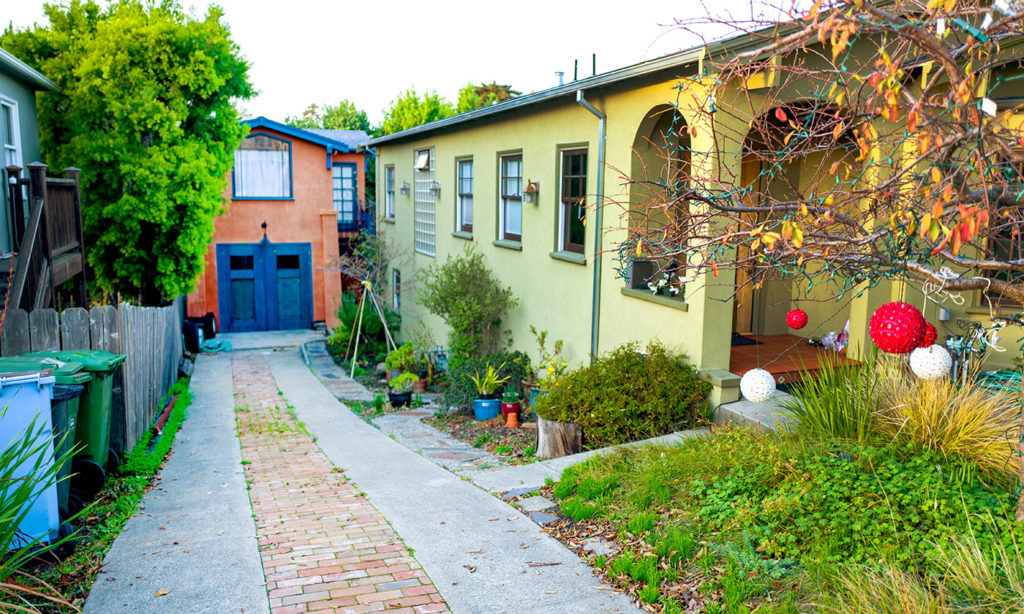
Finding creative solutions to this problem is one aspect of what Berkeley-based architect Daniel Parolek and his firm, Opticos, have been doing for more than a decade. Parolek coined the phrase “missing middle housing” back in 2010 to describe what he identified as a gap in the market for house-scale buildings with multiple units in walkable urban neighborhoods. He argues that dwellings such as duplexes, fourplexes, and bungalow courts provide much-needed diverse housing options for those middle-income renters and buyers.
Typically, these options have been “missing” because they have been made illegal or discouraged by the country’s planners since the mid-1940s. And they sit in the “middle” of a spectrum between detached single-family homes and mid-rise to high-rise apartment buildings.
“The concept of missing middle housing for us primarily started out with a focus on the range of housing types that historically has delivered a broad range of housing choices across the country,” Parolek explains. “First, it’s about scale; then we talk about it delivering affordability, particularly for middle income households on 60 percent average median income or higher.”
In one triplex near Parolek’s home, for example, his son’s kindergarten teacher lives in one unit, while her mother—a first-grade teacher at the same school—lives in the second unit; the third is occupied by her brother, a P.E. teacher at the local middle school. Parolek is convinced that the trend towards multi-generational living and the need for middle-income professionals to live near the workplace, combined with an appetite for more walkable environments, is enough to support public transport and neighborhood services such as shops and restaurants.
Even more compelling perhaps is what missing middle housing represents to racial diversity. Historically, single-family zoning across the country has contributed to racial and economic segregation because it creates a physical divide between affluent and working-class households. Missing middle housing promises more of a neighborhood blend, based on socioeconomic commonalities.
Opponents such as San Francisco’s residents’ associations argue that such developments put added pressure on already dense neighborhoods and that rezoning threatens to change the character of single-family home communities. Another argument used by tenants’ groups, including the Alliance for Community Transit LA, to defeat California’s SB 50 housing bill in the state Senate in January, is that this approach could further exacerbate displacement of low-income residents.
SB 50 would have rewritten zoning laws to support multi-unit buildings near transit centers. It could have helped meet California Gov. Gavin Newsom’s ambitious target of building 3.5 million new homes by 2025.
Kristy Wang, community planning policy director at Bay Area civic planning organization SPUR, hopes any new iteration of the legislation will keep up the pressure on legislators to support multi-unit buildings. “It’s really important to change these rules to allow for more people to live in our neighborhoods,” she says. “Zoning is a barrier to missing middle housing.”
According to U.S. census data, almost two-thirds of California residences are single-family homes. And a 2018 survey by U.C. Berkeley’s Terner Center for Housing Innovation estimates that between one-half and three-quarters of the state’s developable land is zoned for single-family housing only. While widespread rezoning has yet to come, the state has in the past year passed legislation to make it easier to build dwelling units like the Ginorios’ backyard cottage, plus in-building ‘junior’ ADUs—effectively creating up to three units on one lot.
The Census Bureau’s building permits survey shows single-family homes still dominate the housing market, with 4.6 million permitted in the last five years, compared to 215,400 two- to four-unit homes over the same period. Parolek attributes developers’ slow response to building missing middle housing to local planners being stuck in their ways: “I think so few cities have policies and zoning in place to enable missing middle housing that it’s not a huge incentive to be in that arena. They have a proven system that’s been working for decades so it’s really hard to make change within that institutional system.”
But the system clearly is no longer working for everyone. In 2019, Berkeley city council members unanimously approved a proposal for a missing middle survey based on initial report recommendations for multi-unit dwellings that are compatible with single-family homes and affordable for people who earn 80% to 120% of the area’s median income. A key proposal expected from the survey, anticipated this year, is for existing houses or zoning envelopes to be divided into up to four units.
Council member and report co-sponsor Rashi Kesarwani says missing middle housing could give young adults who grew up in Berkeley the opportunity to remain or return to live in a unit built on their parents’ property, or help an aging senior who needs to create a second unit for an on-site caregiver or for supplemental retirement income.
Berkeley’s median house price of around $1.2 million excludes many from living there, she says. “There’s a vast middle class—teachers, firefighters, police officers, electricians, small business owners—who make our community what it is and who also need housing options,” Kesarwani says. “Duplexes, triplexes and backyard cottages are part of the solution.”
Even though California has become notorious for its sky-high housing prices, the lack of housing for middle income people is a nationwide problem. Other cities across North America also are taking steps to increase the housing supply for those who can’t afford expensive single-family homes but make too much to qualify for local assistance.
The most radical solutions so far came from Minneapolis, which made headlines in December 2018 when the city council voted to end single-family zoning in favor of zoning for multiple-unit housing, such as duplexes and triplexes. As part of the city’s plan to tackle many issues such as housing affordability, racial equity and climate change, the move is designed to provide more housing options and more walkable communities in a city whose population grew by 37,000 between 2010 and 2016, but which also has lost about 15,000 low income housing units since 2000.
To stimulate missing middle housing, the Minneapolis City Council launched a $500,000 pilot program in summer 2019, inviting proposals for developments with between three and 20 units. Project recommendations providing a total of 50 units, of which 28 would be affordable, were approved in February.
Kevin Knase, Minneapolis’ senior project coordinator for residential and real estate development, says the program received 21 applications and involves the city funding supporting affordable units that help spur larger private developments.
“Say someone is building a triplex,” he explains. “They can build one that is market rate and two will be affordable. We’re providing financing for the affordable units.”
Other cities and states are advancing missing middle housing:
• In Oregon, whose population grew by more than 400,000 new residents in the past decade, the passage and signing into law of House Bill 2001 in 2019 effectively put an end to single-family zoning, and re-legalized duplexes statewide, and fourplexes in cities with 25,000 or more residents.
• Portland, Oregon, is now in the public hearing stage on a plan to permit fourplexes on all lots — a response to “McMansionization” that would lower the maximum size of new buildings in low-density areas while allowing buildings to contain more homes. Michael Andersen, senior researcher, housing and transportation at Sightline Institute, a Pacific Northwest think tank, says Portland’s residential infill project stands to become “the most progressive reform to low-density zoning in American history.”
• Vancouver, British Columbia, legalized duplexes in 2018 and is actively encouraging ADUs such as basements, secondary suites and backyard cottages as part of its Making Room program to deliver 10,000 missing middle homes over 10 years. The city issued permits for 479 ADUs in 2019 and 38 already in 2020. The city is supporting “gentle densification” of residential blocks near major arterial routes, which in future could include triplex, fourplex and multi-unit dwellings.
• Seattle Mayor Jenny Durkan convened the city’s first Affordable Middle-Income Housing Advisory Council in January 2019 to explore ways to fill the gap between market-rate housing and the housing needs of middle-income families. According to the council’s first report released in January 2020, Seattle has added nearly 140,000 jobs and 122,000 people in the past decade, but 85% of jobs remain in occupations that pay on average less than $100,000 per year. Recommendations include increasing the number of triplexes and cottages, adding to the city’s progressive ADU legislation passed last year that allows two ADUs per lot, and a size limit on new houses.
• And Washington state’s Senate Bill 6536 would relegalize duplexes, triplexes and up to six-plexes in certain areas. Dan Bertolet, Sightline’s research director for housing and urbanism, asserts that state standards “hold cities accountable to do their part and work together across city boundaries,” while giving each community flexibility to make it work in their local context. Microsoft recently announced a $500 million commitment to supporting affordable housing in the greater Seattle area, an implicit acknowledgement of the tech industry’s role in driving up housing prices.
Creative financing solutions such as the Minneapolis program can help incentivize middle missing housing. The San Francisco Housing Accelerator Fund was created by the city in 2014, amid rising rents and a spike in evictions, as an independent financing agency that could work more quickly and more flexibly than the public sector to fund affordable housing development. It makes bridge loans to community-based nonprofits to buy and preserve rent-controlled properties in the city and prevent tenants from being replaced.
Kate Hartley, chief lending and investment officer at the fund, believes such interventions can help spur the growth and development of missing middle housing: “It really gets to what our cities need, which is to help protect our existing communities, help create housing stock where there are a wide range of incomes, and stop the change in demographic through vacancy decontrol that is driving up average income in our cities.”
In South San Francisco, Mary-Jo Ginorio welcomes a return to multigenerational living in her neighborhood, which perpetuates the diversity she so loves there. And she’s excited to see sector-specific housing solutions, such as nearby Jefferson Union High School District’s voter-approved, bond-backed development that broke ground Feb. 5 and will create a four-story building of 122 below-market rate housing units exclusively for teachers and school employees.
Parolek of architectural design firm Opticos has been engaging stakeholders through local walking tours in Berkeley, and nationwide talks to spread the word about the benefits of missing middle housing. His book, Missing Middle Housing, is scheduled to be published in July 2020. In it, he shares ideas and best practices in missing middle housing development that is he hopes will encourage greater support for this approach.
“I would hope that some of those bigger stakeholders, for example employers, will step up and realize they need to put mutual support behind trying to find solutions,” he says.
Originally published by Yes! Magazine, 02.27.2020, under a Creative Commons Attribution-NonCommercial-NoDerivatives 4.0 International license.
About the Author