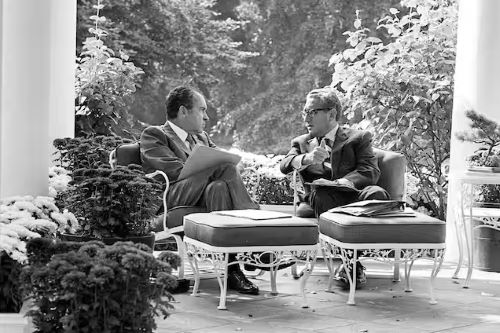
His power- and transactionalist-oriented approach to foreign policy produced a series of destructive outcomes.

By Dr. Jarrod Hayes
Associate Professor of Political Science
UMass Lowell
Introduction
Henry Kissinger, who died on Nov. 29, 2023, at age 100, exercised more than 50 years of influence on American foreign policy.
I am a scholar of American foreign policy who has written on Kissinger’s service from 1969 to 1977 as national security adviser and secretary of state under the Nixon and Ford administrations. I have seen how his foreign policy views and actions played out for good and, mostly, for ill.
When Kissinger entered government as Richard Nixon’s national security adviser, he espoused a narrow perspective of the national interest, known as “realpolitik,” primarily centered on maximizing the economic and military power of the United States.
This power- and transactionalist-oriented approach to foreign policy produced a series of destructive outcomes. They ranged from fomenting coups that put in place murderous dictatorships, as in Chile, to killing unarmed civilians, as in Cambodia, and alienating potential allies, as in India.
Damaging Approach
In his dissertation turned first book, Kissinger argued foreign policymakers are measured by their ability to recognize shifts in political, military and economic power in the international system – and then to make those changes work in their country’s favor.
In this model of foreign policy, the political values – democracy, human rights – that make the United States a distinctive player in the international system have no role.
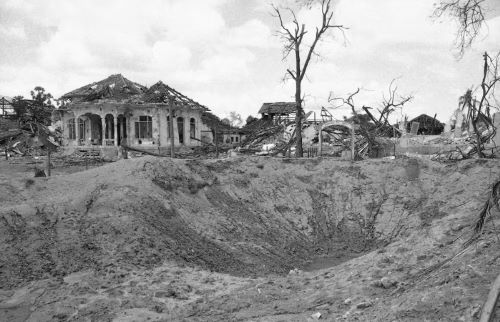
This perspective, with its self-declared realistic agenda, along with Kissinger’s place at the top of the foreign policy establishment as national security adviser and secretary of state for the better part of a decade, made Kissinger into something of a foreign policy oracle for American policymakers of all stripes.
Yet Kissinger’s record reveals the problems with the narrow conception of national interest devoid of values. His time in government was characterized by major policy decisions that were generally detrimental to the United States’ standing in the world.
Cambodian Carnage
When Nixon took office in 1968, he had promised an honorable end to the war in Vietnam.
Nixon faced a problem, however, in trying to gain control of the conflict: the porousness of Vietnam’s borders with Cambodia, through which supplies and soldiers from North Vietnam flowed into the South.
To address this problem, Nixon dramatically escalated a bombing campaign in Cambodia started under his predecessor, President Lyndon Johnson. Nixon later initiated a ground invasion of Cambodia to cut off North Vietnamese supply routes.
As William Shawcross details in his defining book on the subject, Kissinger supported Nixon’s Cambodia policy.
Despite the fact that Cambodia was not party to the conflict fought in Vietnam, U.S. bombing of Cambodia is estimated to have exceeded the total tonnage of all the bombs dropped by the U.S. during World War II, including the nuclear bombs at Hiroshima and Nagasaki.
The campaign killed tens of thousands of Cambodians and displaced millions. The destruction caused by the bombing as well as partial American occupation in 1970 were crucial to creating the political and social instability that facilitated the rise of the genocidal Khmer Rouge regime. That regime is estimated to have killed 2 million Cambodians.
Supporting a Genocidal Leader
In 1970 and 1971, Nixon, with Kissinger’s advice and encouragement, supported Pakistan’s dictatorial president Yahya Khan in his genocidal repression of Bengali nationalists and war against India.
That conflict is estimated to have killed at least 300,000 and possibly more than a million Bengalis. Khan targeted for complete elimination the Hindus in what would become Bangladesh.
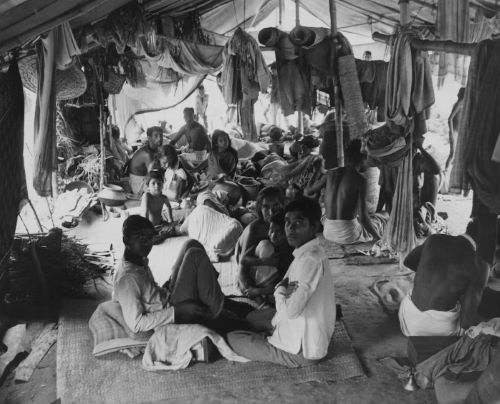
In frustration at pressure from India over the subsequent refugee crisis, Kissinger agreed with Nixon that India – a fellow democracy bearing the burden of millions of refugees from East Pakistan — needed a “mass famine” to put the country in its place.
The duo went so far as to send an aircraft carrier battle group to threaten India after it suffered a series of cross-border attacks by Pakistan.
Nixon and Kissinger’s policy in support of Pakistan during a period of unvarnished brutality and aggression played a significant role in pushing India toward an alignment with the Soviet Union. Nixon and Kissinger injected distrust of the United States into the foundations of Indian foreign policy, dividing the world’s oldest and largest democracies for decades.
Exploiting Kurds, Empowering Saddam
In 1972, Kissinger agreed to a request from the Shah of Iran to provide military aid to Kurds in Iraq who were seeking an independent homeland. Iran’s goal was to put pressure on the Iraqi regime controlled by Saddam Hussein, while Kissinger sought to keep the Soviets out of the region. The scheme was predicated on the Kurds’ belief that the United States supported Kurdish independence, a point the Shah noted. But the U.S. abandoned the Kurds on the eve of an Iraqi offensive in 1975, and Kissinger coldly noted that “covert action should not be confused with missionary work.”
Ultimately, the Iraqi defeat of the Kurds would empower Hussein, who would go on to destabilize the region, kill hundreds of thousands of people and fight unprovoked wars with Iran and the United States.
‘Amoral Vision’
After Kissinger left government service in 1977, he founded Kissinger Associates, a geopolitical consulting firm. Publicly, Kissinger consistently advised U.S. policymakers to bend U.S. policy to accommodate the interests and actions of important foreign powers like Russia and China.
These positions were consistent with Kissinger’s demonstrated willingness to trade away rights of others to gain advantage for the U.S. His positions also presumably enabled Kissinger Associates to maintain access with the foreign policy elites of those countries.
In May 2022, Kissinger publicly argued that Ukraine, a victim of unprovoked aggression by Russia, should cede portions of its internationally recognized territory seized by Russia – as in Crimea – or by Russian proxies such as the Donetsk People’s Republic.
Kissinger also maintained that the United States should accommodate China, arguing against a concerted effort by democracies to counter the rising power and influence of China.
Foreign policy is a difficult field, fraught with complexity and unanticipated consequences. Kissinger’s vision, however, does not offer a panacea to the challenge of American foreign policy.
Over decades, Kissinger’s amoral vision of national self-interest has produced its own set of disasters, a reality the American public and foreign policy leaders are well-advised to bear in mind.
Originally published by The Conversation, 12.14.2022, under the terms of a Creative Commons Attribution/No derivatives license.
About the Author