
White southerners and their political leaders oppose immigration reform more than anyone else in the United States.

By Steve Suitts
Adjunct Professor of History
Institute for Liberal Arts
Emory University
Donald Trump kicked off his large presidential campaign rally in Mobile, Alabama, on August 21, 2015, by amplifying his hardline position on immigration: build a “Chinese wall” on the Mexican border, deport all immigrants without legal status, and deny citizenship to children born in the United States if their parents are not lawful residents. A crowd of at least twenty thousand, almost all-white, roared their approval of Trump’s condemnation of undocumented immigrants—a sentiment many Alabamians apparently share. In the state’s latest poll, Trump is leading all other candidates by almost 20 percentage points.
Republican voters in the heart of Dixie are not alone. White southerners and their political leaders oppose immigration reform more than anyone else in the United States. Nearly half (46 percent) of all Americans who want to deny undocumented immigrants any means citizenship are southerners, primarily white southerners.1 According to the Public Religion Research Institute’s 2013 report, 65 percent of the South’s Republicans, most of whom are white, believe the government should deport all illegal immigrants, and 63 percent of working-class white southerners believe that immigration is changing society for the worse.
Ten of the eleven states of the Old Confederacy joined sixteen other states across the West and Midwest in a November 2014 federal lawsuit that currently blocks President Obama’s executive order to provide a path to citizenship to almost four million illegal immigrants. Representatives from majority-white congressional districts in all states of the former Confederacy provide the bulk of opposition to immigration reform in Washington. Had Congress voted last year along the same lines as almost all representatives from southern states, legislation would have passed barring the President’s executive order creating a path to citizenship, rolling back his earlier order giving young immigrants a chance to stay with their families, and shutting down the Department of Homeland Security as a way to defund reform that might provide citizenship to anyone not lawfully in the US.
Hostility to immigrants has a long tradition in the white South, but it remains a profound, haunting irony, especially during the 150th anniversary of the Civil War. Many white southerners today are citizens, even though their ancestors took up arms against the United States and by their own reckoning gave up US citizenship to become part of a rebel nation. These same white southerners are US citizens today only because their ancestors benefited from a general, generous amnesty (far more than any group in this nation ever has) and from the passage of the Fourteenth Amendment to the US Constitution, which Trump and his supporters, in effect, want to annul.

We forget what secession and the creation of the Confederacy meant for citizenship. The states that seceded believed that it was their right to abandon the United States and to create their own nation in which they became citizens. Like other confederate states, Alabama’s ordinance of secession declared that the state and its people had “withdrawn from the Union known as ‘the United States of America,’ and henceforth ceases to be one of said United States, and is, and of right ought to be, a sovereign and independent State.” The seceding states became “Independent Republics” that came together to “form… a Republic Government of Confederate States, whose right to exist should be peaceably recognized by all nations.”2
President Lincoln did not believe that southern states had a right to secede and considered their actions a rebellion. But after South Carolina attacked the federal fort in Charleston harbor and war ensued, the United States government and its federal courts oscillated between treating Confederates as “rebels” of an insurrection and “enemies” of a warring nation. The Lincoln administration took great pains to avoid any formal recognition of the “Confederate States of America,” but Congress and federal courts often referred to both a rebellion and a war between nations.3
White southerners who organized, supported, and fought for the Confederacy were traitors to the United States, punishable for treason. They renounced US citizenship to become citizens of their own nation-states and the Confederacy. They had become Southerners, not southern citizens of the US. By right, these Confederates should have paid the penalties of treason, which a 1791 law established as death, and/or the loss of all rights and privileges of US citizenship.
As it turned out, almost every white Confederate suffered no denial of life or citizenship through the federal government’s actions after the war. When General Lee surrendered at Appomattox, General Grant put confederate troops “on parole” and sent them home.
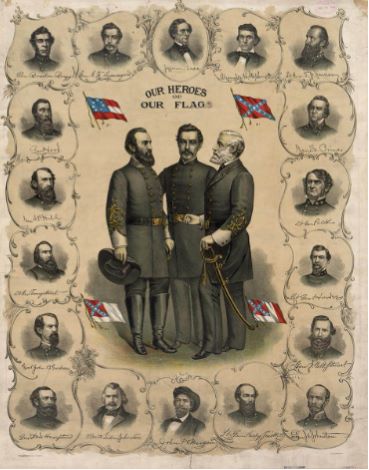
As a condition of voting or holding office, whites in the post-Civil War South were initially required to sign oaths affirming that they had never borne arms against the United States or supported armed hostility. There were some who had not fought against the United States (such as those in Winston County, Alabama, my county of birth), and they had little problem with the stipulation. Most former Confederates, however, saw the oath as an unfair act of disenfranchisement, as if their participation in four years of bloody war with the United States should have no bearing on their immediate return to full rights of citizenship. Some provisional governments, set up in the Reconstruction South by US military generals, also demanded that white southerners seeking to vote affirm their acceptance of “the equality of all men.”4
Presidents Lincoln and Johnson both issued administrative orders providing amnesty and pardons to most Confederates. On Christmas day, 1868, Johnson issued a universal amnesty and a restoration of “all rights, privileges, and immunities under the Constitution.” Five months earlier, the Fourteenth Amendment had become part of the Constitution, establishing right of citizenship for former slaves and for all persons “born or naturalized in the United States.” The amendment also effectively affirmed that all white southerners were now entitled to full citizenship rights, an entitlement they would be able to enjoy and exercise far more than black southerners during the ensuing century.
Several congressional leaders argued that universal amnesty for former confederate leaders was far too generous. Massachusetts senator Charles Sumner wanted as many as five hundred Confederates banished from the United States. During the War, Senator Lyman Trumbull of Illinois suggested that the options were “driving into exile, or killing on the battlefield, or hanging upon the gallows” all Confederates.5 Military and federal authorities charged or indicted a significant number of former confederate leaders, including Jefferson Davis late in the Reconstruction era, but presidents Johnson and Grant used their powers of amnesty and prosecutorial discretion to prevent most cases from going to trial.6
The Fourteenth Amendment initially included a section that acknowledged the earlier iron-clad oaths of secession by preventing any person who “engaged in insurrection or rebellion” or who had “given aid or comfort to the enemies” of the United States from holding federal or state office. A two-thirds vote of Congress could remove that disability. In 1872 Congress passed the General Amnesty Act permitting virtually all former Confederates to hold office.
Within another fifteen years, many ex-confederate generals reappeared as elected state and federal officials. With the Amnesty Act of 1898, no white southerner would have their full rights of citizenship questioned or abridged because they or their ancestors had participated in the Confederacy.

As Donald Trump continues to demonize all undocumented immigrants as dangerous illegals deserving no chance for US citizenship, his demagoguery will resonate with white voters only if our amnesia and hypocrisy about the history of citizenship persist. Indeed, if we apply the Golden Rule to matters of immigration in the context of southern history, white southerners will be the first to invite law-abiding, longtime residents of the United States to earn their citizenship in the country that many of our ancestors abandoned and attacked with no lasting penalty.
Endnotes
- Robert P. Jones, Daniel Cox, Juhem Navarro-Rivera, E.J. Dionne, Jr., and William A. Galston, What Americans Want from Immigration Reform in 2014: Findings from the Public Religion Research and Brookings Institutions’ Religion, Values, and Immigration Reform Survey, Panel Call Back, Washington, DC: Public Religion Research Institute (PRRI), released June 10, 2014.
- Clement A. Evans, ed., Confederate Military History: A Library of Confederate States History, Written by Distinguished Men of the South, Volume I (Atlanta: The Confederate Publishing Company, 1899). Reprint (Honolulu: University Press of the Pacific, 2004), 358.
- For more see, James G. Randall, Constitutional Problems Under Lincoln (Urbana: University of Illinois Press, 1964), 62–73, 96–117, 224–238; Phillip S. Paludan, A Covenant with Death: The Constitution, Law, and Equality in the Civil War Era (Urbana: University of Illinois Press, 1975), 36–49; E. Merton Coulter, The South During Reconstruction 1865–1877 (Baton Rouge: Louisiana State University Press, 1947), 30–32.
- For more see, Walter L. Fleming, Civil War and Reconstruction in Alabama (New York: Columbia University Press, 1905), 527; Dan T. Carter, When the War Was Over: The Failure of Self Reconstruction in the South, 1865-1867 (Baton Rouge: Louisiana State University Press, 1985) 24–31.
- Randall, Constitutional Problems Under Lincoln, 99.
- James A. Rawley, “The General Amnesty Act of 1872: A Note,” The Mississippi Valley Historical Review 47, no. 3 (December 1960): 480–484.
Originally published by Southern Spaces, 08.27.2015, republished with permission in accordance with the Budapest Open Access Initiative.
About the Author