

Defamiliarizing fame by exploring its roots in the ancient world.

By Dr. David Haven Blake
Professor of English
The College of New Jersey
Introduction
“Fame is a bee,” Emily Dickinson wrote in one of her last poems. “It has a song— / It has a sting—.” “Ah, too,” she added, “it has a wing.”
The poem captures Dickinson resigning herself to how ephemeral fame can be, how effortlessly it moves from one person to the next, pleasing, wounding, and deserting them as it travels across the earth.
Dickinson’s comparison came to mind as I prepared a course at The College of New Jersey on the history of fame. On campuses across the country, one can find fascinating classes dedicated to the study of stars like Beyoncé, Madonna, and Bruce Springsteen. My course took a different approach. It focused not on individual personalities, but on the long line of thinkers who have grappled with the meaning of fame.
Fame itself may be fleeting, but for centuries writers and artists have praised and lamented its grip on their lives. Dickinson is a case in point: Though she largely rejected publication and was virtually unknown in her time, she wrote about fame as a fundamental part of her humanity.
Today’s college students are part of a fame culture that is far more absorbing than the one in which their parents grew up. Waves of publicity crash over them daily, with Twitter, Instagram, and BuzzFeed now added to the mix of dorm-room posters and fanmagazines. But young people no longer see themselves as just spectators. Listen to the most savvy among them, and they’ll offer detailed strategies for “creating a personal brand” and “curating a digital identity.” As the phrase goes, they aim to optimize their presence in an attention-based economy.
My aim was to build a course that could defamiliarize fame by exploring its roots in the ancient world. I wanted students to see that fame was not always associated with glamor and excess. I wanted them to appreciate how previous cultures had integrated fame into treasured stories about virtue, character, mortality, and public life. But like Dickinson’s bee, our discussions took flight and frequently landed us in fields far removed from antiquity. In the end, my students discovered the remoteness of the past; what they taught me is its unmistakable presence today.
The Eternal Achilles
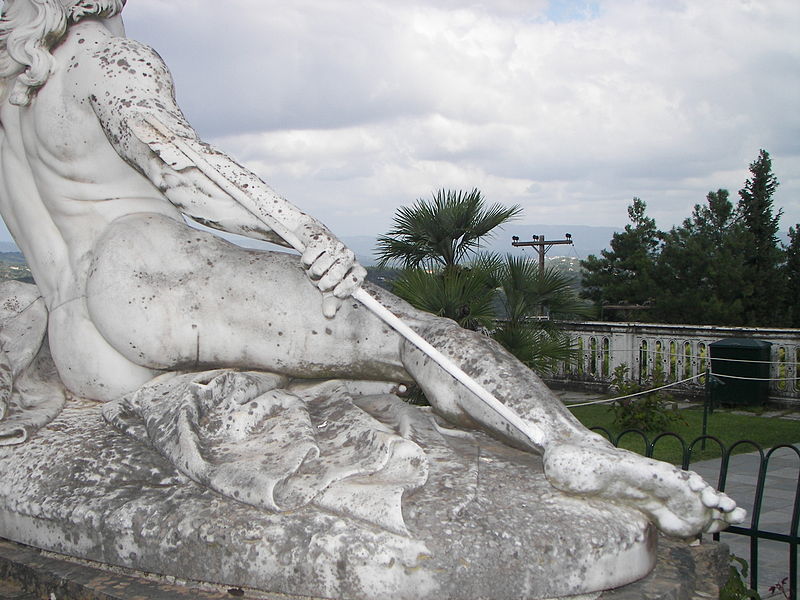
Our course began with Achilles, the great hero of Homer’s Iliad, who for centuries has epitomized the idea that fame is a kind of immortality. Disgusted by the waste of the Trojan War and suffering from injured pride, Achilles must choose between abandoning and rejoining the Greeks’ siege of Troy in the war’s ninth year. “Two fates bear me on to the day of death,” he laments:
If I hold out here and I lay siege to Troy,
my journey home is gone, but my glory never dies.
If I voyage back to the fatherland I love,
my pride, my glory dies . . .
true, but the life that’s left me will be long,
the stroke of death will not come on me quickly.
A mortal by birth, Achilles can either die fighting—and be celebrated—or return to his peaceful fatherland, where he will suffer in anonymity. Glory will give him new life and the godlike immortality that only artists and storytellers can confer.
Because heroics alone cannot preserve Achilles, he aspires to what the Greeks called kleos, which is the immortality that comes from being part of the poet’s song. Without a developed sense of an afterlife, the Greeks believed in the consecrating, imperishable power of art. Achilles has to die in Troy in order to claim his role in Homer’s narrative. His eternal fame remains inseparable from the artistic recreation of his feats.
The Greeks had significant reservations about fame, which, for many students, resonated with their own. In the Odyssey, Odysseus is punished for bragging after blinding the Cyclops, and, when he visits the Underworld, Achilles tells him that life as a slave would have been better than ruling over “the breathless dead.” But amid this ambivalence, we also saw how significant kleos continued to be. Hundreds of years after the Iliad,Alexander the Great recognized the importance of art in keeping his conquests alive. As designed by his favored sculptor, statues of Alexander relied on certain trademark features (the curl of his hair, the cast of his eyes) that identified him for posterity. Like a contemporary politician complaining about his press coverage, Alexander grumbled that, without a poet of Homer’s skill, his fame would be more transitory than that of his hero Achilles.
The Monster
Greek society was fragmented across scores of city-states, and ever hopeful of honor, its warriors entered into battle shouting their fathers’ names. The Roman Republic, however, centered fame in the capital city, a place of commerce, culture, and power. In the evolution of public life, my students and I discerned the beginnings of a thriving fame culture in which artists were no longer just the conferrers of fame, but also the subject of fame themselves. Horace proclaimed that his odes had built a memorial that would “outlast bronze,” a monument that would escape “the innumerable years.” “I will not wholly die,” Horace boasts. “I will grow on, / kept alive by posterity’s praise.” Some 1,600 years later, Shakespeare proved Horace right, drawing on these lines in sonnet 55’s declaration, “Not marble nor the gilded monuments / Of princes shall outlive this powerful rhyme.”
The Romans emphasized fame’s ability to circulate among different segments of society, and, from Cicero to Caesar, leaders learned to cast their accomplishments as part of the greater glory of the state. As we saw in Virgil’s epic poem the Aeneid, however, the public dimension of fame also made it difficult to control. Our discussion centered on Book IV in which Virgil recounts the role of Fama in spreading news about Aeneas’s love affair with the widow Dido, a love affair that was keeping him from leading his fellow Trojans to the shores of Italy.
The scene exemplified the way that the word fama in Ancient Rome encompassed both rumor and fame. After spotting Aeneas and Dido coupling in a cave, Fama (here translated as Rumor) flies across the continents with news of her discovery:
Rumor, quicksilver afoot
and swift on the wing, a monster, horrific, huge
and under every feather on her body—what a marvel—
an eye that never sleeps and as many tongues as eyes
and as many raucous mouths and ears pricked up for news.
“The swiftest of all the evils of the world,” Fama is a winged female monster with countless eyes, mouths, and tongues. She conveys the dependence of fame on gossip, on intrigue, on the conveyance of information and disinformation that keeps one in the public eye.
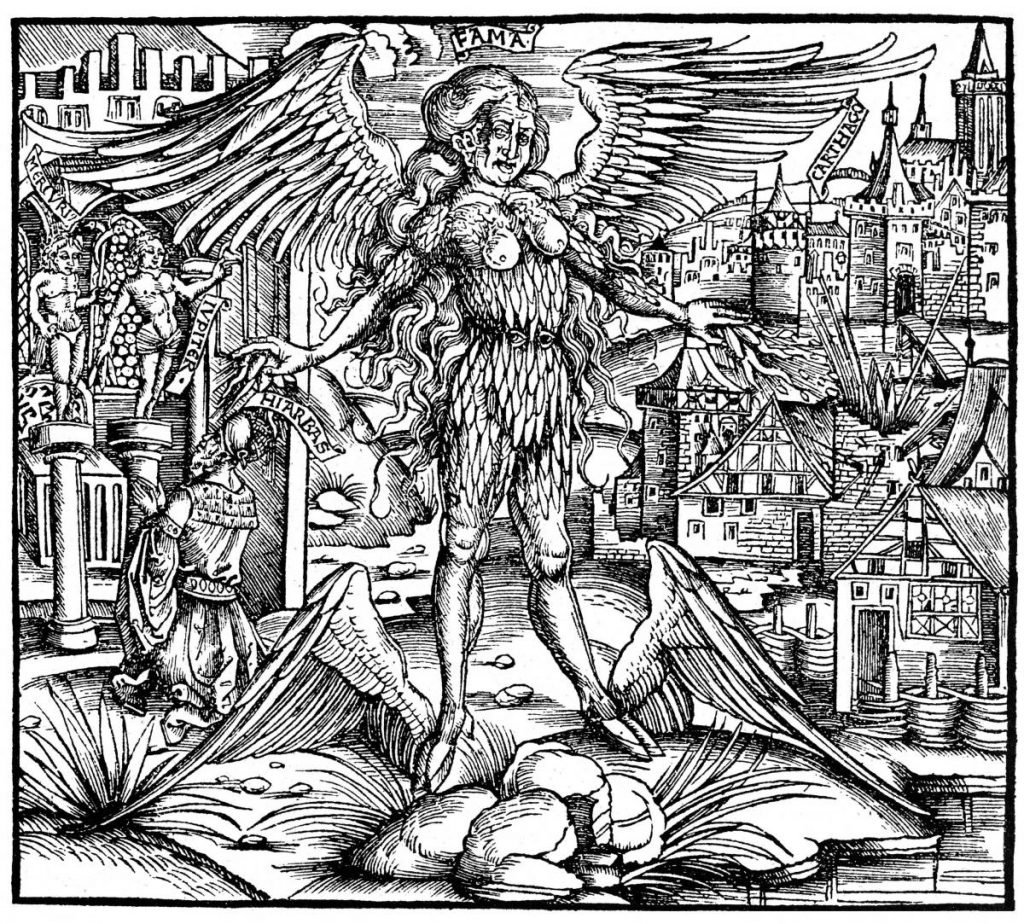
Horace reminded me of twenty-first-century rappers touting the supremacy of their rhymes, but Virgil’s portrait of Fama sent my students immediately to Lady Gaga’s The Fame Monster, the 2009 album with its panoply of would-be stars and relentless paparazzi. The Romanization of Lady Gaga happily continued over the following days as we turned to the poet Ovid’s vision of the House of Fame as a breezy mansion high above the earth with open doors and windows. The passage seemed eerily attuned to the frenzy of celebrity culture today.
Fickle crowds are always in that hall, that come and go, and myriad rumors—false tales mixed with true—are circulated in confusing words. Some fill their empty ears with all this talk, and some spread elsewhere all that’s told to them. The volume of wild fiction grows apace, and each narrator adds to what he hears. Credulity is there and rash Mistake, and empty Joy, and coward Fear, alarmed by quick Sedition, and soft Whisper—all of doubtful life. Fame sees what things are done in heaven and on the sea, and on the earth. She spies all things in the wide universe.
Ovid would later praise fame as a spur for accomplishment and praise, a motivator for seeking the admiration of others. But here in the Metamorphoses, fama reflected the unstable and capricious aspects of fame that my students traced from Rome to New York City. One student remarked that Ovid poignantly conveyed the feeling of daily life in the United States, a House of Fame in which cacophony and misinformation reign.
Jesus Christ . . . Superstar?
Ancient Rome was the backdrop for the radically new paradigm of fame that Jesus of Nazareth announced on the outskirts of Caesar’s empire. A story at once familiar and strange, the Gospel of Mark was especially appealing as a narrative about fame, for it insistently offers competing perspectives on earthly glory and heavenly immortality. The Latin word celebritatem means famous or thronged. With this definition in mind, my students found Jesus to be the most profound celebrity we encountered in the ancient world. Nearly everywhere Jesus goes in the Gospel of Mark, the crowds throng him. A desperate woman grabs his cloak, and he immediately feels his energy depart from him to her.
Rumor plays a critical role in the Gospel of Mark as, despite his protests, news of Jesus spreads across the countryside, flying from village to village and eventually to King Herod. (The news is so powerful, we joked, that even Jesus can’t stop it from spreading.) The claustrophobia in these scenes is overwhelming. Disciples plan escape routes so Jesus can avoid “being crushed by the crowd.” There are so many followers at the Sea of Galilee that Jesus has to preach the Parable of the Sower offshore in a boat. “And there he sat,” Mark tells us, “with the whole crowd on the beach right down to the water’s edge.”
But this astonishing portrait of celebrity—so pertinent to our time with its zealous, fickle crowds, rumormongering, and desperate desire for the charismatic, deified body—also contains the seeds of its own critique. That is, amid all the sweat, joy, and sorrow of his Roman-inflected fame, Jesus promises an afterlife that has nothing to do with art or popularity. He promises forms of glory and immortality that come from God rather than the imperial state.
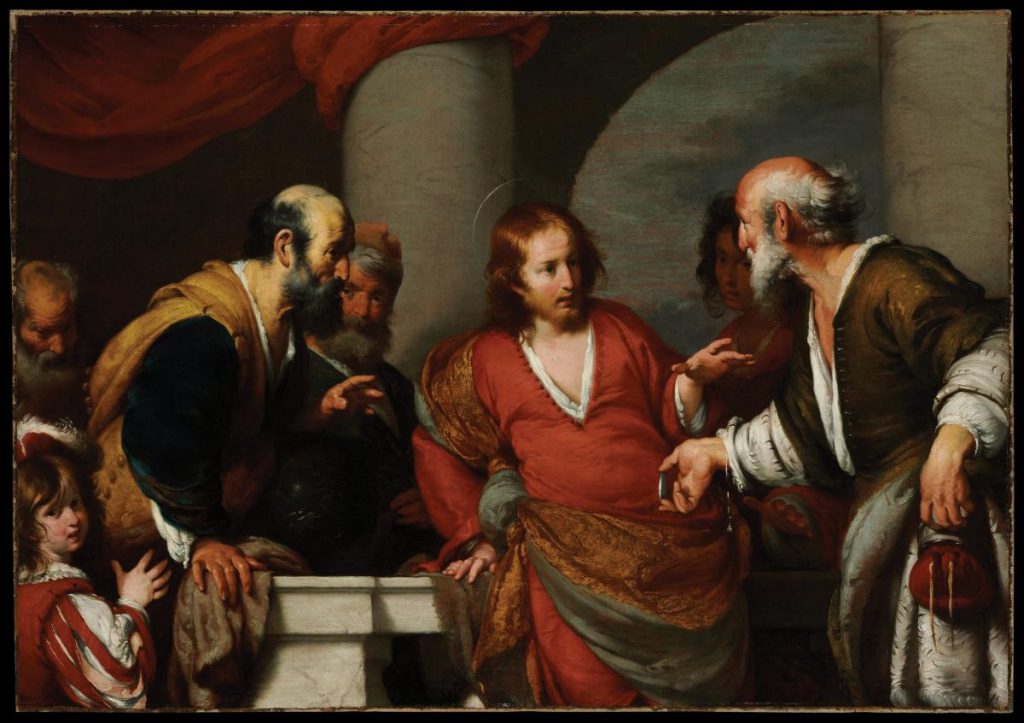
The Gospel presents two competing notions of fame when Jesus looks at a silver coin engraved with Caesar’s profile. Pretending we were in Jerusalem with him, my students and I examined an Internet image of the denarius coin ourselves, discussing how, in passing through the empire, it associated fame with power. The simplicity of Jesus’s response—“Pay Caesar what is due to Caesar and pay God what is due to God”—may have confused the disciples, but, some two thousand years later, my students understood that Caesar’s fame depended on the earthly principles of circulation and exchange. Jesus’s reputation may rise and fall according to caprice, but he also goes beyond the crowd in a perplexing way. If Caesar operates by visible laws, Jesus operates by invisible grace. The currency that creates and extends Caesar’s fame means nothing to Jesus whose promise of immortality hinges not on accomplishment or regard but belief.
The Education of Saint Augustine
Christianity’s subversion of fame reshaped the ancient world. When they read The Confessions by Saint Augustine, the class identified with the writer’s lament that he was addicted to reputation and fame. In surprising ways, the reading provided students with a version of themselves. Augustine’s description of his own student life—his love of theater and spectacle, his wallowing in lust, his gossiping about sexual conquests—could form the basis of a campus novel written anytime over the past century. But it was in his struggle with pride and glory that students saw millennial college students caught between their parents’ aspirations for them and their own sense of self.
A brilliant scholar and teacher, one of the greatest intellectuals of his age, Augustine tells us how earnestly he tried to set aside his “vain and empty ambitions.” He continually resolves to search for religious truth instead of acclaim. And yet, his thirst for praise won’t go away. At a moment of professional triumph, Augustine sees a beggar on the street and painfully concludes that the beggar’s desire for wine was less corrosive than his own desire for the intoxicant of glory. As it has done for centuries, The Confessions imparted the message that loving honor and reputation will lead spiritual seekers astray.
The debates over fame continued over the semester’s final weeks, and, at each stage, the students reevaluated our central terms of fame, glory, honor, renown, and celebrity. (An urban education major compared our texts to “an accumulation of building blocks,” each one necessary for the next day’s class.) We saw Petrarch reconcile the lure of fame with conventional Christian thinking, envisioning a series of allegorical parades in which Fame triumphed over Death, but Time and Eternity triumphed over Fame. We saw Montaigne reject earthly glory, while Dr. Faustus welcomed it to the point of infamy. We marveled at how Milton, Thomas Jefferson, and Alexander Hamilton all agreed that the “love of fame,” as the Federalist Papers put it, was “the ruling passion of the noblest minds.” And, on the last day, we returned to Virgil’s Fama, that flighty female beast, and saw her hovering in the background as Keats compared fame to a “wayward girl” and Dickinson linked it to a winged bee.
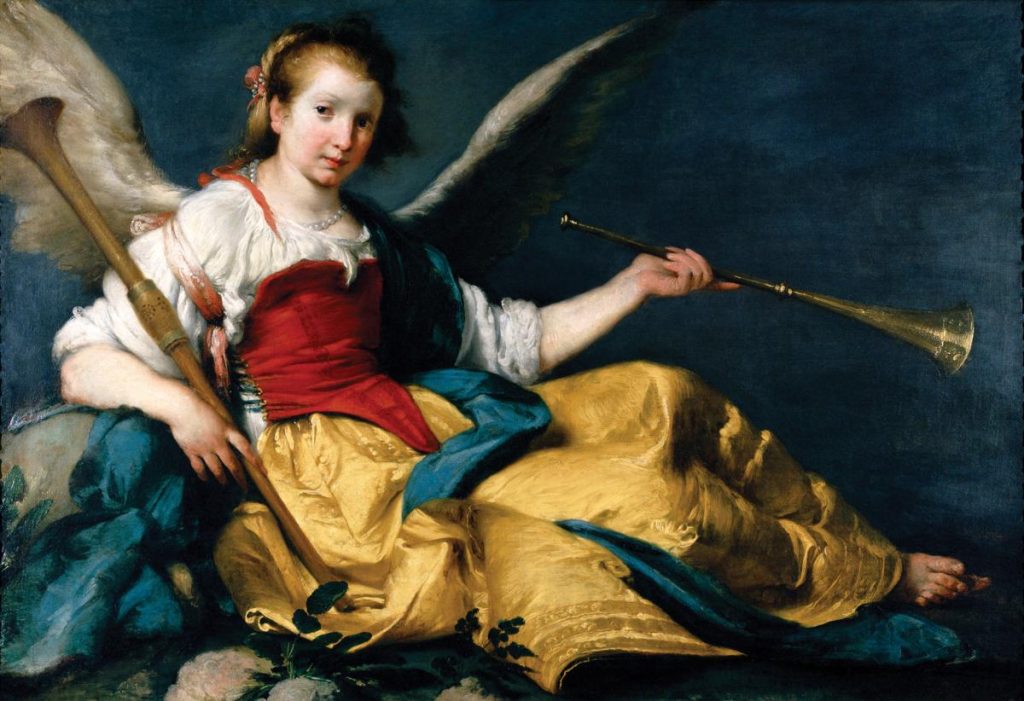
But, in the end, it was Saint Augustine who, for all his rigor, most tapped into my students’ complex response to the history of fame. On the most immediate level, they felt The Confessions beside them at concerts, movies, and football games. At times, Augustine and his friends seemed like other misguided fans, captivated by the spectacles that both enthralled and disgusted them. The students spotted in this early autobiographer a kindred spirit, a writer willing to dramatize his moods and wickedness on the way to creating a public self. “At the end of the day,” an Army veteran and English major concluded, “storytelling is the common denominator of fame.” In contrast to Achilles’s dependence on Homer’s art, the rhetorician Augustine understood that humans tell multiple stories about themselves, that they regularly fashion their experiences to fit the audience at hand. The Confessions, as another student pointed out, spoke to the way a selfie-taking, cyber-posting generation remakes its reputation several times a day.
Although there is something liberating in cultivating these different identities for one’s peers, Augustine’s dissatisfaction with the process came through. A handful of students connected intimately with the saint’s spiritual malaise, but, for many more, reading The Confessions unearthed their own anxieties about living their lives so publicly. Teachers want students to feel pride in their honors and distinctions, if not seek acclaim. But whether they are pursuing leadership positions, academic prizes, or Facebook “likes,” the experience of competing in our celebrity-driven marketplace has left many young people worried and on edge. The love of fame and status does not seem sinful to them, but it is already detracting from their contentment.
Originally published to the public domain by Humanities, the Magazine of the NEH 38:4 (Fall 2017).
About the Author