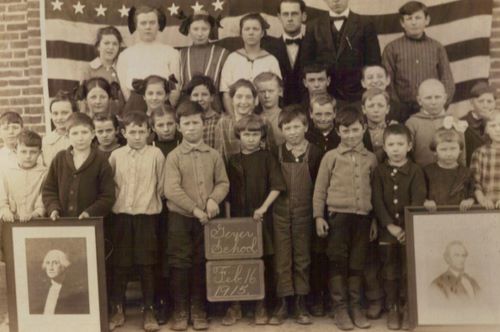
A century ago, a debate was raging about American history textbooks used in the schools.

By Dr. Bruce W. Dearstyne
Adjunct Lecturer in History
University of Maryland
Introduction
Virginia is the latest state to forbid teaching “critical race theory” in schools. Governor Glenn Youngkin, in his first executive order in January, targeted it and what he called other “divisive concepts” that “instruct students to only view life through the lens of race and presumes that some students are consciously or unconsciously racist, sexist, or oppressive and that other students are victims.” Several other states have issued similar prohibitions or are considering doing so.
The issue is important; what young people learn about history in school tends to make a lasting impression that may stick with them for the rest of their lives. Many times in the past, special interests, media pundits, and politicians have weighed in on what should and should not be taught in U.S. history and social studies courses.
Not Enough Patriotism, Too Easy on the British?
A century ago, a debate was raging about American history textbooks used in the schools. The issue played out against the backdrop of social and economic change and a perceived threat of political radicalism. But the flash point was textbooks allegedly slighting American patriots and heroes, particularly in the Revolutionary era, and exaggerating our connections with Britain.
During World War I, some books were revised to emphasize what Americans had in common with Great Britain, our wartime ally, in part as a way of building patriotism and unity for the war effort. But after the war ended, critics insisted the effort had gone too far and denigrated American heroes and national values.

In 1921, newspapers owned by William Randolph Hearst, who assumed a role of defender of American values, began a campaign to arouse “patriotic American parents” to the fact that school textbooks were slighting Revolutionary heroes and glorifying the British.
Charles Grant Miller, a writer for Hearst’s Chicago Herald and Examiner, began a series of exposé articles, later published as a pamphlet, “Treason to American Tradition: The Spirit of Benedict Arnold Reincarnated in United States History Revised in Textbooks.” Miller took on leading high school texts, concentrating on their coverage of the Revolutionary era. He carefully selected examples to prove his point. For instance, some of the books explained that John Hancock was a smuggler who chafed under British regulations, Patrick Henry was an obscure figure before becoming a fiery patriot, John Adams was slow to warm to the cause, Alexander Hamilton once referred to “the people” as “a great beast,” Benedict Arnold became a traitor in part because Congress treated him unfairly, and American rebels were fighting for their rights as Englishmen. Such statements could mislead young people, bias them against their country, and get them to overestimate our British ties. It was all part of a shadowy plot to draw America closer to Britain, said Miller.
Other newspapers took up the cry. History books should be touting American independence and achievements and teaching young people to be proud of their country. Patriot organizations entered the burgeoning discussion, adding that textbooks needed to explain the nation’s history to immigrant children. The American Legion in 1923 suggested a set of principles for books to “inspire the children with patriotism.” The American Bar Association declared in “Our Citizenship Creed” in 1924 that young people should feel that it was “my duty to inform myself of American history,” the Constitution, and historical principles dating back to the nation’s founding.
Politicians entered the fray. Oregon in 1923 prohibited any book that “belittles or undervalues” the heroes of American History. New York State, caught up in a campaign for patriotism during World War I and a fear of radical activities as it ended, passed a series of laws in 1918 and 1919 requiring schools to “promote a spirit of patriotic and civic service and obligation” through courses in “patriotism and citizenship.” The law banned “textbooks containing seditious or disloyal matter” and authorized the Commissioner of Education to establish a committee to review complaints from citizens about such books. The law even authorized removal of teachers for “utterance of any treasonable or seditious word or word or doing any treasonable or seditious act or acts.”
New York City’s School Superintendent appointed a committee to review books being used in the schools. The committee reported in 1922 that several of the books were so misleading about American history that they should be removed from the schools, and others should have offending passages deleted. Statements critical of American heroes might be accurate, the report noted, but too sophisticated for impressionable young people, so “truth is no defense to [sic] the charge of impropriety.” A textbook must contain “no statement in derogation or in disparagement of the achievements of American heroes. It must not question the sincerity or aims and purposes of the founders of the Republic or of those who have guided its destinies. The textbook must contain no material which tends to arouse political, racial, or religious controversy, misunderstanding, or hatred.”
The next year, New York City mayor John Hyland appointed John Hirschfield, the city’s commissioner of accounts, to investigate history books for unpatriotic statements. Hirshfield had no particular qualifications beyond being a self-proclaimed expert in history concerned with promoting patriotism. He held several hearings where books’ critics vented. His report to the mayor recommended eight of the leading texts as being too pro-British and anti-American. Like Charles Grant Miller, Hirschfield cherry-picked examples. One his particular targets was David Muzzey’s An American History, published in 1911. Muzzey skewed the discussion of the issues that motivated patriots in the Revolution, said Hirschfield. He explained that Muzzey said it came down to “a difference of opinion as to the nature of the British Empire” and there was “a debatable question, namely, whether the abuses of the king’s ministers justified armed resistance.” That was just not acceptable.
Chicago mayor William “Big Bill” Thompson, campaigning for re-election in 1927, stressed “America First,” vilified Britain as an enemy of America, and promised to bar “pro-British” texts from Chicago schools.
A 1923 Wisconsin law introduced by a state senator who demanded that American history be taught “in all its original purity” provided that:
No history or other textbook shall be adopted for use or be in any district school, city school, vocational school, or high school which falsifies the facts regarding the War of Independence or the War of 1812 or which defames our nation’s founders or misrepresents the ideals and cause for which they struggled and sacrificed, or which contains propaganda favorable to any foreign government.
Similar requirements were enacted in some other states. In some communities, citizens’ groups were formed to pore through history texts for unpatriotic sentiments.
Impact

The issue was white-hot for a few years and then slowly cooled and largely dissipated by 1930.
For a while, at least, history enjoyed something of a renaissance. People who did not know much about history opened their morning newspapers to read stories about how it was being misrepresented in the schools and what was at stake for their kids and the nation’s future.
But some of the laws were not enforced or barely enforced and had little impact. People came to realize that they could be ignored.
The press, having exhausted the topic and seeing no more potential in the story to sell newspapers, gradually dropped the issue and turned to more newsworthy and sensationalistic topics. Public interest waned as the nation settled into complacency and “normalcy” in the 1920’s. Citizens committees that had been searching through their schools’ history texts grew weary and closed up shop.
Politicians turned to other priorities that would garner more public attention than going after textbooks. Few if any books were removed from New York City schools despite the hostile reports of the mayor’s and the education superintendent’s committees. New York State Historian James Sullivan, who had been appointed by the Commissioner of Education to the committee established by law to consider public complaints about disloyal books in the state’s schools, reported in a 1922 New York Times op-ed essay that his committee had not received a single complaint. New York repealed its school patriotism laws in 1923. The issue receded from public debate. People began to wonder what the fuss had been about in the first place.
Yet the controversy had a chilling effect on teachers’ confidence and independence. A few teachers were removed from the classroom under New York’s loyalty law before it was repealed. In some communities, educators felt they were under the watch of restrictive principals, school boards, or community members. But later, things relaxed. Teachers’ organizations pushed back, citing the need for educators to be independent. School boards and principals decided that maybe the critical passages in the books were not so offensive after all and not worth the cost of buying new books for the students. There were more textbooks being published, giving schools more of a choice.
Prompted by publishers who feared losing sales if their books were panned or banned, some historians altered their books to make them more acceptable to those who demanded patriotic textbooks. David Muzzey’s An American History, published in 1911, had become a lightning rod for critics. In his 1925 edition, he revised the interpretation of the Revolution, presenting it more as resistance to British trampling on American rights and Americans resisting invasion. Muzzey dropped references to the Stamp Act “mob.” The Boston Massacre’s crowd was no longer referred to as “ruffians.”
The issue got diluted because the textbooks expanded their coverage as time went by, emphasizing more social, economic, and recent history and less about wars. That dulled the spotlight on the Revolutionary era, which had been the flash point for most of the critics.
The professional historical community gently dug in and pushed back, reminding the public that presenting objective history was an obligation historians took very seriously. They did it in a way that was enlightening about historians’ work rather than accusatory and confrontational toward critics.
In New Jersey, Princeton University history professors rallied the historical community to turn back efforts to restrict books. Historians needed independence and protection from political interference and special interest group hectoring in order to do their jobs in presenting accurate history.
New York State Historian James Sullivan, in the 1922 op-ed piece in the New York Times referenced above, explained that textbook writers were necessarily selective and interpretive. Space is limited in texts, making it difficult to convey “the full truth about a historical fact.” There had been some tilting toward the British perspective but “historians in our colleges recognized those defects and began to rectify them in their writings and lectures.” Textbooks should avoid cultivating “discord, envy and hatred” in young people and instead promote “sweet reasonableness.” The State Historian later encouraged teachers’ groups to make the case for letting teachers use their own best judgment on what and how to teach history.
Joseph Shafer, Superintendent of the Wisconsin State Historical Society, rebutted his state’s textbook law in an article in the June 1923 Wisconsin Magazine of History. It is impossible to teach history “in all its original purity” as the law’s sponsor had demanded. History is too complex for that. It is up to historians to judge, select, and present history. Interpretations change as new evidence is unearthed or mined in different ways. Historians will not all agree and “we should all insist that differences of view must be treated tolerably.”
James Truslow Adams, a highly respected historian and Pulitzer Prize winner, wrote an article entitled “History and the Lower Criticism” in the September 1923 issue of the Atlantic Monthly. “The forces of reaction and obscurantism” were damaging history and politicians and news commentators were posing self-appointed historical experts. “What then of the future?,” he asked. “Is the writing of popular history to be an effort to discover and to disseminate among the people the true story of mankind in the past, or is it to be written as an ethical or political tract, to further the passionate conflicts of the present?”
The American Historical Association came out strongly against any form of censorship, coercion or undue outside interference in a resolution at its December 1923 meeting:
Genuine and intelligent patriotism, no less than the requirements of honesty and sound scholarship, demand that textbook writers and teachers should strive to present a truthful picture of past and present, with due regard to the different purposes and possibilities of elementary, secondary, and advanced instruction; that criticism of history text-books should therefore be based not upon grounds of patriotism but only upon grounds of faithfulness to fact as determined by specialists or tested by consideration of the evidence; that the cultivation in pupils of a scientific temper in history and the related social sciences, of a spirit of inquiry and a willingness to face unpleasant facts, are far more important objectives than the teaching of special interpretations of particular events; and that attempts, however well meant, to foster national arrogance and boastfulness and indiscriminate worship of national “heroes ” can only tend to promote a harmful pseudo-patriotism.
The textbook controversy led other groups to request or demand more about the influence of their nationalities, including Dutch, Germans, Irish, and Italians.
And 100 years before critical race theory, the NAACP asked for more acknowledgement of the contributions of Black Americans, including their service in the Revolution, Civil War, and World War I. Other groups advocated books devoted just to Black Americans’ history or much more about them in standard accounts.
A Takeaway for Today

Dixon Ryan Fox, president of the New York State Historical Association, wrote a closing-off essay on the previous decade’s history struggles in in the Association’s journal in 1929. He titled it “Americanizing American History.“ In the media and politicians’ speeches, “patriotism is insistently prescribed as an ingredient in history teaching.” Citizens value it. But taken too far, that could lead to the glossing over of historical problems.
There had been “some over-statement of the British argument in the Revolutionary contest and corresponding under-statement of the American,” Fox conceded. But the attacks on the books were overdone and many people regarded the prescriptive laws as “gestures to satisfy certain clamorous groups rather than active legislation.”
Historians in the natural course of revising their books would have corrected any pro-British bias. But in recent years, as a result of the pressure campaign, “it has been undertaken at the demand of propagantist [sic] societies, or of politicians anxious to capture the votes of groups with special interest.”
The American Historical Association “has taken the firmest stand against writing history to order and has strengthened the self-respect of the profession,” Fox concluded.
In his 1928 book American Inquisitors, columnist and political commentator Walter Lippmann wrote that the whole episode showed that too many people believed “that history is something that can be cut and shaped to suit the purposes of the moment.”
Fox’s and Lippmann’s comments might suggest the main takeaway from the “history wars” of the 1920’s: the historical community itself needs to take the lead in selecting, interpreting, and presenting history. It needs to explain its role more fully to the public. Otherwise, interest groups, media pundits, and politicians may step in. That may be what is happening today.
Originally published by History News Network, 02.20.2022, reprinted with permission for educational, non-commercial purposes.
About the Author