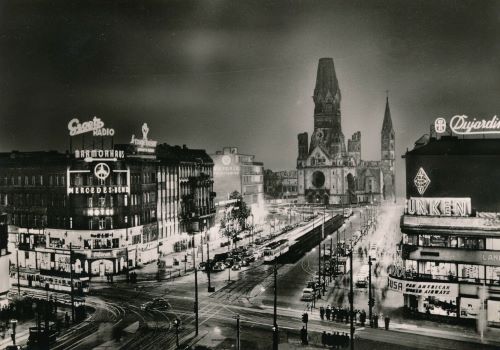
Trends in the development of American literature set in the German capital from around 1900 to the present.

By Dr. Joshua Parker
Associated Professor, English and American Studies
University of Salzburg
Introduction
Over the past century, many studies have been devoted to American literature set in Europe and its capitals. Scholars including D. E. Barclay and E. Glaser-Schmidt, Hans-Jürgen Diller, Hanspeter Dörfel, Elisa Edwards, Peter Freese, Walter Kühnel, Henry Cord Meyer, Martin Meyer, Georg Schmundt-Thomas, and Waldemar Zacharasiewicz have focused on Germany’s image in the American imagination, either literary or from a general standpoint of comparative imagology. Yet despite a marked increase in American fiction treating Berlin since its first designation as Germany’s capital (and an overwhelming increase in the past twenty years), few studies have targeted Berlin itself as a setting or image in American literature and popular consciousness. Those which have are almost limited to Jörg Helbig’s very general collection Welcome to Berlin: Das Image Berlins in der englischprachigen Welt von 1700 bis heute and to Christine Gerhardt’s very specific “‘What was left of Berlin looked bleaker every day’: Berlin, Race, and Ethnicity in Recent American Literature.” This article surveys trends in the development of American literature set in the German capital from around 1900 to the present.
Berlin’s place in the American imagination developed later than that of the Rhineland, the Alps or Bavaria. Outlines of America’s fictional Berlin only began to appear clearly in the last warm glow of the nineteenth century, as the city inspired the first American imaginings of a modern, urban German space. As Berlin becomes ever-more popular in the American imagination today, not least as it grows in popularity with American tourists, it is many ways, as a recent article in the German weekly Die Zeit suggests, both a symbol and litmus test for Europe itself (Jessen). Certainly, it has long served as a laboratory for American culture. As Jeffrey Garten has written, postwar U.S. foreign policy attempted to regenerate Germany “from the ashes of war and remake [it] in its own image” (46). Postwar Berlin was the showcase piece in this project, illustrating both the successes of American policy and its dilemmas. Similarly, Americans writing on Berlin created a textual city in their own domestic image, a process underway long before the U.S. occupation, and continuing for long afterward.
Still, Berlin has its own tales, as well, and history’s clear and fresh marks beckon one toward them as one moves through it. American literature set in Berlin is in many senses, like that of other European cities, a history of the past’s resurgence, the city serving as a sort of portal to the past, allowing contact with history on a personal level. Like the recently reconstructed Neues Museum in the city’s heart, much of Berlin still bears clear traces of a very visible history and, like the current rebuilding of the Berliner Schloss, American writers often seek to reconstruct what seems missing. If “bodies,” as Michel de Certeau wrote, “can be distinguished only where the ‘contacts’ (‘touches’) or amorous or hostile struggles are inscribed on them” (127), bullet and mortar marks on Berlin’s buildings and the still empty gaps between buildings provide blank spaces inviting projections. Berlin’s history, in American eyes, is often a story of decadence, a movement away from norms, destruction, isolation and reunion.
Much nonfiction has supplied American readers with glimpses of pivotal moments in Berlin’s history over the last century, from Mark Twain’s “The Chicago of Europe” (1892), to Percival Pollard’s travel guide-cum-social commentary Vagabond Journeys: The Human Comedy at Home and Abroad (1911), to socialite and sometime spy Martha Dodd’s memoir Through Embassy Eyes (1939) and John Dos Passos’s Tour of Duty (1946), describing Berlin in the year of its capitulation (and his notes for an uncompleted novel, Berlin 1945), Langston Hughes’s I Wonder as I Wander: An Autobiographical Journey (1956) to Edith Anderson’s Love in Exile: An American Writer’s Memoir of Life in Divided Berlin (1999), describing daily life in East Berlin prior to the Wall’s construction. For fiction writers, meanwhile, wrote Ward Just, Berlin, standing at “the dawn of the modern world” has and still offers a story still to be claimed by “whoever could tell it best,” making it “a narrator’s utopia, the story of the world, ruin and rebirth” (304).
1910s-1933

The earliest American nonfiction mentioning Berlin, most dating to the mid-nineteenth century, appears mainly in memoirs by scholars studying, like Henry Adams, at its university, or visiting, like Theodore Dreiser, as tourists. Longer relationships with Germany, like those described by I.A.R. Wylie’s series of memoirs, did much to endear Germany and Germans to American readers prior to the First World War, and Wylie’s novel Towards Morning (1918), portraying an ordinary German soldier’s experiences, encouraged readers’ abiding sympathies for the country in the war’s wake. The First World War had broken Berlin’s reputation as a quiet haven for academic study, however. As American businessmen, artists and tourists formed an increasing presence in Europe, writings set in Berlin often explored issues already embedded in the American cultural landscape, but anomaly to contemporary American identity: divorce before its general acceptance, homosexuality before its decriminalization, class divisions, adultery and drinking. Berlin provided a space where symbols of repressed or uneasily mentioned areas of collective identity appeared. Their representation abroad did not tamper directly with American identity—indeed, it allowed treatment of contemporary social taboos while often reinforcing (or at least paying lip service to) American identity through negative contrast.
Berlin had already slowly begun to attain a pre-war reputation for night life, and economic conditions in the Weimar Republic made it inexpensive for visitors of more modest means. Stories set in Berlin between the wars typically offer images of revelry, political uncertainty and existential isolation, while the city is a space for experiences not yet recognized as part of the traditional American experience, but already entering the mainstream of American social life at the beginning of the twentieth century. Here, they could be safely explored by American writers and readers, while still being portrayed as foreign. Between the wars, Americans found a Weimar Republic whose own “true home” was the spirit of exile (Gay), a “strange and complicated city” where, as a later protagonist would suggest, an outsider might feel “almost at home” (Solmssen). Still attracting scholars, Berlin became a common stopping-over point for Americans with progressive political ideals, while drawing artists like photographer Bernice Abbott (who had come to study sculpture) and painter Marsden Hartley (some of whose earliest abstract work combined Native American patterns with those of German folk paintings). Harold Loeb relocated the literary magazine Broom to Berlin from November 1922 until March 1923, and the city was also home to Der Querschnitt (1921–1936), which published early work by Ernest Hemingway and Ezra Pound.
Robert McAlmon’s short story collection Distinguished Air: Grim Fairy Tales (1925), Sinclair Lewis’s Dodsworth (1929) and the Berlin scenes in Djuna Barnes’s Nightwood (1937), avoided referencing contemporary European politics directly, treating Berlin as a space of leisure, sexual exploration and transgression, while still hinting at something cold and even menacing beneath its surface. McAlmon’s fiction includes some of the first in American literature to portray homosexual life frankly, casually and with a lack of moralizing surprising for the period. Both McAlmon’s and Lewis’s are critical looks at Berlin by American husbands of wives very much enamored with the city, British writer Bryher (Annie Winifred Ellerman) and American newspaper columnist Dorothy Thompson. In 1922, Claude McKay described “something sullen and bitter, hostile and resentful in the atmosphere of Weimar-era Berlin,” believing it “expressed the resentful spirit of all Germany,” its “Wandervögel everywhere like a plague of flies” having “lost their romantic flavor […], with their knapsacks slung over their shoulders, casually taking to the streets as nature lovers take to the woods,” giving “a strange impression of Berlin as a futuristic forest” (239–40). Arousingly aggressive, Berlin mixed the futuristic and the primal.
1933-1945
American narratives written or set during the 1930s often gaze reflectively back to an irrecoverable “lost world,” from a present which was, as a character in Katherine Anne Porter’s Berlin exclaims, like “living in a damnation jail” (199-200). These stories often express a longing for escape from an ambience of dystopia, of shrinking personal privacy and freedom. Thomas Wolfe’s The Web and the Rock (1937), Isherwood’s Berlin stories (1939), Josephine Herbst’s Rope of Gold (1939) and Lillian Hellman’s play The Searching Wind (1944) magnify a rapidly deteriorating sense of innocence and freedom, with a growing sense of anxiety about direct and immediate violence. Upton Sinclair’s 1940s novel series made increasingly pointed reference to political events in Berlin as war was foreshadowed. In later popular fiction set in Berlin during this period, female protagonists often lose their illusions by being used or abused by (and often betrothed to) male Nazis, as in Danielle Steel’s The Ring (1980) or Margot Abbott’s The Last Innocent Hour (1991).
1945-1961
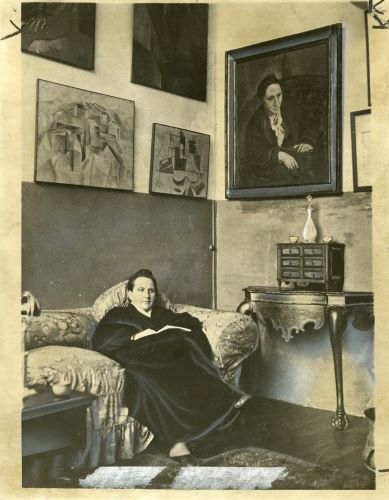
Gertrude Stein was the first well-known American author to enter occupied Germany. Life magazine published a piece on her tour in in August of 1945. J. Gerald Kennedy describes Stein as having becoming an expatriate “in order to position herself at the center of a historical phenomenon—as if the temporal (the twentieth century) had suddenly assumed a spatial form which might be located and even occupied” (185). While few American literati flocked to Berlin in the war’s wake, it could certainly be said that the Cold War itself quickly assumed spatial form in the city. Cold War Berlin became a recurrent literary metaphor for international relations, and was as Durs Grünbein wrote, “both the point from which all horror emanated and the cyclone’s eye, where a long, malicious calm prevailed” where “a good-and-evil madness traversed every body and mind: a geographic, political and anatomical fissure which no biography, no worldview or aesthetic design escaped” (139, my translation).
David Clay Large describes Berlin as the “capital of the Cold War” (2000: xviii), and popular American literature is often still seemingly locked at the occupation period of 1945 to the 1950s. Both earliest novels set in the city during occupation and early reconstruction, William Gardner Smith’s Last of the Conquerors (1948) and Thomas Berger’s Crazy in Berlin (1955), draw directly on the experiences of U.S. soldiers stationed there between 1945 and 1948 (Berger was stationed in Berlin from 1946 to 1948, overlapping Smith’s time there), yet a host of later novels return to the period. Leon Uris’s Armageddon (1963) and Herman Wouk’s The Winds of War (1971) are probably the most popular examples of the panoramic historical Berlin war novel, the latter popularized through adaptation into a television mini-series, while the film success of Joseph Kanon’s The Good German (2001) shows the early occupation period still fascinates readers and moviegoers. Much as Kristin Ross writes that nineteenth-century railroads, in “joining together previously inaccessible places as coordinates in a systematized grid,” began making “space geographic” (4), Americans, having Germany visually mapped for them during the war through newsreel images and newsprint maps, were well-prepared to imagine its space as geographic. After a century of writing on Europe from the perspective of the ‘young’ New World, the Marshall Plan drew forth and embodied America’s colonial/occupying gaze at Europe, which had become that of authority. Yet, as Andreas Daum notes, America’s role in Berlin’s reconstruction was drawn from perceptions of the city as a space mirroring the United States’ own historical myths and political visions.
At least from the start, meanwhile, Americans trying to make sense of Berlin’s landscape found themselves in possession of a ruined landscape that often hardly seemed a city at all. If, as Kevin Lynch suggested, the “image of a city” should ideally allow the individual “to continue to investigate and organize reality,” with “blank spaces where he can extend the drawing for himself” (9), Berlin after 1945 certainly held its share of “blank spaces,” both physical and cultural. David Clay Large notes how Russian troops took treasures from Berlin collections, libraries and archives, comparing them to the “holes and gaps” of vacant lots left by bombing and shelling (2000: 379). Yet holes and gaps also provided passage between two worlds slowly forming dichotomous crusts, dividing the city. Gaps in the Wall allowed tens of thousands of East Germans to pass through it from August 13 to the end of that month in 1961 (Large 453). American fictions set in Cold War Berlin are often fantastic tales of passage through gaps between two regimented worlds, sometimes suggesting a porous, nebulous or contiguous space between the political domains of socialism and capitalism, sometimes highlighting social, sexual and political transgressions of America’s own cultural mores.
As postwar America took up, prior to, during and after McCarthyism, the aegis of dismantling communist structures through discrimination and propaganda aimed at the domestic and international sphere, American authors often began to hint at the fact that the National Socialist party had itself been an international leader in the fight against domestic and international communist movements. By 1953, through the work of the House Un-American Activities Committee, the United States had removed from European U.S. Information Centers (including America House libraries), works of such authors as Sherwood Anderson, Pearl S. Buck, John Dos Passos, Theodore Dreiser, W.E.B. Dubois, Upton Sinclair and Ernest Hemingway (Wagnleitner 137–38). In some cases removed works were incinerated.
While the U.S. federal government led an industry-supported attack on communist artists, leaders, thinkers, followers and sympathizers within its borders, it was engaged in a military and propagandistic attack on the Soviet Union which was ideological in presentation and imperialist in design. As the United States continued a fight against communism for which National Socialism had been the pre-war and wartime standard-bearer, the projection of U.S. policy onto fictionalized Nazis becomes telling.
Much as East German authors Stefan Heym and Christa Wolf set novels criticizing GDR policies in other times and places to avoid censors, postwar American authors often veiled criticism of U.S. domestic policy by fictionally restaging it in uncannily foreign settings. Meanwhile, a rise in literary portrayals of Nazis from the late 1960s into the 1980s might be seen as a means of justifying America’s own contemporary foreign policy, by negative contrast.
1961-1989
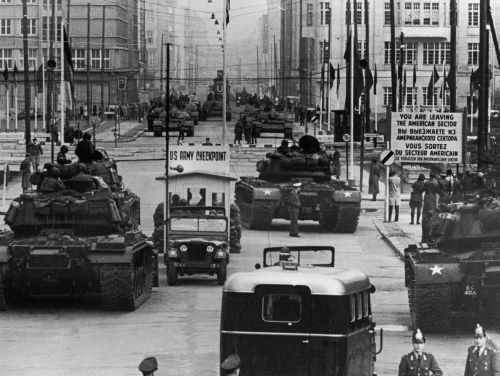
The Berlin Crisis of 1958–1961 returned Berlin to American literature’s spotlight. In the early 1960s, Jörn Donner questioned whether this city lying “in the flat landscape of the March of Brandenburg area” and having such “a distinctive political character,” any longer even had “a face which distinguishes it from other large European cities,” like Paris, “more colorful than Berlin,” or Rome, where “people live on the streets. Could it be,” Donner wondered, “that the name Berlin opens up a world of associations dependent only upon personal experiences and accidental feelings?” Still, he continued, popular conceptions hold “that Berlin is dramatic, and is marked by political tension which might crack at any moment. It is East and West, kidnappings and political murders, a threat of world war” (229). American fiction set here often became an exploration of disparities between a newly bland city and its mythologies.
Themes of searching for something—or someone—arose as popular spy or mystery novels led protagonists searching for clues to someone trapped behind the Wall, find the strange and marvelous hidden in Berlin’s suburbs and nightclubs, or hidden below its surface. In late Cold War fictions, such tales occasionally reveal America’s true enemy lurking not under Berlin or behind its Wall, but in the self (or the U.S. government). Patrick Major, conversely, provides a list of East German films and novels about the Wall, often portraying West Berliners trying to break through the Wall to terrorize East Berlin (176–88). In mixing contemporary East/West political tension and espionage with touches of Weimar-era decadence and corruption, these narratives often open spaces where fictional Americans can either criticize or take part in (or at least observe) alternative lifestyles, a space where their experiences safely leave no lasting trace on their own identities. Berlin in these years appeared as “a Hollywood of set pieces from the hottest points of European history,” the “ideal backdrop” (Grünbein 141, my translation), or as it had for Claude McKay fifty years earlier, a “futuristic forest,” where the creatures inhabiting it (spies, transvestites, prostitutes, drug addicts) are introduced to the literary stage and cultural consciousness in semi-sympathetic terms, sometimes moving to America in hopes of escape from the dramas (or drudgery) of life in eastern Europe.
Several American fictions of this period commemorate the loss of Weimar-era Berlin’s exuberance, and Berlin’s literary image was again marked by nostalgia for a lost past, whether of glamorous decadence or of horror. If physically invisible, it still often felt close and present in indefinable ways. Fictionalized secret Nazi groups often still malevolently plot in the city’s sprawling suburbs or its subways and underground bunkers. In popular novels, history’s ambience remained immediate, with direct connections to the present. Many attempted to connect history with a present which seemed to have made a clear break with it. Divided one side from the other, Berlin was also a city divided from its own historical self. As Richard Ford asked during a 1997 interview with Ingo Schulze in Berlin, “can literature ignore politics in such a tense and self-consciously political climate? Or is everything literary in Germany always still political?” (Schulze and Paustian 37, my translation). Historical and contemporary Berlin suggested an overwhelming mass of continuities more culturally-coded than topographically palpable, and American writers of the next generation, writing after 1989, often sought to highlight continuities with the past in equally coded, while more personal and less political, ways.
1990-Present
Most Americans watching television newscasts in November 1989 had never before seen “so many ordinary Germans,” finding them “surprisingly sympathetic” and unexpectedly “rather similar to themselves, concerned with family, work, and pleasure, suspicious of politicians, fond of freedom and worn-out jeans” (Trommler 353). In the years following the Wende, meanwhile, news reports of a slight rise of violence in newly reunified Berlin, and particularly of anti-Semitic and other racially-motivated attacks on foreigners, worried some visiting Americans attuned to press reports. As Christine Gerhardt notes, authors like Audre Lorde and Susan Neiman “directly or indirectly compare the new German capital to the Berlin of the Cold War era, which is remembered as a place where hope and a sense of belonging could persist in spite of conflicts and unresolved historical legacies.” In contrast to this “lost” city of the 1980s, “the changed, post-Wall Berlin emerges as a ghost town dominated by sites that embody the return of racial and ethnic tension and outright oppression” (9). A backlash of earlier images tended to resurface as Berlin was suddenly and simultaneously (militarily) de-Americanized and increasingly (corporately) Americanized. The two effects combine strangely. As Renate Lachmann notes, “[t]he collapse of rhetoric as a totalizing system allows excluded, ‘forgotten’ discourses to appear,” including “discourses of folklore, superstition, and the supernatural,” culminating in “the rise of the romantic literature of the fantastic, the mise en scène of the ‘other’ of culture” (287). As soldiers disappeared from checkpoints and McDonald’s and Coca-Cola began permeating the landscape around them, minorities including African-American, Jewish-American, female and queer writers sometimes described a sense of oppression, if not from any contemporary source, then from the city’s historical sites themselves.
With the Berlin Wall’s collapse, two main literary streams dealing with the city appear. On one hand, lengthy popular realist or revisionist historical fictions attempt broad portraits of the city before, during and after the Second World War, usually restamping it with stereotypes already sketched out by Thomas Berger or panoramic historical fictions like those of Leon Uris and Herman Wouk. But while stabilizing collective American identity, they shift from earlier models, often using simultaneous plotlines to represent various cultural, political or national groups or classes in a single space at a single moment in history. Something like this effect had been attempted by Upton Sinclair—though it was limited there to portraying extremes between Berlin’s wealthy and working classes. Multiple perspectives appear in revisionist histories eager to incorporate diverse viewpoints, underlining that not all Berliners were directly involved in the Holocaust’s machinery, by including minorities often absent from earlier depictions of the war itself, sometimes concluding by drawing various perspectives toward meeting points. In David Robbins’s novel, portraying Russian foot soldiers, a Berlin family, American soldiers and higher-ups in the Soviet and U.S. governments, points of view shift between theaters of war in unexpected places and in unexpected ways, moving readers’ sympathies back and forth in a more complex dynamics than earlier novels. Such works are more developed than earlier fictions in scope, if not necessarily in quality.
Meanwhile, moves toward retelling Berlin’s history through victims’ eyes distances readers from the ontologically perceived “evil” of Nazism or totalitarianism, while depicting the Holocaust as not only a Jewish, but a broader tragedy, reflecting postmodernism’s concern with history as personal. Margot Abbott’s The Last Innocent Hour (1991) and Robert C. Reinhart’s Walk the Night: A Novel of Gays in the Holocaust (1994) paint the rise of Nazism through the lens of minorities often invisible in earlier fiction. Post-Wall Berlin is no longer simply a Manichean binary system, the “place that witnessed the struggle between good and evil” (Daum 61), but “the ultimate postmodern space” (Borneman 1), as individual voices rise to describe sweeping historical events not through broad social perspectives, but more idiosyncratically. J.S. Marcus’s The Captain’s Fire (1996), a fictionalized memoir of an expatriated Jewish American, treats Nazism more as everywhere present than as ever-present, much as Susan Neiman’s Slow Fire: Jewish Notes from Berlin (1992) chronicled her making the city her home from 1982 to 1988, while attempting to come to terms with echoes of the city’s history. Unlike earlier fictions showing characters fleeing the city to escape being pulled into positions its history seems to configure, a shift appears. Protagonists, if still overwhelmed by the historical shadows they see in Berlin’s spaces, make an (uncertain) peace with them before taking flight, or remain to work within them.
Some recent fictions hint reunified Berlin even suggests a template for narratives of reintegration and reunion. These include overt attempts at healing the past not by universalizing it, but by personalizing it. Much fiction of the 1970s or 1980s tended to simplify the city’s history as an ongoing battle between good and evil in which one might still participate. The narrator of Ward Just’s The Weather in Berlin (2002), while touching on themes from earlier novels, finds a safe personalized spot among the city’s most horrifying landmarks before returning home. While tales like those in Joyce Carol Oates’s Last Days (1984) and Irene Dische’s Strange Traffic (1995) respond to still open wounds of Berlin’s history, others, like Jeffrey Eugenides’s Middlesex (2002) and Anna Winger’s This Must Be the Place (2008), portray a city of healing reunions with estranged parts of oneself—a place that might eventually be a home.
Katharina Gerstenberger’s Writing the New Berlin: The German Capital in Post-Wall Literature counts some three hundred (mostly German) works of fiction set in Berlin since the Wall’s opening, but finds no “great Berlin novel,” leaving the city “a phenomenon in search of a novel” (7). Work published up to today, she suggests, remains too fragmentary and personal to tell ‘Berlin’s tale’ in any comprehensive manner. Yet recent American voices, at their most successful, often situate themselves within a broader socio-historical narrative. In as much as national identity is reflected in these narratives, Berlin is a lens for self-examination, presenting a barrier against American society’s desires, or a bridge to what it attempts to repress over various periods, allowing projections into another space. Fiction, as Kai Mikkonen writes, is “an imaginative ‘recentering’ in another possible world” (105), and often, in fictionalized Berlin, this re-centering relocates the self to reformulate, by contrast or comparison, across time and space, what it means to be American.
Bibliography
- Abbott, Margot. The Last Innocent Hour. New York: St. Martin’s, 1991.
- Anderson, Edith. Love in Exile: An American Writer’s Memoir of Life in Divided Berlin. South Royalton, VT: Steerforth P, 1999.
- Barnes, Djuna. Nightwood. 1937. New York: New Directions, 2006.
- Berger, Thomas. Crazy in Berlin. New York: Richard W. Baron, 1955.
- Borneman, John. Belonging in the Two Berlins: Kin, State, Nation. Cambridge: Cambridge UP, 1992.
- Certeau, Michel de. The Practice of Everyday Life. Trans. Steven Rendall. Los Angeles: U of California P, 1984.
- Daum, Andreas W. “America’s Berlin 1945–2000: Between Myths and Visions.” Berlin – Washington, 1800-2000: Capital Cities,Cultural Representation,and National Identities. Eds. Andreas Daum and Christoph Mauch. Cambridge: Cambridge UP, 2005.
- Dische, Irene. Strange Traffic. New York: Metropolitan Books, 1995.
- Dodd, Martha. Through Embassy Eyes. New York: Harcourt, Brace and Company, 1939.
- Donner, Jörn. Report from Berlin. Trans. Albin T. Anderson. Bloomington: Indiana UP, 1961.
- Dörfel, Hanspeter. “Images of Germany and the Germans in Some of Joyce Carol Oates’ Short Stories.” Germany and German Thought in American Literature and Cultural Criticism. Ed. Peter Freese. Essen: Blaue Eule, 1990. 267–84.
- Dos Passos, John. “Berlin 1945.” Papers of John Dos Passos, Accession #5950, Special Collections, University of Virginia Library, Charlottesville, VA, Box 105–07.
- Dos Passos, John. Tour of Duty. Boston: Houghton Mifflin, 1946.
- Edwards, Elisa. Divided Nation/s: Germany’s Partition in American Novels. Heidelberg: Winter, 2014.
- Eugenides, Jeffrey. Middlesex. New York: Farrar, Straus and Giroux, 2002.
- Freese, Peter. “Exercises in Boundary-Making: The German as the ‘Other’ in American Literature.” Germany and German Thought in American Literature and Cultural Criticism. Ed. Peter Freese. Essen: Blaue Eule, 1990. 93–132.
- Garten, Jeffrey. A Cold Peace. New York: Times Books, 1992.
- Gay, Peter. Weimar Culture: The Outsider as Insider. London: Secker and Warburg, 1968.
- Gerhardt, Christine. “’What was left of Berlin looked bleaker every day’: Berlin, Race, and Ethnicity in Recent American Literature.” Poroi 4.1 (2005): 60–76. Iowa Research Online. DOI: 10.13008/2151-2957.1031.Web. 25 March 2016
- Gerstenberger, Katharina. Writing the New Berlin: The German Capital in Post-Wall Literature. Rochester, NY: Camden House, 2008.
- Grünbein, Durs. “Transit Berlin.” Galilei vermisst Dantes Hölle und bleibt an den Massen hängen. Frankfurt: Suhrkamp, 1996.
- Hall, Rodney Bruce. National Collective Identity: Social Constructs and International Systems. New York: Columbia UP, 1999.
- Hellman, Lillian. The Searching Wind. New York: Viking P, 1944.
- Herbst, Josephine. Rope of Gold. New York: Harcourt, Brace and Company, 1939.
- Hughes, Langston. I Wonder as I Wander: An Autobiographical Journey. New York: Rinehart, 1956.
- Isherwood, Christopher. Goodbye to Berlin. 1939: The Berlin Stories. New York: New Directions, 1954.
- Jessen, Jens. “Berlin Europaplatz: Buden, Bettler, Baustellen: Zeigt sich vor dem Berliner Hauptbahnhof der Zustand des Kontinents? Eine Inspektion.” Die Zeit 2 Jan. 2014. Zeit.de. Web. 25 March 2016.
- Just, Ward. The Weather in Berlin. New York: Houghton Mifflin, 2002.
- Kanon, Joseph. The Good German. 2001. New York: Picador, 2002.
- Kennedy, J. Gerald. Imagining Paris: Exile, Writing and American Identity. New Haven: Yale UP, 1993.
- Kühnel, Walter. “’He closed and locked the German door with a long breath of relief, and took the road to Italy’: Closed American Systems at Work.” Germany and German Thought in American Literature and Cultural Criticism. Ed. Peter Freese. Essen: Blaue Eule, 1990. 133–58.
- Lachmann, Renate. “Remarks on the Foreign (Strange) as a Figure of Cultural Ambivalence.” The Translatability of Cultures: Figurations of the Space Between. Eds. Sanford Budick and Wolfgang Iser. Stanford: Stanford UP, 1996. 282–93.
- Large, David Clay. Berlin. New York: Basic Books, 2000.
- Lewis, Sinclair. Dodsworth. 1929. New York: Harcourt, Brace and Company, 1941.
- Lynch, Kevin. The Image of the City. Cambridge, MA: MIT P, 1960.
- McAlmon, Robert. There was a Rustle of Black Silk Stockings. New York: Belmont Books, 1963. Originally published as Distinguished Air: Grim Fairy Tales, 1925.
- McKay, Claude. A Long Way from Home. 1937. New York: Harcourt Brace, 1970.
- Major, Patrick. Behind the Berlin Wall: East Germany and the Frontiers of Power. Oxford: Oxford UP, 2010.
- Marcus, J. S. The Captain’s Fire. New York: Knopf, 1996.
- Meyer, Henry Cord. Five Images of Germany: Half a Century of American Views on German History. Washington: Service Center for Teachers of History, 1960.
- Meyer, Martin. Nachkriegsdeutschland im Spiegel amerikanischer Romane der Besatzungzeit. Tübingen: Narr, 1994.
- Mikkonen, Kai. “The ‘Narrative is Travel’ Metaphor: Between Spatial Sequence and Open Consequence.” Narrative 15:3 (2007): 288–306.
- Neiman, Susan. Slow Fire: Jewish Notes from Berlin, New York: Schocken, 1992.
- Oates, Joyce Carol. “Ich Bin Ein Berliner.” Last Days. New York: Dutton., 1984. (Esquire Dec. 1982)
- Pollard, Percival. Vagabond Journeys: The Human Comedy at Home and Abroad. New York: Neale, 1911.
- Porter, Katherine Anne. “The Leaning Tower.” 1934. The Leaning Tower and Other Stories. New York: Harcourt, Brace, 1944.
- Reinhart, Robert C. Walk the Night: A novel of gays in the Holocaust. Boston: Alyson, 1994.
- Robbins, David L. The End of War: A Novel of the Race for Berlin. London: Orion, 2000.
- Ross, Kristin. The Emergence of Social Space: Rimbaud and the Paris Commune. London: Verso, 2008.
- Schmundt-Thomas, Georg. “America’s Germany: National Self and Cultural Other after World War II.” Diss. Northwestern U, 1992.
- Schulze, Ingo, and Sven Paustian. “’Berlin ist eine unschuldige Stadt.‘” Interview with Richard Ford. Zeit Magazin 3 Oct. 1997: 30–38.
- Sinclair, Upton. Dragon’s Teeth. New York: Viking P, 1942.
- Sinclair, Upton. Dragon Harvest. New York: Viking P, 1945.
- Smith, William Gardner. Last of the Conquerors. 1948. Chatham, NJ: Chatham Bookseller, 1973.
- Solmssen, Arthur R.G. A Princess in Berlin. Boston and Toronto: Little, Brown, 1980.
- Steel, Danielle. The Ring. New York: Dell, 1980.
- Stein, Gertrude. “Off We All Went to See Germany.” Life Magazine. 6 Aug. 1945: 54–58.
- Trommler, Frank. “Unification Policies and the German Image: Comments on the American Reaction.” Transatlantic Images and Perceptions: Germany and America since 1776. Eds. David E. Barclay and Elisabeth Glaser-Schmidt. Cambridge: Cambridge UP, 1997. 353–61.
- Twain, Mark. “The Chicago of Europe.” Chicago Daily Tribune 3 April, 1892. Twainquotes.com. Web. 25 March 2016.
- Uris, Leon. Armageddon. 1963. New York: Dell, 1985.
- Wagnleitner, Reinhold. Coca-Colonization and the Cold War: The Cultural Mission of the United States in Austria after the Second World War. Trans. Diana M. Wolf. Chapel Hill: U of North Carolina P, 1994.
- Winger, Anna. This Must Be the Place. New York: Riverhead Books, 2008.
- Wolfe, Thomas. The Web and the Rock. 1939. Garden City, NY: Sun Dial P, 1940.
- Wouk, Herman. The Winds of War. New York: Simon & Schuster, 1971.
- Zacharasiewicz, Waldemar. Images of Germany in American Literature. Iowa City: Iowa UP, 2007.
Originally published by the American Studies Journal (2016) under the terms of a Creative Commons Attribution-ShareAlike 3.0 Unported license.
About the Author