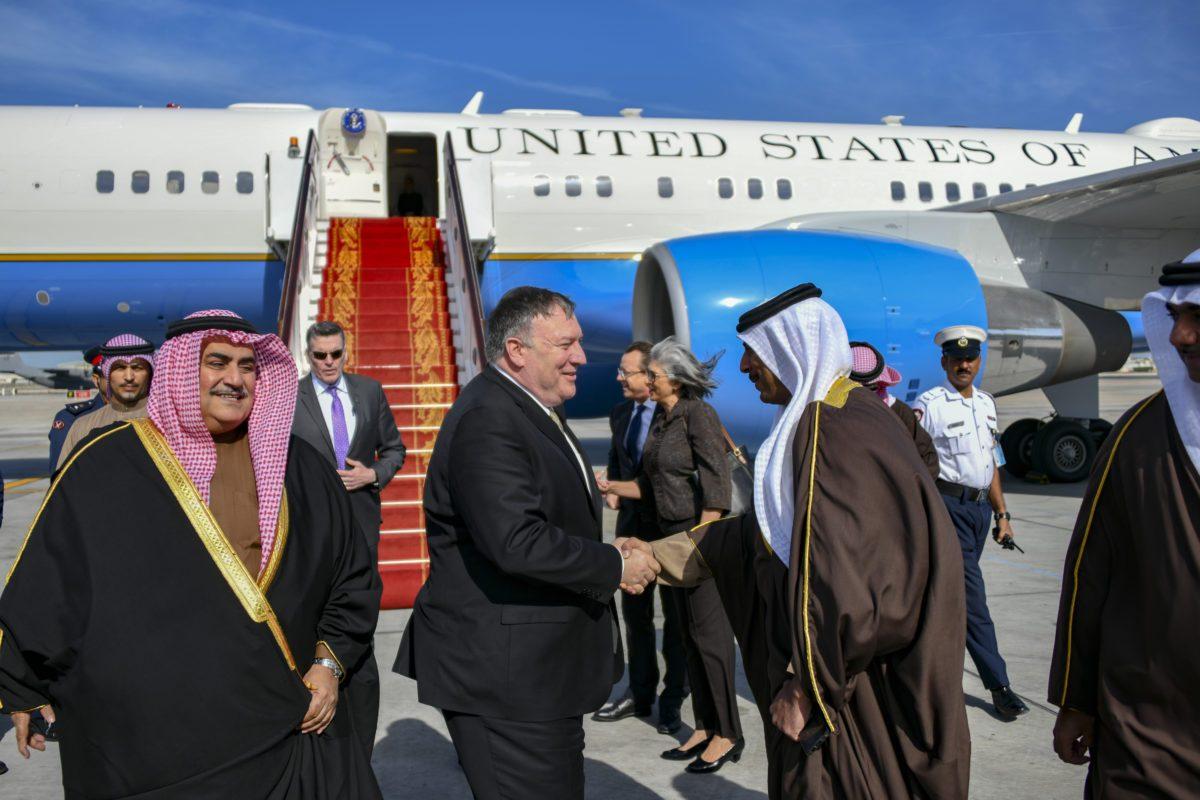

To enlist Bahraini support for his campaign against Iran, Trump lifted some restrictions on arms sales that the Obama administration had imposed because of Bahrain’s less-than-stellar human rights record.

By Thomas Lippman
Every year in late winter or early spring, the commander of all U.S. military forces in the Middle East and Central and South Asia delivers an extensive report to Congress about operations, strategy, planning, and training across his vast area of responsibility.
And every year this “Posture Statement” report demonstrates the extent to which the U.S. Central Command (CENTCOM) relies on partnerships with oppressive and dictatorial regimes whose perceived strategic value overrides concerns about human rights and political and religious freedom.
Saudi Arabia is the best-known example of this uncomfortable reality among the 20 countries with which CENTCOM has or is seeking some forms of military cooperation, but hardly the only one. Egypt, which has been busily cracking down on all forms of dissent, is another, as is Uzbekistan, where according to Amnesty International, “President Shavkat Mirziyoyev as taken some steps to improve the country’s abysmal human rights record” but “grave rights violations such as torture, politically motivated imprisonment, and forced labor in the cotton fields remain widespread.”
And then there is Bahrain, the tiny island state in the Persian Gulf where a monarchy controlled by a small group of Sunni Muslims keeps a tight grip over a restive, mostly Shiite population.
So close is its strategic partnership with the United States that Bahrain is officially designated a “major non-NATO ally,” a distinction that gives it enhanced access to U.S. weapons and training. The classification puts Bahrain in the same legal category as allies such as Australia, Japan, and Israel. As close as Saudi Arabia has been to the United States for decades, the kingdom has never been elevated to that status.
At 293 square miles, Bahrain is a dot on the map with fewer than 1.5 million residents, about half of them foreign workers. It is deeply dependent on Saudi Arabia for economic support and domestic stability. The Saudis have had troops in the island state since they helped put down a popular uprising during the Arab Spring unrest of 2011.
Yet, as Gen. Joseph L. Votel noted in his 2019 “Posture Statement,” “Bahrain is a strong security partner” for the United States as the home port of the U.S. Navy’s Fifth Fleet and “the only operating U.S. naval base in the Central Region.” Votel also said that Bahrain is fully supportive of U.S. efforts to limit Iranian ambitions in the Gulf region and “is a strong partner in countering threat financing, especially helping curtail Iran’s efforts to circumvent financial sanctions.”
According to a report issued in February by the Congressional Research Service:
The Bahrain government’s repression has long presented a policy dilemma for the United States because Bahrain is a longtime ally that is pivotal to maintaining Persian Gulf security. The country has hosted a U.S. naval command headquarters for the Gulf region since 1948; the United States and Bahrain have had a formal Defense Cooperation Agreement since 1991; and Bahrain was designated by the United States as a “major non-NATO ally” in 1992. There are over 7,000 U.S. forces, mainly Navy, in Bahrain.
To enlist Bahraini support for his campaign against Iran, the CRS report said, President Trump lifted some restrictions on arms sales that the Obama administration had imposed because of Bahrain’s less-than-stellar human rights record.
As the CRS report indicated, the U.S. government as a whole is well aware of Bahrain’s suppression of dissent and systematic discrimination against its Shia majority. The latest versions of the State Department’s annual report on human rights around the world and of the department’s Office of International Religious Freedom report contain strong criticism of Bahrain. The Human Rights report cited “allegations of torture; arbitrary detention; political prisoners; arbitrary or unlawful interference with privacy; restrictions on freedom of the press” and revocation of the citizenship of dissidents.
But Votel, like his predecessors, says the United States needs Bahrain and other autocracies in the region and is not in a position to cast them aside because of domestic conditions there. “In our strategic approach, it is important to acknowledge with a degree of humility that there are some things that are beyond our power to change,” he said. “We recognize the strategic importance of the Central Region to our national interests, and four key reasons why we must remain engaged here to preserve them.”
Those “four key reasons,” he said, are:
First, we must not allow another attack on our homeland. The CENTCOM AOR is the world’s epicenter for terrorism and VEOs [violent extremist organizations]. The 9/11 attacks were based from al-Qaeda’s safe haven in Afghanistan and served as a wake-up call that terrorism could be exported from anywhere in the world.
Second, we cannot allow VEOs or rogue nations to acquire weapons of mass destruction (WMDs). Our active presence in this region prevents VEOs from coming together toward that purpose and helps prevent the proliferation of WMD materials.
Third, instability is contagious. It does not respect national borders and grows and spreads if left unchecked. A stable Middle East underpins a stable world. In an already volatile region, our steady commitment to our allies and partners provides a force for stability. As the President’s National Security Strategy states, we must also “work with partners to neutralize Iran’s malign activities in the region.”
The fourth is the reemergence of great power competition, the main challenge highlighted in the NDS [National Defense Strategy]. China and Russia seek to dominate and influence not just their own geographic regions, but the Central Region as well. Just as great power competitors looked to influence energy and trade in the Middle East following the first World War, China and Russia are working very hard today to reshuffle the balance of power in the CENTCOM AOR, trying to displace the U.S from its position of influence. The President’s National Security Strategy directs that the United States seeks a Middle East that is “not dominated by any power hostile to the United States.”
Whether China and Russia are actually “hostile to the United States” may be debatable, given President Trump’s courtship of Russia’s Vladimir Putin and China’s Xi Jinping, but Votel is a military officer. He does not set policy; he executes policy established by the White House and the Defense Department.
If executing that policy means maintaining cozy relationships with odious regimes, Votel is simply following precedents that go far back in U.S. history. President Franklin D. Roosevelt forged an alliance with Stalin to combat the greater evil of Nazi Germany, and during the Cold War Washington cooperated closely with the apartheid government of South Africa to confront communist inroads in Angola and Congo.
It is still true, as Miles Copeland wrote 50 years ago in his classic, cynical book The Game of Nations, that “when our government decides what to do about other countries, it is limited only by considerations of effectiveness. If it works we can do it. When moral considerations loom up, the question is not ‘Can we do it?’ but ‘Can we get away with it?’”
Copeland overstated the case. There have been many occasions when the United States turned against a foreign government because of its domestic policies, the latest example being Venezuela. But as Votel’s report shows, there are some parts of the world where rectitude is a luxury the United States thinks it cannot afford.
Originally published by LobeLog, 03.28.2019, based at the Institute for Policy Studies, a program of Open Society Foundations, under the terms of a Creative Commons Attribution-NonCommercial-NoDerivs 3.0 Unported license.