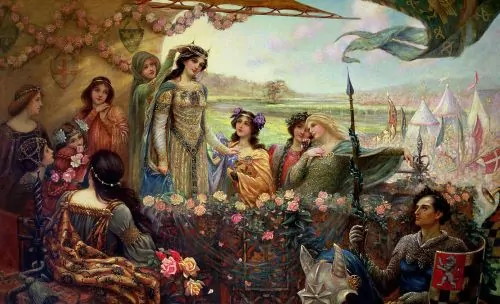
From Lancelot and Elaine to Romeo, Juliet, and Ophelia, medieval and Renaissance literature imagined love as a force that could waste the body, invite death, or overturn reason.

By Dr. Gwenyth Hood
Professor of English Emerita
Marshall University
Lovers in the Middle Ages had a tendency to go mad. In fact, they were subject to a whole range of disorders which nowadays are considered symptoms of mental illness, from pining away to outright suicide, to raging and raving madness. Of course, then as now, these manifestations of inner turmoil were not mutually exclusive. Malory’s Sir Lancelot goes raging mad (495-501) at one stage of his career and starves himself to death at the end of it (723). There are also more or less pure examples of each type: of pining away, Malory’s Elaine, the fair maid of Astalot (638-640); of suicide, Romeo and Juliet; and of raving madness, Ophelia. Though suicide still retains some of its old romantic associations, pining away and raging madness have lost their status as manifestations of love in otherwise healthy people. Thus, modem people tend to regard accounts of love-madness in Medieval and Renaissance literature as evidence that Medieval society naively overestimated the strength of erotic passion.
However, this is far from certain. As C. S. Lewis notes in The Allegory of Love, ”Real changes in human sentiment are very rare … butl believe that they occur .. ” (11). Lewis himself is referring to changes in the sentiments surrounding erotic love. In the classical and early Medieval period, sexual love was regarded merely as a carnal appetite to be controlled by reason, but with the rise of the poetry of Courtly Love, it came to be seen as highly spiritual desire governed by the religion of the god Amor, parallel and a rival to the God of the Christian religion. In the later Middle Ages this rivalry was eventually resolved by a synthesis between the ideals of Courtly Love and those of Christian marriage, a synthesis made easier by the fact that erotic symbolism for the relationship between God and humanity has deep Biblical roots. Lewis traces the progress of this literary synthesis in The Allegory of Love.
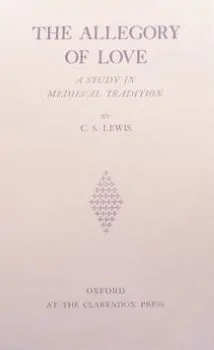
Indeed, Lewis in the Allegory may overstress the literary incompatibility of Courtly Love and Christian marriage in the early sources. For example, he appeals to the authority of Andreas Capellanus (Andrew the Chaplain) in order to make the adulterous nature of the Courtly Love ideal explicit (Allegory 32-43 ). But Andreas does so in the context of providing arguments for would-be seducers to use against ladies who claim pertinaciously that they are in love with their husbands (Tierney 183-5), thus suggesting that many ladies even in his time thought (or pretended they thought) they could synthesize Courtly Love and marriage. Nor do the recondite and precious theological arguments which Andreas uses to demolish the lady’s position have much to do with the motives and feelinps of the great Courtly Lovers in the literature of the time.1
That tension between Courtly Love and Christian ideals did exist is obvious, however, if only because Courtly Lovers ignored pre-existing (or even pre-contracted) marriages as an obstacle to their unions.2 It was a long time before symbols of Courtly Love became an essential part of the marriage pageantry. Lewis credits Edmund Spenser with effecting the literary synthesis most completely in The Faerie Queene (Allegory 297-360). It was far longer, of course, before the passion of love won the right to be considered the most important perequisite to a marriage.
It is beyond the scope of literary studies (or any other single discipline) to determine the relationship between cases of love-madness and the social status of erotic love during the period when they occurred. But the literary examples are suggestive. Of the cases of love-madness listed above, some precede Spenser (those from Malory) and some succeed him (those from Shakespeare)3 but the serious treatment of love-madness in literature does decline in later centuries. This may stem not merely from better understanding of human psychology but also from the greater freedom given people in these later times to follow (within disciplined limits, of course) their “Eros” where it led them. In modem times, following Freud, we look for a good deal of sexual content in neuroses and other mental illnesses, but we do not think of these disorders as temporary conditions which fall upon otherwise healthy people when their love-passions are checked. Our society allows the individual so much freedom in love-choices that if frustrations of a serious order appear, we must ask what in the sufferer’s personality has led him to use his freedom so badly.
ButinMedievalsociety(andotherswhereloversdonot have this freedom) the notion that erotic love could drive people mad may not have been so unrealistic. We understand now that mental illnesses are sometimes provoked by stress between the individual and his social environment; some minds seem to be more in conflict with their environments than others, but an intolerable environment will eventually produce mental collapse in anyone whom it does not first kill. (Such are the well-known casualties of war and prison camps, on which relatively little work has been done, because, after all, the cure is out of the power of the individual physician). So it should be obvious that different cultures will not only perceive madness differently but produce different kinds of madness. Different stresses cause different kinds of collapse.
Sexual love was clearly a source of great stress in the Middle Ages. It had two powerful enemies: the social environment and the Christian religion. Socially and politically, Medieval society was structured inconveniently for romantic lovers. Feudal alliances were important for maintaining political stability, and these alliances were cemented by marriages. The personal feelings of those being married to each other were often not consulted. As C. S. Lewis notes,
Marriages had nothing to do with love, and no ‘nonsense’ about marriage was tolerated. All matches were matches of interest, and worse still, of an interest that was continually changing.
Allegory 13
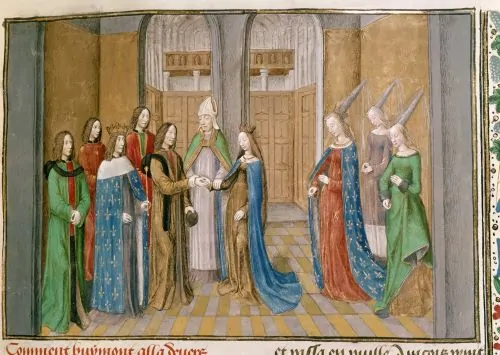
Of course, there is a danger of exaggerating these points, since throughout these times there were always some who had more power than others to make their own marriages. Also, politics did not completely dominate marriage choice except at the very highest levels; nobles sought matches which, besides cementing valuable alliances and bringing wealth or property into the family, would also produce healthy and admirable offspring. These considerations, if unromantic, are at least not wholly cynical. We may suspect that many young people shared their parents’ perspectives on marriage and went along with a minimum of protest.
Some aspects of this pragmatic feudal view of marriage were challenged by the Medieval Church, which demanded monogamy and chastity, forbade divorce and encouraged conjugal affection. The Church demanded a disciplined and dutiful familial love which was subordinated to the love of God. While discouraging the fickleness and disloyalty which might attend raw feudal ambition, Christian teachings also put some obstacles in the way of erotic love; they required young people to obey their parents, and they sternly forbade adultery. Furthermore, even within marriage, the Church discouraged passionate love of the sort which might overrule reasonprecisely the kind of love which Lewis calls “Eros” (Four Loves 131-160) and for which Medieval society invented the pseudo-religion of “Courtly Love.” As Lewis explains it, the Medieval view was expressed most fully by Thomas Aquinas, who declared that the sinfulness of passionate love lay not in the sexual act, per se, nor even in the pleasure which accompanied it, but in “the submergence of the rational faculty” in the act oflove (Allegory 16). Apparently it took a later and more subtle age to condemn romantic love as “idolatry” (Lewis, The Four Loves 155). But whatever the precise grounds of the tension, as Lewis points out,
The general impression left on the medieval mind by its official teachers was that all love-at least all such passionate and exalted devotion as a courtly poet thought worthy of the name-was more or less wicked.
Allegory 14
So on the one hand, to feudal society, Courtly Love was irrelevant to marriage and potentially destructive of feudal relationships. On the other hand, to the Medieval Church it represented the willful (and wicked) subjection of that highest of human faculties (reason) to an unruly passion. However much prestige the famous Courtly Lovers gained in literature and however they won the hearts of the populace, in real life their territory was a no man’s land. This was stressful for them. Perhaps it is not surprising, then, that some important characters in the Medieval-Renaissance Romance cycles experience love-madness in various forms.
Stories of pining away are so numerous that there is be no room to deal with them here in all their complexity.4 But more interesting for our purposes are the stories of Sir Lancelot of the Arthurian cycle and the Paladin Orlando of the Charlemagne cycle, both of whom experience a more extreme and intractable illness-raging madness, triggered by love. Both are eventually cured by divine intervention and both are afterwards returned to their former heroic stature. Lancelot’s madness and Orlando’s share many similar elements, yet they are quite different in the light they cast on Courtly Love. Interesting, too, is the fact that while Malory’s story comes earlier in time, his treatment (while less polished) is more psychologically complex than Ariosto’s and suggestive of the synthesis which is to come between Courtly Love and Christian marriage. Ariosto’s treatment, though probably a more direct influence upon Spenser than Malory’s (Lewis, Allegory 304), heightens the sense of conflict between passionate love and religious values. Ariosto seems to recommend rejection of passionate love, while Malory celebrates it and suggests that it must, somehow or other, be added to a conception of what is holy if holiness is to have any power. Clearly Malory’s conception was victorious in British literature and much of Western Literature, leading to the high dignity in which Romantic Love was held in our culture until a few decades ago. That Ariosto, though later in time, could be reversing this synthesis, shows how little time has to do with progress, and also emphasizes (what we may forget) how dangerous Courtly Love really could be for Renaissance society unless curbed or trained in certain directions.
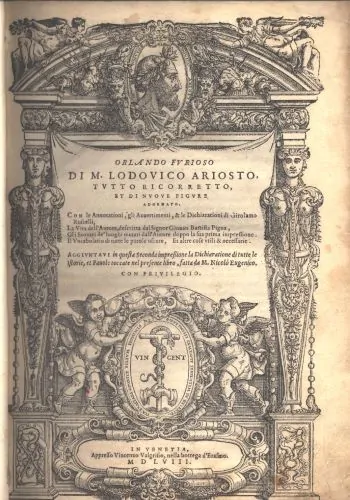
Since the opposition between society and courtly love appears most strongly in Ariosto’s work, we will consider it first although it is was written later (ca. 1516). Orlando, titular hero of Orlando Furioso, is the nephew of Charlemagne as well as the strongest of the Paladins. According to the legends, he is betrothed to the lady Alda (Ariosto 614), who, however, never appears in Ariosto’s story. Meanwhile, he has fallen in love the beautiful blonde pagan princess, An~lica of Cathay, whom the Saracens originally sent to Charlemagne’s court to sow confusion, in which she has been entirely successful. She loves none of her noble suitors, and hence early in Ariosto’s tale two of them are not loathe to join forces in attempting her capture (Canto 1, stanza 7). But Orlando has been her protector of long standing and one of two suitors (the other being the Saracen Sacripant) she considers most “trustworthy” (Canto 12, stanza 23), meaning apparently that these will not rape het if the opportunity arises. Angelica, in the story as Ariosto opens it, has been separated from Orlando. While Orlando searches for her, Angelica happens upon a wounded Saracen foot soldier, Medor (Canto 19, stanza 7). She heals him, falls in love with him, and yields her virginity to him, enjoying his embraces many days in a pastoral retreat. Then the two set out for the Orient together, after Angelica richly rewards the shepherd who has given them harborage. Only when they have departed does Orlando stumble upon their haunt and see their names carved on all the trees. Med.or has also left an Arabic inscription which reads,
Happy plants, verdant grass, limpid waters, dark shadowy cave, pleasant and cool, where fair Angelica, born of Galafron, and loved in vain by many, often lay naked in my arms. I, poor Medor, cannot repay you for your indulgence otherwise than by ever praising you.
Canto 23, stanza 107
Still disbelieving, Orlando goes to the very house where the lovers had stayed and is shown the bracelet, his gift to Angelica, which she had given in exchange for hospitality. After this, says Ariosto, Orlando is unable to sleep in the “downy bed” because “it occurred to him that on this very bed in which he was lying the thankless damsel must have lain down many a time with her lover” (Canto 23, stanza 120). He wanders through the woods weeping day and night. At last he savages the spring where Medor’s inscription appears and sits for three days without eating or sleeping. On the fourth day he loses his mind, rises up, throws off both armor and clothes, and rampages away, performing astonishing feats of strength:
[A]t one jerk he rooted up a tall pine, after which he tore up several more as though they were so many celerystalks. He did the same to oaks and ancient elms, to beech and ash-trees, to ilexes and firs.
Canto 23, stanza 135
Before he is cured, Orlando’s madness brings destruction on many people. A loyal friend of his, Zerbin, receives his mortal wound defending Orlando’s armor from the Saracen Mandricard (Canto 24, stanza 68). This, in tum, causes the death of Zerbin’s lover, Isabel, who tricks her Saracen captor, Rodomont, into killing her so as to avoid submitting to his lust. Orlando kills a number of poor and anonymous people himself. On the seashore he sees and tries to capture Angelica, but “[t]hat he had once so loved and worshiped her was a memory now totally destroyed in him. He ran after her as a hound pursues game” (Canto 29, stanza 61). Angelica saves herself by putting her magic ring in her mouth (the position in which it confers invisibility). But she tumbles off her mare, who is seized by Orlando “as gleefully as another man would a maiden” (Canto 29, stanza 68). The mare, in a fashion, is a surrogate for Angelica, and Orlando rides and drags her to death. He continues on his way, dragging the dead mare with him (a symbol, perhaps, for the futility of his love) and stealing whatever he needs from the surrounding population:
He seized fruit, meat, and bread which he guzzled, and overpowered everybody: some he left dead, others, maimed; he tarried little and kept pressing onwards. He would have dealt scarcely more tenderly with his lady had she not hidden herself; he could not tell black from white and believed that his inflictions were a kindness.
Canto 29, stanza 73
Eventually the madman is forced to abandon the mare’s carcass to cross “a broad river.” On reaching the other side, he solemnly offers a trade to a shepherd he meets on horseback:
I should like to swap my mare for that jade of yours … there she is, lying dead on the other shore. You can have her seen to by a doctor-that apart, I find no fault in her.
Canto 30, stanza 6
When the shepherd laughs and rides away, Orlando pursues, kills him and takes the horse.
Orlando’s failure to perceive the distinction between life and death is, besides a particularly hard-hitting illustration of madness, a comment on the astounding unrealism of courtly love in Ariosto’s vision. But, as Ariosto eventually admits, “I should be mad ifI undertook to relate each and every folly of Orlando, for there were so many, I wouldn’t know when I should finish” (Canto 29, stanza 50).
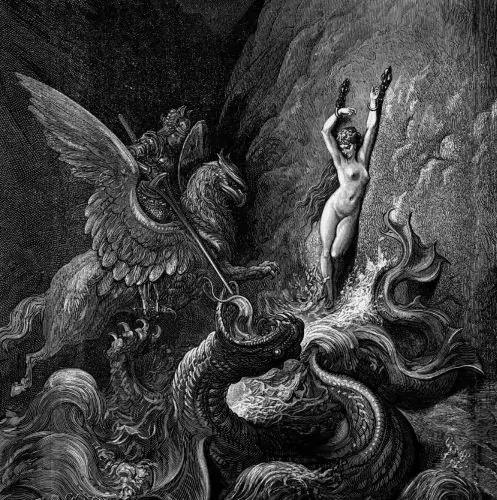
To end the madness, Heaven intervenes directly. The Apostle John brings the hero Astolfo from the Earthly Paradise to the moon for Orlando’s lost wit. John the Beloved frankly explains that Orlando’s madness is a punishment, for God “is harshest against, those He most loves, when they offend him” (Canto 34, stanza 63). Orlando has been remiss in his “duty to foster the Faithful” because of his ”lustful passion fora pagan woman” (stanza 64). But God has set a term of three months on his madness and his lost wits are kept in a valley on the moon, along with a great many other lost things such as “many a reputation … countless vows and prayers … useless time lost in gaming … vain desires” (Canto 34, stanza 74). Astolfo brings the vial away, and Orlando’s friends must capture him, bind hitn, and pour the vial of wits into his nostrils. When this is done, Orlando immediately realizes what has happened.
His old self once more, a paragon of wisdom and manliness, Orlando also found himself cured of love: the damsel who had seemed hitherto so beautiful and good in his eyes, and whom he had so adored, he now dismissed as utterly worthless. His only concern, his only wish now was to recover all that Love had stolen from him.
Canto 39, stanza 61
He immediately turns attention to the war and remains intent on it for the rest out the epic.
Straightforwardly, the account in Orlando Furioso corresponds strictly to Thomas Aquinas’ implied interpretation of Courtly Love as a kind of madness, a passion which is already nearly out of control as soon as it is recognizable for what it is. As Ariosto says,
Though not everyone goes raving mad like Orlando, Love’s folly shows itself in other ways; what clearer sign of lunacy than to lose your own self through pining for another? The effects vary, but the madness which promotes them is always the same. It is like a great forest into which those who venture must perforce Jose their way: one here, another there, one and all go off the track.
Canto 24, stanza 1
Orlando’s “raving madness” is simply a more intense form of this destructive passion, accenting the selfdramatizing, narcissistic behavior which Ariosto must often have observed at Court. It could not be channeled in other directions but must simply be overcome with reason.
This is not to say that Ariosto’s own attitudes toward Courtly Love are fully expressed in his treatment of Orlando’s madness. For one thing, Ariosto reveals himself early as an unreliable narrator whose privilege it is to contradict himself whenever he pleases. At Angelica’s escape, for example, the narrator cries out:
Would that not she alone butthe whole surviving sex had fallen into Orlando’s hands: they’ re a nasty tribe and not an ounce of good is to be found in any of them!
Canto 29, stanza 74
Then in the next canto, the narrator apologizes for his antifeminist remarks:
… I am like a sick man who has endured all too much pain and, at the end of his tether, gives way to passion and starts to curse …. I crave pardon, ladies … You must excuse me if … I babble deliriously. Blame it on my enemy-a lady who has reduced me to the most abject condition, making me say things I regret.
Canto 30, stanza 1-2
Indeed, Ariosto asserts at the very opening of the work that he is on the verge of losing his mind for love. He declares that he will complete the Furioso only if “she who … even now is eroding my last fragments of sanity, leaves me yet with sufficient to complete what I have undertaken” (Canto 1, stanza 1-7)
Many pairs of lovers are celebrated in the Furioso, including the tragic Zerbin and Isabel, Fiordiligi and Brandimart, and particularly Bradimant and Ruggiero, the forebears of Ariosto’s patrons the Estes (Canto 3). Even Angelica’s pairing with Medor, which should have been made contemptible if Ariosto had wished to discredit Courtly Love, is given a dignity and a lyrical beauty. Though Medor is only a foot-soldier, he is courageous (Canto 18, stanza 163 to Canto 19 stanza 25) and as we have seen above, he is properly humble and grateful for the love Angelica bestows upon him. Angelica’s love for him seems to be loyal; Ariosto notes that she eventually “gave [Medor] the sceptre of the Indies” (Canto 30, stanz.as 1625).
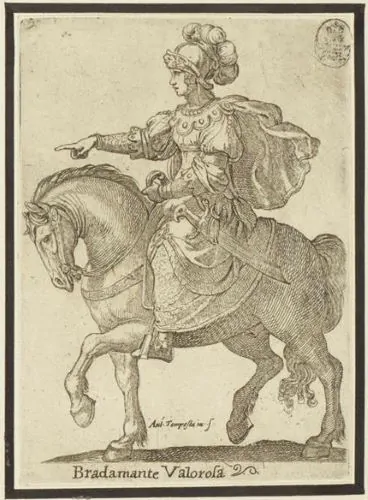
In his tale of Bradamant and her beloved, the Saracen knight Ruggiero, Ariosto partially integrates the romantic, social and theological themes which otherwise play each other to a standstill in his work. But Bradamant’s and Ruggiero’s willingness (or compulsion) to answer society’s other claims before their love may be what makes them worthy forebears of a ducal house. The spectacle of the warrior-maiden Bradamant, one of the most powerful champions in Charlemagne’s following, caught in a crossfire between her parents’ and her brother’s choice of suitors, is most intriguing. It is not a case, either, where the parents consider the choice of spouse to be of no concern to the daughter. Bradamant’s mother angrily demands that she state her views, only the mother is confident that Br adamant has the same priorities she does herself. The Emperor’s son Leo has rank and wealth, while Ruggiero’s only (official) qualification is his courage and prowess in battle. These reasons are enough to make Bradamant’s brother, Rinaldo, put him forward, but Bradamant is simply unable to bring love into this essentially political discussion:
Bradamant remained silent, not daring to contradict her mother, whom she so worshipped and respected that the thought of disobeying her would never have entered her head. On the other hand she would have felt greatly at fault if she were prepared to give verbal assent to what she was not prepared to do. She would not for she could not, Love having robbed her of what little powers of self-disposal she possessed …. [S]he merely sighed and made no answer. Then, when she was out of earshot, her eyes spilt a flood of tears.
Canto 44, stanza 38
The way is paved for the lovers’ happy union when the parents’ candidate withdraws out of respect for Ruggiero. Leo yields explicitly because Ruggiero is in danger of death from pining away (Canto 46, stanzas 22-42). As Leo puts it:
How much more fitting that you rather than I should have the lady: I love her for her virtues, but there is no question of my cutting off my life-threads if she became another’s.
Canto 46, stanza 43
So the passion of love inspires the political society to yield when it becomes powerful enough to cause a death. The lovers cannot find the words to demand their union as a right. They must wait until society itself chooses to take notice of their sufferings. Even so, Bradamant’ s and Ruggiero’s long wait will not be rewarded by a peaceful fulfillment, for Ruggiero is doomed to an early death (Canto 41, stanza 60-63). Thus Courtly Love, in Ariosto’s vision, is a beautiful but and tormenting passion, at worst verging on destructive madness, at best doomed to die young. Love may be more intoxicating than the political machinations which overtly give Ariosto’s story its structure, but its impermanence suggests that people must be mad to put their trust in it.
Yet, though Divine Love theoretically presides over the political and religious struggle in the foreground of the Orlando Furioso and its endorsement is needed to bring the title character back from the netherworld of insanity into the realm of politics, it could easily be shown that Ariosto’s treatment of religion is even more tongue-in-cheek than his treatment of romantic love. Orlando Furioso delights its readers because of its wit, imagination and beauty of expression, but in its treatment of serious themes it reveals the confusion and stress of Renaissance society instead of resolving it; Ariosto cannot dismiss either Divine Love or Courtly Love, and cannot integrate them.
Though Malory’s account of Lancelot’s madness has some superficial similarities to Ariosto’s, his treatment requires a more mystical interpretation of Courtly Love, one which suggests that it is much closer to divine love than to destructive madness. While Orlando is driven to madness by simple jealousy at loss of his unattained loveobject, Lancelot’s madness is set off by something far more complex. Lancelot is driven to a breakdown by the jealousy of others and the ambivalence of his own desires.
Malory’s Lancelot (pace T. H. White) has already consummated his adultery with Queen Guinevere when he meets Dame Elaine, the daughter of Pell es, the Grail King. He has been wandering about seeking adventures when the people of Pelles’s lands ask that he rescue Elaine from Morgan the Fay’s enchantment. This enchantress, jealous of Elaine’s beauty, has condemned her to burn in a kettle until the best knight in the world will take her by the hand. Sir Gawain has already failed. When Lancelot takes her hand, Elaine is freed; Malory notes that as she emerges from the kettle she is “naked as a needle” (478).5 On first seeing her, Lancelot believes she is “the fairest lady … that ever he saw” but after she has been clothed, Malory adds, “Sir Lancelot thought she was the fairest lady that ever he saw unless it were Queen Guinevere” (478).6 Whether Malory was conscious of making a distinction between the lady’s naked and clothed states, between the truth and Launcelot’s subjective judgment, or between first impressions and considered judgment (the latter swayed by loyalty) cannot be resolved here.
In any case, after freeing Elaine, Lancelot goes to her father’s castle, where King Pell es entertains him by letting him see how the Holy Grail supplies everyone at the table with every food he desires. Meanwhile, Pelles ponders a knotty problem. It has been revealed to him that Sir Galahad, who is to achieve the quest of the Holy Grail, must be born of Elaine by Sir Lancelot, but since (as his retainer Dame Brusen knows by witchcraft) Lancelot loves only Queen Guinevere and is otherwise inflexibly chaste, there remains the awkward problem of getting them in bed together. Still Dame Brusen has a plan, and King Pelles gives her full authority.
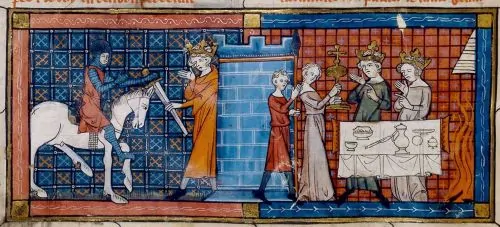
So, after dinner, Lancelot meets a messenger with a ring like one of Queen Guinevere’s, and a letter written in what appears to be Guinevere’s hand, informing Lancelot that Guinevere will be at Case Castle, which is five miles away, that night. Obedient, as a Courtly Lover should be, to the will of his sovereign lady, Lancelot rides at once to Case Castle and asks for the Queen. By way of hospitality, the attendants give him a potion which dims his wits; then he is brought to a royal chamber and goes to bed with the lady there, believing it to be Guinevere.
Only when Lancelot wakes in the morning, the potion having worn off, does he realize his bedfellow is not Queen Guinevere. He draws his sword and cries, “Thou traitoress! What art thou that I have lain with all this night? Thou shalt die right here by my hands!” (480)7 At this Elaine leaps (or “skips” as Malory puts it) “out of bed all naked” falls on her knees and makes a surprisingly dignified speech on her own behalf, her chief point being that “I have in my womb begotten of thee [one] that shall be the most noble knight of the world” (480).8 After learning that she is King Pelles’ daughter, Lancelot decides, “Well, I will forgive you.” He signifies his forgiveness with a dramatic gesture: “therewith he took her up in his arms and kissed her, for she was a fair lady and … lusty and young, and wise as any [who was] that time living.”
Ariosto would here have provided an extended passage explaining just what Lancelot’s thoughts were and what factors he took into consideration in deciding to spare Elaine’s life, but Malory’s simple style leaves us in some doubt as to precisely why Lancelot is so outraged to begin with and then why he relents. Prominent reasons for outrage, easy to support by textual evidence, include: (1) he has been tricked into disloyalty to Guinevere; (2) witchcraft was used; and (3) whoever did this knows about his affair with Queen Guinevere, which could bring about the death of them both. Prominent reasons for relenting are: (1) Elaine is young, beautiful, a princess and until then a virgin; (2) this was done at the will of King Pelles, in obedience to divine prophecy; (3) Guinevere cannot blame him, since he was tricked; (4) Lancelot rather liked the idea of fathering a son of such high lineage; and (5) Elaine and her father clearly do not intend to betray the affair with the Queen. Nevertheless, the quick transition between deaththreat and a surprisingly warm embrace, surely not obligatory under the circumstances, suggests conflicting emotions towards Guinevere and Elaine and what they stand for. Perhaps Lancelot already harbors a secret desire to be freed from the adulterous bond with the frightened and jealous Queen Guinevere.
What, exactly, does Elaine stand for? Her status as the Grail princess, fulfiller of prophecies, and mother of the child of promise, would seem to place her on the side of God, yet she has to be rescued from an enchantment and she cooperates with a scheme involving deceit and witchcraft, giving up her virginity in a manner of which the Medieval Church would definitely not have approved.
On the other hand, while Malory is more serious in his treatment of religion than Ariosto was, he is far less learned. His works display some theological naivete, which, of course, he shares with his sources. To list but a few examples, his holy men and hermits seem to think it an intelligent strategy to conjure up a devil to ask him whether a certain dead man had gone to heaven (551-2). Earlier in his work Malory states that Arthur’s sister, Morgan le Fay, was brought up in a nunnery where “she learned so much that she was a great clerk of necromancy” (5). If convents were where they learned magic in those days, no wonder Pelles resorts to Dame Brusen’s crafts so readily. Malory’s characters’ views on the theological status of Courtly Love also differ from those of Thomas Aquinas. Elaine, the Fair Maid of Astolat, (a different person from Elaine, King Pelles’s daughter, though T. H. White conflates them) is instructed by her confessor to stop thinking about love and answers,
Why should I leave such thoughts? Am I not an earthly woman? … [M]y belief is that I do no offense, though I love an earthly man, unto God, for He formed me that way, and all manner of good love comes from God. And other than good love, I never loved Sir Lancelot. (639)9
If it has not entirely slipped Elaine’s mind that she offered to be Lancelot’s paramour if he would not marry her, then she evidently does not regard sexual love between unmarried people as an offense, or not a serious one. Nor is she inclined to take responsibility for her loss of control in the passion of love. Though she acknowledges that she loves Lancelot “out of measure” (a phrase which means both “boundlessly” and “beyond what is right”), she asserts, “Of myself, Good Lord, I had no power to withstand the fervent love which has brought me death.”10 And of course, if she had not the power, she cannot be blamed; even God cannot expect people to accomplish more with reason than reason was intended to accomplish. Aquinas, of course, might not have admitted that reason and the human will were so fragile. Elaine, and probably Malory with her, boldly assumes the right to adapt what she understood of theology to her own circumstances.
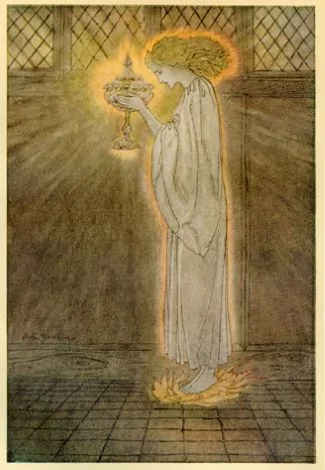
It must be this kind of religion which the Grail society represents. It was a popular religion, more sympathetic to the stresses and troubles of the secular world than convent theology could be, and consequently more ready to adapt to special circumstances, make exceptions to hard rules, and heed underlying forces rather than precise fulfillment of rules. Grail society may have a deeper vision of God’s influence on their world than does Camelot, but it is not independent of secular and political conditions; Morgan the Fay’s power to imprison Elaine and Elaine’s need for Lancelot to rescue her are enough to demonstrate this. But though Grail society is partially dependant on Camelot, underneath it still was driven by a different spirit, one more in love with God than worldly comfort and fame.
Elaine, King Pelles’ daughter, represents this community and accepts its responsibility to produce the knight who is to achieve the Quest of the Holy Grail. Since Lancelot, the destined father, will not, because of his own misdirected emotions, either marry Elaine or love her par amours, she agrees to stoop to deceit. Did she regard this as sinful? Perhaps not. For Medieval society, the offense a Princess committed in giving up her virginity outside of marriage lay in the disgrace it caused her family, but in Malory’s world, this disgrace seems much mitigated if the man in question is of high rank.11 If, furthermore, the maiden’s father not only consents but demands the relationship, and if he in tum is obeying Divine Prophecy, why then there is no offense at all. Would the Grail society have thought that it was wronging Lancelot with this bedroom trick? Again, perhaps not. What right of his was violated? The perception was that the maiden lost more than the man by lying with him, and Lancelot’s motive for refusing Elaine is his love for Guinevere, an adulterous love which he had no right to cultivate. It would matter to the Grail Society, of course, that Lancelot’s adultery offended not only religious standards but political ones too, threatening the destruction of the feudal society which give the country its only stability. Lancelot himself is to repent this bitterly at the end of his story (723). It also matters to the Grail society (as it would not to a cloistered moralist) that Arthur was a worthy king (unlike the dastardly King Mark) who deserved his wife’s respect and loyalty. Elaine is to point this out to Guinevere later (488).
In short, it is hard to see how the Grail society could have acknowledged any moral force in Lancelot’s love for Guinevere sufficient to annul its own intentions. In Elaine they offered him what was, at worst, a lesser sin than the one he intended, and at best what might have become a prestigious marriage.
Lancelot, of course, is dismayed at the trick, but after the first moment he is unable to articulate his sense of wrong, except to declare that Dame Brusen should be punished for her witchcraft. When Elaine asserts simply that Dame Brusen was also acting on King Pelles’ instructions, he gives the matter up. Elaine herself betrays no sense of shame when she ultimately confronts Queen Guinevere, although she has a ready tongue for reproaching Queen Guinevere’s adultery:
[A]las! madame, you have done great sin and yourself great dishonor, for you have a royal lord of your own, and therefore it should beyourdutyto love him; forthere is no queen in this world who has such another king as you have. And if you did not exist, I might have won the love of my lord Sir Lancelot. (488)12
Not even Guinevere can find a vocabulary to reproach Elaine; at this time she contents herself with instructing the young spitfire to leave Court in the morning and keep quiet about what she knows if she values Lancelot’s life.
It is not so surprising, then, that after Elaine enters into a sexual relationship with Lancelot in obedience to her father and to prophecy, because there was a promised holy child who must be begotten, she does not remain unaffected. What the Fair Maid of Astolat calls “good love,” what Lewis calls “Eros,” are not separate in her mind from desire to beget excellent children. Obedience to the will of God is not incompatible with love for a man who was God’s image and yet a unique individual who has saved her from enchantment. The central contradiction of Courtly Love and Christian marriage, as Lewis expresses it, that in Courtly Love there is no end to the devotion the knight owes the lady and in Christian marriage there is no end to the duty which the wife owes the husband (Lewis, Allegory 36) was no more strange to her than the paradox on which Christian marriage was modeled by the Apostle Paul, that there is no end to the devotion which the human race owes to Christ and yet Christ came into the world to be a servant and give up his life for the human race. Unconfused by Thomistic theology or Andreas Capellanus, Elaine the Grail Princess declares that she is in love with Sir Lancelot and she will not marry anyone else (481).
Eventually she asks her father’s permission to visit Arthur’s court for a great feast. Her father gives it, with a strange proviso:
[I]n any case, if you love me and want to have my blessing, be certain that you are arrayed in the richest manner, and do not spare for cost” (485).13
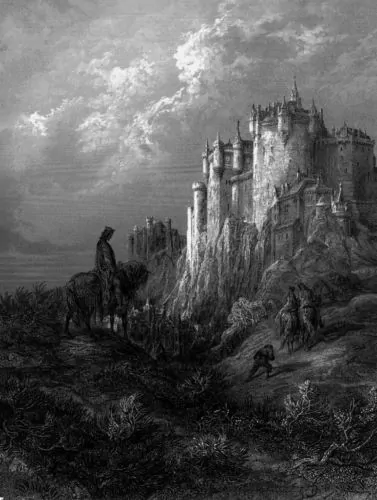
Here, too, one could almost long for an Ariostian analysis of King Pelles’ s state of mind. Is he merely being an indulgent father, sparing his daughter the trouble of begging for the finery she no doubt desires by anticipating the request and making it an order? Is he merely signifying emphatic approval of her design? Is he conscious of the stigma of illegitimacy on Galahad, his grandson, and desirous of proving that he is not ashamed of his daughter and what she has done?
But perhaps there is more to it. The Divine, in its invasion of human society, can take two strategies: it can understate itself and remain on the borders of the society’s knowledge, thereby challenging the people around to seek it out and grow in their perceptions through the quest. Or it can manifest itself directly, in which case it will outshine the secular world every time. The Holy Grail practices both of these things by tum, and so, it seems, does the society which serves the Grail. In this case, Pelles may be simply instructing his daughter that the strategy this time is to manifest her beauty, not to understate it.
In any case, Elaine obeys and her visit is a sensation. That she is “the fairest and best beseen lady that was ever seen that that court” is the opinion of everyone, “Arthur and Queen Guinevere” and “all the knights” (485). All the knights contend to show her courtesy and attention-all except Lancelot, who is mortified:
But when Sir Lancelot saw her he was so ashamed, because he [had drawn] his sword on her on the morning after he had lain with her, that he would not greet her or speak with her. And yet Sir Lancelot thought that she was the fairest woman that he had ever seen in all his life’s days. (485-86)14
Loyalty can do only so much, and perhaps also, Lancelot’s judgment has improved with age. Under the circumstances, Queen Guinevere feels insecure and orders Lancelot to come to her bed that night “or else … I am sure you will go to your lady’s bed, Dame Elaine, by whom you begot Galahad” (486). Lancelot quickly declares himself ready to do whatever the Queen asks.
Elaine, meanwhile, is heartbroken by Lancelot’s failure to speak to her and confides in Dame Brusen, who offers to bring Lancelot to her room the same way she did it the first time. There is no order from Pelles to be obeyed this time, and no child of prophecy to be begotten, only Elaine’s own erotic and marital ends; nevertheless, Dame Brusen does not form her plan until Lancelot and Guinevere have already made their adulterous arrangements. Perhaps Malory’s audience would have seen Elaine as having a natural claim on Lancelot as the mother of his only child, faithful only to him, and it must be further admitted that Guinevere is not exactly playing fair; she makes full use of her position of feudal superiority and all the old claims of loyalty, precisely because she suspects that Lancelot seriously desires what Elaine has to offer and would come to an understanding with her if left to his own devices. Elaine accepts Dame Brusen’ s proposal and Lancelot does not notice the deception, though no potion is used this time.
Guinevere, meanwhile, has a sleepless night “nigh out of her wit” when her messenger returns with word that Lancelot’s bed is empty. But as it happens, Elaine’s chamber is near the Queen’s and Lancelot talks in his sleep. Queen Guinevere hears him and is “wroth out of measure.” She coughs “so loud that Sir Lancelot awaked” (487). He realizes where he is, runs toward the Queen’s chamber, and meets her on the way, but she angrily banishes him from court, adding, “And not so hardy, thou false traitor knight, that evermore thou come in[to] my sight!” Lancelot, instead of remonstrating with either Guinevere or Elaine, simply cries “Alas!” and falls to the ground in a swoon. Guinevere turns and leaves him. Lancelot rises up in Elaine’s presence and she knows by ”his countenance” that he is “mad forever” (487). He leaps out the window, wounding himself with thorns, and runs into the forest. Elaine, after rebuking the Queen for her adultery, departs from court, informing Lancelot’s cousin Sir Bors what has happened so that Lancelot’s family may search for him. Lancelot’s kinsmen in tum tell Queen Guinevere what they think of her, at which she swoons, relents, and starts out a search for the mad Lancelot. Sir Bors also tries to reproach Elaine but makes no impression on her.
In his madness Lancelot’s behavior in some ways resembles Orlando’s. He is fierce and anti-social. However, mad Lancelot is less destructive and less out of touch with reality than mad Orlando. Unlike Orlando he does not go entirely naked, but wears the ragged clothes in which he ran away. He does not pursue women. Though once he jumps into bed with a naked woman, he is looking for a place to sleep (496). He seems dimly to remember the rules of chivalry and never attacks human beings unless provoked. On one occasion when he has been living quiescently in chains in the home of a knight, Sir Bliaunt, who is treating him as kindly as he knows how to treat a madman, he breaks his chains to help when he sees his protector being attacked by a larger force (497). Also, while Ariosto suggests that madness is dangerous and calls for self-defense, Malory suggests that madness is helpless and needs protection. Mad Orlando is nearly invulnerable, but mad Lancelot could easily have been killed several times if people had not taken pity on him, first Sir Bliaunt (496), then the hermit who finds him wounded by a boar (498), and finally the knights of King Pelles’ castle who rescue him from mob violence (499).
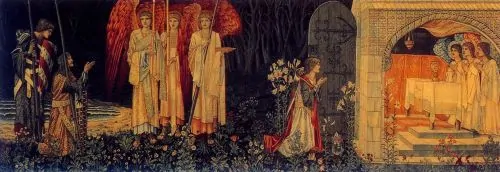
At King Pelles castle he is kept as a “fool” until one day he falls asleep by a well in King Pelles’ garden where Elaine happens by and recognizes him. She appeals to her father, and King Pelles has Lancelot carried to the chamber of the Holy Grail. The Holy Grail is uncovered and “by miracleand by virtue of that holy vessel” he is healed (500). Lancelot is bewildered to find himself where he is and then ashamed to learn how he came there.
Madness, however, does not cure him of passionate love. On recovery he remembers and grieves for his banishment by Guinevere. On the other hand, he does not seem utterly downcast. He requests a castle in Pelles’s territory and when he is given one he calls it “The Joyous Isle.” There he lives with Elaine and other ladies and knights given to her for companions, but he goes through the ceremony once a day of looking toward “Logris, where King Arthur and Queen Guinevere were” (502) and weeping. So he remains until some knights of the Round Table come upon him, recognize him, and persuade him to return to court, a prime argument being “it has cost my lady the queen twenty thousand pounds seeking you.” After he returns to court King Arthur inquires curiously as to why Lancelot went mad. Was it for love of Princess Elaine, by whom he has a son? Lancelot replies, ”My lord … if I did any folly I have what I sought” (506). Malory adds “But all Sir Lancelot’s kinsmen knew for whom he went out of his mind.”
By Ariosto’s standards, it is questionable whether Lancelot’s madness has been cured at all; and just as puzzling is that the Holy Grail, which cured Lancelot, is associated with Elaine, yet the cure gives him the freedom to return to his adulterous relationship with Guinevere, which he is to repent so bitterly. In a sense, however, Lancelot’s relationship with Elaine foreshadows his experience in the Quest of the Holy Grail; though Lancelot apparently is sincere in his desire to perfect himself and willingly suffers many humiliations in order to win the vision, and although he is ultimately granted more insight into the Grail than any but the three knights (Bors, Percival and Galahad) who achieve the quest, he is denied the full vision because he is “in his privy thoughts and in his mind so set inwardly to the queen” (611). Sure enough, when he returns from the quest, “Sir Lancelot began to resort unto the Queen Guinevere again and forgot the promise and the perfection that he made in the quest . . . so the:r. loved together more hotly than they did before” (611).15 Notwithstanding this, Sir Lancelot’s greater seriousness on his return from the quest is the occasion of the next quarrel the lovers have and as he says, “I was but late on the Quest of the Holy Grail and … it may not yet be lightly forgotten” (611). After the last battle which ends Malory’s work, when Arthur is dead, Lancelot apparently wishes to marry Guinevere, but Guinevere is determined to remain a nun. Then (at long last) she counsels him to take a wife. Lancelot becomes a monk instead, and pines away to deathafter she dies (723).
Though it is not explicitly said, the impression is created that some of the same qualities which cause Lancelot to, as he confessed on the outset of the Grail quest, “[love] a queen unmeasurably and out of measure long” (539) also made him an appropriate father for the Grail Prince. Though the hermit, like the wise men in Ariosto’s poem, define the relationship as ”lechery” (540), quite clearly there is more to it than that. The complex intertwining of feelings which reveal themselves in this long work include Lancelot’s pride and thirst for worldly glory (so thoroughly mortified during the Quest, 555-557) which make him seek a queen’s favor, his pleasure in the distinction her favor brings him, his gratitude and his sense of obligation for the danger in which she puts herself by loving him, and the deep affection that comes from long intimacy. Though some of these tendencies are rebuked in the Grail stories, some are clearly praised. Plainly the same sensitivities which make Lancelot loyal to Queen Guinevere also make him susceptible to the call of Divine Love.
Indeed, the manner of the adulterous lovers’ deaths confirms the importance of their love in the divine scheme of things. Lancelot, having been a priest for twelve months, is informed by a vision that Guinevere is dying and that he is to go and bury her beside King Arthur. Likewise, Guinevere is notified by vision that she is dying and Lancelot is coming to bury her. That Malory’s God permits Lancelot to perform this last service for the woman he has loved signals forgiveness for their sin at the same time that it makes a demand for restitution; Lancelot is being instructed, once more and finally, to return Guinevere to Arthur. Understanding this, Guinevere expressly prays to “Almighty God” that she be dead before Lancelot arrives.
Her prayer is granted, and when Lancelot arrives to find her gone only a half hour, “he wept not greatly, but sighed” (723). After burying her, he faints for grief, and in response to a rebuke from a hermit who believes he is regretting the loss of past pleasures, he declares that his grief is for pure penitence, because seeing Arthur and Guinevere together where they belonged made him realize that he had betrayed them both (723). After this, he eats and drinks little until he dies. Is this pining away yet another example of the love-grief which carried off the Fair Maid of Astalot and threatened to kill Ariosto’s Ruggiero? Or is it the excessive penitence which sometimes struck monks, nuns and hermits during the same period? No distinction is possible; of course it is both. When Lancelot dies, the bishop has a vision that he is taken up by angels through the gates of Paradise. Lancelot’s dead body is found lying “as [if] he had smiled” with a sweet “savor” (often representing holiness), about him. But by his own choice he is buried at the Joyous Garde (in order, he declared, to avoid breaking a vow made earlier), the refuge which he had provided to Tristram and Isode during King Mark’s wrath, and where he himself had lived with Queen Guinevere during her exile from Arthur’s court. On their own initiative, his fellow hermits carry him there in the same horse-bier which had carried Queen Guinevere. All may bitterly repent the adultery and the destruction it wrought, but it does not alter their sympathy and homage for many things which were good and noble about this love.
Rather than a different thing altogether, then, from holy love, the love Lancelot and Guinevere share is a less mature and partly corrupted form of the love which draws the knights after the Holy Grail. Knights who cannot feel this single-minded loyalty never even get well started on the Quest. Hence, Lancelot may perceive the love of Elaine as something better and yet more difficult than the love he has achieved, and it is a measure of his sensitivity that the pain of breaking from what is genuine in the old relationships is enough to drive him mad. This is why, in restoring him to reason, the Holy Grail does not destroy his love for
Hence, as opposed to Ariosto where a passionate love which cannot be integrated with society is matched with a malignant kind of madness which is highly destructive and yet indestructible, Malory presents a kind of passionate love which is in harmony with divine love, although its misdirection and corruption can have disastrous consequences. The shape of the Malory’s story suggests that this force cannot be ignored or suppressed but must somehow be taken into account in political society. When this happens, the stress on those with deep personal romantic feelings will obviously be reduced, to the point where stories about people who go mad or pine away from love will hardly be believable.
See endnotes and bibliography at source.
Originally published by Mythlore: A Journal of J.R.R. Tolkien, C.S. Lewis, Charles Williams, Mythopoeic Literature 16:3 Article 4 (03.15.1990, 20-61), Southwestern Oklahoma State University, under a Creative Commons Attribution-NonCommercial-NoDerivatives 4.0 International license.
About the Author