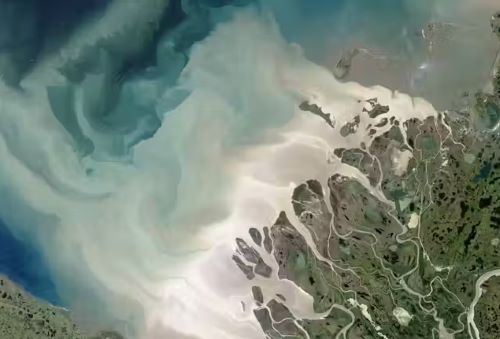
Thawing permafrost and intensifying storms will change how water moves into and through Arctic rivers.

By Dr. Michael A. Rawlins
Associate Director, Climate System Research Center
Associate Professor of Climatology
UMass Amherst

By Dr. Ambarish Karmalkar
Assistant Professor of Geosciences
University of Rhode Island
Introduction
As the Arctic warms, its mighty rivers are changing in ways that could have vast consequences – not only for the Arctic region but for the world.
Rivers represent the land branch of the earth’s hydrological cycle. As rain and snow fall, rivers transport freshwater runoff along with dissolved organic and particulate materials, including carbon, to coastal areas. With the Arctic now warming nearly four times faster than the rest of the world, the region is seeing more precipitation and the permafrost is thawing, leading to stronger river flows.
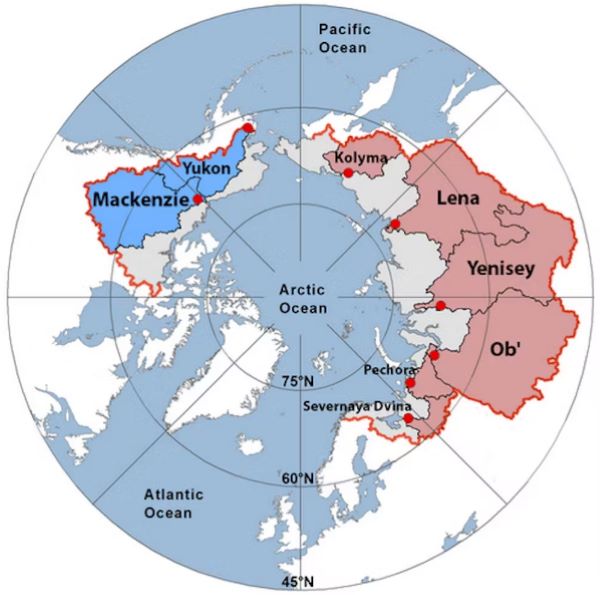
We’re climate scientists who study how warming is influencing the water cycle and ecosystems. In a new study using historical data and sophisticated computer models of Earth’s climate and hydrology, we explored how climate change is altering Arctic rivers.
We found that thawing permafrost and intensifying storms will change how water moves into and through Arctic rivers. These changes will affect coastal regions, the Arctic Ocean and, potentially, the North Atlantic, as well as the climate.
Thawing Permafrost: Big Changes in Arctic Soils
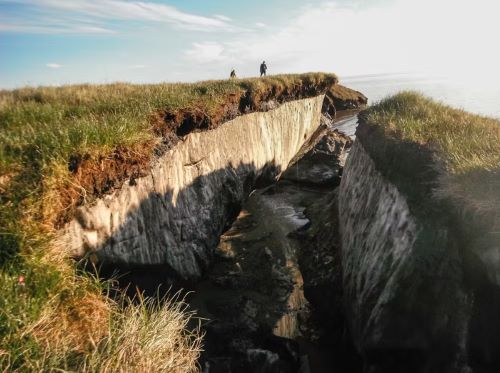
Permafrost thaw is one of the most consequential changes that the Arctic is experiencing as temperatures rise.
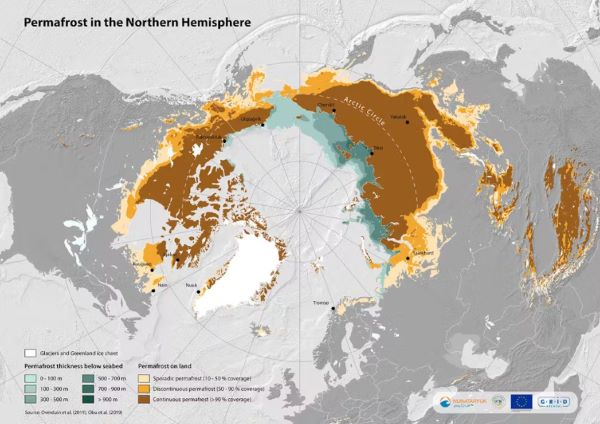
Permafrost is soil that has been frozen for at least two years and often for millennia. It covers approximately 8.8 million square miles (about 22.8 million square kilometers) in Earth’s Northern Hemisphere, but that area is shrinking as the permafrost thaws.
Historically, most water going into Arctic rivers flows atop frozen permafrost soils in spring. Scientists call this “overland runoff.”
However, our results suggest that as warming continues, an increasing fraction of annual river flow will come from under the surface, through thawed soils in the degrading permafrost. As the overall flow increases with more precipitation, as much as 30% more of it could be moving underground by the end of this century as subsurface pathways expand.
When water flows through soil, it picks up different chemicals and metals. As a result, water coming into rivers will likely have a different chemical character. For example, it may carry more nutrients and dissolved carbon that can affect coastal zones and the global climate. The fate of that mobilized carbon is an active area of study.
More carbon in river water could end up “outgassed” upon reaching placid coastal waters, increasing the amount of carbon dioxide released into the atmosphere, which further drives climate warming. The thaw is also revealing other nasty surprises, such as the emergence of long-frozen viruses.
More Rain and Snow, More Runoff
The Arctic’s water cycle is also ramping up as temperatures rise, meaning more precipitation, evaporation, plant transpiration and river discharge. This is primarily due to a warmer atmosphere’s inherent ability to hold more moisture. It’s the same reason that bigger snowstorms are occurring as the climate warms.
Our study found that the bulk of the additional precipitation will occur across far northern parts of the Arctic basin. As sea ice disappears in a warming climate, computer models agree that a more open Arctic Ocean will feed more water to the atmosphere, where it will be transported to adjacent land areas to fall as precipitation.
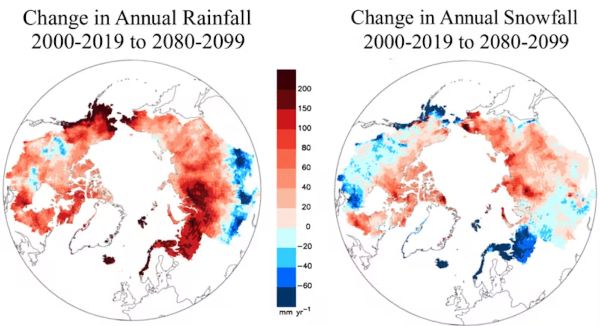
More snow in northern Alaska, Siberia and Canada will lead to more water flowing in rivers, potentially up to 25% more under a high-warming scenario based on our research. There is more carbon in the soil in northern parts of the Arctic compared with the south. With permafrost thaw, those regions will also see more water coming into rivers from below the surface, where additional soil carbon can leach into the water and become dissolved organic carbon.
More old carbon is already showing up in samples gathered from Arctic rivers, attributed to permafrost thaw. Carbon dating shows that some of this carbon has been frozen for thousands of years.
Impacts Will Cascade through Arctic Ecosystems
So, what does the future hold?
One of the most notable changes expected involves the transport of fresh water and associated materials, such as dissolved organic carbon and heat energy, to Arctic coastal zones.
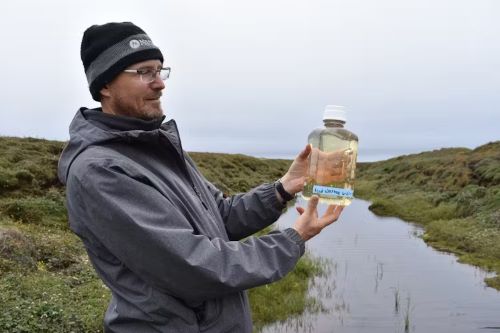
Coastal lagoons may become fresher. This change would affect organisms up and down the food chain, though our current understanding of the potential affects of changes in fresh water and dissolved organic carbon is still murky.
River water will also be warmer as the climate heats up and has the potential to melt coastal sea ice earlier in the season. Scientists observed this in spring 2023, when unusually warm water in Canada’s Mackenzie River carried heat to the Beaufort Sea, contributing to early coastal sea ice melting.
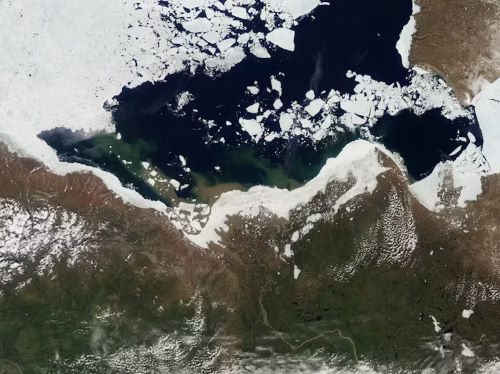
Finally, more river water reaching the coast has the potential to freshen the Arctic Ocean, particularly along northern Eurasia, where big Russian rivers export massive amounts of fresh water each year.
There are concerns that rising river flows in that region are influencing the Atlantic Meridional Overturning Circulation, the currents that circulate heat from the tropics, up along the U.S. East Coast and toward Europe. Evidence is mounting that these currents have been slowing in recent years as more fresh water enters the North Atlantic. If the circulation shuts down, it would significantly affect temperatures across North America and Europe.
At the coast, changing river flows will also affect the plants, animals and Indigenous populations that call the region home. For them and for the global climate, our study’s findings highlight the need to closely watch how the Arctic is being transformed and take steps to mitigate the effects.
Originally published by The Conversation, 03.05.2024, under the terms of a Creative Commons Attribution/No derivatives license.
About the Author