
By Dr. Sonia Coman
Anne van Biema Postdoctoral Fellow
Smithsonian Institution
Introduction
Japan’s arts are often in dialogue with artistic and cultural developments in other parts of the world. From the earliest aesthetic expressions of the Neolithic period to today’s contemporary art—here is a brief survey to get you started.
Please note that while the material is organized chronologically, it highlights major themes and introduces makers and objects recognized as especially influential.
Jōmon Period (c. 10,500 – c. 300 B.C.E.): Grasping the World, Creating a World

The Jōmon period is Japan’s Neolithic period. People obtained food by gathering, fishing, and hunting and often migrated to cooler or warmer areas as a result of shifts in climate. In Japanese, jōmon means “cord pattern,” which refers to the technique of decorating Jōmon-period pottery.
As in most Neolithic cultures around the world, women made pots by hand. They would build vessels from the bottom up from coils of wet clay, mixed with other materials such as mica and crushed shells. The pots were then smoothed both inside and out and decorated with geometric patterns. The decoration was achieved by pressing cords on the malleable surface of the still moist clay body. Pots were left to dry completely before being fired at a low temperature (most likely, just reaching 900 degrees Celsius) in an outdoor fire pit.
Later in the Jōmon period, vessels presented ever more complex decoration, made through shallow incisions into the wet clay, and were even colored with natural pigments. Jōmon-period cord-marked pottery illustrates the remarkable skill and aesthetic sense of the people who produced them, as well as stylistic diversity of wares from different regions.

Also from the Jōmon period, clay figurines have been found that are known in Japanese as dogū. These typically represent female figures with exaggerated features such as wide or goggled eyes, tiny waists, protruding hips, and sometimes large abdomens suggestive of pregnancy. They are unique to this period, as their production ceased by the 3rd century B.C.E. Their strong association with fertility and mysterious markings “tattooed” onto their clay bodies suggest their potential use in spiritual rituals, perhaps as effigies or images of goddesses. Besides dogū, this period also saw the production of phallic stone objects, which may have been a part of the same fertility rituals and beliefs.
Images of the female body as symbols of fertility are encountered in many parts of the world in the Neolithic period, presenting features unique to the regions and cultures that produced them. The preoccupation with fertility was increasingly twofold, namely the fertility of women and that of the land, as people began cultivating it and transitioning to a settled agricultural society.
Yayoi Period (300 B.C.E. – 300 C.E.): Influential Importations from the Asian Continent (I)

People from the Asian continent who were cultivating crops migrated to the Japanese islands. Archaeological evidence suggests that these people gradually absorbed the Jōmon hunter-gatherer population and laid the foundation for a society that cultivated rice in paddy fields, produced bronze and iron tools, and was organized according to a hierarchical social structure. The Yayoi period’s name comes from a neighborhood of Tokyo, Japan’s capital, where artifacts from the period were first discovered.
Yayoi-period artifacts include ceramics that are stylistically very different from the cord-marked Jōmon-period ceramics. Although the same techniques were used, Yayoi pottery has sharper and cleaner shapes and surfaces, including smooth walls, sometimes covered in slip slip (a liquid clay mixture used in the production and decoration of pottery), and bases on which the pots could stand without being suspended by rope. Burnished surfaces, finer incisions, and sturdy constructions that suggest an interest in symmetry are characteristic of Yayoi pots.
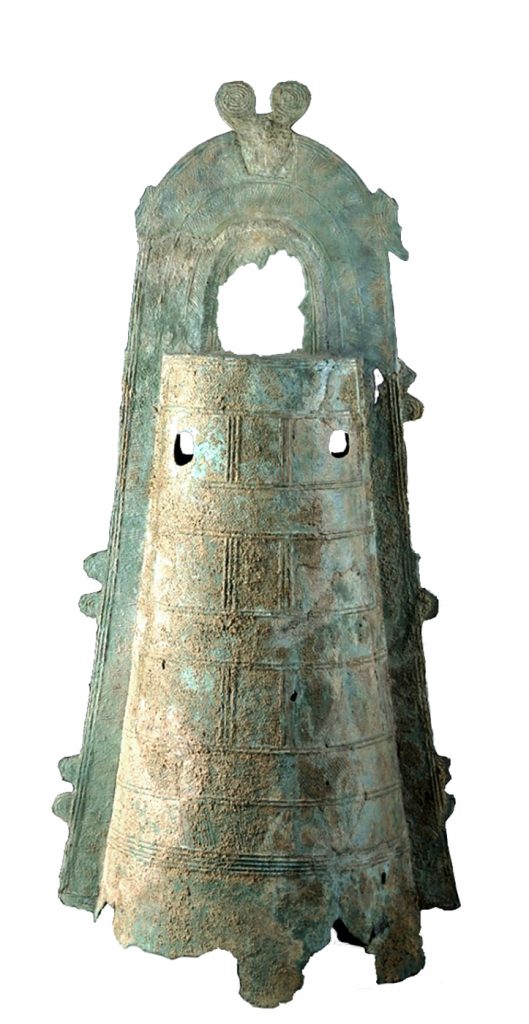
Some studies suggest that Yayoi pottery is linked to Korean pottery of the time. The Korean influence extends beyond ceramics and can be seen in Yayoi metalwork as well. Notably, Yayoi period clapper-less bronze bells closely resemble much smaller Korean bells that were used to adorn domesticated animals such as horses.
These bells, together with bronze mirrors and occasionally weapons, were buried on hilltops. This practice was seemingly linked to ritual and may have been considered auspicious, perhaps for the fertility of the land in this primarily agricultural society. The magical or ritualistic function of the bells is further suggested by the fact that the bells were not only clapper-less, but they also had walls that were too thin to ring when hit.
The bells became larger later in the Yayoi period, and it is believed that the function of these larger bells was ornamental. Across regions and over the span of a few centuries, such bells varied in size from approximately 10 cm to over 1 meter in height.
Kofun Period (c.3rd Century-538): Influential Importations from the Asian Continent (II)
The Kofun 古墳 period is so named after the burial mounds of the ruling class. The practice of building tomb mounds of monumental proportions and burying treasures with the deceased arrived from the Asian continent during the 3rd century. Originally unadorned, these tombs became increasingly ornate; by the 6th century, burial chambers had painted decorations. The burial mounds were encircled with stones; hollow clay earthenware, known in Japanese as haniwa 埴輪, were scattered for protection on the land surrounding the mounds. Kofun were typically keyhole-shaped, had several tiers, and were surrounded by moats. The resulting structure amounted to an impressive display of power, advertising the control of the ruling families. The largest kofun is the Nintoku mausoleum, measuring 486 meters!

The hollow clay objects, haniwa, that were scattered around burial mounds in the Kofun period, have a fascinating history in their own right. Initially simple cylinders, haniwa became representational over the centuries, first modeled as houses and animals and ultimately as human figures, typically warriors. The later pieces have been of great help to anthropologists and historians as tokens of the material culture of the Kofun period, offering a glimpse into that society. Whether offerings for the dead or protective barriers meant to guard the tombs, haniwa have a strong aesthetic identity that continues to be a source of inspiration for Japanese ceramists.

Through gradual consolidation of political power, the Kofun-period Yamato clan became a kingdom with seemingly remarkable control over the population. In the 5th century, its center moved to the historical Kawachi and Izumi provinces (on the territory of present-day Osaka prefecture). It is there that the largest of the kofun burial mounds testify to a thriving Yamato society, one that was increasingly more secular and military.

Simultaneously, the potter’s wheel was used for the first time in Japan, likely transmitted from Korea, where it had been adopted from China. This new technology was used to produce what is known as Sue ware—typically bluish-gray or charcoal-white footed jars and pitchers that had been fired in sloped-tunnel, single-chamber kilns (anagama 穴窯) at temperatures exceeding 1,000 degrees celsius. Like other types of ancient Japanese pottery, Sue ware continues to be a source of inspiration for ceramists, in Japan and beyond.
Asuka Period (538-710): The Introduction of Buddhism
The Asuka period is Japan’s first historical period, different from the prehistoric periods reviewed so far because of the introduction of writing via Korea and China. With the Chinese written language also came standardized measuring systems, currency in the form of coins, and the practice of recording history and current events. Standardization and record-keeping also encouraged the crystallization of a centralized, bureaucratic government, modeled on the Chinese.
All this was imported when a new religion—Buddhism—was introduced in Japan, significantly changing Japanese culture and society. Unlike Japan’s indigenous “way of the gods” (Shintō – Japan’s indigineous religion, Shintō entails belief in the sacred power of animate and inanimate things, as well as ritual practices for the worship of ancestors and gods, known as kami), Buddhism had anthropomorphic representations of deities. After the introduction of Buddhism, we see a shift in the visual and material culture of Shintō. If, before Buddhism, Shintō gods were associated with sacred objects such as mirrors and swords (the imperial insignia), after the introduction of the new religion they began to be represented in anthropomorphic images, although such images were hidden in the inner sanctuaries of Shintō shrines.

By the time Buddhism reached Japan, it had spread from India to China and had undergone several changes in imagery and styles. In Japan, Buddhism profoundly influenced indigenous culture, but it was equally shaped by it, resulting in new forms and modes of expression. The imperial household embarked on major Buddhist commissions. One of the earliest and most spectacular is a temple in Nara, Hōryūji or the “temple of flourishing law.” The founding of Hōryūji is attributed to the ailing emperor Yomei, who died before seeing the temple completed; Yomei’s consort, empress Suiko, and regent Prince Shōtoku (574-622) carried out the late emperor’s wishes. Given the influence of empress Suiko’s Buddhist patronage, the Asuka period is also referred to as the Suiko period. Prince Shōtoku, too, is celebrated as one of the earliest champions of Buddhism in Japan. In fact, a century after his death, he began to be worshipped as an incarnation of the historical Buddha.

Like the enduring legend and legacy of Prince Shōtoku, Hōryūji has had a long and complex life well past the Asuka Period. With structures that vanished in fires and earthquakes as early as the 7th century to the temple’s pagoda that was dismantled and reassembled during World War II, Hōryūji underwent numerous changes and its buildings currently date from the Asuka period to the late 16th century! A complex site with some of the world’s oldest wooden structures, Hōryūji exemplifies ancient Japanese architectural techniques and strategies, including the slight midpoint bulging of round columns, which has been compared to the similar practice of entasis (a slightly convex curve in the shaft of a column, used to correct the visual illusion of concavity that occurs with straight shafts) in ancient Greek architecture.

Hōryūji houses one of the best known, albeit mysterious, Buddhist representational sculptures of the Asuka period—the so-called Kudara Kannon 百済観音, a slim and life-size image of the bodhisattva of compassion, sculpted in camphor wood. The first cultural property in Japan to be designated as a “national treasure,” this sculpture first appeared in Japanese records in the 17th century. The “Kudara” in its name, assigned well after the Asuka period, is the Japanese term for Baekje, one of the three historical kingdoms of Korea. The sculpture’s astounding grace derives from its slight smile, slim frame, and flowing lines.

Hōryūji was not the only major temple developed in the Asuka period. When the capital was transferred from Asuka to Nara, a temple known as Hōkōji was relocated as well. In its new location, the temple grew significantly under the name of Gangōji. One of the temple’s treasures is the Asuka daibutsu 飛鳥大仏 or the Great Buddha of Asuka—a devotional image that testifies to the early Buddhist representational tradition in Japan. It is also the oldest of the daibutsu or ‘great Buddhas’—large sculptural devotional images of the Buddha.
Of the original, cast in 609 and attributed to a sculptor of Korean descent, only the face and the fingers of the right hand remain. These details, however, reveal the Chinese-inspired style of Tori Busshi, with soft features, smooth surfaces, and simple and elegant lines.

The late Asuka period, also referred to as the Hakuhō period (late 7th century), saw a momentous transformation of Japanese society, prompted by the so-called Taika reforms. Implemented after the death of Prince Shōtoku, these reforms were modeled on the Chinese system of government and led to a greater centralization of Japanese imperial power. In the realm of Buddhist sculpture, the Hakuhō period marked a rapid expansion and dissemination of Buddhist imagery across Japan. Full-bodied sculptures, like the four Heavenly Kings at Hōryūji, are more visually assertive than the Kudara Kannon and announce the influence of Tang-dynasty Chinese culture. In that, the Hakuhō period can also be considered the first segment of the subsequent era—the Nara period.
Nara Period (710-794): The Influence of Tang-Dynasty Chinese Culture
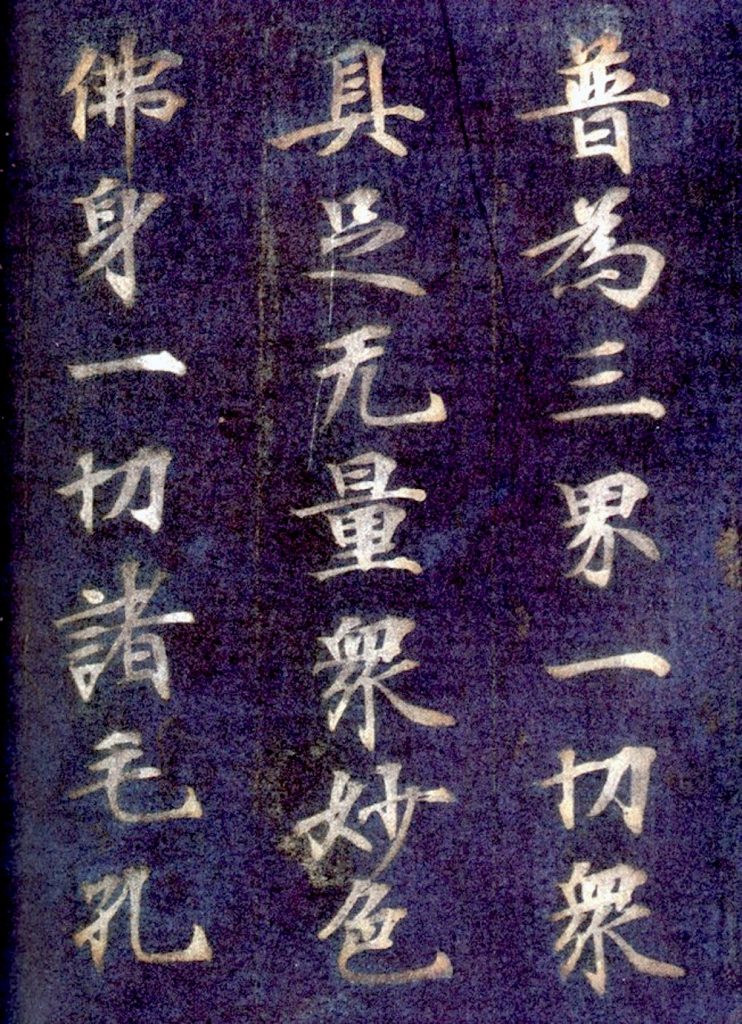
China’s Tang dynasty concentrated such a diverse range of foreign influences that its artistic and cultural characteristics are often referred to as the “Tang international style.” This style had a major impact in Japan as well. Featuring an eclectic and exuberant mix of Central Asian, Persian, Indian, and Southeast Asian motifs, Tang-dynasty visual culture comprised paintings, ceramics, metalware, and textiles.
As these foreign imports were shaping Chinese artistic expression at home, Tang-dynasty artifacts and techniques spread beyond China to neighboring states and along the Silk Road. In Japan, the lavish Tang style was intertwined with Buddhist devotional art.
Elegantly transcribed sutras, calligraphed in silver ink on indigo-dyed paper, exemplify this form of Tang-inspired Nara-period art. The painstaking practice of copying Buddhist sacred texts by using precious materials was deemed to earn spiritual merit for everyone involved, from those preparing the materials to the patrons.
The intermingling of political power and Buddhism in the Nara period found its utmost expression in the building of the “great eastern temple” or Tōdaiji and, within this temple, in the casting of the “great Buddha”—a gigantic bronze statue that stood approximately 15 meters/ 16 yards tall and necessitated all available copper in Japan to produce the casting metal.

Although the current statue is a later replacement of the Nara-period artifact, it nonetheless suggests the effect of opulence and awe that it must have achieved in its day. Tōdaiji continued to transform and adapt through the centuries, but its identity is still inextricably linked to the grand scale and commensurate ambition of Nara-period culture.
Sociopolitical power was concentrated, during the Nara period, in the new Heijō capital (today’s city of Nara). Surrounded by Buddhist temples, the Heijō palace was the primary site of imperial power. It also housed subsidiary ministries, modeled on the Chinese centralized government. Generous spaces characterized the palace complex. These spaces accommodated outdoor celebrations, like those of the New Year, but also served to emphasize a sense of distance and therefore the due reverence to the emperor. The palace complex was designed to separate the realm of the emperor from the outside world. That principle of separation was reflected within the palace compound itself, where the emperor’s living quarters were set apart from government buildings. The architectural configuration of the palace reflected the hierarchical configuration of power.
Little of the palace survives today, as various structures within the complex suffered the vicissitudes of nature and history, while others were transferred to the new capital, Heian, for which the next period was named.
Heian Period (794-1185): Courtly Refinement and Poetic Expression
The new capital, Heian or Heian-kyō, was the city known today as Kyoto. There, during the Heian period, a lavish culture of refinement and poetic subtlety developed, and it would have a lasting influence on Japanese arts. The approximately four centuries that comprise the Heian period can be divided into three sub-periods, each of which contributed major stylistic developments to this culture of courtly refinement. The sub-periods are known as Jōgan, Fujiwara, and Insei.
The so-called Jōgan sub-period, spanning the reigns of two emperors during the second half of the 9th century, was rich in architectural and sculptural projects, largely spurred by the emergence and development of the two branches of Japanese esoteric Buddhism. Two Buddhist monks, Saichō and Kūkai (also known as Kobo Daishi), traveled to China on study missions and, upon their respective returns to Japan, went on to found the two Japanese schools of esoteric Buddhism: Tendai, established by Saichō, and Shingon, established by Kūkai.

Among the many ideas and objects that they had brought back from China was the Mandala of the Two Worlds, a pair of mandalas (diagrams of the universe in Hindu and Buddhist symbolism) that represent the central devotional image of Japan’s schools of esoteric Buddhism. Comprised of the “Womb World Mandala” (mandala of principle) and the “Diamond World Mandala” (mandala of wisdom), the Mandala of the Two Worlds was first assembled as a pair by Kūkai’s teacher in China. One such pair, still housed in Kūkai’s temple in Kyoto (Tōji, the “eastern temple”) represented a blueprint for countless mandalas made in Japan over the centuries.

Among the many ideas and objects that they had brought back from China was the Mandala of the Two Worlds, a pair of mandalas that represent the central devotional image of Japan’s schools of esoteric Buddhism. Comprised of the “Womb World Mandala” (mandala of principle) and the “Diamond World Mandala” (mandala of wisdom), the Mandala of the Two Worlds was first assembled as a pair by Kūkai’s teacher in China. One such pair, still housed in Kūkai’s temple in Kyoto (Tōji, the “eastern temple”) represented a blueprint for countless mandalas made in Japan over the centuries.
It is believed that the consequential trip to China of Saichō and Kūkai was enabled by a member of the Fujiwara, the family that gives the name of one of the Heian sub-periods. The influence of the Fujiwara clan was paramount in the Japanese political and artistic world of the 9th and 10th centuries. Their power was bolstered by the ever-growing shōen system (shōen were tax-exempt private estates that undermined state control) and ensured by their control of the imperial line, as Fujiwara daughters were married to imperial heirs.

One of the only surviving structures from the Fujiwara period, the Phoenix Hall of the Byōdō-in (a Buddhist temple in Uji, outside Kyoto) is one of Japan’s most valuable cultural assets, with a fascinating, multi-layered story. The Phoenix Hall derives its name from the statues of phoenixes—auspicious mythological birds in East Asian cultures—on its roof.

Completed in 1053, the Phoenix Hall was sponsored by a member of the Fujiwara family—Fujiwara no Yorimichi—a pious believer in yet another type of Buddhism, known as Pure Land. This occurred at a time when many imperial villas like the Byōdō-in were converted into Buddhist temples. Having spread to Japan through the efforts of the monk Hōnen, the Pure Land School of Buddhism taught that enlightenment could be achieved by invoking the name of Amida, the Buddha of infinite light. Practitioners engage in the ritualistic invocation of Amida’s name—the nenbutsu 念仏—hoping to be reborn in Amida’s Pure Land, or the Western Paradise, where they can continue their journey towards enlightenment undisturbed.

The Amida sculpture in the Phoenix Hall at Byōdō-in is the only work still extant by Jōchō, an influential sculptor who was awarded remarkable distinctions, worked on various commissions from the Fujiwara family, and organized fellow sculptors into a guild. Jōchō’s Amida at Byōdō-in reflects the sculptor’s yosegi-zukuri 寄木造 technique, in which the sculpture is formed from multiple joined pieces of wood. This technique was different from the ichiboku-zukuri 一本造 technique, according to which the sculpture is carved out of a single block of wood.


During the Heian period, the style known as yamato-e (大和絵 or 倭絵) is born. Understood as “Japanese” as opposed to “Chinese” or otherwise “foreign,” yamato-e encompasses a wide range of technical and formal characteristics but refers to specific formats—folding screens (byōbu 屏風) and room partitions (shōji 障子)—and specific choices of subject matter—landscapes with recognizably Japanese features and illustrations of Japanese poetry, history, mythology, and folklore.

A favorite subject for late-Heian-period yamato-e was the Tale of Genji (Genji monogatari 源氏物語), written in the first years of the 11th century and attributed to a lady-in-waiting at the imperial court, Murasaki Shikibu. A complex novel that focuses on the romantic interests and entanglements of the prince Genji and his entourage, the Tale also provides a fascinating entryway into Heian-period court life, complete with the aesthetic principles and practices that resided at its core.

The earliest illustrations of the Tale came in handscroll format. Surviving fragments exemplify the yamato-e mode of narrative painting: illustrations by episode interspersed with passages of text; roofless buildings, multiple viewpoints (typically both frontal and from above), and schematic renditions of faces ( hikime kagihana 引目鈎鼻, literally translated as “drawn-line eyes, hook-shaped nose.”)

A brief review of the Heian period cannot be complete without mention of the development of Japanese poetry, wakain particular. Waka was an integral part of the Tale of Genji, and Murasaki Shikibu came to be known as one of the 6 immortal poets (all of whom were from the Heian period).
Permeating the spirit of Heian-period Japanese poetry and the imagery it inspired was a heightened sense of refinement, expressed in elegant verse, stylized visual motifs, precious materials, and embellished surfaces.
The Insei rule—the third and last of the Heian sub-periods —refers, literally, to the imperial practice of ruling from within a (monastery) compound. During Insei, cloistered emperors had a higher degree of political control. It was during this period that a sense of aesthetic and ethical congruence developed, according to which the beautiful and the good are intrinsically interconnected.
Originally published by Smarthistory, 12.02.2019, under a Creative Commons Attribution-NonCommercial-ShareAlike 4.0 International license.
About the Author